


In the northern Maldives, two atolls dominate wish-lists for lagoon scenery, quiet islands, and serious underwater life: Raa Atoll and Lhaviyani Atoll. Both require a seaplane hop from Malé and both promise the castaway-luxury combination that has made the country famous. Yet they offer noticeably different moods, reef experiences, and resort line-ups. This guide compares them side by side so you can decide which atoll will deliver the better holiday for you.
Orientation: Where Raa and Lhaviyani Sit in the Maldives Map
Raa and Lhaviyani lie north of Malé in what many repeat visitors now see as the Maldives’ sweet spot: far enough from the capital to feel remote, but close enough for a single seaplane hop instead of a longer domestic flight plus speedboat combination. Expect roughly 35 to 50 minutes by seaplane from Malé’s Velana International Airport to most resorts in either atoll, depending on how many stops your flight makes along the way.
Lhaviyani sits slightly closer to Malé, at around 120 to 150 kilometres, and is usually reached in about 40 minutes of seaplane flying time. There is no practical speedboat option from the airport at this distance, so all mainstream resort transfers rely on seaplanes operated by local carriers such as Trans Maldivian Airways. Raa is a touch further out, and its outer islands nudge into the Maldives’ UNESCO Biosphere Reserve area that also includes parts of neighbouring Baa Atoll, which is relevant if manta rays are high on your wish list.
For travellers, this geography translates into two things. First, both atolls demand a daylight arrival in Malé, since seaplanes do not operate at night; if your international flight arrives after mid-afternoon, you will almost certainly overnight near the airport and connect the following morning. Second, because both atolls are a similar seaplane distance, logistics rarely tip the scales decisively between them. Instead, your decision will be driven by what kind of island, reef, and resort atmosphere you prefer.
In simple terms, Lhaviyani offers a compact cluster of well-known resort islands around a handful of channels rich in sharks and rays, while Raa spreads its resorts more thinly across wider lagoons and channels that see fewer daily dive boats. That difference in density shapes everything from how your horizon looks to how busy the popular reefs feel.
Resort Landscape: Styles, Budget Levels, and Atmosphere
Lhaviyani Atoll has a long head start in tourism and today combines classic, mid-market islands with some of the country’s most exclusive private hideaways. Kuredu Island Resort remains one of the best-known names here, a large, lively island that attracts European couples and families with multiple pools, golf, and reputable dive operations. In contrast, Hurawalhi Island Resort positions itself firmly as an adults-only luxury retreat with 90 villas, an intimate feel, and the headline 5.8 Undersea Restaurant, where diners sit inside a glass tunnel 5.8 metres below the surface looking out over a living reef.
Lhaviyani also hosts Kudadoo Maldives Private Island, a tiny, ultra-luxury property where just a handful of residences share an “anything, anytime, anywhere” style all-inclusive plan that covers fine dining, spa treatments, and diving. Travellers choosing Kudadoo are typically less focused on specific dive sites and more on total privacy and frictionless indulgence, but they benefit from access to the same rich marine life as neighbouring islands. Smaller adults-only resorts such as Komandoo add to Lhaviyani’s reputation as a strong option for honeymooners and child-free travellers, even though a couple of islands, including Kuredu, still welcome families.
Raa Atoll’s resort line-up is newer, and it shows in the design language: many properties have a sleek, contemporary look, with overwater villas that emphasise large decks and private pools. The InterContinental Maldives Maamunagau Resort is a good example, offering 81 villas and seven food and beverage outlets, pitched squarely at couples and well-travelled families who value dining variety and a polished spa. Other Raa resorts, such as Reethi Faru or Kudafushi, skew slightly more mid-range, but they still deliver classic white-sand beaches, house reefs of varying quality, and full-service dive centres.
In budget terms, both atolls sit in the upper mid-range to luxury bracket, with starting rates at quieter resorts sometimes dipping lower in May or June. A couple travelling in shoulder season might find entry-level beach villas in either atoll for roughly the same ballpark nightly rate, while Lhaviyani’s ultra-luxury private island experiences at places like Kudadoo sit clearly at the top of the market. For many travellers, the practical choice becomes whether they want a more traditional island-resort vibe with well-established operations (Lhaviyani) or a slightly more modern aesthetic and often quieter island setting (Raa).
Reefs, Diving, and Snorkeling: How the Underwater Worlds Compare
Both atolls are known for strong diving, and both rely on seaplane access partly because their reefs and channels attracted dive operators before mass tourism followed. Lhaviyani has long been a favourite among divers looking for “big stuff”: local dive centres commonly highlight grey reef sharks, nurse sharks, eagle rays, and seasonal manta rays on their schedules. The atoll’s channels can carry significant current, which concentrates fish life but demands at least an intermediate level of comfort in the water for many of the signature dives.
House reef quality in Lhaviyani varies by island. Dedicated snorkellers tend to rate resorts such as Hurawalhi and Komandoo well for being able to drop in directly from the beach or jetty and find vibrant coral slopes with good fish life. Large islands such as Kuredu do have house reefs, but they do not enjoy the same reputation among snorkel purists as some smaller “snorkeller’s islands” elsewhere in the Maldives, so most guests wanting the best underwater scenery there will join organised snorkel or dive boat trips.
Raa Atoll’s underwater appeal is quieter in terms of global reputation, but it benefits from relatively lower resort density and therefore less concentrated boat traffic on individual reefs. Divers here report healthy pelagic sightings at outer channels and thilas, with occasional devil rays, reef sharks, and abundant schooling fish. At resorts like InterContinental Maldives Maamunagau the house reef is explicitly marketed as one of the property’s strongest features, and guests can snorkel directly from the beach into a reef that often rivals or outperforms more famous islands closer to Malé.
For travellers who mainly want easy house-reef snorkeling, Raa arguably has a slight edge, because several resorts were planned with direct reef access as a selling point. For divers chasing specific sharky channels or wanting to combine several high-adrenaline drift dives in a week, Lhaviyani’s grid of well-mapped dive sites is extremely compelling. In both atolls, virtually every resort offers its own dive centre with PADI or equivalent training and guided boat dives ranging from gentle coral gardens for novices to more challenging channel crossings for experienced divers.
Lagoon Scenery, Island Feel, and Sense of Seclusion
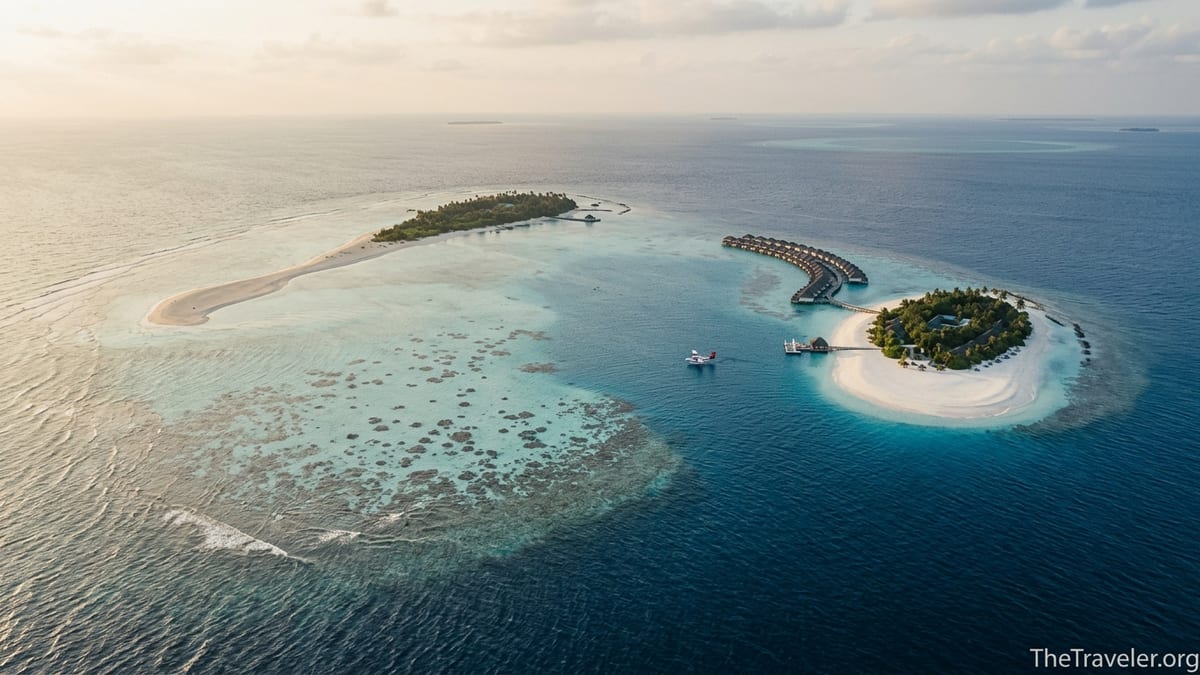
Visually, Lhaviyani is the archetypal Maldives postcard: a string of emerald-green islands scattered along a narrow reef rim, each ringed with white sand and sitting next to a shelf that drops rapidly into deep blue water. From a seaplane window, the effect is dramatic, with tight clusters of reefs and islands creating strong colour contrasts. On the ground, however, this compact geography means that from some resorts you may see neighbouring islands, other resort jetties, or distant infrastructure on the horizon, especially if you walk around the beach at low tide.
At water level, Lhaviyani’s lagoons often slope quickly from shallow turquoise into darker blue. This makes for impressive views from water villas, which may sit directly over deeper channels with fish cruising beneath the decks. It can also mean that wading far out from shore is less feasible in some areas, especially for small children, although most family-friendly islands maintain protected, gently shelving beach sections for swimming.
Raa, by comparison, feels more wide-open. Many of its resorts are set on islands with broad, sweeping lagoons and large sandbanks that emerge at low tide. Guests at resorts like Reethi Faru or Kudafushi often remark on being able to walk well out from the beach across ankle-deep water, surrounded by nothing but pale sand and glassy shallows. At InterContinental Maldives Maamunagau, the mix of lagoon shallows and drop-off edges within a short swim of shore offers varied scenery: guests can paddle in bath-warm water near the beach, then fin a short distance to snorkel along a richer reef slope.
If your ideal Maldives scene is an uninterrupted horizon with no other resorts in sight and the ability to stroll along sandbanks that feel almost like private islands, Raa is likely to appeal more strongly. If you care more about the visual drama of steep drop-offs, deeper water villas, and a buzz of distant seaplanes arriving and departing, Lhaviyani’s more compact geography can be part of the charm rather than a drawback.
Transfers, Practicalities, and Trip Length Considerations
Because both atolls are seaplane-only for resort guests, the key logistical questions are the same whichever one you choose. First, you will pay a separate transfer fee on top of your room rate, usually charged per person and added to your final bill. In 2026 pricing, many mid to upper-tier resorts in these atolls quote return seaplane transfers in the region of several hundred US dollars per adult. Children’s rates are often discounted, but the cost remains significant for families of four or more.
Second, your international flight times matter. Seaplanes operate during daylight hours only and typically stop flying in the late afternoon, which means arrivals into Malé after this window almost always involve an overnight stay near the airport before flying to your resort the next morning. This affects travellers on shorter breaks in particular. For a three-night stay, losing half a day on either end to transfers can make the trip feel compressed, and some travellers prefer atolls reachable by speedboat only in that scenario. For week-long or longer stays, the seaplane leg becomes a memorable part of the experience more than a logistical irritation.
In pure convenience terms, neither Raa nor Lhaviyani has a decisive advantage. Flight times are similar, seaplane schedules are equally subject to weather and operational reshuffles, and both atolls have enough resorts to justify frequent daily connections in high season. One subtle difference is that because Lhaviyani’s islands are clustered somewhat closer together, your seaplane may make multiple splash-downs, turning the journey into a short “milk run” that gives you aerial views of several resorts before your stop. Whether that feels like a bonus or a delay is a matter of taste.
If you are combining two resorts in one trip, some operators can arrange direct seaplane hops between a Raa resort and a Lhaviyani resort, but most itineraries will route via Malé. In that case it often makes sense to choose both properties within the same atoll to simplify logistics, for example pairing a larger family-friendly island with a smaller, more romantic adults-focused property in Lhaviyani.
Families vs Couples: Which Atoll Suits Your Travel Style?
Lhaviyani has a prominent reputation among couples and honeymooners, largely because of its cluster of adults-only or adults-oriented properties. Hurawalhi and Komandoo are both designed primarily with romantic travel in mind, offering quiet beaches, intimate villa layouts, and restaurants geared towards slower, multi-course dining. Kudadoo takes that further into the ultra-luxury space, where privacy and attentive, personalised service are the main selling points.
Families are not excluded from Lhaviyani. Kuredu Island Resort in particular is laid out almost like a small village, with kid-friendly pools, broad beaches, and a lively programme of activities suitable for teens and younger children. Some of the more upscale islands in the atoll also welcome children in beach villas and occasionally in selected overwater categories. However, if you are travelling with toddlers or younger children, you will need to check each resort’s policy on minimum age in water villas and whether kids’ clubs operate year-round or only in high season.
Raa’s profile is more balanced between couples and families. Newer properties like InterContinental Maldives Maamunagau pitch themselves unapologetically as mixed-use resorts, offering both a strong kids’ club programme and high-end spa and dining facilities aimed at adults. Mid-range options such as Reethi Faru or Kudafushi also see a blend of honeymooners and families, attracted by good-value all-inclusive packages and beaches that are easy for children to play on thanks to gentle lagoon slopes.
If your group includes children and you prefer not to share the island with a large number of honeymoon couples, Raa’s more mixed demographic can feel more relaxed. If you are seeking a classic couple-focused Maldives escape with quieter evenings, more adults-only space, and iconic features like an undersea restaurant dinner for two, Lhaviyani leans more strongly in your favour.
Costs, Dining, and Overall Value for Money
On raw pricing, both atolls cover a wide range, from relatively accessible four-star-plus islands to ultra-luxury hideaways. In shoulder seasons such as May or November, you might see starting rates for a beach villa in Raa at a mid-range resort come in slightly below comparable properties in Lhaviyani, in part because Raa still has a smaller global profile. These differences are typically modest rather than dramatic, and they fluctuate with promotions, tour-operator contracts, and airline fares.
Dining is where some travellers perceive a clearer distinction. Lhaviyani’s more established islands have had years to refine their culinary offerings. Kuredu, for example, runs multiple buffet restaurants and several a la carte venues, while Hurawalhi is noted for a strong all-inclusive plan and the option to splurge on a multi-course tasting menu at its famous undersea restaurant. Kudadoo’s everything-included concept, which covers premium drinks and fine dining, sets a very high bar in the region and can represent strong value if you plan to eat and drink generously.
Raa’s newer resorts often respond with breadth and flexibility instead of headline gimmicks. InterContinental Maldives Maamunagau hosts several dining outlets for a relatively small villa count, meaning a high restaurant-to-room ratio that reduces repetition on week-long stays. Other Raa properties rely on extensive buffet spreads with rotating themes and more casual beachside venues, which work well for families who prefer flexible mealtimes and familiar options for children.
Over the full cost of a holiday, including transfers and on-island spending, many couples find that Raa and Lhaviyani come out surprisingly similar at like-for-like quality levels. The better value for money usually lies not in the atoll choice itself, but in how well your chosen resort’s inclusions match your habits. Heavy spa users and divers may extract outstanding value from an all-inclusive luxury plan in Lhaviyani, while families who mostly want straightforward meals, house-reef snorkeling, and a kids’ club might find a mid-range Raa resort delivers more than enough for less outlay.
So Which Atoll Offers the Better Overall Holiday Experience?
When you step back from the details, two broad personalities emerge. Lhaviyani Atoll is the more famous diver, with a cluster of islands built around channels that funnel big marine life, several adults-only or adults-first resorts, and one of the country’s most talked-about undersea dining rooms. It is ideal for couples who want a mix of romance, serious diving, and polished, sometimes indulgent resort experiences from the moment they land on the seaplane pontoon.
Raa Atoll, while less famous by name, feels more like a quietly confident younger sibling. Its lagoons are wide, its resort density is lighter, and its mix of modern island designs and strong house reefs makes it especially appealing to travellers who rank snorkeling, barefoot beach time, and a sense of open space above high-profile brand names. Families in particular often find Raa an appealing compromise between natural beauty, kid-friendly facilities, and relative seclusion.
If you are a couple planning a once-in-a-lifetime honeymoon, prioritise dramatic channel dives, and are excited by the idea of a special-occasion meal in an underwater restaurant, Lhaviyani likely offers the better overall fit. On the other hand, if you want room to roam on sandbanks, easy house-reef snorkeling, and a relaxed island atmosphere that suits both adults and children, Raa edges ahead.
For many Maldives regulars, the “best” northern atoll is simply the one whose individual resort matches their priorities most precisely. Seen that way, both Raa and Lhaviyani are excellent canvases. The right answer for you is less about the name of the atoll and more about whether you picture yourself clinking glasses in an adults-only bar after a sharky channel dive in Lhaviyani, or watching your children chase tiny fish along a Raa sandbank at low tide as the sun goes down.
FAQ
Q1. Which atoll is better for first-time visitors to the Maldives, Raa or Lhaviyani?
For a classic first-time Maldives experience with dramatic overwater villas, strong diving, and well-established service, Lhaviyani is often the safer bet. Its resorts have been welcoming international guests for longer, and islands like Kuredu and Hurawalhi are used to orienting newcomers to seaplane logistics, snorkeling, and local conditions.
Q2. Is one atoll noticeably cheaper than the other?
Not dramatically. At similar quality levels, nightly rates and transfer costs are broadly comparable. You may occasionally find slightly sharper pricing in Raa, especially at newer or more mid-range resorts, but the bigger difference usually comes from the individual resort’s meal plans and inclusions rather than from the atoll itself.
Q3. Which atoll has better house-reef snorkeling right from the beach?
Both offer good options, but Raa has a slight edge in the number of resorts where guests consistently report strong snorkeling directly from shore, such as at InterContinental Maldives Maamunagau or several mid-range islands with fringing reefs close to the sand. In Lhaviyani, some resorts still deliver excellent house-reef experiences, but others rely more on boat trips for the very best sites.
Q4. Are seaplane transfers different between Raa and Lhaviyani?
From a traveller’s perspective, they are very similar. Both involve checking in at a dedicated seaplane terminal near Malé, waiting for your flight in a lounge, and then flying around 35 to 50 minutes to your resort. Prices and schedules are broadly comparable, and in both atolls transfer timings are grouped around daylight hours, which means late-night international arrivals usually require an overnight near the airport.
Q5. Which atoll is better for serious scuba divers?
Serious divers tend to gravitate slightly more towards Lhaviyani for its established network of sharky channels and well-known sites with strong currents and big pelagic encounters. That said, Raa also provides excellent diving, including reefs with sharks, rays, and large schools of fish. Your choice should come down to the specific dive centre and site portfolio of your chosen resort rather than the atoll name alone.
Q6. Is one atoll more child-friendly than the other?
Raa’s resort mix skews more evenly between couples and families, with several properties offering strong kids’ clubs, shallow lagoons, and flexible all-inclusive plans that suit multi-generational groups. Lhaviyani certainly has family-friendly islands such as Kuredu, but a higher proportion of its resorts focus on adults-only or honeymoon travel, which can influence the overall atmosphere on the island.
Q7. What about lagoon scenery and beaches: which feels more idyllic?
Both atolls have classic white-sand beaches and turquoise water, but they present different moods. Lhaviyani often delivers dramatic views of deeper blue channels and nearby islands. Raa tends to feel more open and spacious, with broader lagoons and longer sandbanks that appear at low tide. If you value a sense of wide, uninterrupted horizon, Raa has a slight advantage.
Q8. Are there significant differences in weather between Raa and Lhaviyani?
No, not in a way most visitors will notice. Both lie in the same general region of the Maldives and share the same monsoon-driven seasons. Conditions vary more by month and prevailing winds than by the small distance between the two atolls, so choosing your travel dates is more important than choosing between Raa and Lhaviyani for weather alone.
Q9. Which atoll is better for a short 3- or 4-night trip?
Because both require seaplane transfers, neither is ideal for very short stays, as you lose proportionally more time to travel days. If you do choose a short break, Lhaviyani’s slightly closer location can mean marginally shorter total transfer time, but in practice the difference is small. For a three- or four-night stay, it is more important to pick a resort with good all-round facilities so you can make the most of your limited days on the island.
Q10. If I want to combine the Maldives with another destination, which atoll works better?
For multi-stop itineraries that pair the Maldives with destinations like Sri Lanka or Dubai, both atolls integrate similarly into flight plans because all seaplane transfers route through Malé. In these cases, choose the atoll whose resort best matches your priorities. Lhaviyani is ideal if you want a highly polished, romantic finale to a wider trip, while Raa works well if you want a more laid-back, lagoon-focused beach escape after a busy city or cultural itinerary.