


The northern Maldives can feel like a world away from the busy central atolls, with fewer crowds, wild reefs and a growing mix of luxury resorts and affordable local-island stays. For first-time visitors, understanding where Haa Alif, Haa Dhaalu, Shaviyani, Noonu, Raa, Baa and Lhaviyani sit on the map, how to reach them and what each offers is the key to planning a smooth, rewarding trip. This guide breaks down the main northern atolls, transfers, costs, weather, and the best ways to dive, snorkel and explore on a first visit.
Understanding the Northern Atolls
The northern Maldives stretch from Haa Alif in the far north down to Lhaviyani, a broad arc of remote atolls roughly 250 to 400 kilometers from Malé. They are less densely developed than the central Kaafu atolls and remain dominated by long reef lines, scattered resort islands and inhabited local islands. Travel time from Velana International Airport in Malé to most of these atolls is around 35 to 70 minutes by seaplane or a combination of domestic flight and speedboat.
Haa Alif and Haa Dhaalu form the northern tip of the country and are some of the most remote holiday regions. Shaviyani and Noonu lie slightly south, followed by Raa, Baa and Lhaviyani closer to the central belt. Baa is internationally known as a UNESCO Biosphere Reserve, with Hanifaru Bay famous for seasonal manta ray feeding. Lhaviyani, by contrast, has become a compact resort hub, with properties like Le Méridien Maldives Resort & Spa and Fushifaru Maldives reachable in about 35 minutes by seaplane from Malé.
For first-timers, the main decision is choosing between a single resort-island holiday, staying on a local island guesthouse, or combining a resort with time on an inhabited island. The northern atolls lend themselves well to all three styles. High-end resorts in Noonu, Raa and Baa lean into luxury and seclusion, while local islands in Haa Alif, Haa Dhaalu and Shaviyani offer a glimpse of Maldivian village life at a fraction of resort prices.
Because each atoll is spread out and there are no direct ferries between most resort islands, it is usually best to focus on one area per trip rather than trying to hop between many atolls. Typical first itineraries involve five to seven nights on one resort or guesthouse island, sometimes adding a second stop within the same atoll to vary the experience without complicated transfers.
Atoll-by-Atoll Highlights
Haa Alif and Haa Dhaalu offer some of the wildest, least developed scenery in the country. In Haa Alif, JA Manafaru sits close to the northern edge of the Maldives and is reached by a domestic flight plus speedboat or private seaplane. Current transfer fact sheets quote around 70 minutes by private seaplane. Travelers often pair this with smaller, more understated properties such as Hideaway Beach Resort & Spa in Haa Alif, known on review sites for strong house-reef snorkeling where turtles and reef sharks are commonly seen right off the beach.
Shaviyani and Noonu atolls are quickly becoming a cluster of high-end escapes. In Noonu, resorts like Noku Maldives, ROBINSON Noonu and other five-star properties are typically accessed by a 35 to 45 minute seaplane ride from Malé, or by domestic flight to Maafaru airport followed by a 30 minute speedboat. This combination can be slightly cheaper and more weather-resilient than a pure seaplane transfer while still keeping overall travel time under 90 minutes from arrival at Velana International Airport.
Raa and Baa are favorites among divers and snorkelers. Baa Atoll’s designation as a UNESCO Biosphere Reserve has helped preserve rich coral and fish life, and the reef manta ray aggregations at Hanifaru Bay draw visitors worldwide between roughly June and November. Many Baa resorts, from boutique options like Milaidhoo to family-friendly properties, run half- or full-day excursions into the protected bay for snorkeling with mantas when conditions allow. Raa, just to the north, has a mix of luxury and mid-range resorts with access to walls, channels and thilas that are less trafficked than those around the capital.
Lhaviyani Atoll is one of the most accessible of the northern group. A cluster of resorts, including Le Méridien Maldives Resort & Spa and smaller islands like Fushifaru, can be reached on regular seaplane services in about 35 minutes from Malé. Lhaviyani’s long outer reef and numerous channels make it popular with divers seeking manta cleaning stations, sharks and large schools of fish. For first-time visitors who want that “postcard Maldives” feeling without very long transfer times, Lhaviyani and Baa often offer a practical balance.
Resorts vs Local Islands: Choosing Your Base
Most visitors to the northern Maldives still choose resort islands, where the entire island is run by a single hotel and packages often include meals, activities and airport transfers. At the high end, overwater villas in Noonu or Baa can cost from around 800 to 1,500 US dollars per night in low season and significantly more in peak months. For example, travelers have reported overwater packages at well-known brands reaching the 1,500 dollar range per night once taxes and service charges are included, with half-board or full-board meal plans.
There is, however, a growing network of guesthouses and small hotels on inhabited local islands in Haa Alif, Haa Dhaalu, Shaviyani and Raa. A simple but comfortable guesthouse room on an island like Dhidhdhoo (Haa Alif) or one of the inhabited islands in Shaviyani can often be found from roughly 60 to 120 US dollars per night, sometimes including breakfast. These islands usually have a designated “bikini beach” where tourists can swim in regular swimwear, while the rest of the island observes conservative dress codes in line with local culture.
Resorts offer full privacy, alcohol service and wide-ranging facilities like spas, multiple restaurants, dive centers and kids’ clubs. A resort such as ROBINSON Noonu, for instance, packages domestic flights and speedboats into its pricing so guests have a single point of contact for transfers. Local islands, by contrast, rely on public ferries, chartered speedboats and separate excursion operators. Costs for excursions like snorkeling trips, sandbank visits and sunset dolphin cruises often range from 25 to 70 US dollars per person on local islands, compared with 80 to 200 US dollars or more for resort-run versions.
For a first visit, a common compromise is to book four or five nights at a resort in Noonu, Raa, Baa or Lhaviyani and then add two or three nights on a local island in Haa Alif or Haa Dhaalu. This lets you experience both polished resort comforts and the rhythm of Maldivian community life. If your stay is shorter than a week, however, it may be wise to choose just one type of base to avoid spending too much time and money on extra transfers.
Transfers and Getting Around
Because the northern atolls are far from Malé, nearly all resort stays here require either a seaplane or a domestic flight combined with a speedboat. Operators like Trans Maldivian Airways run scheduled seaplane services from the separate seaplane terminal near Velana International Airport to resort jetties in Baa, Raa, Noonu, Lhaviyani and further north. Typical seaplane flight times range from around 35 minutes to Lhaviyani or Noonu up to roughly 60 to 70 minutes for the northernmost Haa Alif and Haa Dhaalu properties.
Domestic flights and speedboats are the main alternative. For example, some Noonu resorts route guests via Maafaru International Airport on a 35 minute domestic flight followed by a 25 to 30 minute speedboat transfer. In practice, this can feel similar in total journey time to a direct seaplane, but domestic flights are less sensitive to weather and sometimes cheaper. In 2025 and 2026, many properties in the northern atolls have been quoting return seaplane or domestic plus speedboat transfers in the region of 350 to 700 US dollars per adult, with some ultra-luxury islands charging more.
If you are staying on a local island rather than a private resort, inter-island travel is usually via scheduled public ferries or chartered speedboats. Public ferries can cost the equivalent of a few US dollars per leg but operate only on certain days and can take several hours to cover a route between an outer atoll and Malé. A chartered speedboat from an island in Shaviyani or Raa back to the capital might run anywhere from 250 to 600 US dollars depending on distance, boat size and fuel prices, but can be shared among multiple passengers.
Because transfers are so central to the experience and budget, it is important to clarify with your accommodation whether airport transfers are mandatory and what they cost, and to factor this into your nightly price comparison. Some boutique resorts in Baa, for instance, periodically run promotions that include the return seaplane transfer in the room rate, which can significantly reduce the total cost for couples or families.
Diving, Snorkeling, Reefs and Beaches
The northern Maldives are a major draw for divers and snorkelers. Baa Atoll’s Hanifaru Bay is perhaps the most famous single site, recognized as a core zone within the UNESCO Biosphere Reserve and managed under a dedicated conservation plan. Between about June and November, when plankton blooms build up in the small, funnel-shaped bay, huge numbers of reef manta rays gather to feed, sometimes joined by whale sharks. Access is strictly controlled, and only guided snorkeling in small groups is allowed, with time limits in the water to minimize disturbance.
Outside Hanifaru, Baa and Raa atolls host dozens of thilas, outer walls and channels that suit all levels of diver. Beginners can start on sheltered reefs in 5 to 15 meters of water, while more experienced divers drift along channels in moderate to strong current searching for grey reef sharks, eagle rays and large schools of fusiliers and jacks. Many resorts operate house reefs that can be reached with a short swim from the beach or jetty, and charge per-diver prices that commonly sit around 80 to 150 US dollars for a two-tank boat dive, plus gear rental.
Haa Alif, Haa Dhaalu, Shaviyani and Noonu are known for relatively untouched coral gardens and fewer dive boats. Hideaway Beach Resort & Spa and other northern properties are regularly praised in recent visitor reports for house reefs where turtles, reef sharks and large schools of fish are seen on almost every snorkel. In Noonu and Raa, channel dives often bring encounters with pelagics in clearer water during the northeast monsoon, roughly December to April.
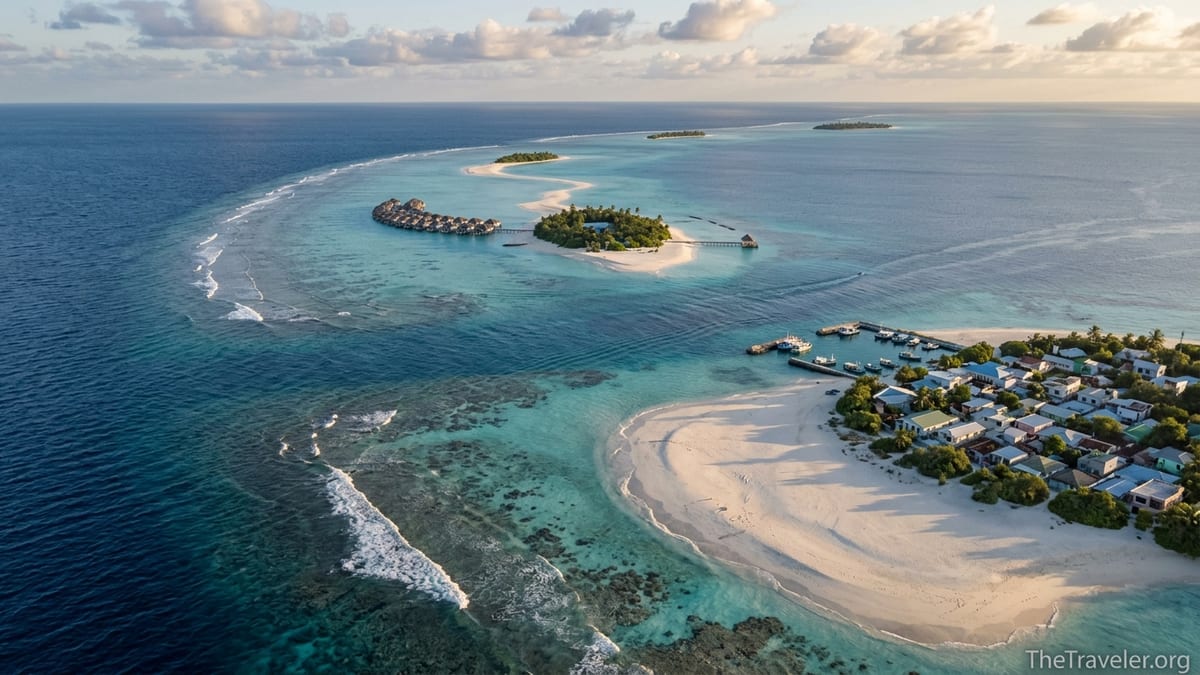
Beaches across these atolls are typically classic Maldives: fine white sand, shallow turquoise lagoons and narrow sandspits that appear and disappear with the tides. Some resort islands in Lhaviyani and Baa have long sandbanks that can be reserved for private picnics, often priced around 150 to 300 US dollars per couple including boat transfer and basic catering. On local islands, publicly accessible beaches are usually more modest, but many now maintain a designated tourist beach with loungers and basic facilities, reachable by a few minutes’ walk from guesthouses.
Weather, Seasons and When to Go
The Maldives are tropical and warm year-round, with average daytime air temperatures typically in the high twenties Celsius and sea temperatures hovering around 27 to 29 degrees. The weather is shaped by two main monsoon patterns: the drier northeast monsoon roughly from December to April and the wetter southwest monsoon roughly from May to November. In the northern atolls, this pattern is broadly similar, though local conditions can vary from year to year.
The high season for resort stays usually runs from late December through March, when skies are often clearer and seas calmer, particularly on the eastern sides of the atolls. Room rates and seaplane prices during this period are at their highest, and popular resorts in Noonu, Baa and Lhaviyani can fill up months in advance for Christmas and New Year. If you are aiming for these peak dates, booking 9 to 12 months ahead is prudent.
From May to November, passing rain showers and choppier seas become more common, especially on western exposures. This is also when the famous manta aggregations in Baa’s Hanifaru Bay are most likely to occur, typically peaking between about July and October. For many visitors, this “shoulder to wet” season combination of lower prices, fewer crowds and the chance to see large numbers of mantas outweighs the increased chance of overcast days.
For a first visit focused on snorkeling, diving and budget, many travelers aim for the transitional months of late April, May or November. During these times, resorts in Raa, Baa and Lhaviyani often advertise lower nightly rates and special packages, seaplane backlogs are smaller, and you can still have stretches of sunshine mixed with brief showers. If you prioritize very calm seas and do not mind paying more, then January and February remain the safest bets.
Costs, Budgets and Practical Planning
Travel costs in the northern Maldives are shaped by three main factors: accommodation, transfers and meals. For a mid-range resort in Baa, Raa or Lhaviyani, low-season beach villas can sometimes be found in the 350 to 600 US dollar per night range before taxes, often on half-board or full-board plans. Overwater villas and peak-season dates can easily double that figure. Over the past two years, travelers on forums have reported four-night packages, including full board and round-trip seaplane transfers, totaling around 4,000 to 5,000 US dollars for two people at certain four- and five-star properties.
On local islands, budgets look very different. A couple staying in a simple guesthouse at 80 dollars per night for a week, adding perhaps 40 dollars per day for meals and 50 to 100 dollars per person for a couple of excursions, can keep total ground costs well under 1,500 dollars, even after adding a domestic flight or chartered speedboat. This makes northern local islands attractive for repeat visitors who want long stays and do not need resort amenities like spas or fine-dining restaurants.
Seaplane and domestic-flight transfers are a frequent surprise for first-timers. It is important to read the fine print and understand that many resorts will charge 350 to 700 dollars per adult for mandatory return transfers, often invoiced separately from the room. Some luxury brands in Baa and Noonu periodically run promotions that bundle these transfers into their nightly rate, which can save several hundred dollars on a one-week stay.
Day-to-day costs once you are on the island depend heavily on your board plan. In resorts, buffet dinners can run to 70 to 120 dollars per person if not included, while à la carte main dishes may start from around 25 to 40 dollars. Soft drinks often cost 5 to 10 dollars and cocktails more. On local islands, simple meals of fish curry, rice and snacks in local cafés might cost under 10 dollars, though tourist-focused restaurants will be higher. In all cases, remember that a 10 percent service charge and 16 percent goods and services tax are typically added to bills, so the final price is higher than the menu headline.
The Takeaway
For first-time visitors, the northern Maldives offer an appealing blend of remoteness and growing choice. Haa Alif and Haa Dhaalu feel wild and far-flung, Shaviyani and Noonu are becoming a cluster of stylish high-end resorts, Raa and Baa deliver serious reef and megafauna encounters, and Lhaviyani offers postcard beaches within a short seaplane hop of Malé. Choosing the right atoll is mostly a matter of balancing budget, willingness to take longer transfers and interest in diving or manta encounters.
If your priority is manta rays, reefs and a mix of comfort and access, Baa and Raa are strong first-time choices. If you want upscale seclusion and are comfortable with longer or more complex transfers, look at Noonu or Haa Alif. Travelers on tighter budgets who still want clear water and white sand should consider a guesthouse on a local island in Haa Dhaalu or Shaviyani, perhaps paired with a few nights at a more polished resort.
Whatever you choose, careful planning around transfers, board plans and travel months will have more impact on your experience than the exact resort brand. Confirm transfer prices before booking, pay attention to seasonal patterns if you hope to see mantas or whale sharks, and avoid trying to cross multiple atolls in a single short trip. With realistic expectations and a bit of research, the northern Maldives can deliver precisely what most first-time travelers are seeking: warm water, soft sand, thriving reefs and a real sense of being at the edge of the map.
FAQ
Q1. Which northern Maldives atoll is best for first-time visitors?
For a first visit, Baa and Lhaviyani are often the easiest choices. They offer good resort variety, relatively short seaplane transfers from Malé and strong snorkeling and diving, with Baa adding the bonus of Hanifaru Bay during manta season.
Q2. How much should I budget for a one-week trip to a northern resort?
A couple staying seven nights at a mid-range resort in Baa, Raa or Lhaviyani, including half-board meals and seaplane transfers, might reasonably budget from about 5,000 to 8,000 US dollars in total, depending on season, villa type and extras like spa treatments and excursions.
Q3. Are local islands in the northern atolls suitable for a first trip?
Yes, if you are comfortable with simpler facilities, conservative dress codes off the tourist beach and arranging activities through local operators. For budget-conscious or longer-stay travelers, islands in Haa Alif, Haa Dhaalu and Shaviyani can be excellent introductions to Maldivian culture.
Q4. What is the difference between a seaplane and domestic flight transfer?
A seaplane lands directly at your resort’s jetty and typically takes 35 to 70 minutes from Malé, but it is daylight-only and weather dependent. A domestic flight uses a small regional airport such as Maafaru in Noonu, followed by a speedboat ride, and can sometimes be more flexible or slightly cheaper.
Q5. When is the best time to see manta rays in Baa Atoll?
Manta ray encounters at Hanifaru Bay are most reliable between about June and November, often peaking from July to October when southwest monsoon currents bring plankton-rich water into the bay, although exact timing varies by year and conditions.
Q6. Can I visit more than one atoll on a short trip?
On trips of a week or less it is usually better to focus on one atoll, or at most two nearby ones, to avoid spending a large share of your time and budget on extra flights and speedboats. Within a single atoll, combining two islands is more manageable than crossing large distances.
Q7. Do I need to be an experienced diver to enjoy the northern atolls?
No. Most resorts and many local islands have house reefs suitable for beginners, discovery dives and snorkeling. Experienced divers will find more challenging channel and deep reef sites in Raa, Baa and Lhaviyani, but first-timers can still see turtles, reef sharks and mantas on guided snorkels.
Q8. Are food and drinks very expensive at resorts?
They can be. At many northern resorts, buffet dinners may cost 70 to 120 US dollars per person if not included, and drinks are heavily taxed. All-inclusive or half-board plans often represent better value, especially for guests who plan to stay on the island for their entire trip.
Q9. Is it safe to travel to remote northern islands?
Generally yes. The Maldives has a well-established tourism infrastructure, and resorts and guesthouses in the northern atolls are used to hosting international visitors. As with any destination, keeping valuables secure, following safety briefings for water activities and respecting local customs are sensible precautions.
Q10. How far in advance should I book a northern Maldives trip?
For travel in peak season between late December and March, booking 9 to 12 months in advance is recommended, especially for popular resorts in Baa, Noonu and Lhaviyani. For shoulder and wet-season months, three to six months is often sufficient, though specific properties with limited villa numbers can still sell out earlier.