


The northern Maldives feels wild and far from the crowds, but reaching its remote atolls takes more planning than a simple hop by boat. Between seaplanes, domestic flights, speedboats and resort-arranged connections, your arrival and departure can add hundreds of dollars and several hours to the trip. Understanding how transfers work and why resort location matters will help you choose the right island, avoid awkward overnight layovers in Malé and keep surprises off your final bill.
How Transfers Work in the Northern Maldives
Almost all international flights into the Maldives land at Velana International Airport on Hulhulé Island, near Malé. From there, you connect onward to your resort using either a seaplane direct to the resort, or a domestic flight to a northern regional airport such as Hanimaadhoo, Hoarafushi or Ifuru, followed by a resort speedboat. For a handful of closer islands in northern atolls, it is also possible to travel entirely by speedboat, but distances quickly become long and seas rougher the farther north you go.
Unlike many destinations where you can simply book a taxi on arrival, in the Maldives almost all resort transfers are pre-arranged through the property or your tour operator and are charged separately from your room rate. The resort will typically coordinate your seaplane or domestic flight with their preferred airline and schedule a shared or private speedboat at the far end. On arrival in Malé, uniformed staff holding resort signs usually meet you just outside customs and escort you to the seaplane terminal or domestic check-in.
Because transfers are so integrated into resort operations, you rarely have a choice of airline or schedule beyond broad arrival windows. For example, a resort in Haa Alifu Atoll may use Maldivian’s domestic flights to Hoarafushi plus a 10 minute speedboat, while another in Raa Atoll might exclusively use seaplanes landing at its own lagoon pontoon. Guests generally cannot mix and match cheaper alternatives without prior approval, and some resorts explicitly require you to use their arranged transfer.
Timing is also more constrained than people expect. Seaplanes operate only in daylight, usually from early morning until mid to late afternoon, while domestic flights run into the evening. That means your international arrival or departure time can dictate whether you need an overnight in Malé, whether a domestic flight is more realistic than a seaplane and even which resort is practical for your dates.
Northern Airport Gateways: Hanimaadhoo, Hoarafushi and Ifuru
The northern Maldives is served by several domestic airports that act as gateways for resort and local island transfers. The main hubs are Hanimaadhoo (HAQ) in Haa Dhaalu Atoll, Hoarafushi (HRF) in Haa Alifu Atoll and Ifuru (IFU) in Raa Atoll. All three are connected to Velana International Airport by domestic services, primarily operated by Maldivian, with flight times from Malé typically around 45 to 75 minutes depending on routing.
Hanimaadhoo is the largest of the three and has been undergoing an expansion project that includes upgrading facilities and extending the runway. It serves a mix of local islands and higher-end resorts in the surrounding atolls. For example, some properties in Haa Dhaalu and the eastern side of Haa Alifu route guests via Hanimaadhoo, followed by speedboat transfers ranging from 30 minutes to over an hour.
Hoarafushi, opened more recently as a domestic airport in Haa Alifu Atoll, is particularly important for top-end northern resorts which sit very close to the country’s northernmost reefs. A typical transfer might involve a Malé to Hoarafushi flight of roughly 50 to 75 minutes, then a short 10 minute speedboat out to a private island. Luxury properties such as JA Manafaru publish sample schedules showing both seaplane options and domestic flight plus speedboat routings, giving guests a sense of timing and alternatives if sea or weather conditions disrupt one mode.
Ifuru in Raa Atoll serves resorts in Raa and parts of nearby Baa and Noonu. The airport sits within a resort complex that has attracted both domestic flights and, more recently, limited international charter operations. For guests, that usually translates into a Malé to Ifuru domestic flight of about 40 to 45 minutes, followed by a resort speedboat of 20 to 60 minutes depending on the island. Resorts in central-north atolls sometimes give you the choice between a seaplane landing at the property or a domestic flight to Ifuru plus speedboat, with costs and schedules varying between the two.
Seaplanes: Iconic, Expensive and Daylight Only
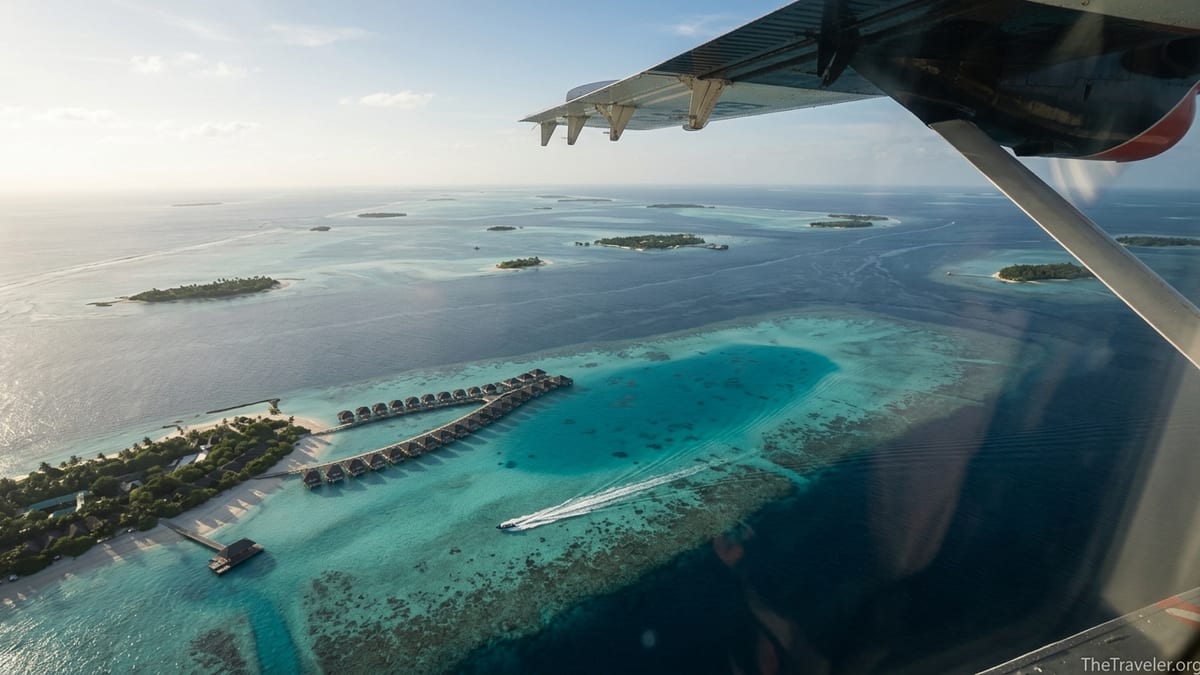
For many visitors, the seaplane ride is part of the Maldives dream. Aircraft operated by companies such as Trans Maldivian Airways and Manta Air connect Velana’s seaplane terminal with remote resorts, skimming low over sandbanks and reef systems. From Malé to far northern atolls, seaplane flights typically take 60 to 90 minutes, sometimes with one or two stops at nearby islands to drop off other guests.
Seaplane transfers are also the most expensive common option. As of 2026, return seaplane transfers to more distant resorts commonly range from roughly 400 to 820 US dollars per adult, depending on distance and resort policy, with children often charged a reduced but still significant rate. Luxury properties in the far north sometimes offer private seaplane charters from around 7,000 US dollars one way for up to a dozen passengers, which can make sense for larger groups or those wanting to control exact departure times.
Most seaplane operators apply a luggage allowance of around 20 kilograms of checked baggage plus 5 kilograms of hand luggage per person. Excess baggage is usually accepted on a space-available basis for an extra fee per kilogram, and may travel on a later flight if the aircraft is weight restricted. This is particularly important for guests carrying dive gear, camera equipment or winter wardrobes from previous stops. In practice, many travelers find that packing closer to 20 kilograms total per person simplifies check-in and reduces stress.
The biggest limitation of seaplanes is their operating window. Because they land on open water and need sufficient visibility, services only run in daylight hours. If your international flight arrives in Malé after around 15:00 to 16:00, it is unlikely you will be able to connect to a seaplane that same day. Similarly, early morning international departures can require you to leave the resort the previous afternoon and stay overnight near the airport. If your priority is to avoid an extra hotel night in Malé, then a resort accessible via domestic flight plus speedboat may be a better fit than a seaplane-only property in the far north.
Domestic Flights and Speedboats: Flexible and Often Cheaper
Domestic flights connect Velana International Airport with a growing network of regional airports, including Hanimaadhoo, Hoarafushi and Ifuru in the north. Compared with seaplanes, they use standard runway-equipped aircraft, operate well into the evening and are generally less weather sensitive. For northern resorts that pair a domestic flight with a short speedboat ride, this can be a more forgiving option for late arrivals and delayed international flights.
Domestic fares are also typically lower than seaplane prices. Recent domestic promotions have advertised return fares from Malé to Hanimaadhoo or Ifuru in the region of just over 100 US dollars per person for locals and residents, with higher but still relatively moderate prices for tourists. Once the resort adds a return speedboat leg, many northern properties using domestic flights price their total round-trip transfers somewhere around the mid-range of Maldivian options, often between roughly 350 and 520 US dollars per adult. This is still a major line item on your bill but can be noticeably cheaper than a long seaplane journey of similar distance.
The final leg from a northern domestic airport to your resort is almost always by speedboat. Short hops can be as quick as 10 to 20 minutes, while more distant islands might require 60 minutes or more across open seas. Resorts schedule these boats around arriving flights, grouping guests to keep costs manageable. Unlike short speedboat runs in the central atolls where per-person prices for local island transfers might be 25 to 50 US dollars each way, private resort speedboats in the north are priced to cover long distances and fuel costs and are rarely sold as stand-alone services to outsiders.
For independent travelers heading to local islands in northern atolls, it is sometimes possible to combine a domestic flight with a shared public speedboat operated by local companies. For example, a visitor might fly Malé to Ifuru and then take a public or chartered speedboat to a local island in Raa. Fares are much lower than resort boat prices, though crossings can take well over an hour and run on limited schedules. If you are staying at a resort, you should assume you will use the transfer they provide unless they explicitly confirm they accept guests arriving on independently arranged boats.
Luggage Rules, Timing and What Happens if You Are Delayed
Luggage allowances in the Maldives catch many travelers out, particularly those flying on seaplanes or small domestic aircraft after a long-haul international flight. While major airlines might allow 30 kilograms or more in economy, seaplane operators commonly cap total baggage at about 25 kilograms per person, combining checked and cabin allowance. Domestic flights are a bit more flexible, but still tend to sit around 20 to 23 kilograms plus a small carry-on. Excess baggage can usually be carried for an additional per-kilo charge, but there is no guarantee it will travel on the same flight.
On arrival days, your resort will ask for your international flight details in advance so they can book the closest available seaplane or domestic connection. If your inbound flight is significantly delayed, they will try to rebook you onto the next departure. With domestic flights that operate into the evening, this usually works, although you may reach your island after dark. With seaplanes, a long delay can mean missing the day’s last flight and having to overnight near the airport at your own cost. Some higher-end packages include assistance and accommodation in these cases, but most do not, so it is worth checking the small print.
For departures, resorts typically set fixed transfer times that may feel earlier than you expect. Guests flying home from Malé around midday might find themselves leaving a northern resort at 6:00 in the morning to build in contingencies for weather delays or air traffic. On seaplane routes, resorts usually target a buffer of at least three hours between your seaplane’s arrival in Malé and your international flight’s scheduled departure. Domestic flights can cut that down a little, but check-in and security queues at Velana can be unpredictable on busy days.
If you anticipate traveling with unusual items, such as surfboards, large camera rigs or dive gear, let both your resort and booking agent know before you travel. Some domestic aircraft and seaplanes have strict length or weight limits for oversized luggage, and you may be asked to send bulky items on a later flight or pay surcharges. Packing in soft-sided duffels rather than hard suitcases can also help staff fit bags more efficiently into seaplane holds and boat lockers.
What Transfers Really Cost and Why Location Matters
Transfer costs in the Maldives are high by global standards and can be a shock if you focus only on nightly room rates. In the northern atolls, where distances are greater, this effect is even stronger. As of 2026, many resorts within 80 kilometers of Malé that use shared speedboats charge in the region of 100 to 250 US dollars per adult round-trip, while remote seaplane-only properties can charge 400 to 820 US dollars per adult, sometimes more for ultra-luxury islands.
Northern resorts using domestic flights plus speedboats often fall in the middle of that range. For example, a round-trip transfer might combine a Malé to Hanimaadhoo domestic ticket with a 30 to 60 minute speedboat at a total package price of roughly 350 to 520 US dollars per adult. At the very top end, a private seaplane charter direct to a northern resort can exceed 7,000 US dollars each way. For couples or small families, shared transfers almost always offer better value; private charters only begin to look economical for larger groups or those with significant time constraints.
Resort location strongly shapes both your transfer cost and your risk of disrupted travel. A property in Raa Atoll served via Ifuru, for example, may offer better evening flight connections and lower transfer prices than a seaplane-only island at the extreme northern tip of Haa Alifu. On the other hand, the very remoteness of those far-north islands is part of their appeal: fewer overflights, darker skies, and a sense of being at the edge of the archipelago. When comparing resorts in the north, it is helpful to view transfer price and logistics as part of the total cost and experience, rather than as an afterthought.
Another reason location matters is sea state. During the southwest monsoon season, roughly May to November, seas in more exposed channels can become choppy and crossings feel particularly bumpy in smaller boats. If you are prone to seasickness and planning to travel in those months, a resort with a shorter speedboat leg from its domestic airport can be more comfortable than one requiring a long open-ocean ride. In some cases, choosing a seaplane transfer can actually be smoother even if it is more expensive, but remember that weather can still cause delays and schedule changes.
Choosing Between Seaplane, Domestic Flight and Speedboat
When you are comparing northern Maldives resorts, it makes sense to start by asking three practical questions: what is the transfer type, what does it cost per person and how does it align with my international flight times. A resort that looks like a bargain on nightly rate may become more expensive than a closer competitor once you add 800 or more US dollars per couple in seaplane transfers. Conversely, a property with slightly higher room prices but a more affordable domestic flight plus speedboat package may come out better on your total holiday cost.
If you are arriving in Malé after mid-afternoon or leaving early in the morning, prioritize resorts in the north that can be reached via domestic flight, such as those using Hanimaadhoo, Hoarafushi or Ifuru. Their longer operating hours offer more flexibility in case of delays, and you are less likely to need an overnight near the airport. Travelers with midday or early afternoon international arrivals and departures have more freedom to choose seaplane-only resorts if the aerial experience is a big part of the dream.
Comfort and accessibility are also factors. Seaplanes are noisy and relatively cramped, with basic seating and no air-conditioning on the ground. Boarding involves walking on a floating platform and climbing narrow steps, which can be awkward for anyone with limited mobility. Domestic jets and turboprops, by contrast, feel closer to standard regional flights, with proper boarding ramps or stairs and more conventional cabins. If you are traveling with very young children, elderly relatives or anyone with mobility concerns, you may find the domestic flight plus speedboat combination more manageable.
Finally, think about how often you realistically plan to leave the island. Resorts accessible by private speedboat from Malé sometimes allow occasional day trips to local islands or the capital at extra cost. By contrast, remote northern islands reached by seaplane or domestic flight are effectively “one way in, one way out”; popping back to Malé for a day of shopping or sightseeing is rarely practical. If you want a single, secluded base and do not mind staying put, the northern atolls are ideal. If you prefer to combine a resort with a stay on a local island or some time in Malé, you may find it easier to start or finish your trip closer to the central atolls and transfer north only for part of your stay.
The Takeaway
Reaching the northern Maldives is not difficult, but it is structured in ways that can surprise first-time visitors. Seaplanes offer scenic, direct access to remote atolls but come with higher prices, stricter luggage limits and daylight-only operations. Domestic flights to gateways like Hanimaadhoo, Hoarafushi and Ifuru provide more forgiving schedules, especially for late international arrivals, with onward resort speedboats bridging the final stretch of ocean.
The key to a smooth experience is to treat transfers as a core part of your planning. Ask every resort for up-to-date round-trip transfer costs and operating windows before you book, check how your international flight times line up with their standard schedules and be honest about how much you want to spend and how far you want to travel after a long-haul flight. For some, the extra expense of a northern seaplane ride will feel like money well spent on views alone. For others, a practical domestic flight and a short speedboat hop will be the right balance of cost and comfort.
Above all, remember that in the Maldives you are often paying not just for a room but for a carefully managed journey across a vast ocean of islands. Choosing a resort whose transfer logistics match your priorities can mean the difference between starting your holiday with a rushed sprint through airports and finishing it with a calm sunrise ride across still, glassy water as the northern atolls come slowly into view.
FAQ
Q1. Can I book my own seaplane or domestic flight instead of using the resort’s transfer?
The vast majority of resorts require you to use their arranged transfer and will coordinate bookings with their preferred carriers. A few places in the north may allow you to arrive on independently booked domestic flights or local speedboats if you request approval in advance, but you should never assume this. Always confirm with the resort before buying separate tickets.
Q2. How much should I budget for transfers to a northern Maldives resort?
For most northern resorts, expect to spend roughly 350 to 820 US dollars per adult for round-trip transfers, depending on whether the route uses domestic flights plus speedboats or longer seaplane legs. Ultra-luxury properties and private charters can cost significantly more. Children often pay reduced but still substantial rates, so families should pay close attention to the fine print.
Q3. What happens if my international flight to Malé is delayed and I miss my seaplane?
If you miss your seaplane because of a delay, the resort and seaplane operator will usually move you to the next available flight. If there are no more flights that day, you will typically need to overnight in or near Malé at your own expense and continue the next morning. Travel insurance that covers missed connections can be valuable, and resorts can help arrange airport-area hotels if needed.
Q4. Are domestic flights in the Maldives safe and comfortable?
Domestic flights are operated on standard regional aircraft and are widely used by both locals and tourists. Cabins are simple but comfortable for the short sector lengths, usually under 75 minutes. You can expect basic in-flight service, assigned seats and standard safety procedures similar to other regional airlines.
Q5. Is seasickness a concern on speedboat transfers in the north?
Sea conditions vary by season and route. On calm days, even long crossings can be smooth, but during the southwest monsoon months choppier seas are common, especially in more exposed channels. If you are prone to motion sickness, consider resorts with shorter speedboat legs, travel with medication such as motion sickness tablets and sit toward the rear of the boat where motion can feel slightly less intense.
Q6. Can I combine a northern resort stay with time on a local island?
Yes, but it requires more planning than in the central atolls. You may be able to fly to a northern domestic airport, stay on a local island reached by public speedboat and then transfer by resort boat or chartered speedboat to your chosen property. Always coordinate timings carefully and check that the resort accepts independent arrivals before finalizing local island bookings.
Q7. Do northern seaplane routes run year-round?
Seaplane services operate year-round, but exact schedules and frequencies vary with demand and daylight hours. In low season or during periods of poor weather, flights may be consolidated or rescheduled. Domestic flights are generally more resilient in bad weather, so resorts sometimes switch guests to domestic-plus-speedboat routings when seaplane operations are disrupted.
Q8. How early do I need to leave a northern resort for my flight home?
As a rule of thumb, resorts aim to have you back at Velana International Airport at least three hours before your international departure, sometimes more if you are flying long-haul. That can mean leaving a northern island six or more hours before your scheduled flight, particularly if the transfer involves both a speedboat and a seaplane or domestic sector.
Q9. Are transfer costs ever included in northern Maldives packages?
Some tour operators and online travel agencies bundle transfer costs into package prices, and a few resorts occasionally run promotions that include transfers for stays of a certain length or in specific room categories. However, many properties list transfers separately, so always check whether the quoted rate includes or excludes them before you compare offers.
Q10. Is the seaplane experience really worth the extra cost in the north?
For many travelers, yes. Flying low over the atolls offers a unique perspective on the reefs and lagoons and is often described as a highlight of the trip. That said, if you have a tight budget, are sensitive to noise and heat or are arriving late in the day, a domestic flight plus speedboat can be the more practical and comfortable choice, with views of the islands still visible from the air at cruising altitude.