


The northern Maldives feels a world away from the busy resort ring around Malé. Atolls such as Haa Alifu, Haa Dhaalu, Shaviyani, Raa, Baa and Lhaviyani offer quieter islands, strong house reefs and a mix of polished resort stays and local-island guesthouses. The challenge is working out how to string them together without losing a day to airport benches and boat piers. This guide breaks down realistic 5, 7, 10 and 14 day routes through the northern Maldives, with concrete examples of resorts, local islands and transfer combinations that actually work in 2026 schedules.
How Northern Atolls Fit Together
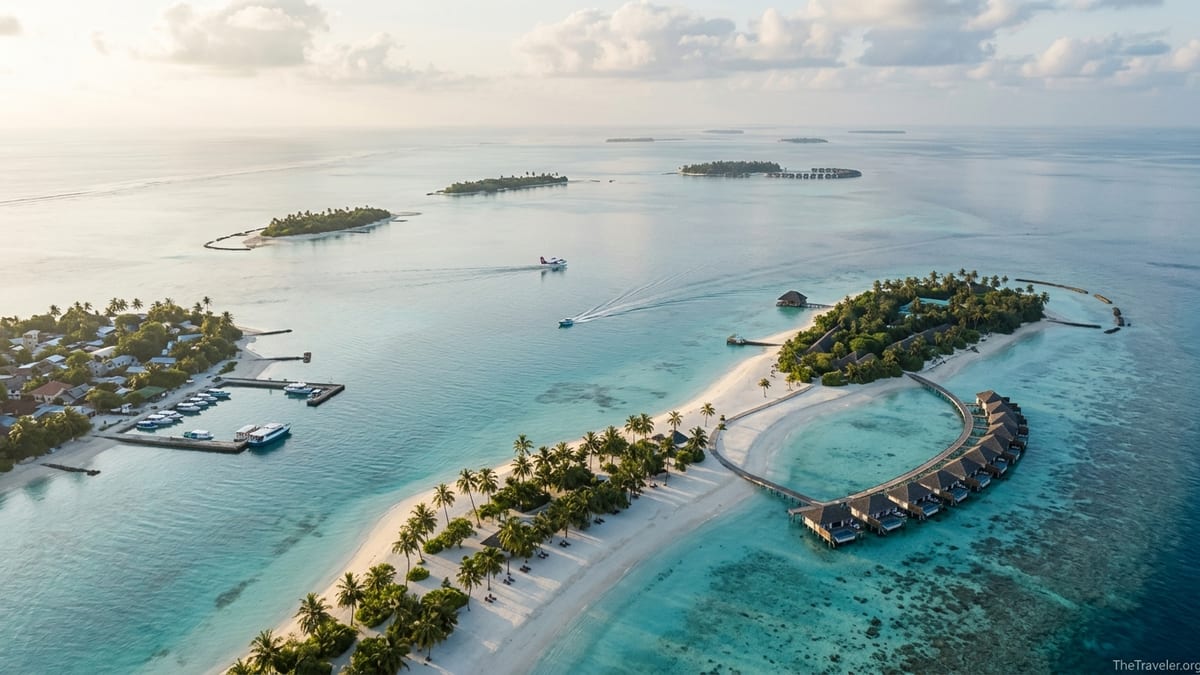
On a map, the northern Maldives looks like a loose staircase of atolls rising above Malé. From south to north, the most relevant for this guide are Baa, Raa, Lhaviyani and Noonu, then Shaviyani, Haa Dhaalu and Haa Alifu at the far top. Administratively, each carries a code letter such as Baa, Raa or Lhaviyani, but for trip planning it is more useful to think in clusters around domestic airports and seaplane corridors rather than the codes themselves.
Velana International Airport near Malé remains the main gateway. From here, travelers either board shared speedboats to closer atolls like Baa and Lhaviyani, domestic flights to hubs such as Dharavandhoo in Baa, Hanimaadhoo in Haa Dhaalu or Ifuru in Raa, or shared seaplanes that land directly by resort jetties. In practice, your choice of first resort largely dictates your transfer mode, because each island contracts specific operators. It is rarely possible to “shop around” for a cheaper random seaplane or boat; you book the resort’s contracted transfer, added as a separate line on your invoice.
Travel times and costs vary widely. Typical round trip transfer prices in 2026 range roughly from 100 to 400 US dollars per person for shared speedboats to nearby atolls, around 350 to 520 dollars for domestic flight plus speedboat packages to more remote atolls, and around 400 to 820 dollars for shared seaplane transfers, with some ultra luxury resorts charging more. These ranges matter when comparing a Baa or Lhaviyani speedboat resort to a far north seaplane island that appears only slightly more expensive per night on paper.
Domestic connectivity to the north has improved, particularly via Hanimaadhoo and Ifuru. National carrier Maldivian has repeatedly increased frequencies during peak periods, and government fare reductions mean sample round trip tickets from Malé to Hanimaadhoo can fall in the low to mid 100 dollar range in economy, with Malé to Ifuru and Malé to Dharavandhoo typically below that. Resorts usually package these flights with short speedboat hops, and some high end properties in Haa Alifu and Haa Dhaalu also offer direct seaplane options from Malé for travelers who prefer a single leg.
Understanding Transfers: Seaplane, Domestic Flight and Speedboat
Seaplanes are the iconic Maldives transfer, especially on northern routes where open ocean gaps are wider. In practice they are shared floatplanes seating around 15 passengers on fixed daytime schedules, normally operating from first light to late afternoon. Resort seaplane transfers in 2026 typically cost roughly 400 to 800 dollars per person round trip, and premium brands can be higher. For example, guest reports and published rate sheets show round trip seaplane charges at well known luxury properties now running close to or above 900 dollars per person in some cases, and private seaplane charters for a family can easily reach several thousand dollars one way.
Domestic flights use standard runway airports like Hanimaadhoo, Dharavandhoo or Ifuru. Fares have fallen in recent years, with official announcements indicating round trip Malé to Hanimaadhoo tickets in the region of just over 100 to around 140 dollars depending on class and demand, and Malé to Ifuru and Malé to Dharavandhoo sitting slightly lower. Resorts then add a short speedboat ride from the domestic airport to their jetty, often bundled into a single “domestic flight plus speedboat” transfer fee in the 350 to 520 dollar per person round trip range when sold through the hotel.
Speedboats are the workhorses of the closer atolls. Many Baa and Lhaviyani resorts can be reached in about 30 to 90 minutes by shared speedboat from Malé. A public speedboat from Malé to a popular local island such as Maafushi, just south of the capital, can cost about 25 dollars one way for context, while resort operated speedboats to northern atolls are usually higher, commonly around 150 to 400 dollars per person round trip depending on distance and branding. Travel times to northern local islands like Kamadhoo in Baa or Ukulhas in North Ari will often mix public ferries, scheduled speedboats and, in some cases, domestic flights to keep connections workable.
Two practical points matter for itinerary design. First, seaplanes only fly in good daylight, so late afternoon international arrivals may require an overnight near Malé if your first stop is a seaplane only resort in Raa, Baa or Haa Alifu. Second, resort to resort transfers are rarely economical unless the islands share the same seaplane or speedboat provider. Direct private transfers between distant resorts can run into thousands of dollars one way. For multi atoll trips, it is usually cheaper to route back through Malé or a domestic hub such as Dharavandhoo or Ifuru and then continue by scheduled service.
5 Day Northern Maldives: Single Resort or Resort Plus Local Island
With only five days on the ground, the priority should be minimizing transfer time. The most straightforward 5 day northern itinerary is a single resort stay in Baa, Raa or Lhaviyani, ideally reachable by speedboat or short seaplane hop. A realistic example would be flying into Malé in the morning, taking an afternoon seaplane to a Baa atoll resort such as a mid range all inclusive island, and then returning by seaplane on day five in time for an evening international departure. On this schedule you lose part of day one and part of day five to transfers but retain three full days on the island.
Travelers who want a taste of local life can combine a resort with a nearby local island guesthouse. One workable route is two nights at a resort in Baa atoll followed by two nights on Kamadhoo or Dharavandhoo, both inhabited islands served by guesthouses. You would typically arrive via domestic flight to Dharavandhoo or seaplane to a nearby resort, spend the first two or three nights on the private island, then take a short local boat or resort arranged launch to the guesthouse island for the last nights. A simple example could be flying to Dharavandhoo, transferring by speedboat to a mid range resort, then boat back to stay in a small guesthouse near the domestic airport for easier departure.
For price conscious travelers, a pure local island 5 day trip to the north is also realistic. You could fly Malé to Hanimaadhoo, then speedboat to a guesthouse island in Haa Dhaalu or Haa Alifu. Domestic flights on this route are typically priced at just over 100 dollars round trip when booked independently in advance, and local guesthouse rooms can start from under 100 dollars per night. The trade off is that ferry schedules in the far north are often every other day, so you need to match your flights carefully and accept that snorkeling and beach quality might be slightly less polished than at a high end resort.
Whichever pattern you choose, avoid attempting two separate resorts plus a local island in five days in the northern atolls. The transfer overhead will erode your time in the water, and you may find yourself spending precious holiday hours in domestic terminals and jetty queues rather than on the reef.
7 Day Routes: Classic Resort Weeks and Two Stop Combos
A 7 day window opens the door to deeper northern itineraries without overwhelming transfer costs. Many travelers still prefer a simple one resort week, particularly at islands that market themselves on house reef snorkeling and diving. A concrete example is a seven night stay in Baa atoll, timing your visit for the June to October season when manta rays gather at cleaning stations like Hanifaru Bay. You might arrive in Malé, connect onto a 20 minute domestic flight to Dharavandhoo and then a 15 minute speedboat to your resort, with a pre arranged excursion to Hanifaru included in your package.
Those who want contrast can split the week between a northern resort and a local island. One pattern is four nights at a seaplane resort in Raa followed by three nights at a guesthouse in Baa or Lhaviyani. You could, for instance, fly into Malé, take a seaplane directly to a medium or upscale resort in Raa, then at the end of your stay transfer by domestic flight via Ifuru back toward Malé and immediately continue on a scheduled speedboat or ferry to a local island near the capital for your last nights. This keeps the expensive seaplane leg to a single inbound sector and uses more affordable boats closer to Malé for the back half of the trip.
Another 7 day option stays entirely in the far north. You arrive in Malé, connect to Hanimaadhoo by domestic flight and speedboat to a Haa Alifu resort for four or five nights. On day five or six you move by speedboat to a nearby local island, perhaps one with a small harbor and several guesthouses, and finish with a night back near Hanimaadhoo before flying to Malé on day seven. The domestic flight cost remains roughly in the 100 to 150 dollar round trip range when booked early, but the mix of upscale resort and modest guesthouse balances overall budget.
For divers, seven days is enough to justify a multi atoll focus, such as combining Baa and Raa or Raa and Lhaviyani. In practice this usually means choosing two resorts that are connected by the same seaplane corridor or that both use the same domestic hub. For instance, you could spend three nights at a Baa seaplane resort then pay a supplemental fee for a direct seaplane hop to a partner resort in Raa, or route back through Malé mid trip and on to Lhaviyani by speedboat. These cross resort transfers are almost always more expensive than simple resort to airport transfers but can still be manageable if you keep the distances modest.
10 Day Itineraries: Multi Atoll Explorations
With 10 days, a northern Maldives trip can stretch from speedboat atolls near Malé up into the far north, or weave together resort and local stays across two or three atolls. An illustrative 10 day route might start with three nights in Lhaviyani atoll at a resort known for calm lagoons and easy snorkeling, reached by a 40 to 50 minute speedboat from Malé. After settling in and recovering from your flight, you would transfer on day four back to Malé, then continue the same afternoon on a domestic flight to Dharavandhoo for the Baa section of your trip.
Days four to seven could be spent in Baa atoll, splitting time between a resort and a nearby local island if you want to compare experiences. For example, you might spend two nights at a small boutique resort within speedboat reach of Dharavandhoo, enjoy a manta or whale shark excursion, then move across to a guesthouse on Dharavandhoo itself for two more nights. Here you would have access to more modest local cafés and community life while still being close to the domestic airport for your final segment north.
On day eight, the itinerary could push further to Haa Dhaalu or Haa Alifu. You would take a domestic flight from Dharavandhoo or Malé up to Hanimaadhoo, then connect by speedboat to a high end resort on a private island in Haa Alifu. Three nights here would give you time for outer reef dives and sandbank picnics in a region that still feels far from the central resort belt. Given current pricing patterns, the combined domestic flights for this 10 day route, including Malé to Dharavandhoo and Malé to Hanimaadhoo or vice versa, are likely to land in the mid hundreds of dollars per person when booked through resorts or as part of a package.
An alternative 10 day itinerary stays in the mid north, bouncing between Raa, Baa and Noonu. One version starts with a four night stay at a mid range all inclusive resort in Raa reached by seaplane or by a domestic flight to Ifuru plus speedboat, then moves by domestic hop back toward Baa for three nights on a local island like Kamadhoo, finishing with three nights in Noonu at a relaxed guesthouse or entry level resort. The appeal here is variety: sandbank trips in Raa, manta encounters in Baa and quieter local reef snorkeling in Noonu, all while avoiding the long domestic legs to the far north.
14 Day Journeys: Layering Resorts, Local Islands and Transit Nights
A full two weeks in the northern Maldives allows for patient routing that respects daylight flight windows and local ferry timetables while still giving you generous time in the water. One ambitious but realistic 14 day itinerary might combine Lhaviyani, Baa and Haa Alifu in a loose northbound arc. You would arrive in Malé and take a shared speedboat to a Lhaviyani resort for four nights, adjusting to the climate and time zone. On day five, you travel back to Malé and continue by domestic flight to Dharavandhoo for three nights in Baa, timing your stay for manta season if possible.
From Baa, you route via Malé once more or connect on a domestic sector to Hanimaadhoo, depending on schedules, and transfer by speedboat to a Haa Alifu resort for four more nights. The final days are left flexible: you might add a night on a local island near Hanimaadhoo at the end, staying in a simple guesthouse and walking to the airport pier for your flight south, or spend your final 24 hours at an airport hotel near Malé to reduce stress before your international departure. This structure spreads out the more expensive and time consuming transfers while still delivering three distinct atoll experiences.
Another 14 day route is built explicitly around combinations of private island luxury and local island culture. For example, you could plan five nights at an upscale retreat in Raa atoll, reached by seaplane or domestic flight to Ifuru plus speedboat, then move for four nights to a guesthouse on an inhabited island in the same atoll, using affordable local dhoni boats and occasional organized excursions to explore nearby sandbanks. From there, you travel back via Ifuru and Malé toward Baa, finishing with four nights on a small eco resort in the UNESCO Biosphere Reserve section of the atoll.
Families sometimes prefer to anchor their 14 day stays at a single resort and use excursions rather than transfers to create variety. In the northern Maldives this can still feel like a multi destination trip because many resorts in Baa and Raa offer full day boat trips to neighboring atolls, uninhabited islands or local villages. A sample pattern could be a fortnight at a large family oriented resort in Lhaviyani, with pre booked excursions such as a combined snorkeling and local island visit, a night fishing trip and a visit to a nearby sandbank for sunset. Although you technically stay on one island, the variety of outings adds texture without the disruption of packing and repacking.
Whichever 14 day pattern you choose, build at least one buffer night into your schedule. A common strategy is to spend the last night at a simple airport hotel near Malé or on a local island with quick speedboat access, especially if your international flight departs in the morning. This reduces the risk that poor weather, a delayed seaplane or a missed domestic connection in the far north will cause you to misconnect with your long haul flight home.
Practical Planning: Budgets, Seasons and Booking Tactics
Trip budgets for northern Maldives routes are shaped as much by transfers as by nightly rates. A week at a modest resort in Baa reached by speedboat can sometimes be cheaper overall than a week at a slightly less expensive property in Haa Alifu that requires a premium seaplane transfer. For a family of four, the difference is stark: if the seaplane adds 700 dollars per person round trip, that is 2,800 dollars in transfers before you have paid for a single excursion. When comparing resorts, always ask for transfer costs for your exact dates, including taxes and service charges, before you commit to non refundable flights.
Seasonality also matters. The traditional high season from roughly December to April brings higher room and transfer prices but the best odds of blue skies and calm seas. The southwest monsoon months from May to October often mean more cloud and occasional storms but also bring plankton rich waters that attract manta rays and whale sharks, especially in Baa atoll’s protected areas. Shoulder months such as late April, early May and late November can offer lower prices while still delivering good weather windows for boat journeys between atolls.
Booking tactics for multi atoll northern trips in 2026 include leveraging resort packages that bundle transfers and meals, and being flexible on arrival and departure times. Some airlines from Europe and Asia now arrive in Malé early enough in the morning to connect same day to seaplanes and domestic flights; others land late afternoon, effectively forcing an overnight near Malé before you can continue north. In that case, consider using the extra night to explore a nearby local island rather than simply adding an airport hotel, provided you are comfortable navigating short public ferry or speedboat rides.
Insurance and contingency planning are no longer optional on complex itineraries. Weather disruptions, mechanical issues and air traffic constraints in peak weeks can all lead to seaplane delays. Travel insurance that covers missed connections and extra accommodation can soften the impact if a domestic flight is cancelled or if rough seas prevent a speedboat from departing on schedule. When designing 5, 7, 10 or 14 day routes that layer multiple atolls and transfer modes, always build at least a half day of slack before your long haul flight home.
The Takeaway
The northern Maldives rewards travelers who are willing to think in terms of routes rather than isolated islands. Baa and Lhaviyani offer relatively straightforward access from Malé by speedboat or short seaplane hop, while Raa, Shaviyani, Haa Dhaalu and Haa Alifu feel more remote and often rely on domestic flights or longer seaplane legs. Five day trips work best as single resort stays or simple resort plus local island combos, seven days gives room to add a second atoll, 10 days opens up true multi atoll journeys, and 14 days supports layered itineraries that move gradually north with built in buffer nights.
Costs for seaplanes, domestic flights and speedboats can rival or exceed nightly room rates, so realistic planning means requesting transfer quotes early, aligning your international flight times with daytime seaplane windows, and considering guesthouse stays or closer atolls if budgets are tight. In return, the northern atolls offer quieter reefs, a stronger sense of remoteness and the chance to mix barefoot luxury with local village life in a single trip. With deliberate routing and realistic expectations about logistics, you can turn the archipelago’s scattered geography into the backbone of a memorable 5, 7, 10 or 14 day adventure.
FAQ
Q1. Is it realistic to visit more than one atoll in a 5 day northern Maldives trip?
It is technically possible but often not enjoyable. With only five days, you will lose too much time to transfers if you try to cover more than one resort and one local island, especially in the far north.
Q2. How much should I budget for transfers on a 7 day trip to Baa or Lhaviyani atoll?
As a rough guide, expect around 150 to 400 US dollars per person round trip for shared speedboats or 400 to 800 dollars for shared seaplanes, depending on distance and resort.
Q3. Are domestic flights to Hanimaadhoo or Ifuru significantly cheaper than seaplanes?
Domestic flight fares from Malé to Hanimaadhoo, Ifuru or Dharavandhoo are often in the low to mid 100 dollar range round trip in economy when booked early, but resorts typically package them with speedboat transfers into bundled fees that can still reach several hundred dollars per person.
Q4. Can I book my own seaplane or speedboat instead of using the resort’s transfer?
Usually no. Resorts contract specific operators, and transfers are arranged through the hotel. Independent seaplane bookings are rare, and ad hoc private boats between distant resorts are extremely expensive.
Q5. What happens if my international flight arrives in Malé after seaplanes stop flying for the day?
You will normally need to spend the night near Malé and continue to your northern resort next morning by seaplane or domestic flight, so plan your arrival time carefully when booking flights.
Q6. Is it safe and practical to stay on local islands in the far north?
Yes, provided you are comfortable with simpler infrastructure and less frequent transport. Guesthouses on islands served by Hanimaadhoo or Dharavandhoo can be good bases, but you must match your flights to ferry or speedboat schedules.
Q7. How far in advance should I book transfers for a 10 or 14 day multi atoll itinerary?
It is wise to lock in transfers at least two to three months ahead for peak season, and even earlier if your route relies on limited domestic flights or specific seaplane corridors between northern atolls.
Q8. Are there child discounts on northern Maldives transfers?
Many operators and resorts offer reduced transfer rates for children and sometimes infants, but policies vary, so ask each property for exact age brackets and percentages before booking.
Q9. Can I dive in multiple northern atolls on one trip without joining a liveaboard?
Yes, if you allow at least 10 days and choose resorts or guesthouses in Baa, Raa, Lhaviyani or Haa Alifu that have well organized dive centers and workable connections by seaplane or domestic flight.
Q10. What type of travel insurance is recommended for complex northern Maldives itineraries?
Look for policies that cover missed connections, weather related delays, additional accommodation and rebooking costs, since seaplanes and speedboats can be disrupted by storms or operational issues.