


The Maldives begins for most travelers in the same place: Velana International Airport on the island of Hulhulé, across the water from the capital Malé. From there, though, your path quickly splits. Do you head north across the channel into North Malé Atoll, the country’s most developed and surf-famous lagoon, or south into quieter, more laid-back South Malé Atoll? Both are reachable by speedboat, both offer classic overwater villas and turquoise shallows, yet they feel surprisingly different on the ground. Here is how they really compare when you are making a commercial decision about where to book.
Orientation: Two Neighboring Atolls, Two Different Vibes
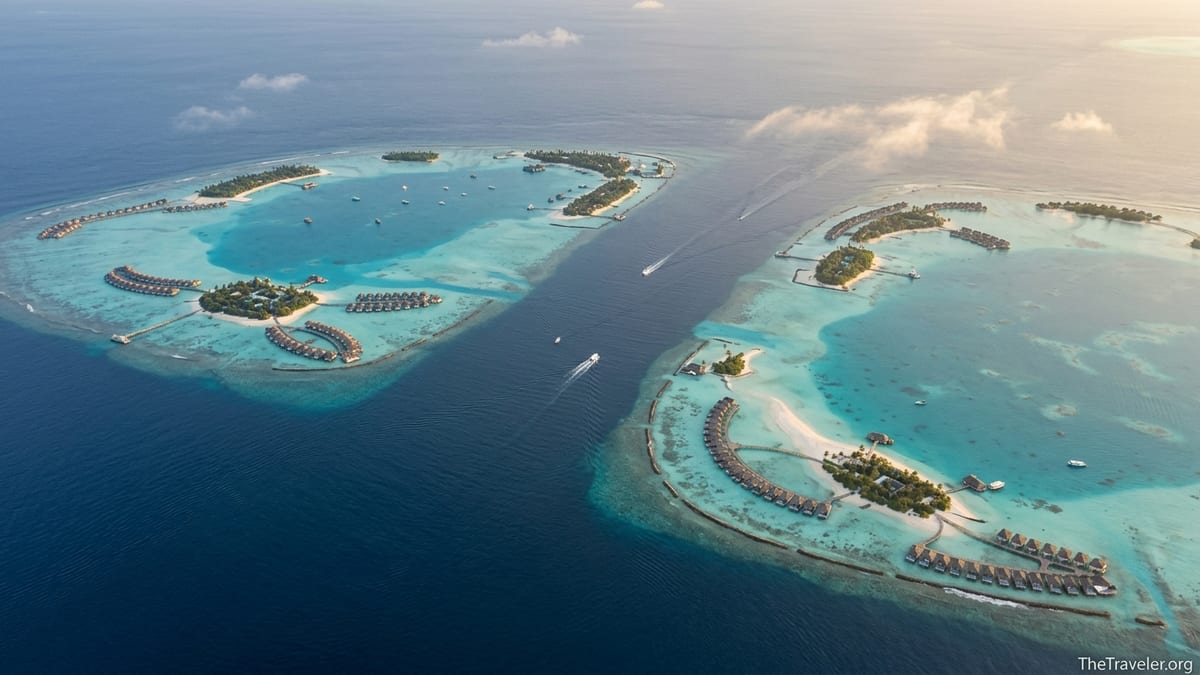
North Malé Atoll and South Malé Atoll sit on either side of Malé, separated by the deep Vaadhoo Kandu channel. On a map they look like mirror images, but for travelers they have distinct personalities. North Malé is the original tourism engine of the country, with many of the Maldives’ earliest private-island resorts, iconic surf breaks like Cokes and Sultans, and a high density of both big-name luxury brands and more affordable islands. South Malé, by contrast, developed later and a little more slowly, with fewer resorts, more space between them, and a growing mix of high-end hotels and budget-friendly local islands.
Because they are so close to the airport, both atolls avoid the seaplane transfers required for farther-flung parts of the country. That single fact has shaped everything from average nightly prices to the types of guests you meet at breakfast. In practical terms, if you want a “Maldives postcard” trip without adding an expensive domestic flight or seaplane, your choice almost always comes down to North Malé versus South Malé.
Crucially, there is no unanimous “winner.” The better atoll is the one that matches your priorities: is it surfing world-class waves, snorkeling a healthy house reef, keeping transfer costs down, or hiding away in ultra-luxury seclusion? The answer will usually point you clearly toward one side of Malé or the other.
Airport Access and Speedboat Transfers
From Velana International Airport, both North Malé and South Malé resorts are reached almost exclusively by speedboat, with journey times typically between about 15 and 60 minutes depending on distance and sea conditions. That makes both atolls ideal for late-night arrivals from Europe or early-morning departures to Asia, when seaplane transfers to more remote atolls are not operating. For example, many North Malé resorts such as Meeru Island Resort and Huvafen Fushi advertise around 30 to 45 minutes by speedboat, while South Malé properties like Anantara Dhigu or Holiday Inn Resort Kandooma are generally in the 30 to 40 minute range.
Where North Malé pulls ahead is sheer variety and competition in the speedboat market. You will find everything from simple, shared transfers used by mid-range resorts and local islands, to sleek, air-conditioned private boats employed by high-end brands like Hilton Maldives Amingiri or LUX* North Malé Atoll. Round-trip transfer pricing for shared speedboats in either atoll often falls in the rough band of 150 to 300 US dollars per adult, with children discounted, while private transfers cost more but can be worthwhile for families or groups.
South Malé, meanwhile, benefits from proximity: several islands lie almost on the doorstep of the airport lagoon. Taj Exotica Resort & Spa, Hard Rock Hotel Maldives and SAii Lagoon Maldives are among the closest, often quoting 15 minutes or less by speedboat. This is particularly attractive if you are traveling with young children, nervous sailors, or older relatives who may not enjoy a longer boat ride in choppy seas.
If minimizing travel friction is your top priority, South Malé’s cluster of resort and local islands near the airport edges ahead. If you are happy with up to an hour on a speedboat in exchange for more choices and sometimes better value per night, North Malé opens more doors.
Resort Density, Atmosphere and Price Levels
North Malé Atoll is the most developed region for tourism in the Maldives. Resort islands here often sit within sight of one another, especially in the central and eastern parts of the atoll. You might watch the lights of nearby properties like Kurumba, Bandos or Meeru twinkling across the water at night. This density means more competition, a broader price spectrum, and greater choice for those who like to compare multiple options before booking.
In North Malé you will find everything from simple, established three and four star properties right up to boutique luxury retreats. A couple on a tighter budget might choose an older, good-value resort such as Biyadoo’s equivalents in North Malé or a local-island guesthouse on Thulusdhoo or Himmafushi, while honeymooners gravitate toward stylish private islands with underwater spas and high-end villas. The feel here is energetic: more boats moving around, more excursion operators, and more chances to mix with other travelers if you wish.
South Malé is less crowded with resorts, and that shapes the mood. Although there are still several well-known names, including Waldorf Astoria Maldives Ithaafushi, OZEN RESERVE BOLIFUSHI, COMO Cocoa Island, Sun Siyam Olhuveli and family-friendly all-inclusive properties, they are spaced a little farther apart. Many guests report a quieter, more “away from it all” sensation even though they are only a short speedboat hop from the capital.
Price-wise, both atolls cover a wide range, but the very top of the luxury spectrum tilts slightly toward South Malé. Flagship properties like Waldorf Astoria Maldives Ithaafushi and Naladhu Private Island aim squarely at ultra-luxury travelers, while North Malé still offers high-end stays but with a larger representation of mid-range and upper-mid-range resorts. If your priority is having the broadest range of budgets and styles within one atoll, North Malé wins. If you are specifically targeting ultra-lux ampleness or a slightly more tranquil feel, South Malé has the edge.
Surfing: North Malé’s Icons vs South Malé’s Quieter Lineups
For surfers, North Malé Atoll is almost synonymous with Maldivian waves. Legendary reef breaks such as Cokes, Chickens, Sultans, Honky’s, Jailbreaks, Pasta Point, Lohis and Ninjas all sit within this atoll, accessed by boat from nearby resorts or local islands. Cokes, near Thulusdhoo, is a powerful right-hand reef break known for long, hollow walls, while adjacent Chickens is a fast left. Sultans is a consistently peeling right-hander a short boat ride away, and Jailbreaks off Himmafushi serves up a quick, exciting right with more exposure to swells.
Because these breaks are relatively close to Malé and to each other, surf charters and land-based surfers concentrate here, especially from March to October when southwest swells are common. The trade-off is crowd factor: on a good day at Sultans or Cokes you might share the lineup with several charter boats and guests from multiple islands. For intermediate and advanced surfers who prioritize variety and the chance to tick off famous waves, North Malé is the clear winner despite the crowds.
South Malé Atoll offers fewer named breaks but a more relaxed surfing rhythm. Spots such as Kandooma Right, Foxy’s and Riptides draw a mix of intermediate and advanced surfers, often staying at surf-friendly resorts like Holiday Inn Resort Kandooma or on nearby local islands such as Guraidhoo. Kandooma Right, in particular, has built a reputation as a playful, rippable right-hander that wraps around the reef in front of the resort, giving guests the rare treat of watching waves from their breakfast table.
If you want maximum wave options and do not mind paddling out with a crowd, North Malé Atoll is better. If your ideal is a more mellow surf scene where you can build a routine around one or two breaks, South Malé is often more forgiving. For non-surfing partners, both atolls offer plenty of snorkeling, spa time and poolside relaxation while the surfers chase sets.
Snorkeling, Diving and House Reefs
Both North and South Malé Atolls sit within the central Maldivian chain, which is well known for clear water, plentiful reef fish, and a mix of inside-lagoon and channel dives. However, there are subtle differences in how easy it is to enjoy that underwater world from your front door. In North Malè, many of the older, established resorts have had time to develop well-organized dive centers and multiple daily boat trips to nearby sites, while newer properties have invested heavily in artificial reef projects and coral restoration.
For snorkelers, North Malé offers a patchwork of house reefs. Some islands have coral gardens that start only a few fin kicks from the beach, while others rely more heavily on boat trips to outer reefs and channels. Guests at islands like Bandos or Meeru, for example, often combine easy “house reef” swims with guided excursions to spots known for turtles or reef sharks. Local islands such as Thulusdhoo and Himmafushi offer budget-friendly snorkeling excursions with simple speedboats and local guides.
South Malé has a reputation among many dive professionals as particularly strong for channel and drift dives, thanks to passes that funnel nutrient-rich water and attract pelagic life. Divers staying on islands like Biyadhoo, Embudu Village or Fihalhohi often have quick access to signature sites with reef sharks, rays and large schools of fish. Several South Malé resorts, including Sun Siyam Olhuveli and OZEN LIFE MAADHOO, advertise excellent house reefs where you can see reef sharks and turtles straight from the beach or your overwater villa steps.
If easy, off-the-beach snorkeling is a must, look closely at individual resorts in both atolls rather than choosing purely by geography. At a broad level, South Malé has a slight edge for channel-style diving and drift dives that appeal to more experienced divers, while North Malé offers a denser network of operators and excursion options. In either atoll, coral health can vary from patch to patch, and many properties are actively working on coral frame projects, so it is worth asking recent guests or your agent about current conditions.
Beaches, Lagoon Character and Scenery
On the surface, the beaches in North and South Malé look almost identical: white coral sand, turquoise shallows, a line of palms, and the lagoon dropping off to deep blue at the reef edge. In practice, each island’s orientation and lagoon shape have more impact on your experience than whether it is in the north or the south. That said, there are some broad tendencies that help differentiate the atolls.
In North Malé, more resorts are located on the atoll rim, with deeper water and a clearly defined “drop-off” where snorkeling can be excellent. This configuration can mean slightly stronger currents on some sides of the island, fantastic if you like a bit of drift while snorkeling but something families with small children should approach cautiously. North Malé also offers more views back toward Malé and the airport in its southern sector, which some guests find distracting and others barely notice.
South Malé has a mix of lagoon-side islands and those on the outer edge. Many resorts here, particularly those in broader lagoon systems like Olhuveli and Maadhoo, benefit from wide, shallow sandbanks that are perfect for long walks in ankle-deep water. Smaller, romantic islands such as COMO Cocoa Island are surrounded by soft, sheltered lagoons that feel tailor-made for floating and paddleboarding. Because there are fewer neighboring islands in direct line of sight, you may have more uninterrupted horizon views from your villa deck.
For pure beach quality, you can find powder-soft sand and clear water in both atolls. If you imagine yourself drifting over a steep reef edge with mask and snorkel, North Malé’s outer-rim islands appeal. If your dream is wading out along a wide sandbank at sunset with almost no one else around, South Malé’s lagoon-dominated islands have a small but noticeable advantage.
Luxury Hotels, Families and Couples: Who Each Atoll Suits Best
Both atolls have strong hotel lineups across the spectrum, but they lend themselves to slightly different types of trips. North Malé’s long history means a concentration of well-known, time-tested resorts at mid- to upper-mid-range price points. These often suit families and couples who want classic Maldivian overwater villas, pools and kids’ clubs without going to full “blank check” luxury. Properties like Kurumba, Meeru and several local-island guesthouses cater well to multi-generational groups, divers, and repeat visitors who value dependable service and varied facilities.
South Malé, in contrast, has positioned itself strongly at the high end while still offering options for more modest budgets. Ultra-luxury retreats such as Waldorf Astoria Maldives Ithaafushi, Naladhu Private Island, Taj Exotica and OZEN RESERVE BOLIFUSHI are firmly aimed at honeymooners, celebrities and travelers celebrating major milestones, with villa butlers, lavish spa complexes and multi-restaurant dining. At the same time, resorts like Sun Siyam Olhuveli, Holiday Inn Resort Kandooma and SAii Lagoon Maldives welcome families with children’s clubs, multi-bedroom villas and all-inclusive or half-board plans that simplify budgeting.
For couples, both atolls are strong choices, but the flavor is a little different. North Malé shines for active couples who want to combine romance with surfing, diving, or easy access to local islands and excursions into Malé. You might split your stay between a surf-friendly local island like Thulusdhoo and a small private island resort for a “two sides of the Maldives” experience without needing a seaplane. South Malé, by contrast, is more tailored to privacy and indulgence: think private sandbank dinners, overwater spa treatments, and discreet service that minimizes the sense of being near a busy airport.
Families often find South Malé especially convenient thanks to the short transfers to resorts with kids’ clubs, shallow lagoons and a variety of dining venues. A typical family itinerary might see parents booking a week at Anantara Dhigu, using the kids’ club for a few hours a day while they dive, join a cooking class, or take a sunset cruise. In North Malé, families who enjoy a bit more bustle and are happy on slightly longer boat rides will appreciate the many mid-priced resorts and local-island guesthouses that can stretch a budget further.
Which Side of Malé Works Best for Different Trips?
When you weigh up airport access, surf breaks, reef quality, hotel mix and overall feel, some clear patterns emerge about which atoll fits which kind of trip. For a short stay of three or four nights, particularly after a long-haul flight, South Malé Atoll’s ultra-short transfers and high concentration of easygoing, lagoon-based resorts make a lot of sense. You could land in the evening, be at your villa at Hard Rock Hotel Maldives or Taj Exotica within roughly 15 minutes by speedboat, and be swimming in the lagoon before jet lag even sets in.
For longer trips of seven nights or more, North Malé Atoll often becomes more compelling, especially if you want variety. You could start at a local-island guesthouse on Thulusdhoo to surf Cokes and Chickens or dive with a small local operator, then transfer by speedboat to a mid-range resort like Meeru or a boutique property closer to the atoll rim for a more cocooned finale. Because there are more islands within shorter boat hops, it is easier to swap scenery without adding a seaplane or domestic flight.
Serious surfers will almost always gravitate to North Malé for the abundance of world-class breaks, but South Malé can be an excellent choice for intermediates or those traveling with non-surfing partners and children, thanks to mellow waves such as Kandooma Right and family-friendly resort infrastructure. Dedicated divers could happily choose either atoll, but if you are particularly interested in channel dives and drift dives with sharks and rays, South Malé’s dive-focused resorts like Biyadhoo and Embudu Village are very strong contenders.
If your primary aim is a milestone honeymoon or luxury celebration, you will likely find yourself comparing names predominantly in South Malé, where several of the country’s flagship ultra-luxury islands sit within a 30 to 40 minute speedboat ride of the airport. If, instead, you are combining the Maldives with a broader trip through Sri Lanka or India and want to keep overall costs in check, North Malé offers more room to economize on accommodation while still delivering the classic overwater-villa experience.
The Takeaway
Choosing between North Malé Atoll and South Malé Atoll is less about finding a universally “better” atoll and more about matching what each side does best to the trip you have in mind. Both are easy to reach by speedboat from the international airport, both offer the full spread of glassy lagoons, overwater villas and technicolor reefs that define the Maldives experience, and both have an ever-growing portfolio of resorts and guesthouses.
North Malé excels at choice and activity. It has more resorts, more local islands, and the lion’s share of the country’s famous surf breaks, along with well-established dive operations and a wide range of price points. If you are an active couple, a surfer, a diver, or a value-conscious traveler who still wants that overwater-bungalow postcard, the north side of Malé is often the smarter fit.
South Malé stands out for convenience and curated luxury. Transfer times are generally shorter, the atmosphere on many islands feels a little more spacious and secluded, and several of the country’s most exclusive addresses sit here. For honeymooners, families who want a smooth, low-stress arrival, and travelers planning a once-in-a-decade splurge, the south side often delivers exactly the mix of ease and indulgence they are looking for.
In the end, the good news is that there is no wrong choice. With realistic expectations and careful selection of your island, you can have an outstanding Maldives stay on either side of Malé. Focus on what matters most to you, ask precise questions about transfers, reef access and facilities when booking, and your chosen atoll will likely feel like the right answer the moment your speedboat noses up to the jetty.
FAQ
Q1. Which atoll is better for a first-time visitor to the Maldives, North Malé or South Malé?
For a first-time visitor who wants classic Maldives scenery with minimal travel hassle, South Malé often works best thanks to very short speedboat transfers and a high concentration of easygoing, lagoon-based resorts. If you are comfortable with a slightly longer boat ride and want more resort variety and activities, North Malé is an equally strong starting point.
Q2. Do I need a seaplane to reach resorts in North Malé or South Malé Atoll?
No. One of the main advantages of both North and South Malé Atolls is that they are normally served by speedboat transfers from Velana International Airport, so you can avoid the cost and scheduling constraints of seaplanes.
Q3. Which atoll is better for surfing?
North Malé Atoll is generally considered better for surfing because it contains many of the Maldives’ most famous breaks, including Cokes, Chickens, Sultans and Jailbreaks, with multiple charter boats and local operators serving them. South Malé also has good waves, such as Kandooma Right and nearby reef breaks, but with fewer options overall.
Q4. Which atoll has better snorkeling and diving?
Both atolls offer excellent snorkeling and diving, but they shine in slightly different ways. North Malé provides a dense network of operators and easy access to a range of sites, while South Malé is particularly strong for channel and drift dives that attract sharks, rays and schooling fish. For snorkeling straight from the beach, it is best to compare individual house reefs in both atolls rather than choosing purely by location.
Q5. Is one atoll generally cheaper than the other?
Prices vary more by specific resort than by atoll, but North Malé tends to offer a wider spread of mid-range and upper-mid-range options as well as local-island guesthouses, which can make it easier to find lower nightly rates. South Malé hosts several ultra-luxury properties that push the top end of the price scale, although it also has family-friendly and all-inclusive resorts at more moderate levels.
Q6. Which atoll is better for families with young children?
South Malé often has the edge for families with young children because of its very short speedboat transfers, shallow lagoons ideal for paddling, and a number of resorts with strong kids’ clubs and family facilities. That said, many North Malé resorts are also highly family-friendly, so it is worth comparing kids’ club programs, room configurations and pool setups in both atolls.
Q7. Which side of Malé is more suitable for a honeymoon or special occasion?
For a high-budget honeymoon or special celebration, South Malé is particularly appealing thanks to its cluster of ultra-luxury resorts offering private pools, butler service and elaborate dining. North Malé, meanwhile, suits couples who want to blend romance with activities such as surfing, diving and local-island visits, often at slightly more accessible price points.
Q8. Will I feel crowded in North Malé Atoll because there are more resorts?
You may see more boat traffic and neighboring islands in North Malé, especially in its central and southern areas, but most resorts are still on their own private islands with plenty of personal space. If absolute seclusion and uninterrupted horizon views are key priorities, you may prefer carefully chosen South Malé islands that are more isolated within broad lagoons.
Q9. Can I combine stays in both North Malé and South Malé in one trip?
Yes, it is straightforward to combine both atolls in a single holiday. Many travelers split their stay, for example starting with an activity-focused resort or local island in North Malé and finishing with a quieter, more luxurious property in South Malé. Transfers between islands are usually by private or shared speedboat arranged through the resorts or local operators.
Q10. How should I decide between North Malé and South Malé if my budget and dates are flexible?
Start by listing your priorities: surf, diving, kids’ facilities, ultra-luxury, transfer time, or access to local culture. If surfing variety, local-island experiences and a wide price range top the list, lean toward North Malé. If ultra-convenient transfers, lagoon-style beaches and a focus on privacy and indulgence matter most, South Malé will likely be the better fit.