


In the Maldives, choosing a resort is not just about villas and views. It is also about how you actually reach your island. With hundreds of resorts spread across 26 natural atolls, the transfer from Malé’s Velana International Airport can range from a 10 minute speedboat hop to a complex combination of domestic flights and boat rides. Understanding which atolls are easiest to access and how transfer logistics work can save you money, reduce stress after a long-haul flight, and even shape which resort is right for you.
How Transfers Shape Your Maldives Itinerary
Every international arrival into the Maldives funnels through Velana International Airport on the island of Hulhulé, just off the capital Malé. From here, resorts arrange your onward transfer by speedboat, seaplane or domestic flight plus speedboat. Unlike many beach destinations, there are no inter-island roads. Your transfer choice is dictated almost entirely by which atoll your resort sits in and how far it is from Malé.
As a rule of thumb, resorts within about 90 minutes by sea tend to use speedboats, while islands farther away rely on seaplanes or scheduled domestic flights that connect to regional airports. Speedboat transfers to nearby atolls such as North Malé, South Malé and parts of Ari and Vaavu are typically 15 to 60 minutes, depending on distance and sea conditions. Seaplanes are used for mid-distance atolls, with flight times around 20 to 45 minutes. The far-flung southern and northern atolls often require a 30 to 60 minute domestic flight plus a shorter speedboat leg at the end.
These differences matter in practical ways. Speedboats usually operate into the evening and can often be arranged for late arrivals. Seaplanes, on the other hand, are limited to daylight hours, which can mean an overnight stay near the airport if your international flight lands late. Domestic flights operate longer hours than seaplanes and serve as the backbone of transfers to distant atolls, but they add another check in, potential waiting time and luggage rules to your trip.
Costs also vary sharply. Round trip speedboat transfers to nearby atolls are often priced in the region of a few hundred US dollars per adult, depending on distance and whether the resort heavily subsidises the transfer. Seaplane transfers are frequently priced around the mid hundreds of US dollars per person for a round trip, with longer routes trending higher. Domestic flights sit somewhere in between when combined with a short speedboat ride, but become the only realistic option for resorts in remote atolls such as Gaafu Dhaalu or Addu.
The Easiest Atolls: North & South Malé by Speedboat
If your top priority is an easy arrival with minimal waiting time, the atolls closest to Malé are the most straightforward. North Malé Atoll, directly surrounding the airport, offers the Maldives’ simplest transfers. Resorts here are typically 10 to 45 minutes by speedboat from Velana International Airport, and many operate 24 hour transfer services or at least late night departures when seas are safe.
Concrete examples illustrate the convenience. Kurumba Maldives, one of the closest full service resorts, lies roughly 10 minutes from the airport by speedboat. CROSSROADS Maldives, which includes SAii Lagoon Maldives and Hard Rock Hotel Maldives, is about a 15 minute ride from the terminal and even functions as a convenient first night stop for guests heading farther afield the next day. Other well known North Malé resorts such as Meeru Island Resort & Spa, Sheraton Maldives Full Moon Resort & Spa and Baros Maldives also fall inside a comfortable sub one hour speedboat radius.
South Malé Atoll is just as easy, with transfer times typically between 30 and 45 minutes by speedboat. Popular resorts such as Velassaru Maldives, Anantara Dhigu, Anantara Veli and Naladhu Private Island operate frequent speedboat runs that allow late evening arrivals to go straight to their island. For travellers landing around or after sunset, these nearby atolls remove the risk of missing last seaplane departures.
For many first time visitors, this zone around Malé provides the ideal balance of classic lagoon scenery and hassle free access. You step off your international flight, clear immigration, meet the resort representative in the arrivals hall and are on the water within a comparatively short time. If you are travelling with young children, carrying sports equipment, or simply exhausted after a long night flight, a resort in North or South Malé Atoll can mean being barefoot on the sand less than an hour after clearing the airport.
Speedboat Reach: Vaavu and Parts of Ari Atoll
Beyond the immediate Malé atolls, a ring of nearby atolls is still accessible by speedboat, though journey times lengthen. Resorts in Vaavu Atoll and selected islands on the closer edges of Ari Atoll often use speedboats when sea conditions are favourable. Travel guides and airport information sources indicate that speedboats are commonly used for Vaavu and parts of Ari because they sit within the outer edge of that 90 minute sea transfer guideline from Malé.
In real terms, that means resorts such as Alimatha Aquatic Resort or Cinnamon Velifushi Maldives in Vaavu Atoll are reachable by speedboat, with typical transfer times often quoted around 75 to 90 minutes in calm weather. Some properties in the northern part of Ari Atoll, like Ellaidhoo Maldives by Cinnamon, may also offer speedboat options from Malé at around 90 minutes, although many neighbouring resorts prefer seaplanes for comfort and predictability, particularly in choppy seasons.
At this distance, personal tolerance for boat travel becomes important. Although a 90 minute speedboat ride can be straightforward in calm seas, conditions in the open channels can occasionally be rough, especially during the southwest monsoon period. Travellers prone to seasickness may find a 25 to 30 minute seaplane more comfortable, even at a higher cost. Some resorts positioned at the margin of speedboat range offer both options, with seaplanes marketed as the premium, time saving choice and speedboats as the budget friendly alternative.
One practical strategy, particularly for longer stays, is to combine a convenient atoll with a more distant one. For example, you might spend your first night at a North Malé resort like Kurumba or a lifestyle hub like CROSSROADS, both reached by quick speedboat, then transfer onward by seaplane to a farther atoll the next morning. This approach can help if your arriving flight lands late afternoon but you still want to experience a more remote island later in the trip.
Seaplane Atolls: Baa, Ari, Lhaviyani and Beyond
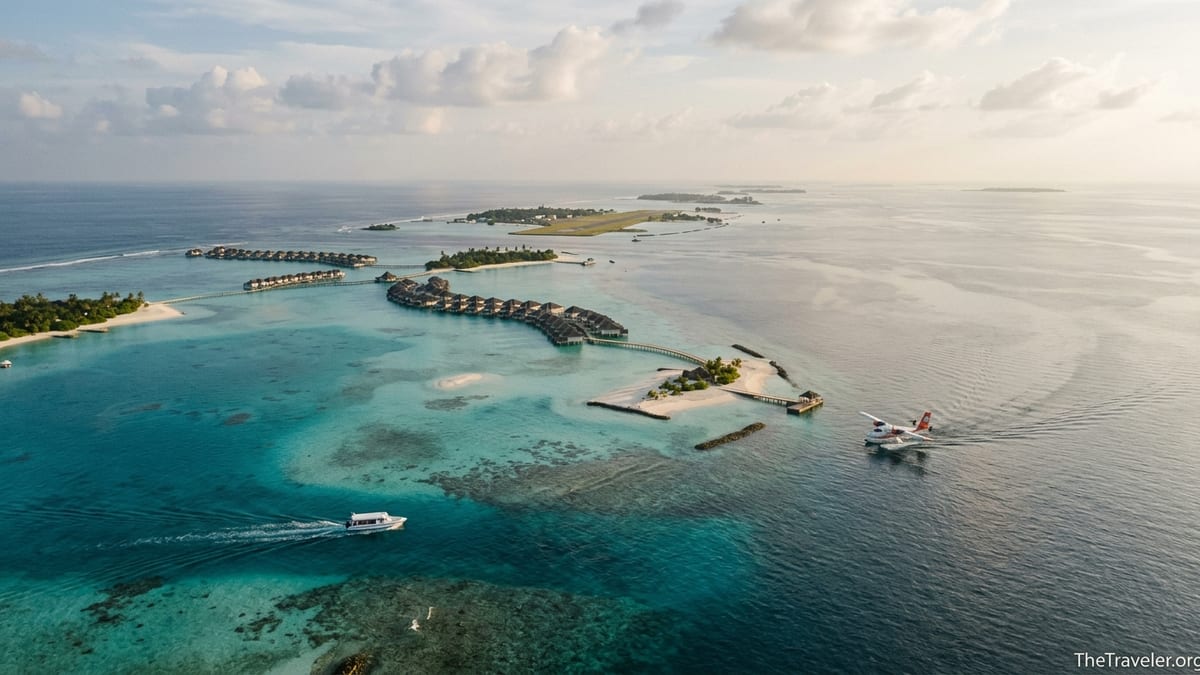
For many travellers, the image of a tiny red and white seaplane skimming over coral reefs is synonymous with the Maldives. Seaplanes come into their own for mid distance atolls beyond comfortable speedboat range. Resorts in Baa, the central and southern parts of Ari, Lhaviyani and many farther atolls rely primarily on seaplanes that link directly from Velana International Airport to small floating pontoons or island jetties.
Typical flight times vary by distance. Visitor information sources describe some of the shortest seaplane hops, to closer parts of Malé Atoll, taking only about 10 to 15 minutes, while the longest routes to distant atolls can approach 60 to 70 minutes. For popular atolls such as Ari and Baa, average seaplane flight times tend to sit in the 20 to 35 minute range. As one concrete example, Constance Moofushi in South Ari Atoll is usually reached by a seaplane journey of roughly 25 to 30 minutes. In Baa Atoll, high profile luxury resorts such as Soneva Fushi, Amilla Maldives and The Westin Maldives Miriandhoo similarly rely on seaplane transfers in that general time band.
There are two important trade offs to consider. First, seaplanes operate only in daylight, typically between early morning and late afternoon. If your international flight lands after the last practical seaplane departure time, your resort or tour operator will usually book you into an overnight stay near the airport and schedule the seaplane for the following morning. Second, seaplanes are priced higher than speedboats. Many resorts quote return seaplane transfers in the region of a few hundred US dollars per adult, with prices rising for outlying atolls and premium services.
Luggage rules are another key factor. A common allowance on Maldivian seaplane operators is around 20 kilograms of checked baggage plus about 5 kilograms of hand luggage per person, with excess charged per kilogram. The cabins are compact, and larger cabin baggage is often stowed in the rear rather than kept at your feet. If you plan to travel with dive gear, camera housings or large sports equipment, check both the airline and seaplane luggage rules in advance and be prepared for possible fees.
On the positive side, a seaplane flight is often a highlight of the trip. You fly at relatively low altitude over a patchwork of turquoise lagoons, reef rings and tiny sandbanks. For many travellers choosing resorts like Mirihi Island Resort or W Maldives in Ari Atoll, the seaplane ride is almost as much a part of the experience as the destination itself. Just remember that the scheduling is not like a traditional scheduled airline; seaplane operators group passengers going to nearby islands, which can mean some waiting time at the seaplane terminal after you check in.
Domestic Flight Atolls: Reaching the Remote Edges
Atolls that sit far from Malé, particularly in the far north and far south, are usually served by scheduled domestic flights. These flights are operated by local airlines that run regular routes from Velana International Airport to regional airports such as Dharavandhoo in Baa, Ifuru in Raa, Maafaru in Noonu, Kooddoo in Gaafu Alifu, Maavarulu in Gaafu Dhaalu and Gan in Addu Atoll, among others. From these small airports, resorts complete the journey with a short speedboat ride.
Domestic flights have a few advantages over seaplanes. They are generally able to operate into the evening and at night, using conventional runways and instrument flight rules. Airport information sources note that domestic flight times from Malé to nearer atolls can be about 25 to 30 minutes, stretching up to around 90 minutes to reach the southernmost atolls. Once you land, the onward speedboat leg can be as quick as 10 to 15 minutes if your resort is close, or up to around an hour for more distant islands within the same atoll.
For example, guests heading to resorts in Gaafu Dhaalu Atoll, such as Ayada Maldives, typically take a domestic flight from Malé to a regional airport like Kooddoo or Maavarulu, followed by a shorter speedboat ride. In the deep south, stays in Addu Atoll or the famous shark diving destination of Fuvahmulah involve a domestic flight of about one hour to Gan or Fuvahmulah airports, again with resort arranged transfers from there. Atolls like Haa Alif and Haa Dhaalu in the far north are similarly accessed via domestic flights to airports such as Hanimaadhoo.
The trade offs here center on time and logistics. Domestic flights add an extra check in step at the domestic terminal and may involve a layover between your international arrival and the domestic departure. The luggage allowance can be similar to or slightly more generous than seaplanes, but it is essential to check your tickets carefully, as some international airlines now interline with Maldivian carriers while others do not. When they do not, you may need to collect your baggage, clear customs, and then recheck it for the domestic sector.
For travellers willing to undertake the longer journey, these remote atolls offer quieter islands, more local culture and, in some cases, exceptional diving. However, they are not ideal if you are on a tight schedule or anxious about connections. Plan at least a buffer of several hours between your international arrival and any onward domestic flight, and consider spending your first or last night in the Malé area if your connecting times are tight.
Late Arrivals, Luggage and Weather: Practical Considerations
When comparing resorts and atolls, consider not only how you will reach the island, but also what might happen if your flight is delayed or your bags are heavy. The key constraint is daylight. Seaplanes cannot operate after dark and usually aim to land before sunset time for safety and visibility. If your international flight is scheduled to land after mid to late afternoon, there is a real possibility that you will not make the last seaplane of the day, especially if immigration queues are long or your flight is late.
Resorts that rely on seaplanes often handle this by booking you into an overnight hotel near the airport or at a nearby speedboat accessible resort, then moving you onward by seaplane the next morning. This arrangement is practical but can add an unplanned extra night to your budget. By contrast, many speedboat routes in North and South Malé Atoll can operate after dark, conditions permitting, which means that a heavily delayed evening flight may still allow you to reach your island the same night.
Luggage is another deciding factor. If you plan to travel light, with one suitcase and a small carry on per person, most seaplane and domestic flight rules will not trouble you. But if you are bringing dive gear, professional camera equipment or bulky sports items, the standard seaplane allowance of about 20 kilograms checked plus 5 kilograms hand luggage per person can be restrictive. Excess luggage fees are charged per kilogram and can add up quickly on seaplane routes. Domestic flights can also enforce weight limits, although they may offer options to pre purchase extra baggage at a lower rate.
Finally, consider weather and sea conditions. During the calmer months, often around January to April, long speedboat rides to more distant atolls like Vaavu or parts of Ari can be smooth and simple. During the wetter or windier months, a 90 minute crossing in a fast boat can feel long and bumpy. Seaplanes, while spectacular, are also sensitive to weather, and heavy rain or strong winds can delay flights. If you prefer to minimise motion and potential disruption, choosing a resort within 30 to 45 minutes by speedboat in the Malé atolls is typically the most forgiving option.
Matching Atolls and Transfers to Your Travel Style
The easiest way to think about transfer logistics is to match atoll regions and transfer types to your personal priorities. If convenience and predictability matter most, focus on North Malé and South Malé Atolls, where resorts like Kurumba Maldives, Meeru Island Resort & Spa, OBLU Xperience Ailafushi or a cluster of integrated options at CROSSROADS are all within around 15 to 45 minutes by speedboat. These work especially well for short breaks, families with young children or trips where you expect late evening arrivals.
If you want the postcard perfect seaplane experience without pushing to the extremes of distance and time, look toward central atolls such as Ari, Baa and Lhaviyani. Resorts such as Constance Moofushi and Mirihi in Ari Atoll, Soneva Fushi or Amilla in Baa Atoll, and Hurawalhi in Lhaviyani are all well established examples that pair seaplane access with classic lagoon and reef scenery. Here, allow generous arrival and departure buffers in case of seaplane scheduling changes, and keep baggage lean.
For divers or adventure travellers seeking more off the beaten path experiences, domestic flight atolls like Gaafu Dhaalu, Addu or Fuvahmulah can be the right choice. Resorts and guesthouses in these regions often attract guests who view the extra flight as a fair trade for quieter islands or world class shark encounters. However, the connection times, added cost and potentially longer total travel day mean these destinations are better suited to longer trips of a week or more, rather than a quick five night stay.
Whatever you choose, always verify transfer details before booking. Ask the resort or tour operator to confirm the transfer type, typical timing window, approximate travel time from landing to check in, current round trip price per adult and child, included baggage allowance and what happens in case of international flight delays. These questions can reveal whether a resort is a smooth fit for your arrival schedule or a potential source of first day stress.
The Takeaway
In the Maldives, transfer logistics are not a minor detail. They are central to how your holiday starts and ends. North and South Malé Atolls offer the easiest and most forgiving options, with speedboat transfers that can usually accommodate late flights and generous baggage. Nearby atolls like Vaavu and parts of Ari extend that reach for those willing to spend a bit longer at sea.
Seaplane focused atolls such as Ari, Baa and Lhaviyani deliver the iconic aerial views that many travellers dream of, at the cost of stricter daylight schedules and tighter luggage rules. The most remote atolls rely on domestic flights and additional speedboat legs, rewarding patient travellers with greater seclusion and distinctive diving or local culture.
By understanding how atoll geography links to transfer types, and by matching those realities to your budget, arrival time and travel style, you can narrow down resort choices long before you start comparing villas and meal plans. When you step out of Malé’s terminal into bright lagoon light, that preparation pays off in the smoothest possible journey to your chosen slice of sand.
FAQ
Q1. Which Maldives atolls are easiest to reach from Malé for first time visitors?
North Malé and South Malé Atolls are generally the easiest, with most resorts reached by speedboat in 10 to 45 minutes. These transfers are less affected by daylight restrictions and are usually simpler for late arrivals and families.
Q2. If my flight lands in the evening, should I avoid resorts that need seaplanes?
Yes, if you want to reach your resort the same night. Seaplanes operate only in daylight, so late afternoon or evening arrivals often require an overnight stay near the airport. In that case, choose a speedboat accessible resort in North or South Malé, or plan a deliberate overnight before a seaplane trip the next day.
Q3. Are speedboat transfers always cheaper than seaplanes?
In most cases they are, especially for nearby atolls. Round trip speedboat transfers to Malé area resorts are typically priced lower than seaplane transfers to mid distance atolls. Exact figures vary by resort and distance, so always request current prices when comparing options.
Q4. How long are typical seaplane flights to popular atolls like Ari or Baa?
Average seaplane flight times to resorts in Ari and Baa Atolls are usually around 20 to 35 minutes, depending on the exact island and routing on the day. The very longest routes in the country can approach an hour, while a few closer islands may be only 15 minutes away by seaplane.
Q5. What is the usual luggage allowance on Maldives seaplanes?
A common allowance is about 20 kilograms of checked baggage plus 5 kilograms of hand luggage per person. Anything above that is charged as excess on a per kilogram basis. Cabins are small, so large cabin bags may be stowed rather than kept at your feet.
Q6. When do domestic flights make more sense than seaplanes?
Domestic flights are the practical choice for far northern and southern atolls that sit well beyond seaplane range, and they are useful for travellers arriving later in the day since they can operate after dark. They also suit those who prefer a more conventional aircraft and runway operation.
Q7. Can I choose between speedboat and seaplane for the same resort?
Sometimes, but not always. A few resorts on the edge of speedboat range, especially in Ari or Vaavu, may offer both options at different prices. Many properties, however, are tied to one transfer type due to distance and contracts with specific operators, so always check before booking if you want flexibility.
Q8. How much waiting time should I plan for at Malé before my transfer?
Waiting times vary. For speedboats in the Malé atolls, many guests depart within an hour of clearing immigration, especially at busy resorts with frequent runs. For seaplanes and domestic flights, allow a buffer of at least two to three hours between your scheduled landing and onward departure to allow for baggage, check in and any schedule changes.
Q9. Is it worth staying one night near Malé before heading to a remote atoll?
For long haul travellers landing late in the day or those heading to distant atolls by seaplane or domestic flight, an overnight near Malé can be a smart choice. It reduces stress around connections, gives you time to adjust after your flight and can be combined with a short speedboat accessible resort stay.
Q10. How should transfer logistics influence my resort choice overall?
Start by matching transfer type to your arrival time, budget and comfort level. If you value simplicity and short travel days, prioritise speedboat accessible resorts in the Malé atolls. If the seaplane experience or remote seclusion is important to you, accept the higher cost and stricter timing in exchange for that setting. Let transfers be a key filter before you compare specific resorts.