


Arriving in the Maldives is unforgettable: a ring of tiny emerald islands, brilliant blue lagoons, and the sense that you are landing in the middle of the ocean. What many first-time visitors do not realize is that the most important part of the journey starts after you clear immigration. Your resort is usually on a different island, sometimes a different atoll, and getting there involves a carefully choreographed transfer by speedboat, seaplane, or domestic flight plus boat. Understanding how these options work will help you choose the right resort, control your costs, and avoid stressful surprises on arrival day.
How Maldives Transfers Work After You Land
Almost all international visitors arrive at Velana International Airport, just off the capital Malé. From the moment you step into the arrivals hall, your onward transfer is usually handled by your resort or guesthouse. In practice, that means a representative holding a sign with your hotel name, who escorts you either to the speedboat pier in front of the terminal, to the seaplane check in counters, or to the domestic terminal for a short local flight. You cannot normally buy a random ticket to a resort speedboat or seaplane at the airport; those services operate on closed contracts with specific hotels, and your accommodation will book you onto the correct service based on your flight details.
Most resorts require your international flight details several days in advance so they can schedule you into shared transfers. A typical pattern: if you land in Malé at 9:30 in the morning, check in, drop your bags, and wait for the next shared seaplane or speedboat departure, often leaving within one to two hours. For a resort in North Malé Atoll you might be on a speedboat within 30 minutes of clearing customs, whereas a seaplane resort in Raa, Baa, or Lhaviyani Atoll might involve waiting for a sufficient number of guests before the 40 minute flight takes off.
For domestic flights, the resort generally books you onto a scheduled service with local carriers such as Maldivian, Manta Air or Villa Air to one of the domestic airports like Dharavandhoo in Baa Atoll or Gan in Addu Atoll. From there, a resort speedboat will meet you for the final hop, which may take anywhere from 10 to 45 minutes depending on distance. This extra step extends travel time but opens up more remote atolls that do not have seaplane service or where the distances from Malé are too great for boats.
Because transfers are integral to reaching the property, they are often mandatory and charged separately from your room rate. Costs are typically quoted as round trip per person, and they can easily add hundreds or even thousands of dollars to the final bill, particularly for seaplane and domestic flight combinations. Planning with those numbers in mind is essential when comparing packages.
Speedboat Transfers: When Boats Make Sense
Speedboat transfers are the simplest option because they operate directly from the pier outside Velana International Airport. Resorts in North and South Malé Atolls, and a handful of closer islands in nearby atolls, rely on fast motor boats that cover the distance in 15 to 60 minutes. For example, a resort like Varu by Atmosphere in North Malé is typically around 40 minutes by shared speedboat, while many South Malé properties sit about 30 to 45 minutes from the airport, depending on sea conditions.
Costs vary widely. Budget friendly resorts and local island guesthouses close to Malé might package a shared speedboat round trip in the range of roughly 100 to 200 US dollars per person. Higher end brands, especially luxury names that operate their own large yacht style boats, can charge significantly more. There are documented cases of premium resorts in the North Malé area quoting over 600 dollars per adult for a round trip shared speedboat, and some ultra luxury properties with designer yachts charging close to 2,000 dollars for two adults for the return transfer. The distance and the style of vessel both influence the price as much as the brand.
Speedboats tend to run during both daylight and after dark, subject to weather. That is a key practical advantage if your international flight arrives late in the evening or after a delay. A resort in South Malé that you can reach by boat may still be able to pick you up at 22:00, while a seaplane resort would likely have to put you in a nearby airport hotel and fly you the next morning. On the other hand, the ride itself can be bumpy. Guests prone to seasickness often prefer to sit toward the back of the boat and may wish to take motion sickness tablets before departure, especially on longer crossings where the vessel leaves the calm lagoon and traverses open ocean channels.
For independent travelers staying on local islands rather than private resorts, scheduled speedboats run like sea buses on set timetables, with seats sold per person. Boats between Malé and popular islands such as Maafushi, Thulusdhoo, Gulhi, and Dhigurah typically cost a fraction of private resort transfers, though you must match your arrival and departure times to the boat schedule or stay a night in Malé or Hulhumalé if your flight arrives too late.
Seaplanes: Scenic, Spectacular and Pricey
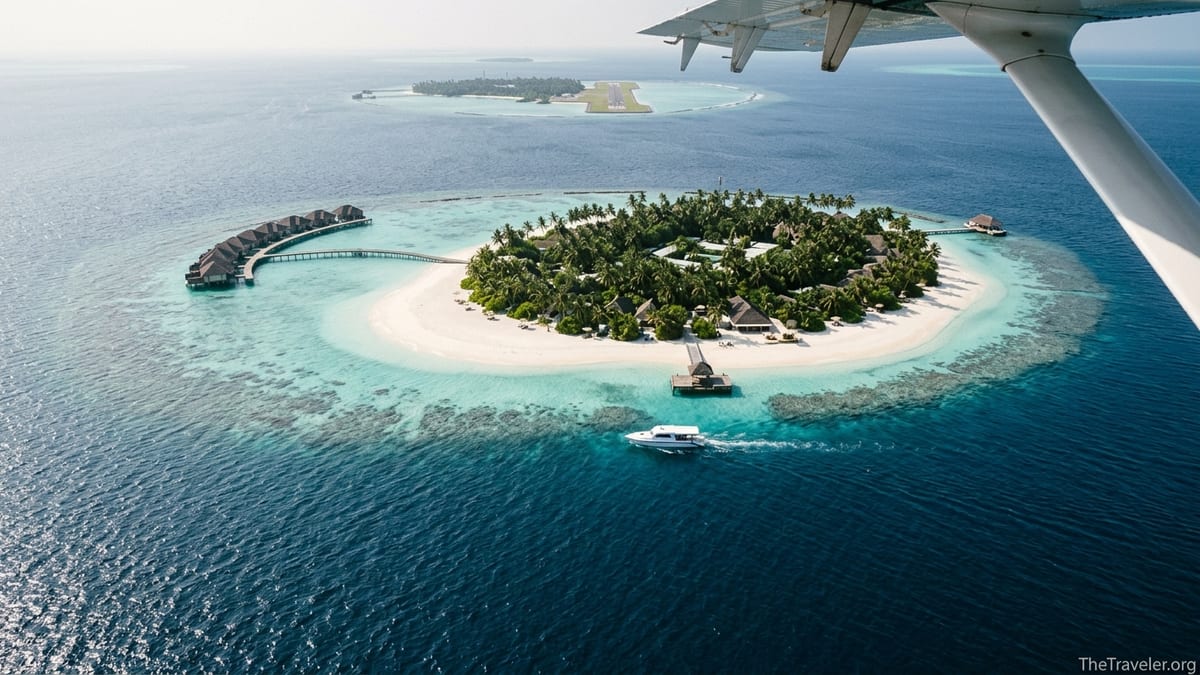
Seaplanes are the iconic Maldives image: tiny aircraft landing directly in the lagoon, skimming past overwater villas. Operators like Trans Maldivian Airways and Manta Air run fleets of twin otter seaplanes based at dedicated terminals near Velana International Airport. After check in, guests are usually transported by shuttle bus to the seaplane terminal and wait in an air conditioned lounge until their resort flight is called. From there, the plane lands as close as possible to the resort, either at its own seaplane platform or at a shared pontoon from which a smaller boat collects guests.
The main limitation is that seaplanes operate only in daylight hours, typically from around 6:00 to late afternoon. They need sufficient visibility to take off and land on open water. If your international flight lands after mid afternoon, many resorts will automatically place you in an overnight stop near the airport and schedule your seaplane for the next morning. Likewise, early morning international departures can require leaving your resort on the last seaplane of the previous day and spending a night near Malé. This has cost implications, both for extra hotel nights and for losing potential time in the resort.
Seaplanes are usually the most expensive transfer type on a per person basis. In mid range outer atoll resorts, round trip shared seaplane transfers commonly fall somewhere around 400 to 800 US dollars per adult, with children often discounted. For example, a Baa Atoll or Raa Atoll resort might quote around 450 to 650 dollars per adult for the return journey, while some ultra luxury properties in more remote northern or southern atolls can approach or exceed 900 dollars per adult. These rates are subject to fuel surcharges and local taxes, and they change periodically, so always cross check the latest figure in your booking confirmation.
Luggage restrictions are stricter than on long haul international flights. A standard allowance for seaplanes is typically 20 kilograms of checked baggage plus 5 kilograms of hand luggage per person, with a combined maximum weight of around 25 kilograms. Some operators and resorts mention a 25 kilogram total allowance that includes checked and cabin bags together. Excess baggage is normally allowed but charged per kilogram, often at a rate in the region of 5 US dollars per kilo, and it is always subject to space and weight constraints on the aircraft. In practice, large or heavy items may travel on a later flight if the seaplane is full, so keep essential medications, documents, and a change of clothes in your hand luggage.
Domestic Flights plus Boat: Reaching the Farther Atolls
For more distant atolls, particularly in the far south or areas that lack practical seaplane coverage, resorts rely on a combination of domestic flights and speedboat transfers. After landing in Malé you check in for a domestic flight with a local carrier and then travel on a turboprop aircraft such as an ATR to a regional airport. Examples commonly used by resorts include Dharavandhoo in Baa Atoll for nearby islands, Kooddoo in Gaafu Alif Atoll serving southern resorts, and Gan in Addu Atoll at the southern end of the country.
From these domestic hubs, resorts operate their own speedboats for the final leg. One resort might be a 10 minute boat ride from the airport, another 30 to 40 minutes across the atoll. In some cases, as with a resort located directly on an airport island, the transfer may be as simple as a buggy ride from the tiny terminal to the lobby. This arrangement can reduce costs compared with long seaplane hops and allows access during night hours, since domestic flights operate on normal schedules and boats can usually run after dark, provided the weather is acceptable.
Price wise, domestic flight plus boat combinations tend to sit between speedboats and seaplanes, although it depends on distance and brand. Typical round trip adult fares for domestic transfers hover in a broad range from around 350 to 550 US dollars per person. For instance, a resort in Gaafu Alif Atoll using a domestic flight to Kooddoo followed by a 25 minute speedboat may quote a return transfer of roughly 400 to 500 dollars per adult, while properties in the deep south accessed via Gan can be similar or slightly higher. Again, these figures are approximate and can change with fuel, taxes, and airline pricing.
Luggage allowances on domestic flights are usually similar to seaplanes, commonly allowing around 20 kilograms of checked baggage plus 5 kilograms of hand luggage as standard, with the option to purchase additional weight. The advantage over seaplanes is that domestic routes run in most weather and during evening hours, making them more reliable if your international flights do not line up neatly with daytime arrivals or if there are delays. The trade off is that you lose the seaplane’s scenic, low altitude views in favor of a more conventional, but often smoother and quieter, short flight.
Timing Your Arrival, Connections and Luggage
To avoid stress, it is important to match your international flight times to the transfer type your resort uses. If your chosen resort is reachable by speedboat, you have the most flexibility. Evening arrivals and late night landings can still connect to a shared or sometimes private boat, and you will usually be on the island in under an hour for nearby atolls. With seaplanes, you should target a landing in Malé no later than early afternoon, ideally between about 8:00 and 13:00, to allow time for immigration, baggage claim, and seaplane check in before the last flights leave the terminal.
On departure day, your resort schedules your boat or seaplane to get you back to Malé around three hours before your international flight, sometimes more during peak seasons. That means a seaplane resort might request you check out at 6:00 for a 7:00 seaplane in order to connect with a 10:30 international departure. For domestic flights, the resort and the airline work with a timetable similar to a short regional flight connection: expect to leave the resort at least four to five hours before your international takeoff if a domestic leg and boat transfer are involved.
Packing smart for Maldives transfers is as important as any fashion choice. Because seaplanes and domestic flights often have a 20 kilogram checked bag limit, travelers coming off long haul flights that allow 23 or 30 kilograms per suitcase can be caught off guard. Aim to keep your main checked bag within the lower limit, and distribute heavier items among traveling companions if possible. Keep valuables, medications, swimwear, sunscreen, and a light change of clothes in your carry on. That way, even if your checked bag is routed on a later seaplane due to weight constraints, you can still enjoy the beach as soon as you arrive.
If you are planning to bring special equipment such as dive gear, camera rigs, or surfing boards, contact your resort well in advance to confirm how these items are handled. Some seaplane operators place size limits on surfboards or may require them to travel by local cargo boat instead of the plane. Dive centers at the resort might already have the equipment you intend to lug from home, and renting locally may end up cheaper and easier than paying overweight and special handling fees.
What Transfers Really Cost and How to Budget
Transfer pricing in the Maldives can be confusing, especially because it is often quoted in small print, separate from room rates, and subject to change. As a rule of thumb, shared speedboat transfers to resorts within one or two atolls of Malé might run somewhere between about 100 and 300 US dollars per adult for a round trip, although high end brands can charge more for a premium vessel, on board refreshments, and private style service. Mid range resorts sometimes include these charges in promotional packages, so a deal that advertises “free transfers” may simply bundle that cost into a higher overall price.
Seaplane transfers tend to be significantly higher. For many popular seaplane only resorts in atolls like Baa, Lhaviyani, Raa, Noonu, or Dhaalu, it is common to see adult round trip seaplane charges in the range of roughly 450 to 800 dollars per person, including taxes. Family travelers should note that even with children’s discounts, the total can climb quickly. A family of four paying 500 dollars per adult and 300 dollars per child, for example, would add 1,600 dollars to the holiday bill before considering any extras. Ultra luxury resorts occasionally price even higher, in line with their overall positioning.
Domestic flight and speedboat combinations generally fall into a similar band, especially for routes to southern atolls. Round trip adult fares might start around the mid 300 dollar mark and climb into the 500 dollar range or beyond, depending on distance and whether the resort absorbs some of the cost. For remote all inclusive resorts, you may encounter promotions where domestic transfers are discounted or included for longer stays, which can make a big difference to the overall value of a 7 or 10 night holiday.
There are some ways to control or at least anticipate transfer costs. First, always ask your resort or travel advisor to quote the current total transfer price including all taxes and surcharges for your dates, in writing, before you book. Second, consider choosing a resort in North or South Malé Atoll that uses speedboat transfers if your budget is tight or if you are staying only three or four nights; the savings compared with seaplane islands can be substantial. Third, think about splitting your stay, combining a few nights on a well connected local island reached by public speedboat with a shorter stay at a more remote private resort. This lets you experience both environments while keeping the total cost in check.
Choosing a Resort Based on Accessibility
When comparing Maldives resorts, travelers often focus on villa photos, all inclusive menus, and snorkelling reviews, but transfer logistics should sit near the top of your checklist. Start by asking yourself how comfortable you are with long boat rides and small aircraft, and how much of your arrival and departure days you are willing to spend in transit. If you know you are prone to seasickness or nervous on small planes, that should influence which atoll and resort you select.
If you prefer minimal transit on arrival, focus on North and South Malé Atoll resorts that offer shared speedboat transfers. These islands are close enough to the airport that you can often be in your villa within an hour or two of landing, even with immigration queues. This is especially appealing for short breaks of three to five nights, where losing half a day each way to complex transfers has a larger impact on value. Couples on long weekend getaways from regional hubs like Dubai or Singapore often choose these accessible atolls to maximize time on the sand.
Travelers who crave remoteness and are willing to pay for it gravitate toward outer atoll resorts served by seaplane. These islands can feel exquisitely isolated, ringed by healthy reefs and far from the shipping traffic around Malé. The trade off is a more rigid schedule, potential overnight stops near the airport if your long haul flights do not align with daytime seaplane operations, and higher per person transfer charges. For honeymooners on once in a lifetime trips, the seaplane ride itself is often part of the dream, and the extra cost can feel justified.
For extended stays or more budget conscious travelers seeking good house reefs without the highest transfer bills, domestic flight plus boat resorts are worth a close look. Because domestic airlines operate on fixed schedules, these properties sometimes have more predictable transfer times, and the combination can work well when you originate from a city with convenient connections into Malé in the afternoon or evening. Some southern atoll resorts also benefit from being closer to sites like famous shark channels or manta points, which appeals to divers despite the added complexity of the journey.
The Takeaway
Transfers are the invisible backbone of a Maldives holiday. Whether you skim across the waves by speedboat, glide low over turquoise atolls in a seaplane, or hop between islands on a domestic flight, the logistics will shape how you experience your first and last days in paradise. Factoring in travel times, luggage limits, schedules, and real world costs allows you to choose a resort that fits not only your dream but also your comfort level and budget.
When planning, ask explicit questions about transfer type, approximate duration, latest and earliest operating times, luggage allowances, and total price including taxes. Use that information alongside room rates and meal plans when comparing options. With the right match between resort and transfer, your journey from airport runway to overwater villa can feel as seamless and serene as the lagoon that awaits you.
FAQ
Q1. Do I have to book Maldives transfers through my resort?
In almost all cases, yes. Resort speedboats, seaplanes and domestic flight connections are contracted services that only accept bookings via the hotel or your travel agent. Independent tickets are generally not sold for private resort transfers, although local island guesthouses may help you book public ferries and scheduled speedboats.
Q2. How much do Maldives transfers cost on average?
Shared speedboats to nearby atolls often cost roughly 100 to 300 US dollars per adult round trip, while seaplanes commonly run in the 450 to 800 dollar range. Domestic flight plus boat combinations typically fall somewhere in between, around 350 to 550 dollars or more per adult, depending on distance and resort category.
Q3. What are the luggage limits on seaplanes and domestic flights?
Most seaplane and domestic carriers allow about 20 kilograms of checked baggage plus 5 kilograms of hand luggage per person as standard. Extra weight is usually chargeable per kilogram and subject to aircraft capacity, so heavier bags may travel on a later flight if the plane is full.
Q4. Can seaplanes operate at night in the Maldives?
No. Seaplanes operate only in daylight for safety reasons, because they land and take off on open water and require good visibility. If your international flight arrives late afternoon or at night, you will typically stay near the airport and fly to your seaplane resort the next morning.
Q5. Are speedboat rides very rough?
Conditions vary by day and route. Short hops within protected lagoons are usually quite smooth, but longer crossings that pass through open ocean channels can be choppy. If you are prone to motion sickness, choose a resort closer to Malé, sit toward the back of the boat, and consider motion sickness medication.
Q6. Can I save money by using public ferries to reach a resort?
Public ferries and scheduled local speedboats are an excellent way to reach inhabited local islands with guesthouses, but private resort islands typically require their own contracted transfers. In most cases you cannot arrive at a resort on a public boat without prior arrangement, and the resort will still need to coordinate your final leg.
Q7. How early should I provide my flight details to the resort?
Ideally you should send your confirmed arrival and departure flights as soon as you book your stay, and at least several days before you travel. This allows the resort to schedule you into seaplane or domestic connections and helps ensure you are not left waiting for long periods at the airport.
Q8. What happens if my international flight is delayed?
If you are booked on a speedboat or domestic flight, the resort and transfer operator will usually try to adjust your connection. With seaplanes, a long delay that pushes you past daylight hours can mean staying overnight near the airport and flying the next morning. Travel insurance that covers missed connections is advisable.
Q9. Do children pay the same price for transfers as adults?
Policies vary by resort and operator. Many properties offer reduced transfer rates for children and sometimes free transfers for infants, but others charge close to adult prices. Always ask for child transfer costs for your specific dates before confirming your booking.
Q10. Can I bring surfboards or dive gear on Maldives transfers?
Often yes, but you must check in advance. Some seaplanes and domestic flights have size and weight limits for boards and large equipment, and may charge extra or require items to travel separately. Dive gear is usually permitted subject to weight allowances, while some resorts provide rentals that may be easier than transporting your own kit.