

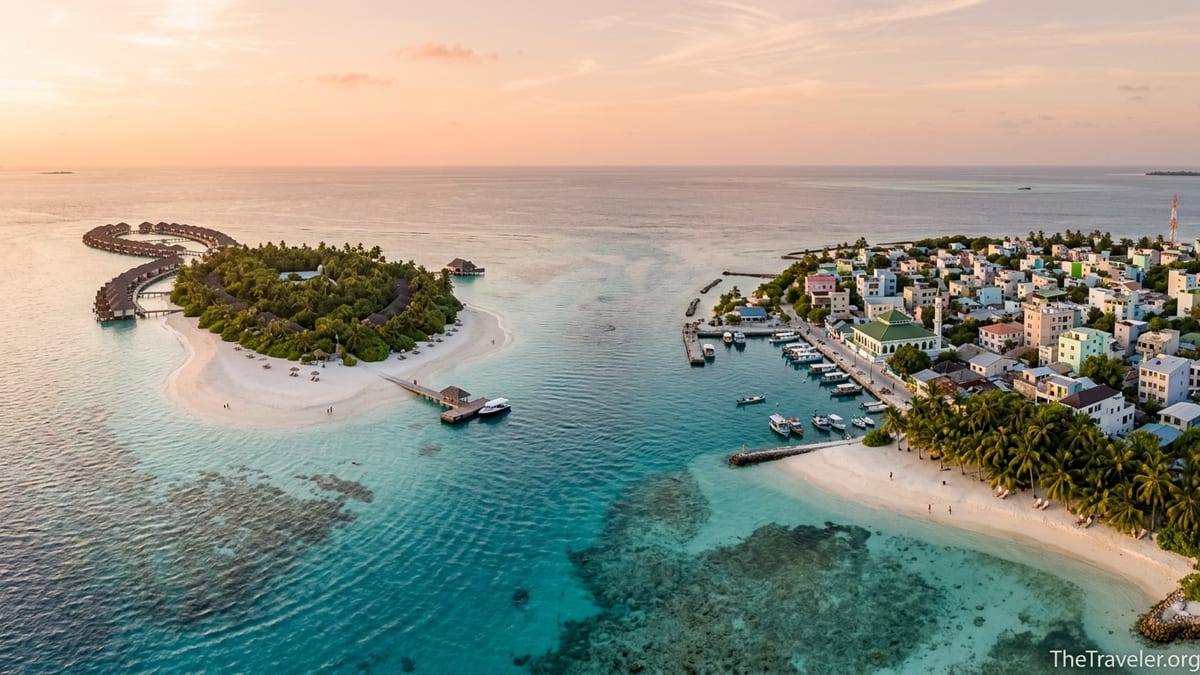
For decades, a Maldives holiday meant one thing: flying into Malé, boarding a boat or seaplane and vanishing onto a private resort island. Since local island guesthouses were legalised in 2009, a very different Maldives has opened up: lived-in islands with schools, mosques, corner shops and small hotels tucked behind palm trees. Today travellers planning a trip face a very specific choice: splash out on a self-contained resort, or stay on a local island and experience everyday Maldivian life. The right answer depends less on glossy photos and more on what you value in a holiday, from budget and privacy to culture, food and even your feelings about drinking alcohol.
Resort Island vs Local Island: The Big Picture
The Maldives still follows a dual tourism model. Resort islands are typically uninhabited sandbars leased to hotel companies, developed under a one-island-one-resort concept. Think of places like Bandos Maldives near Malé or LUX* South Ari Atoll, where every building, jetty and palm-fringed path belongs to a single property and only guests and staff are allowed on the island. Local islands, by contrast, are inhabited communities such as Maafushi in South Malé Atoll or Thoddoo and Ukulhas in Alif Alif Atoll, where Maldivians live year-round and tourism exists alongside island life.
This structural difference shapes everything. On a resort island, you are in a controlled environment designed for relaxation and spending, with restaurants, dive centres and kids’ clubs packaged together. On a local island, you stay in small guesthouses or boutique hotels and use shared community spaces: the harbourfront, the mosque square, the corner café serving sweet black tea. One model is built around privacy and convenience, the other around integration with a working island.
Because of that, resort islands tend to attract honeymooners, couples celebrating big anniversaries and families looking for hassle-free all-inclusive packages. Local islands appeal to budget-conscious travellers, long-stay digital nomads, divers and anyone who wants more direct contact with Maldivian culture, even if that means fewer frills and more self-organisation.
Costs and Value for Money
The cost gap between resort and local islands is stark. In 2026, many local-island guesthouses quote rates between about 60 and 180 US dollars per night for a clean double room with air conditioning and breakfast, especially on islands such as Maafushi, Fulidhoo and Thoddoo. Mid-range beachfront guesthouses with a small pool and on-site restaurant often sit around 120 to 150 dollars in high season. By contrast, entry-level rooms at established four-star resorts like Kuredu or Meeru frequently start around 250 to 300 dollars per night for two, while overwater villas at high-end properties such as Anantara Kihavah or Four Seasons Landaa Giraavaru can run from roughly 1,200 to well over 2,500 dollars per night.
Transfers add another layer. Public ferries between Malé and popular local islands can cost the equivalent of just a few dollars but run on limited schedules and take several hours. Shared speedboats arranged by guesthouses to islands like Ukulhas or Fulidhoo generally fall in the 30 to 80 dollar per person range depending on distance. Resort transfers are rarely that cheap: speedboat transfers to islands in the Malé atolls typically cost between 150 and 300 dollars per adult return, while seaplane transfers to more distant atolls can run 400 to 800 dollars per person.
On the ground, everyday expenses diverge too. On local islands, eating at simple cafés and local restaurants might cost 5 to 15 dollars per meal, and a generous seafood dinner in a tourist-oriented beach restaurant may come to 20 to 30 dollars per person. At many resort islands, main-course prices in à la carte restaurants often range from around 25 to 60 dollars, and buffet dinners or all-inclusive supplements quickly add hundreds of dollars to the bill over a week. For a seven-night stay for two, realistic total costs on a local island can come in below 4,000 dollars including flights, while a week at a five-star all-inclusive resort with seaplane transfers can easily exceed 10,000 dollars.
Value for money depends on how you travel. If you care most about having a large villa steps from a perfect lagoon, with gourmet dining and high staff-to-guest ratios, a well-chosen mid-range resort might offer strong value despite the higher sticker price. If you are comfortable with simpler rooms, eating in local cafés and arranging excursions through small operators, the same budget can buy two or three times as many days on a local island.
Beaches, Dress Codes and Alcohol Rules
The postcard images of the Maldives are real in both settings: powdery white sand and aquamarine water are standard across the country. The difference is how freely you can use the beach. On resort islands, the entire shoreline is geared towards tourists. You can walk, sunbathe and swim in standard beachwear or bikinis anywhere, apart from occasional dress requests in certain fine-dining restaurants. Sun loungers line the sand, and many villas have private or semi-private strips of beach or direct steps into the lagoon.
On local islands, the Maldives’ status as a Muslim country shapes what is appropriate. Villagers use the main beaches clothed, often fully covered, and swimming in bikinis is limited to designated “bikini beaches.” These are clearly signposted stretches, often screened by vegetation to maintain privacy and respect community norms. On Ukulhas and Thoddoo, for example, bikini beaches are broad and photogenic, with swings, hammocks and good snorkelling access, but you are expected to cover shoulders and knees when walking through the village to get there.
Alcohol is perhaps the single biggest practical difference. By law, inhabited islands do not sell alcohol in shops, cafés or guesthouses. Travellers staying on local islands who want to drink must either skip alcohol altogether, join a boat excursion to an offshore “floating bar” that holds a liquor licence, or book a day pass at a nearby resort to enjoy drinks there. On private resort islands, alcohol is freely available to guests in bars and restaurants and is often included in all-inclusive packages. This means sunset cocktails by the pool at properties like Bandos or LUX* South Ari are part of the daily rhythm, whereas on Maafushi or Fulidhoo many evenings revolve around mocktails, juices and coffee instead.
For some travellers, these restrictions barely matter. Others feel strongly that a beach holiday without a glass of wine at dinner does not feel complete. Being honest about your preferences here is crucial. If swimming in a bikini everywhere and having drinks on tap are non-negotiables, a resort island or at least a split stay including several resort nights will be far more comfortable.
Accommodation Quality, Food and Activities
Resort islands are built to be self-sufficient. Accommodation ranges from simple beach bungalows to multi-bedroom residences with private pools and butlers. Even at mid-range properties, you can expect landscaped grounds, multiple restaurants, a spa, a dive centre and organised activities from yoga classes to sunset cruises. At Anantara Kihavah, for example, guests can dine in an underwater restaurant, visit a substantial spa complex or join astronomy sessions at an on-island observatory, without ever leaving the island.
On local islands, accommodation is far more modest in scale but improving every year. Many guesthouses now offer modern, air-conditioned rooms with décor that would not look out of place in a city boutique hotel, and a handful on islands like Maafushi and Thoddoo have rooftop pools or small beach clubs. There are still simpler, more basic properties, and occasional issues such as limited soundproofing, smaller room sizes or less elaborate landscaping than resorts. The trade-off is intimacy: you might know the owner by name, be invited for a home-cooked meal or get personalised advice on which side of the island has the best sunset.
Food follows the same pattern. Resorts import much of their produce and can offer everything from sushi and wood-fired pizza to multi-course tasting menus, alongside buffets tailored to international tastes. Local islands tend to have a cluster of cafés serving Maldivian dishes such as mas huni (tuna and coconut with flatbread), short eats like deep-fried tuna snacks and simple grilled fish with rice. Tourist-focused beach restaurants might offer pasta, burgers and fresh seafood platters. Portions are usually generous and prices comparatively low, but vegetarians and those with strict dietary requirements may need to ask ahead and be flexible.
Activities are abundant in both settings but organised differently. At resorts, snorkelling excursions, fishing trips, dolphin cruises, yoga sessions and kids’ clubs are built into the daily programme and can be added to your bill with a signature. On local islands, guesthouses work with independent boat owners and guides to offer similar experiences. You might book a manta ray snorkelling trip with a small operator in Dharavandhoo or a sandbank picnic and night fishing excursion in Fulidhoo. Prices often come in noticeably lower than resort equivalents, though equipment and guiding standards can vary, so it pays to check reviews or rely on recommendations from your guesthouse.
Culture, Atmosphere and Privacy
Staying on a local island places you in the middle of Maldivian daily life. You will hear the call to prayer from the mosque, pass children in school uniforms on sandy lanes and see fishermen repairing nets at the harbour. Shops stock basics like biscuits, bottled drinks, flip-flops and phone credit. Parents push strollers along the waterfront in the evening breeze. Tourism is present, but life is not arranged solely around visitors. This is particularly noticeable on islands like Ukulhas that combine a strong environmental ethic with local livelihoods, or in larger islands such as Gan in Laamu Atoll, where guesthouses sit among residential streets and coconut groves.
For travellers who enjoy slow travel and people-watching, this is a major draw. You can chat with café owners about the monsoon seasons, attend a boduberu drum performance put on by local youth or watch traditional “fangi vinun” palm-thatch weaving. At the same time, you will need to adapt: dress more conservatively away from the bikini beach, keep noise down near mosques and be aware that Fridays and religious holidays can affect opening hours and ferry schedules.
Resort islands, by contrast, are designed as bubbles. Staff may be Maldivian, but they largely commute from nearby local islands or live in dedicated staff villages. Cultural programming is curated: a weekly Maldivian buffet with live drumming, perhaps a cooking class or short language lesson. Many guests appreciate this light-touch exposure without having to think about local etiquette or schedules. Privacy is deeply embedded: overwater villas at properties such as COMO Cocoa Island or adults-only resorts in the Lhaviyani and Raa atolls offer a level of seclusion that no local island can match, with private decks, pools and unobstructed ocean views.
The downside is that the experience can feel placeless. It is entirely possible to spend a week at a resort, interact mostly with international staff and fellow guests, and leave with only a surface sense of Maldivian culture. Some travellers find that comfortable; others wish they had seen more of how people actually live beyond the resort jetty.
Getting Around: Transfers and Logistics
Whichever island type you choose, you will almost certainly arrive via Malé’s Velana International Airport. From there, your onward journey diverges. Resorts typically arrange transfers automatically once you book, bundling you onto a private speedboat or seaplane that leaves from near the airport. This is convenient but inflexible and costly. Flights that land late at night can force an overnight stay near the airport because many seaplanes only operate in daylight. Some resorts close to Malé, such as Bandos or Kurumba, are accessible by 15 to 20 minute speedboat rides, which is attractive for short stays.
Local islands require a bit more planning, but the process is manageable with preparation. Public ferries connect Malé and many atolls on set schedules, usually once a day or a few times a week, and take several hours. They are extremely inexpensive but can be slow and susceptible to weather delays. For example, travellers heading to Maafushi often choose shared speedboats, which complete the journey in around 30 minutes but must be booked in advance. Guesthouses on islands like Fulidhoo, Ukulhas or Thoddoo will typically coordinate speedboat departures to match common flight arrival times.
Island hopping is easier within the local-island network than between resorts. You can, for instance, combine a few nights in Hulhumalé with stays in Fulidhoo and Thoddoo by piecing together ferries and speedboats at relatively low cost. Resort-to-resort transfers often mean backtracking through Malé or paying for private boat charters. For travellers dreaming of visiting several atolls on one trip, a chain of local islands or a mixed itinerary (guesthouse plus one resort) usually proves more efficient.
One logistical advantage of resorts is how little you need to think once you arrive: bills are consolidated, language is rarely an issue and reception can handle everything from snorkel gear to spa bookings. On local islands, you will be dealing with multiple small businesses for accommodation, excursions and meals, which brings more choice but also more moving parts. Using a reputable local agent or doing thorough research before you go reduces the risk of surprises.
Who Should Choose Which Experience?
Matching island type to traveller profile is often the key to a successful Maldives trip. Honeymooners and couples celebrating major milestones frequently gravitate toward resort islands because of the seamless service and built-in romance: think candlelit dinners on the beach, private plunge pools and staff who know your name by the second day. Parents with young children may also prefer resorts with kids’ clubs, shallow lagoons and medical staff on call, so they can relax without constantly planning the next meal or ferry.
On the other hand, independent travellers, long-stay visitors, backpackers and many divers find local islands ideal. A couple staying in a 100 dollar per night guesthouse on Thoddoo, eating in local cafés and booking shared excursions, can spend two or three weeks in the Maldives for the cost of a single week at a premium resort. They get the same turquoise water and coral reefs, along with the chance to build relationships with local residents, shop in family-run minimarts and see how a small island community functions.
There is also a growing trend toward hybrid itineraries. Travellers might book five nights in a guesthouse on Fulidhoo, focusing on manta ray or nurse shark excursions at relatively low prices, then finish with three nights at a resort reachable by speedboat from Malé to enjoy unlimited bikini freedom, alcohol service and a more luxurious room. This approach splits the budget, gives a taste of both “two Maldives” and reduces the risk of regret if you are unsure which environment you will prefer.
If you are highly sensitive to crowding and crave silence, it is worth thinking carefully. Some popular local islands have grown busy in recent years, with construction, motorbikes and day-trip boats. A low-density resort in a remote atoll can actually be quieter. Conversely, if you hate feeling confined or worry about “resort fever,” the ability to walk real streets, try different cafés and interact with residents on a local island will feel refreshing.
The Takeaway
Choosing between a Maldives resort island and a local island stay is less about which is objectively better and more about matching the experience to your expectations. Resorts deliver privacy, convenience and high levels of comfort, along with easy access to alcohol, relaxed dress codes and a curated menu of activities. They are expensive but straightforward: you pay for a carefully crafted bubble of tropical ease.
Local islands offer access to the same Indian Ocean beauty at a fraction of the accommodation cost, plus the chance to experience Maldivian culture from the inside. You trade all-inclusive buffets for harbourfront cafés, and butler service for friendly guesthouse hosts who may also be your snorkelling guides. Alcohol restrictions, dress codes and more modest infrastructure are part of the deal.
For many travellers, the smartest move is not to choose at all. A split stay, with several nights on a local island followed by a shorter burst of resort luxury, makes it possible to enjoy both authenticity and indulgence without blowing the budget. Whether you end up chatting to fishermen over sweet tea in a village café or sipping a sunset cocktail from an overwater deck, understanding the contrasts between these two sides of the Maldives will help you plan a trip that feels right for you.
FAQ
Q1. Can I drink alcohol on Maldivian local islands?
Alcohol is not sold on inhabited local islands, so guesthouses and cafés cannot serve it. To drink, you need to visit a resort on a day pass or join an excursion to an offshore floating bar where alcohol is allowed.
Q2. Are the beaches really better on resort islands than on local islands?
Both have beautiful white-sand beaches and clear water, but resort islands usually offer quieter, less crowded shores and full bikini freedom, while local islands restrict swimwear to designated bikini beaches.
Q3. How much cheaper is a local island stay compared with a resort?
As a rough guide, guesthouses on local islands can start around 60 to 180 US dollars per night, while many resorts begin at roughly 250 to 300 dollars and climb into the thousands for overwater villas and ultra-luxury brands.
Q4. Is it safe to stay on a local island in the Maldives?
Local islands that welcome tourists are generally considered safe, with low levels of petty crime. Normal travel common sense applies, such as securing valuables and respecting local customs, but most visitors report feeling very comfortable walking around.
Q5. Can I visit a resort for the day if I am staying on a local island?
Yes, many resorts near popular guesthouse islands sell day passes that include boat transfers, access to facilities and sometimes lunch or drinks, which is a common way for local-island guests to experience resort-style luxury.
Q6. Will I experience Maldivian culture if I stay at a resort island only?
You will get curated touches such as Maldivian nights, drum performances and some local staff interaction, but the experience is largely international. Staying on a local island offers a much deeper view of everyday Maldivian life.
Q7. What should I wear on a Maldivian local island?
In villages and public areas, both men and women should dress modestly, covering shoulders and at least to the knees. Bikinis and swim shorts are acceptable only on clearly marked bikini beaches or on boats during excursions.
Q8. Are activities like diving and snorkelling as good from local islands as from resorts?
Yes, the reefs and marine life are shared. Many local islands sit near excellent dive sites and house reefs, and guesthouses work with local dive centres and boat captains to offer trips similar to those arranged by resorts, often at lower prices.
Q9. Is a split stay between a guesthouse and a resort complicated to organise?
It usually is manageable with some planning. You can book your guesthouse and resort separately, then coordinate speedboat or domestic flight transfers so that you move from one to the other via Malé or a nearby atoll on a convenient day.
Q10. Which option is better for families with young children, resort or local island?
Resort islands tend to suit families better, thanks to kids’ clubs, shallow lagoons, medical facilities and flexible dining. Confident, budget-conscious families who do not need alcohol and are comfortable with modest dress codes may also enjoy the slower pace of a well-developed local island.