


Planning a first trip to the Maldives can feel overwhelming. More than 150 private island resorts stretch across 26 atolls, with speedboats, seaplanes, water villas, beach villas, meal plans and mysterious "house reefs" all competing for your attention. This guide unpacks how resort islands really work, what the different atolls offer and how to choose the right island for your travel style and budget.
How Private Resort Islands in the Maldives Work
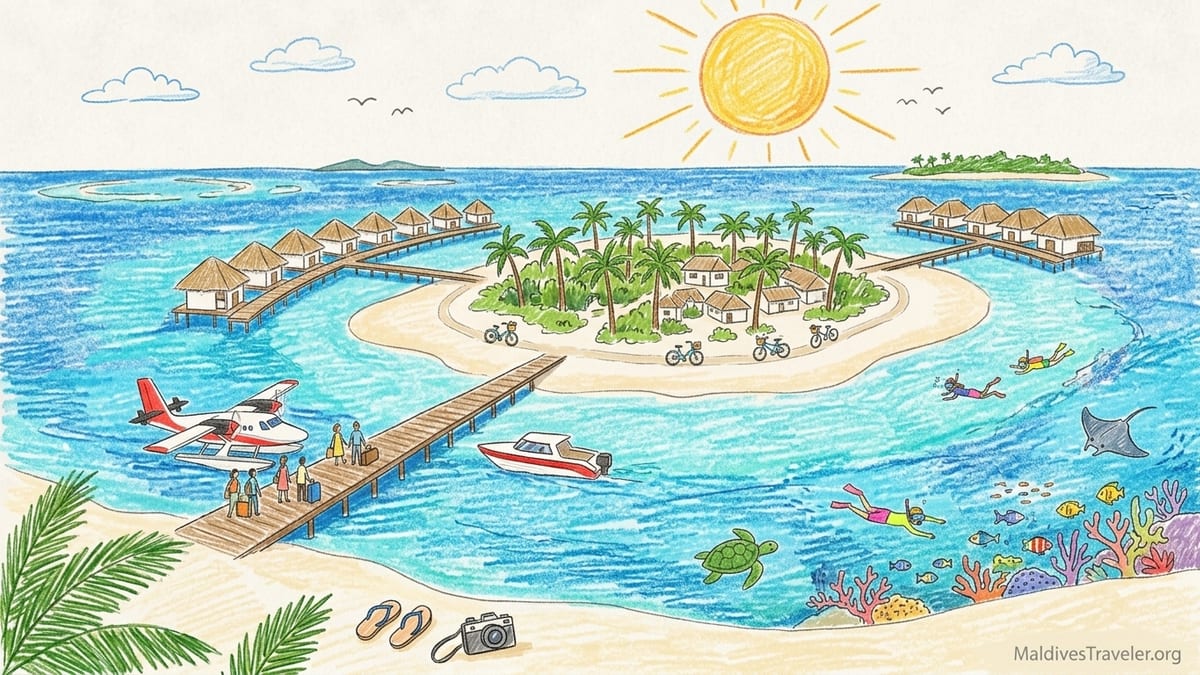
Most visitors to the Maldives stay on a private resort island. Each island typically hosts just one resort, with its own beaches, restaurants, dive center and staff village. Once your speedboat, seaplane or domestic flight drops you at the jetty, you are essentially in a self-contained world where everything from snorkeling to cocktails is operated by that one property.
Resorts range from small barefoot islands with 40 to 80 villas to sprawling developments with over 300 rooms and multiple islands linked by bridges. In North Malé Atoll, for example, One&Only Reethi Rah sits on a large island with long roads and bicycles, while Baros Maldives is a compact adults-focused hideaway where you can walk around the island in ten minutes. In more remote atolls such as Noonu or Dhaalu, ultra-luxury properties like Soneva Jani or Kandima Maldives occupy their own sizeable lagoons, often with dramatic overwater villa jetties extending far into the turquoise shallows.
Because you are captive to one resort, your choice of island has a direct impact on your experience and total trip cost. Nightly rates only tell part of the story. Airport transfers, compulsory meal plans, drink prices and paid excursions vary enormously between properties and atolls. For a realistic budget you need to look at the whole ecosystem of a resort: how you get there, what is included and what you will likely spend on food, drinks and activities once you arrive.
First-time visitors sometimes try to pick a resort by scrolling photos on social media, but many islands look similar in wide-angle drone shots. The smarter approach is to decide first which area of the Maldives suits you, then what kind of resort layout and vibe you want, and only then compare individual properties. The next sections walk through the main resort atolls and the practical choices that matter most.
Choosing Your Atoll: From Easy Access to Remote Escape
North and South Malé Atolls are the gateway to the country and home to the highest concentration of resorts. North Malé, where the international airport sits, is speedboat-only territory, with transfer times of roughly 20 to 45 minutes to islands such as Sheraton Maldives Full Moon, VARU by Atmosphere, Gili Lankanfushi and The Ritz-Carlton Fari Islands. South Malé is a touch quieter but similarly convenient, with resorts like Anantara Dhigu and OZEN Life Maadhoo typically reached in under an hour by speedboat.
Ari Atoll, split into North Ari (Alif Alif) and South Ari (Alif Dhaalu), is one of the most popular areas for first-timers who care about marine life. South Ari is known as the whale shark hotspot, with resorts such as Lux South Ari, Lily Beach or Vilamendhoo offering frequent excursions to spot them. Most Ari resorts require a seaplane transfer of around 25 to 35 minutes from Malé, which adds cost but also delivers that classic aerial view of lagoons and sandbars as you hop between islands.
Baa Atoll, a UNESCO Biosphere Reserve, is famous for manta rays aggregating at Hanifaru Bay during the southwest monsoon. Resorts like Soneva Fushi, Anantara Kihavah and Four Seasons Landaa Giraavaru attract serious snorkelers and divers, and many repeat guests. Nearby Lhaviyani and Raa Atolls offer a mix of well-established and newer properties, including Kuredu, Komandoo, Cora Cora Maldives and Kudafushi, often with strong house reefs and a quieter atmosphere than the busy Malé region.
Noonu, Dhaalu and the deep southern atolls appeal to travelers who value remoteness and are willing to accept longer transfers. In Noonu you find some of the country’s most exclusive island resorts, such as Velaa Private Island and Soneva Jani, while Dhaalu hosts contemporary, often larger-scale properties like Kandima Maldives and Niyama Private Islands. Further south, Laamu, Gaafu Alifu, Gaafu Dhaalu and Addu Atoll are reached via a domestic flight plus speedboat. These southern atolls see fewer visitors, which means less boat traffic, fewer day-trippers and a more “edge of the map” feeling, along with seasonal surfing and excellent diving.
Beach Villas vs Water Villas: What You Really Get
Water villas over a turquoise lagoon have become the signature image of the Maldives, but they are not automatically the best choice for every traveler. A beach villa sits on the island itself, set a few steps back from the sand behind dense tropical vegetation. You typically have direct beach access, more shaded outdoor space and often a larger private garden or courtyard, sometimes with a plunge pool or open-air bathroom.
Overwater villas stand on stilts above the lagoon, connected by a jetty. They usually offer direct ladder access to the sea, wide views and more privacy from passing guests. Entry-level water villas at well-known resorts such as Meeru Island, Kuramathi or Sun Siyam properties can feel surprisingly spacious, while top-tier villas like the overwater residences at Joali in Raa or Soneva Jani in Noonu include private pools, slides and multiple bedrooms.
From a practical standpoint, beach villas are often better for families with younger children, who may not be allowed in overwater villas for safety reasons or may find jetty distances tiring. They also appeal to guests who love walking straight out to a broad beach and who value shade and greenery. Water villas suit honeymooners and couples seeking privacy and that iconic “wake up over the ocean” feeling. Expect to pay more for water villas: at the same resort you might see an entry-level beach villa in shoulder season starting around a lower nightly rate per couple, with the equivalent water villa costing several hundred dollars more per night.
If budget is limited, a smart strategy is to split your stay. For example, spend three or four nights in a beach villa and two or three nights in a water villa at the same resort. Many properties in Ari and Baa atolls allow such mixes, letting you experience both perspectives without paying for a full week of premium overwater rates.
Meal Plans, Restaurants and What Food Really Costs
Meal plans are one of the most confusing parts of Maldives pricing. Most resorts offer a spectrum from bed-and-breakfast (breakfast only) through half board (breakfast and dinner), full board (three meals, usually without drinks) to all-inclusive (meals plus at least some drinks and activities). Some properties, such as Lily Beach in South Ari or VARU by Atmosphere in North Malé, run on a premium all-inclusive basis where almost all guests are on the same comprehensive plan.
Prices vary widely, but as a broad example, upgrading from breakfast only to half board at a mid-range resort might add roughly 60 to 100 US dollars per person per night. Moving to an all-inclusive plan can easily add 120 to 200 dollars per person per night or more, especially at five-star properties. On islands with several a la carte restaurants, these supplements buy you credits or set menus rather than unlimited choices, so reading the inclusions carefully is essential.
If you stay on breakfast only or half board, you need to budget for extras. A simple poolside lunch on a resort island commonly runs 25 to 40 dollars per main course before tax and service, and a glass of house wine may cost 10 to 18 dollars. Cocktails in premium resorts like those in Baa or Noonu often start in the high teens or low twenties. Over a week, a couple who occasionally orders cocktails, soft drinks and coffees can easily add more than a thousand dollars to their bill if they are not on some level of inclusive plan.
The number and style of restaurants also matter. Larger islands such as Sun Siyam Iru Fushi in Noonu or Kandima in Dhaalu can have ten or more outlets, ranging from Italian and Asian to teppanyaki or beach grills. Small boutique resorts may only have one main restaurant and a bar, which feels intimate but can start to feel repetitive on long stays. For food-focused travelers, or for anyone staying more than six or seven nights, an island with at least three or four distinct dining options tends to deliver a more satisfying experience.
House Reefs, Lagoon Quality and Resort Size
“House reef” refers to the coral reef system accessible directly from the resort’s beach or jetties. For snorkelers and divers, the quality and proximity of that reef can be a deciding factor. Classic house reef islands such as Vilamendhoo in South Ari, Kandolhu in North Ari or Mirihi in South Ari are often ringed by drop-offs where you can swim a short distance from shore and find vibrant coral, turtles and reef sharks without joining a boat trip.
Not every island has a strong house reef. Some, particularly in North and South Malé or in broader lagoons, are surrounded instead by expansive, shallow sand-bottomed lagoons ideal for paddling, paddle-boarding and beginner swimming. Resorts like LUX South Ari or Anantara Dhigu have wide turquoise lagoons that are visually spectacular and child-friendly but require boat rides to reach the best snorkeling. When comparing islands, consider whether you prioritize daily, independent reef access or a big, photogenic lagoon.
Resort size shapes the feel of your holiday. Small islands with under 80 villas, such as Baros in North Malé or Komandoo in Lhaviyani, tend to feel peaceful and personal, with staff quickly learning your preferences. Medium-sized resorts with around 100 to 200 villas, like Kuredu in Lhaviyani or Kuramathi in North Ari, feel more like villages, with multiple beaches and restaurant hubs. Very large properties with over 250 or 300 villas, particularly in Dhaalu or some parts of Ari, can support kids clubs, waterparks and long activity lists, but you may need bicycles or buggies to get around, and the atmosphere is busier.
Coral health has improved in some areas since major bleaching events in past years, but recovery is patchy and varies even within an atoll. For current conditions it is worth checking recent guest photos or speaking with a specialist travel advisor. As a rule of thumb, the further you travel from busy shipping and ferry lanes, and the more a resort invests in marine conservation, the better your chances of seeing healthier reefs and bigger marine life.
Transfers: Speedboat, Seaplane and Domestic Flights
Every resort markets its transfer as part of the experience, but for your schedule and budget the differences are significant. Resorts in North and South Malé atolls use speedboats from the main airport, Velana International. These transfers usually take between 15 and 60 minutes, operate throughout the day and into the evening, and are generally the least expensive option. For example, a return shared speedboat transfer at a mid-range resort near Malé might cost in the region of 150 to 250 dollars per adult, with discounted rates for children.
Seaplane transfers serve many of the resorts in Ari, Baa, Lhaviyani, Raa, Noonu and Dhaalu. Flights typically run during daylight hours only, roughly between early morning and late afternoon, and are weather dependent. They are scenic but expensive. As an illustration, return seaplane transfers can often fall in the 350 to 800 dollar range per adult depending on distance and contract rates, with children sometimes paying half or a reduced percentage. At luxury properties in remote atolls, transfer costs for a family of four can add several thousand dollars to the overall bill.
In the far south and at some central atolls, domestic flights replace or complement seaplanes. You fly on a local airline from Malé to an atoll airport such as Kooddoo or Gan, then complete the journey by speedboat. Travel time can exceed two or three hours in total, especially if you have to wait for connections, but domestic services operate into the evening and are less restricted by daylight. In price terms they sit somewhere between speedboats and seaplanes, though connecting boat legs and handling fees add to the final figure.
When comparing resorts, always check whether transfer costs are included in your package or added separately, and confirm the latest flight schedules if you arrive late at night. Choosing a speedboat-accessible resort in North or South Malé can save both money and potential overnight layovers, while choosing a seaplane or domestic-flight resort rewards you with greater seclusion and those unforgettable aerial views of the atoll chains.
Understanding Total Trip Cost and Value
Headline room rates rarely tell the full story of a Maldives holiday. To compare resorts realistically, add together four main components: accommodation, transfers, food and drink, and activities. A couple booking seven nights in a mid-range beach villa in shoulder season might see a base package of, for example, around 4,000 to 5,000 dollars including breakfast and speedboat transfers. At a more remote, seaplane-access resort in Baa or Noonu, similar dates and room categories might start much higher, before adding transfers and meal plan upgrades.
Transfers are the first hidden cost. A family of four flying to an Ari or Baa resort on a seaplane can easily spend 1,500 to 3,000 dollars on transfers alone. Then come meals and drinks. If you choose half board instead of all-inclusive, you may save on the upfront rate but spend more daily on lunches, drinks and extras. At many five-star resorts, a simple lunch for a family can quickly reach over 100 dollars once taxes and service charges are applied. Alcohol is heavily taxed in the Maldives, so wine and cocktails are consistently expensive compared to many other destinations.
Excursions and activities further shape the budget. A half-day snorkel trip might cost 60 to 100 dollars per person, while specialized experiences such as whale shark excursions in South Ari or manta safaris in Baa can cost more. Spa treatments, motorized water sports and private dining experiences all add to the bill. On the positive side, many resorts offer free use of kayaks, stand-up paddleboards, non-motorized water sports and basic snorkeling gear, which can fill many days without extra spending.
Finally, remember the Maldives green tax and service charges. A government “green tax” is applied per person per night, with different rates for resorts and guesthouses, and most properties also add service charge and GST to almost all transactions. The bottom line is that first-time visitors should allow a generous margin above the room rate and transfers. For many couples, a realistic all-in budget for a week at a four-star-plus speedboat resort, including transfers, meals, drinks and a few excursions, often ends up significantly higher than the simple package price suggests.
Matching Resorts to Different Types of Travelers
The best way to avoid disappointment is to match the island’s character to your own travel style. If you are a first-time honeymoon couple who wants simple logistics and plenty of privacy, a small to medium-sized resort in North Malé, South Malé or Ari with a mix of beach and water villas and at least three dining venues works well. Examples include Baros in North Malé or Kuramathi in North Ari, both of which offer romantic settings without requiring domestic flights.
Families with younger children often prioritize kids clubs, shallow lagoons and shorter transfer times. Islands like Meeru in North Malé, Sun Siyam Olhuveli in South Malé or Kuredu in Lhaviyani offer family-friendly facilities, multiple pools and varied restaurants. Some run generous kids-stay or kids-eat offers in certain seasons, which can make a significant difference to a family budget. Checking villa categories is essential, as some resorts have true two-bedroom units while others simply add extra beds into standard rooms.
Divers and serious snorkelers might accept longer seaplane hops in exchange for exceptional reefs. In this case, islands in Ari, Baa, Raa and some of the southern atolls come into their own. Vilamendhoo and Mirihi in South Ari, Kandolhu in North Ari, and smaller Baa properties near Hanifaru Bay are classic choices. For guests who dream of manta rays or whale sharks, choosing the right atoll and travel season is more important than choosing the flashiest villa design.
Travelers seeking maximum seclusion or ultra-luxury, and who are less price-sensitive, have a concentration of choices in Noonu, Baa and some southern atolls. Soneva Jani, Cheval Blanc Randheli, Velaa Private Island, Joali and Joali Being exemplify the high end of Maldivian hospitality, pairing large villas and private pools with bespoke experiences and cutting-edge wellness programs. Here, nightly rates and transfer costs are high, but in exchange guests enjoy space, privacy and service levels that are difficult to match elsewhere.
The Takeaway
The Maldives is more than a collection of pretty photos. It is a complex patchwork of atolls, transfer types, island sizes and resort concepts that can deliver anything from a simple barefoot beach break to a once-in-a-lifetime ultra-luxury escape. For first-time visitors, the key decisions are where to go, how far you are willing to travel from Malé, which villa type suits your needs, and how you want to handle food and drink costs.
North and South Malé atolls win on ease and value for travel time, Ari and Baa shine for marine life and classic seaplane glamour, while Lhaviyani, Raa, Noonu, Dhaalu and the southern atolls reward those chasing quieter beaches and fewer boats on the horizon. Beach villas and water villas each have their strengths, and meal plans can make or break your budget depending on how you like to eat and drink on holiday.
If you start with honest answers about your priorities, budget and tolerance for transfers, you can narrow down the hundreds of options to a short list of islands that truly fit. From there, the Maldives becomes less of an overwhelming puzzle and more of an exciting menu of possibilities, whether you are planning a short anniversary escape or a once-in-a-decade family celebration.
FAQ
Q1. Is a seaplane resort really worth the extra cost for a first Maldives trip?
For many first-timers the seaplane flight is a memorable highlight, with views of the atolls you cannot get any other way. It adds significant cost and limits you to daytime arrivals, so if budget or timing are tight a good speedboat-access resort in North or South Malé can still deliver a classic Maldives experience without the extra expense.
Q2. How many nights should I stay in the Maldives as a first-time visitor?
A stay of 6 to 8 nights works well for most first-time visitors, giving time to recover from jet lag, enjoy a mix of snorkeling, spa time and excursions and still have unstructured beach days. Shorter stays can feel rushed once you factor in transfers, especially if you choose a seaplane or domestic-flight resort.
Q3. Is it better to choose a beach villa or water villa for my first visit?
If you value privacy and direct access to the lagoon, a water villa is hard to beat, but it costs more and may be less suitable for younger children. Beach villas offer more shade, space and easy sand access, often at a lower rate. Many first-timers split their stay, starting in a beach villa and finishing with a few nights in a water villa.
Q4. Are all-inclusive plans good value in the Maldives?
At mid-range and upper-mid-range resorts, particularly those accessible by speedboat, well-designed all-inclusive or premium all-inclusive plans can offer good value if you plan to enjoy drinks and several excursions. At ultra-luxury properties where nightly rates and extras are very high, all-inclusive supplements may be steep, so it is important to compare what is actually included with what you realistically consume.
Q5. Which atoll should I choose if I want to see whale sharks or manta rays?
For whale sharks, South Ari Atoll is the most reliable area, with multiple resorts offering regular excursions. For manta rays, Baa Atoll, especially around Hanifaru Bay in season, is a strong choice. Some other atolls also have manta sites, but these two areas offer the most established, easy-access encounters for first-time visitors.
Q6. How far in advance should I book a Maldives resort?
For high season travel, particularly around December to March and major holidays, booking 9 to 12 months in advance gives the best choice of villas and rates. For shoulder seasons you might find good options 4 to 6 months out, but seaplane-heavy atolls and smaller boutique resorts can still fill early, especially for popular villa categories.
Q7. Are children allowed in overwater villas in the Maldives?
Policies vary by resort. Some properties do not allow children below a certain age in overwater villas for safety reasons, while others require signed waivers or insist on specific child-safety measures. If you are traveling with kids and want an overwater stay, confirm the resort’s rules before booking.
Q8. How much should I budget for food and drinks if I am not on all-inclusive?
This depends on your resort and habits, but as a broad guide a couple at a four-star-plus resort might easily spend several hundred dollars per day on lunches, drinks and occasional extras if only breakfast or half board is included. Checking sample menus and prices before you commit to a meal plan can help you decide which option is best for your style.
Q9. Is it easy to combine two different resorts in one Maldives trip?
Combining two resorts is possible and can be rewarding if planned carefully, for example pairing a speedboat-access island near Malé with a more remote seaplane resort. However, transfers between atolls can be time-consuming and expensive, often routing back through Malé, so it usually makes most sense when you have at least 9 to 10 nights in total.
Q10. Do I need to worry about dress codes or cultural rules on resort islands?
On private resort islands the atmosphere is relaxed, and swimwear is acceptable on beaches and by pools. Evening dress codes are usually smart casual, with cover-ups or T-shirts expected in restaurants and bars. Respectful clothing is required when passing through Malé or local islands, where knees and shoulders should be covered in public areas.