


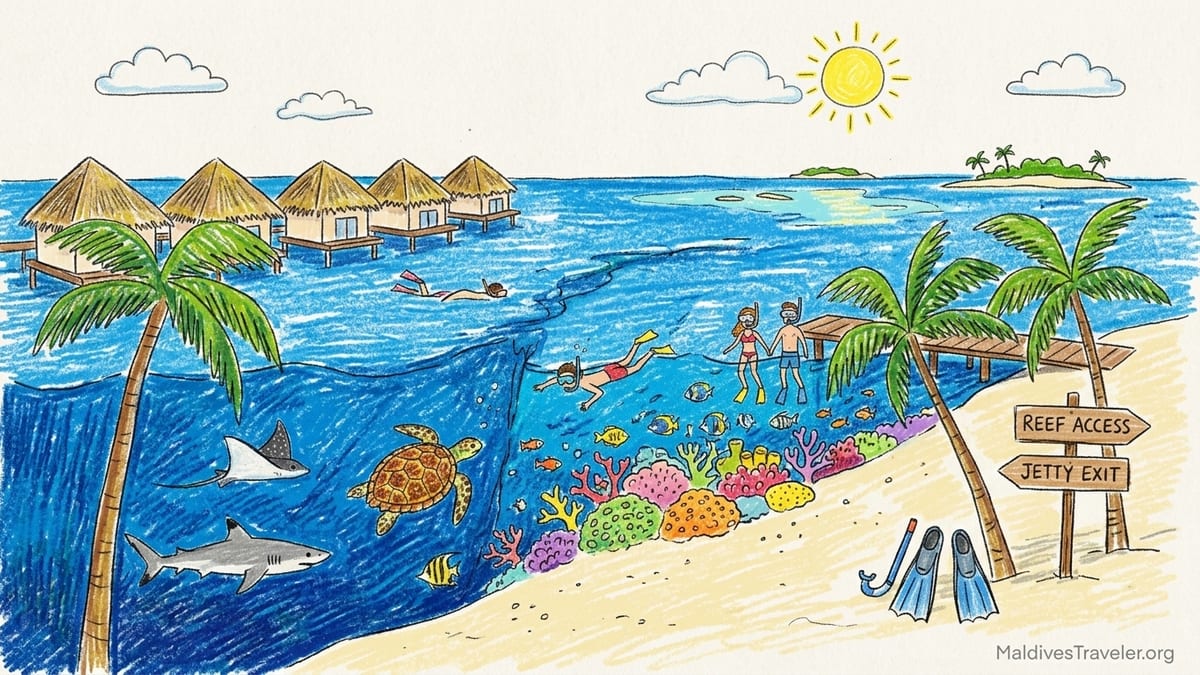
In the Maldives, those brochure-perfect turquoise lagoons can be misleading. A vast, pale-blue lagoon may look idyllic from your sun lounger, yet offer long surface swims over sand and seagrass before you reach any real coral. If your dream trip is built around snorkeling with turtles, reef sharks and rays, you need to choose your resort by house-reef quality and access, not by how glossy the villas look in marketing photos. Recent 2026 coverage and specialist snorkel rankings increasingly focus on this reef-first approach, highlighting a handful of resorts where you can drop into serious coral gardens just a few fin kicks from the beach.
What Actually Makes a Great Maldives House Reef
Not every Maldivian island has a strong house reef, and even among the good ones, the experience can be very different. Reef-first experts and 2026 snorkeling rankings consistently point to a few practical factors: how close the reef edge is to the beach, how many safe entry and exit points exist, how strong the currents are on a typical day, and how much living coral remains after past bleaching events. Resorts with the best scores usually sit on the outer edge of an atoll, where the reef wall drops quickly into deep water and attracts more big fish and passing rays.
For snorkelers, distance from sand to reef edge is critical. At some islands the hard-coral “wall” begins just 3 to 10 meters from the shore, so you simply wade out, put your face in the water and you are on the reef. At others, you might need to swim 80 to 150 meters across a shallow lagoon before you see anything more than sand and seagrass. That can be fine for confident swimmers, but it is a very different holiday for beginners or anyone not comfortable far from shore.
Entry points matter just as much. A strong house-reef resort will usually mark several easy entry and exit channels around the island, sometimes with ropes, buoys or ladders on the jetty. A few, such as the better North Malé and South Ari properties, design whole snorkeling “circuits” where you can drift with the prevailing current and exit at the next jetty. By contrast, a pretty lagoon resort with no real reef may push you toward paid boat trips if you want proper coral and bigger marine life.
When you factor in marine life, the standout resorts are those where guests still report daily encounters with green and hawksbill turtles, blacktip reef sharks cruising in the shallows, and regular rays on the drop-off. These species are present across much of the Maldives, but they are far easier to see at resorts with healthy coral structures and direct access to atoll-edge walls rather than enclosed, sandy lagoons.
North Malé Atoll: Classic Reefs Close to the Airport
North Malé Atoll remains one of the best choices if you want a strong house reef without a long domestic flight. Recent 2026 reef comparison tables rate several islands here as A or A plus for snorkeling quality, with reef edges typically 5 to 20 meters from the beach and shore entry considered easy for most swimmers. That proximity means you can put on a mask outside your villa and be over living coral in a few seconds, which is ideal for short, frequent swims rather than one big expedition each day.
Baros Maldives is a well-known benchmark in this area for house-reef fans. Independent reef-rating tools and guest reports frequently describe a near-continuous coral garden encircling the island, with the drop-off starting just beyond a narrow sandy shelf. The distance from the beach to the reef edge is often around 10 meters, and there are multiple signed entry channels. Currents here are usually mild to moderate, so many visitors simply snorkel clockwise around sections of the island, using jetties and ladders as exit points. Blacktip reef sharks, schooling fusiliers and regular turtle sightings are commonly mentioned.
Banyan Tree Vabbinfaru offers a slightly different profile. Its fringing reef sits roughly 100 meters from the beach across a shallow lagoon, which you can wade and fin across in calm weather. Once at the drop-off you find a healthy coral wall and good fish life, including rays on the sandy slopes and small reef sharks patrolling the edge. For less confident swimmers, that 100 meter crossing can feel like a commitment, so many guests here choose to join guided drift snorkels along the outer wall, entering from a jetty and exiting at another point where staff are waiting.
Grand Park Kodhipparu has recently started marketing its “Kodhipparu Reef Connection” concept, building entire stay packages around its house reef rather than spa menus or rooftop bars. Its reef, ranked among the top house reefs in recent regional awards, lies close enough to the overwater villas that guests can often see rays and reef fish directly below their terraces. Entry is usually from ladders off the jetties or from marked beach channels, and the resort positions staff and buoys to keep beginners out of the strongest current zones. You can still book speedboat trips to nearby manta points, but for everyday snorkeling, most guests stay on the house reef.
South Malé, Ari and Faafu: Reef-First All-Rounders
Moving south, a cluster of islands in South Malé, South Ari and Faafu atolls consistently appear in 2026 snorkeling rankings for their combination of easy access and varied marine life. These areas see reasonably strong currents in channels, but most resorts selected by snorkel specialists are located where the flow is manageable along the house reef, making them suitable for careful beginners under guidance and very rewarding for experienced swimmers.
COMO Cocoa Island in South Malé is often singled out as a textbook house-reef setup. The reef drop-off runs so close to the overwater villas that once you descend the villa steps and swim a few meters, you are hovering above a steep wall dotted with hard and soft corals. The resort’s brief lagoon section means the distance from deck to reef edge can be a matter of seconds, not minutes. Currents along the wall vary from gentle to moderate depending on tide, and staff routinely advise guests which direction to swim for an easy return. Snorkelers here regularly report reef sharks, turtles and occasional eagle rays.
In Faafu Atoll, Filitheyo is known among divers and snorkelers for having one of the stronger shore-entry house reefs in the country. A 2026 dive brochure notes seven designated entry and exit points around the island, allowing you to choose shorter or longer sections depending on your comfort level. The reef starts close to the beach in many spots, often within 10 to 15 meters, and quickly drops to 20 meters plus. Because there are multiple marker buoys and ladders, you rarely need to fight the current to get back; you simply exit at the next point. Guests commonly mention vibrant coral cover interspersed with sandy patches that attract rays, plus frequent turtle encounters.
South Ari Atoll adds another layer: pelagic life. Resorts such as Lily Beach and Conrad Rangali sit near channels known for whale sharks and manta rays, and their house reefs reflect the richness of the surrounding waters. While you should not expect a whale shark on the house reef itself, it is realistic to see several species of rays and large schools of fish on a normal snorkel. At these properties, the reef is usually reachable with a short swim from the beach or villa, but many guests still choose a paid boat excursion at least once to visit known whale shark aggregation areas further along the atoll edge.
Remote Southern Atolls: Spectacular Reefs, Stronger Currents
The deep south of the Maldives, particularly Gaafu Alifu and Gaafu Dhaalu atolls, is often described as a different country for snorkelers. Because these reef systems are more remote and less developed, specialist rankings and marine surveys regularly highlight them for having some of the healthiest coral cover in the nation. Resorts here are usually reached by domestic flight plus speedboat, but in return you get more dramatic underwater topography, steep walls and, in many cases, exceptional marine biodiversity right off the beach.
Park Hyatt Hadahaa in Gaafu Alifu is a prime example. Reef-focused comparison tools rate its wraparound house reef extremely highly, noting that living coral forms a near-continuous ring around the island. The reef starts just a few meters from shore in places and quickly drops into blue water. Guests report regular sightings of turtles and reef sharks on everyday swims, along with dense schools of reef fish. However, currents can be noticeably stronger here than around Malé, especially on the ocean-facing sides, so the resort guides guests toward particular sections depending on tide and wind.
Ayada Maldives in neighboring Gaafu Dhaalu also earns frequent praise for its 360 degree house reef. The reef can be accessed from multiple points along the beach and from jetties, and the edge is often within 10 to 20 meters of the shore. Here too, the drop-off is quite steep, which brings in more pelagic visitors such as eagle rays and larger groupers. For intermediate snorkelers comfortable with some current, it is possible to plan a long drift snorkel along one side of the island and exit at a down-current jetty. For beginners, guided sessions in the more sheltered corners of the reef are recommended, and those who prefer gentler conditions can always opt for a boat trip inside more protected lagoons.
Raffles Maldives and The Residence Maldives, both in the far south, are examples where resorts market not just one but two house reefs. Each island sits adjacent to separate reef structures, allowing guests to choose between leeward and windward sides according to conditions. Marine biologists working with these properties report multiple resident hawksbill turtles, blacktip reef sharks that patrol the channels in front of the villas and seasonal manta sightings nearby. Compared with central atolls, boat trips here tend to focus on drift snorkeling in wide channels with higher current, so a strong-reef house right at the resort is a major advantage on days when conditions are too lively for long excursions.
Value-Focused Reefs: Strong Coral Without Ultra-Luxury Prices
Travelers increasingly want reef quality without paying for superyacht marinas and Michelin-branded restaurants. Several mid-range and upper mid-range resorts have emerged in 2026 snorkel guides as smart buys: the rooms might be simpler, but the house reef is outstanding. Reviewers frequently mention islands such as Vilamendhoo, Reethi Beach and Eriyadu in this context, where guests describe being in the water with turtles and reef sharks on a daily basis despite paying far less than at flagship luxury brands.
Vilamendhoo, in South Ari Atoll, is frequently recommended in reef-first forums and recent social media trip reports. Visitors from late 2024 and 2025 describe an “excellent house reef” that circles much of the island, with access from several marked points along both the east and west sides. The reef edge is generally less than 20 meters from the beach in many spots, which makes it easy to dip in for 30 minutes before breakfast or at sunset. Because the island is larger than a boutique property, you also get a choice of more sheltered corners when wind or current pick up.
Reethi Beach in Baa Atoll is another value-focused favorite, with a walk-in reef that wraps around most of the island. Guest comments often mention being able to see turtles and rays along the shallows even before they reach the drop-off. The coral is not pristine everywhere, but several stretches remain vibrant, and because the island has multiple jetties and entry channels, you can adapt your route to your swimming ability. Paid boat trips to nearby manta cleaning stations are strongly recommended during peak season, but for everyday snorkeling, the house reef is sufficient for many visitors.
Eriyadu in North Malé is marketed more toward divers, yet its house reef is arguably one of the better-kept secrets for snorkelers on a relative budget. A dive operator brochure from late 2024 highlights five distinct entry and exit points around the island, each leading directly to coral slopes rich in rays and turtles. The reef lies close to shore, and while accommodation and facilities are simpler than the ultra-luxury names, the underwater experience compares surprisingly well. For travelers willing to trade designer interiors for easy daily encounters with reef life, these islands represent strong value.
Currents, Coral Condition and Beginner Suitability
Currents are a defining feature of Maldivian snorkeling. The same water movement that brings nutrients and pelagic visitors can also make some house reefs challenging for first timers. In general, islands on the very edge of atolls, or beside wide channels, experience stronger flows, especially around changing tides. Those currents often run parallel to the reef wall, which can be ideal for drift snorkeling but intimidating if you are not comfortable in open water. Before booking, beginners should look for resorts that are routinely described as “gentle” or “sheltered” in recent 2025 and 2026 reviews rather than simply “dramatic” or “full of current.”
Coral condition is another essential filter. The Maldives has experienced several bleaching events over the past decade, and while many reefs are recovering, not every resort has good live coral cover. Specialist 2026 house-reef rankings now separate “good fish life over mostly dead coral” from “living coral gardens,” and this distinction matters for the feel of your snorkel. Resorts in more remote atolls such as Gaafu Alifu, Laamu and Haa Alifu tend to score particularly well for living coral, while some near-airport islands rely more on fish life and occasional coral patches.
For beginners, house reefs where the drop-off is within 10 to 30 meters of the beach, currents are usually mild and several marked entry points exist are the best bets. North Malé stalwarts like Baros, along with islands such as Dhigali in Raa Atoll, match this profile. Dhigali’s own reef fact sheet notes that the reef begins just 3 to 4 meters from the beach in many sections and then slopes down to 20 to 25 meters, allowing novices to stay over the top of the coral in very shallow water while more confident swimmers explore the edge.
For very nervous swimmers or families with small children, it may still be worth paying for occasional boat trips to sheltered lagoon reefs, even if the resort has a solid house reef. Many properties pair a gentle inner-lagoon nursery area with a more energetic outer wall, which allows guests to build confidence before progressing to the full reef. When reviewing recent guest comments, pay attention not only to mentions of turtles and sharks, but also to whether people describe feeling “safe” and “comfortable” in the water.
When Paid Boat Trips Are Still Worth It
A strong house reef reduces your dependence on paid excursions, but it rarely replaces them entirely. Even at resorts with top-tier reefs, boat trips can unlock different species or underwater landscapes that you will not see directly off the beach. For example, South Ari islands with good house reefs still organize whale shark safaris to channel edges where these giants congregate. You might spend most of your holiday snorkeling the house reef for free, then budget for one or two targeted boat days for bucket-list encounters.
In Baa Atoll, a resort such as Reethi Beach or a higher-end neighbor might give you excellent everyday house-reef snorkeling, yet the main manta ray show occurs at famous offshore cleaning stations. Here, house reef and boat trips work together: you use the house reef for daily swims and fish life, then pay for a few well-timed excursions when the mantas are in season. Because these trips are weather and tide dependent, talking with the resort’s marine biologist on arrival is often the best way to schedule them.
Meanwhile, islands located inside more enclosed lagoons, even if they advertise some coral, may essentially require boat trips for serious snorkeling. Large, sandbar-style islands with wide turquoise shallows and only scattered coral heads can be beautiful for swimming but underwhelming if you are expecting walls of coral. Some luxury brands with weak house reefs focus instead on private trips to nearby channels and outer atoll walls, which can still provide excellent snorkeling, but the total cost of your stay climbs quickly when you add multiple excursions at typical Maldivian prices.
As a planning rule, if you choose an island that 2026 reef guides rate A or A plus for snorkeling, you can reasonably plan to spend most days on the house reef and budget for one to three boat trips over a week. If your chosen resort is rated closer to C or “fishy lagoon,” factor in the cost of several excursions per week just to reach coral-rich areas, and consider whether a reef-first island might offer better overall value even if the nightly room rate is higher.
The Takeaway
For a snorkeling-focused Maldives trip in 2026, the quality of the house reef should be your starting point, not an afterthought. A vast, light-blue lagoon photographed from a drone does not guarantee good coral or daily marine encounters. Instead, look for islands where recent, reef-specific comparisons confirm that the reef edge sits close to the beach or villa, multiple easy entry points are marked and guests consistently report turtles, reef sharks and rays right off the shore.
Outer-atoll and channel-edge resorts in North and South Malé, Ari, Baa, Faafu and the deep southern atolls offer some of the strongest combinations of accessibility and marine life. Names like Baros, COMO Cocoa Island, Vilamendhoo, Filitheyo, Reethi Beach, Dhigali and a handful of southern properties such as Park Hyatt Hadahaa and Ayada appear again and again in dedicated 2026 snorkeling rankings for good reason. They let you slide into serious reef environments within a few fin kicks of your room, often without needing a boat.
Ultimately, the right island depends on your confidence in the water and your appetite for current. Beginners and families may prefer near-airport islands with gentle slopes and clearly marked channels, while experienced snorkelers might gravitate toward remote southern reefs with steeper walls and more dramatic drift potential. Either way, by putting reef quality, entry points and marine life at the center of your resort search, you dramatically increase the chances that your Maldives holiday will live up to the underwater images that first inspired you to go.
FAQ
Q1. How close should the house reef be to the beach for easy snorkeling?
For most snorkelers, a reef edge within 10 to 30 meters of the beach or villa is ideal. This keeps surface swims short, allows quick sessions between meals and makes it easier to exit if you get tired or conditions change.
Q2. Do I need to be a strong swimmer to enjoy a Maldives house reef?
You do not need to be an athlete, but you should be comfortable floating in open water, using fins and a mask, and dealing with mild current. Beginners should choose islands known for gentle conditions and multiple exit points, and consider starting with guided snorkels from the resort’s watersports or dive center.
Q3. Are currents at Maldives house reefs dangerous for snorkelers?
Currents vary widely. On many popular house reefs they are mild most of the time and run parallel to the reef, which can be great for drift snorkeling. Around channels and outer atoll corners they can be strong. Checking tide information, following resort guidance and staying within marked areas significantly reduces risk.
Q4. Can I see turtles and reef sharks directly from the shore at good house-reef resorts?
Yes, at the better house-reef islands it is common to see hawksbill or green turtles grazing on the reef and small blacktip reef sharks cruising the shallows on daily snorkels. Larger sharks are more often encountered on deeper dives and channel drifts rather than on the immediate house reef.
Q5. How many entry points should a good house reef have?
There is no fixed number, but three or more clearly marked entry and exit points around the island make route planning much easier. Some dedicated snorkel resorts have five to seven signed channels, ladders or jetties so you can adapt your swim to current and your own stamina.
Q6. Are remote southern atolls always better for snorkeling than near-airport islands?
Remote southern atolls often have healthier coral and more dramatic walls, but they can also have stronger currents and require extra travel time and cost. Several near-airport islands still have excellent house reefs, so for many travelers the best choice is a strong reef in North or South Malé that is easy to reach.
Q7. Will I still need paid boat trips if my resort has a top-rated house reef?
Not for everyday snorkeling, but most guests still book one or two excursions during a week-long stay, for example to see whale sharks in South Ari or manta rays at specific cleaning stations. A great house reef reduces how often you feel compelled to pay for trips but does not make them obsolete.
Q8. How can I tell if a resort’s lagoon pictures hide a weak reef?
Look beyond marketing photos and read recent reef-specific reviews and 2026 snorkeling rankings. If guests mention long swims over sand to reach coral or say that “boat trips are essential” for good snorkeling, the lagoon is probably prettier than it is fishy.
Q9. Is renting snorkeling gear from the resort good enough, or should I bring my own?
Most resorts rent masks, snorkels and fins, but bringing your own well-fitting mask and snorkel is strongly recommended. A good fit reduces leaks and fogging, which makes long reef sessions more enjoyable and safer, especially where currents are present.
Q10. Are children able to enjoy house-reef snorkeling in the Maldives?
Yes, many families snorkel together on suitable house reefs. Choose islands with sheltered sections, shallow coral tops and gentle currents, and use buoyancy aids such as vests or noodles. Starting with short, supervised sessions near easy exit points helps build confidence.