


For many first-time visitors, the Maldives means overwater villas on remote private islands. Yet some of the country’s most rewarding travel happens on local islands, where Maldivians actually live. Here, guesthouses sit beside family homes, mosque calls mix with the sound of surf, and prices are closer to Southeast Asia than to five-star luxury. This guide explains what Maldivian local islands are, how they differ from resort islands, and how to decide between popular spots such as Maafushi, Thulusdhoo, Fulidhoo, Rasdhoo, Ukulhas, Thoddoo, Dhigurah and Dharavandhoo.
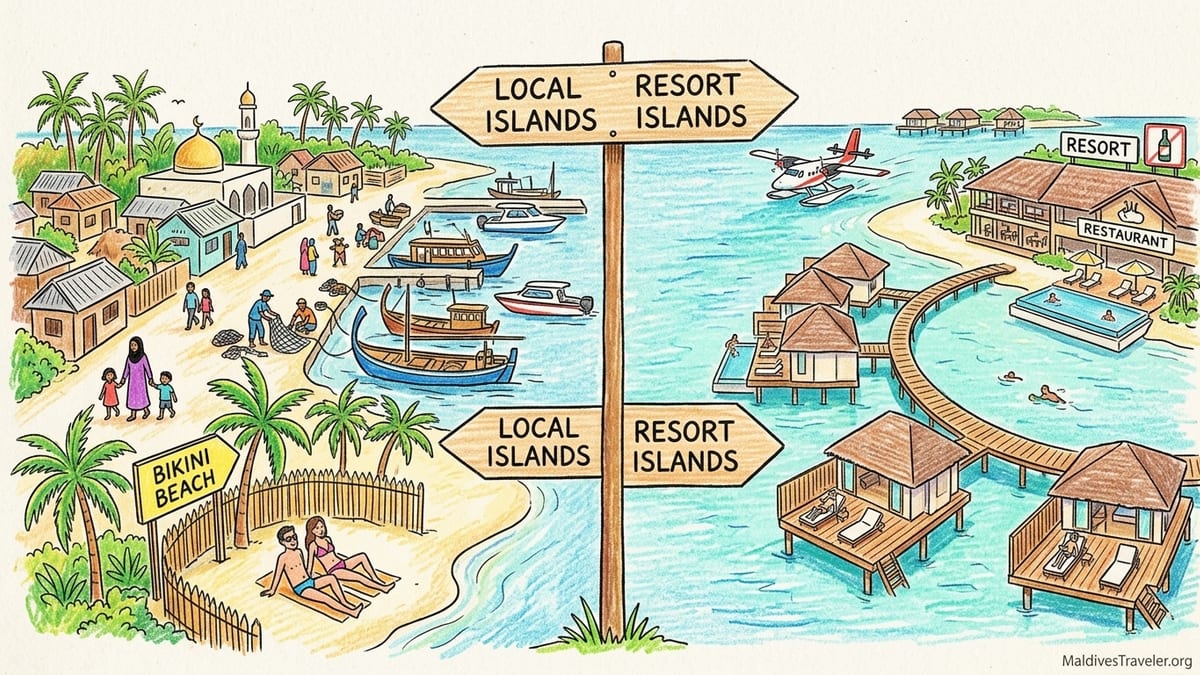
What Local Islands Are, And How They Differ From Resort Islands
In Maldivian tourism, there are two very different worlds: private resort islands and inhabited local islands. A resort island is usually leased to a single hotel company that controls the entire island. Guests arrive by speedboat or seaplane and spend their stay in a self-contained bubble of restaurants, spas and water villas. You can wear what you like, drink alcohol freely and pay almost everything in US dollars. By contrast, a local island is an inhabited island where Maldivian families live and work, with schools, mosques, small shops and local council offices. Tourism happens through independently run guesthouses and small hotels rather than a single resort operator.
The experience on a local island feels closer to visiting a village in Thailand or Sri Lanka than to staying in an all-inclusive resort. Instead of golf carts and butlers, expect sandy streets, children cycling to school and fishermen mending nets by the harbor. Guesthouses on many local islands typically cost somewhere in the range of 50 to 150 US dollars per night for a good double room with air-conditioning and breakfast, depending on season and island, which is much lower than the nightly rates on many resort islands. Meals at simple cafés known as hotels or tea shops might cost roughly the same as a meal in a mid-range restaurant in a Southeast Asian beach town, which can make a week on a local island comparable in cost to a long weekend in a resort.
There are also important cultural and legal differences. The Maldives is a Muslim country, and on local islands visitors are expected to follow local norms. Alcohol is not sold on land, and swimwear is restricted to designated "bikini beaches" or resort excursions. You will hear the call to prayer from mosques throughout the day, and Friday follows a different rhythm, with some shops and government services closing for longer prayer times. Many travelers find that this mix of tourism and daily life is exactly the appeal of a local island stay, especially if it is their first introduction to the Maldives beyond glossy resort brochures.
For a first-time visitor, it often helps to think of resort islands as controlled, predictable luxury experiences and local islands as independent travel bases that require a bit more planning but reward you with lower costs and more local interaction. Many visitors now combine both: a few nights in a resort for the iconic overwater-villa photo, and the rest of the trip on a local island for snorkeling, culture and value.
Key Local Islands At A Glance
While there are dozens of inhabited islands open to visitors, a handful have emerged as the most practical starting points for first-timers. Maafushi in South Malé Atoll is the original hub of local-island tourism, with the highest density of guesthouses, a busy excursion scene and easy transfers from the capital. It is the right fit if you want a social atmosphere, a wide choice of cafés and tour desks on every corner, and do not mind crowds or a built-up feel.
Thulusdhoo in North Malé Atoll has built a clear identity as a surf island, thanks to famous reef breaks nearby and a long-standing link to the Coca-Cola bottling plant that once made it a regional hub. The vibe is more laid-back than Maafushi, with surfboards leaning against guesthouse walls and cafés catering to long-stay surfers working remotely between sessions. If you want consistent waves and a community of surfers, Thulusdhoo is an obvious choice.
Further out, Fulidhoo in Vaavu Atoll is a small island known for clear water, a compact village and easy access to channels where reef sharks and rays are often seen on snorkeling trips. Rasdhoo and Ukulhas in Alif Alif Atoll are favorites for combining a village feel with good house reefs, meaning you can snorkel just off the beach and see plenty of marine life. Thoddoo stands out as the farming island of the Maldives, with fields of watermelons and papayas behind the beaches, while Dhigurah in South Ari Atoll is long, thin and close to the whale shark corridor that draws marine-life enthusiasts. Dharavandhoo in Baa Atoll is the gateway to world-famous Hanifaru Bay, where manta rays gather seasonally, and has its own domestic airport, making it a practical base for manta-focused trips.
Each of these islands has a distinct personality. A traveler who wants beach life plus nightlife will lean toward Maafushi. Someone who wants manta rays and is happy to plan around a domestic flight might choose Dharavandhoo. A couple looking for long walks on a quiet sandspit and the chance to see whale sharks has strong reasons to head for Dhigurah. Understanding these differences before you book can save you from landing on an island that does not match your expectations.
Guesthouses, Bikini Beaches and What Daily Life Looks Like
On local islands, accommodation almost always means guesthouses or small hotels. These range from very simple rooms above a family home to modern, boutique-style properties with rooftop terraces and plunge pools. In Maafushi, for example, you will find multi-story guesthouses with around 20 to 30 rooms, elevators and on-site restaurants, catering to the steady flow of budget-conscious visitors. On quieter islands like Fulidhoo or Thoddoo, typical guesthouses might have 6 to 12 rooms, run by a local family who can organize snorkeling, sandbank trips and meals on request.
Room facilities are usually comfortable rather than luxurious: expect air-conditioning, private bathrooms, hot water and Wi-Fi in most mid-range places. Some guesthouses include a simple breakfast of fruit, eggs and Maldivian short eats, while others offer half-board or full-board packages that bundle in dinner. On islands such as Ukulhas or Rasdhoo, several guesthouses have invested in smart, minimalist rooms and well-designed courtyards to attract couples willing to pay a bit more for comfort without jumping to resort-level prices.
Bikini beaches are an important concept. Because local islands follow conservative dress norms, there is usually a specific stretch of beach where tourists can wear standard swimwear such as bikinis and swim shorts. This part of the beach is often screened with palm fencing or vegetation. On Maafushi, the main bikini beach is at the northern end of the island, lined with sun loungers and with guesthouses directly behind it, so you can walk from your room to the water in minutes. On Dhigurah, the bikini beach runs along a long sandbank at the western end, giving a sense of space even when there are several visitors in the water.
Daily life follows a slow rhythm. Locals might rest indoors during the hottest part of the afternoon, and evenings are when families gather on joali rope swings outside their homes. Children play football on the island pitch, and cafés fill with people drinking black tea or sweetened condensed milk coffee. For travelers, this means the island might feel very quiet at midday, but livelier around sunset. Respecting this rhythm, and simple rules like not walking around the village in swimwear and keeping noise down near mosques, goes a long way toward a smooth stay.
Food, Culture and Alcohol Rules on Local Islands
Food on local islands is more varied than many first-time visitors expect, though menus often repeat familiar patterns. Local cafés serve Maldivian dishes such as mas huni, a breakfast mix of tuna, coconut and onion eaten with flatbread, and hedhikaa, small savory short eats that are easy to try as snacks. Simple fish curries, fried whole reef fish and rice are common, and most tourist-oriented restaurants add grilled chicken, burgers, pasta and fresh juices for international tastes. On Thoddoo, which is known for agriculture, you will often see local watermelons and papayas on menus, sliced for breakfast or blended into juices and smoothies.
Culturally, visitors will notice mosques as the tallest buildings on many islands and hear the call to prayer several times a day. Friday is a holy day, and while cafés and guesthouses still serve guests, some shops and offices may close during midday prayers. Dress codes are straightforward: modest clothing such as T-shirts and knee-length shorts for walking around the village, and bikinis or swim trunks only on the bikini beach or during excursions. Public displays of affection are generally kept low-key, especially near family areas and mosques.
Alcohol is one of the most significant differences between resort and local islands. By law, alcohol is not sold in shops, cafés or guesthouses on inhabited islands. You cannot walk into a convenience store and buy beer, and bringing alcohol into the country in your luggage is not allowed. On some of the busier local islands, such as Maafushi, floating bars or safari boats moor just outside the island’s harbor. These offshore facilities operate under resort-style licenses, so guests can take a short transfer boat, usually for a small fee, and buy drinks on board. On quieter islands, many visitors simply accept a dry holiday or plan a night or two at a resort if having drinks at sunset is a priority.
It is worth planning your expectations accordingly. If you book a week on a local island hoping for happy hours by the beach, you may feel frustrated. If you arrive knowing that sunsets mean fruit juice or coffee on the sand, and that the trade-off is more authentic daily life and more affordable diving or snorkeling, the rules make more sense in context.
Getting Around: Speedboats, Ferries and Flights
Reaching local islands almost always involves boats, and understanding the options helps avoid missed connections. Shared speedboats are the most common transfer method for first-time visitors. These are fast launches that run on fixed schedules between Malé or the airport and popular islands such as Maafushi, Thulusdhoo, Rasdhoo, Ukulhas, Thoddoo, Fulidhoo and Dhigurah. Travel times are typically around 30 to 45 minutes for islands in the Malé atolls, around 60 to 90 minutes for Alif Alif or Vaavu, and around 90 to 120 minutes for islands in South Ari, though exact schedules and durations change with operators and sea conditions.
Public ferries are slower but much cheaper, used by locals and budget travelers with flexible time. These government-backed boats travel fixed routes between atolls, often only once a day or a few times a week, and almost never on Fridays. Reaching Maafushi from Malé by public ferry, for instance, takes around 90 minutes and costs a modest sum compared with a shared speedboat. Ferries to more distant islands like Ukulhas or Fulidhoo might involve several hours of travel and changes at intermediate islands, which can make them less practical for short trips but appealing for long stays.
Some islands, such as Dharavandhoo in Baa Atoll, have domestic airports that connect to Malé by short flights. Travelers targeting manta ray season in Hanifaru Bay often fly from Velana International Airport to Dharavandhoo on local airlines, then transfer a few minutes by speedboat or car to their guesthouse. For Dhigurah and neighboring islands in South Ari, there is also the option of flying to a nearby domestic airport and then continuing by boat, but many first-timers simply take the direct speedboat from Malé for simplicity.
Whichever route you choose, plan transfers carefully around your international flights. Boats and domestic flights may not align neatly with late-night arrivals or very early departures. Many travelers spend their first or last night in Malé or on nearby Hulhumalé to avoid the risk of missing connections. It is common practice to ask your guesthouse to arrange transfers, as owners keep track of current boat operators, timetables and any last-minute changes due to weather.
Island Identities: How To Choose Between Maafushi, Thulusdhoo, Fulidhoo & More
Each of the main local islands has a character that suits different travelers. Maafushi is the busiest and most developed, with dozens of guesthouses, several dive centers, many excursion counters along the main street and a lively bikini beach. If you imagine yourself booking sandbank trips, dolphin cruises and resort day passes on arrival rather than in advance, Maafushi is convenient. The downside is that it can feel crowded in high season, and the built-up waterfront looks more like a small town than a deserted island.
Thulusdhoo is synonymous with surfing. Reef breaks nearby attract both shortboarders and longboarders, and several guesthouses and surf camps cater specifically to wave hunters. Even if you are not a surfer, the island has a relaxed atmosphere, with café culture and a slightly industrial edge from its history as a work island. It suits visitors who like a balance of activity and quiet, and who do not mind that the main draw is more the waves than photogenic sandbanks.
Fulidhoo in Vaavu Atoll is a compact island where you can cross from one side to the other in a few minutes on foot. The lagoon is usually very clear, and guests often join snorkeling excursions to nearby channels where they might see nurse sharks and stingrays. With only a handful of guesthouses compared with Maafushi, nights are quieter and the village feel is strong. Travelers who prioritise marine life, simplicity and a calm atmosphere often pick Fulidhoo over busier options.
Rasdhoo and Ukulhas, both in Alif Alif Atoll, appeal to those seeking a balance between good beaches and easy snorkeling. Rasdhoo has a compact village, a bikini beach and quick access to dive sites that attract both beginners and experienced divers. Ukulhas is known for a long, clean beach and a reef that comes close to shore along one side of the island, which means you can often see turtles and reef fish within a short swim from the sand. Environmentally minded travelers sometimes favor Ukulhas because of local efforts to keep the island tidy and manage waste more carefully than in the past.
Thoddoo looks and feels different again. Agriculture is central here, with fields of watermelons, papayas and vegetables stretching inland. Many guesthouses sit along sandy lanes shaded by trees, and the main bikini beaches are set slightly away from the village, giving a wild, natural feel. For travelers who like cycling through farmland and picking up fresh fruit directly from island producers, Thoddoo offers something you will not find on more tourism-driven islands.
Dhigurah in South Ari Atoll is long and narrow, its name even meaning "long island". A sandy path runs through the village down to a broad sandspit and one of the longest bikini beaches on any local island. The main reason many visitors come, however, is the proximity to the South Ari whale shark corridor. Guesthouses arrange regular boat trips to look for these gentle giants, and many travelers plan their entire trip around the chance of snorkeling beside them. Dharavandhoo, finally, is less about beaches and more about access to Hanifaru Bay in Baa Atoll, where manta rays gather seasonally. Between its domestic airport, local dive centers and guesthouses, it serves as a practical base for visitors whose top priority is seeing mantas rather than island-hopping.
Snorkeling, Diving and Classic Excursions
The appeal of local islands is not limited to their villages and beaches. Surrounding reefs and channels provide easy access to some of the marine life that made the Maldives famous, often at lower prices than equivalent trips from luxury resorts. On islands such as Ukulhas, Fulidhoo and Rasdhoo, it is common to walk from your guesthouse to the bikini beach with a mask and fins and be over coral gardens within minutes. House reefs vary in quality between islands, but many have sections where you can see reef fish, turtles and, with luck, rays or small sharks without joining a boat trip.
Dive centers on local islands are typically well equipped for both beginners and certified divers. Maafushi has multiple operators offering introductory dives, PADI Open Water courses and fun dives at nearby sites. Rasdhoo is a known base for channel and reef dives where pelagic species may pass, while Dharavandhoo and neighboring islands in Baa Atoll focus heavily on manta ray experiences in season. Dhigurah and the wider South Ari area are known for whale shark excursions, where boats search set feeding areas for these large plankton-feeding sharks.
Standard excursions sold on local islands look familiar across atolls. Guesthouses and tour shops advertise half-day sandbank trips, where you are dropped on a shallow sandbar for swimming and photos, often combined with a picnic lunch. Dolphin cruises typically head out near sunset to watch pods of spinner dolphins ride the bow waves. Night-fishing trips use simple hand lines, with your catch sometimes cooked back at your guesthouse for dinner. Prices tend to be lower than resort excursions, although exact figures change with fuel costs and demand.
When comparing islands, it helps to match the marine life you care about most to the right base. If your dream is swimming with whale sharks, for example, Dhigurah or another South Ari local island is a more logical base than Maafushi. For mantas in season, Dharavandhoo in Baa Atoll is more appropriate. For varied snorkeling directly from the beach without daily boat trips, many visitors prefer Ukulhas, Rasdhoo or Fulidhoo, where reefs or drop-offs sit relatively close to shore.
The Takeaway
For a first-time visitor, local islands in the Maldives offer a way to experience the country’s lagoons and reefs without resort-level prices, and with more contact with Maldivian daily life. Understanding the basics is crucial: guesthouses instead of overwater villas, bikini beaches instead of unrestricted sunbathing, tea shops and family cafés instead of cocktail bars, and speedboats and ferries instead of seamless private transfers. Once those fundamentals are clear, the differences between islands become a set of appealing choices rather than confusing details.
Maafushi suits social, flexible travelers who want many excursion options on their doorstep. Thulusdhoo calls surfers and those who like a village with a distinct identity. Fulidhoo, Rasdhoo and Ukulhas reward visitors who prioritize snorkeling and a smaller-island feel. Thoddoo offers a rare glimpse of Maldivian agriculture alongside wide beaches, Dhigurah combines long sands with whale shark access, and Dharavandhoo provides a gateway to one of the world’s best-known manta ray aggregation sites. Any of these islands can anchor a memorable first trip, especially when you give yourself enough days to adjust to the slow pace and shifting light of the atolls.
If you still want the full resort experience, consider a hybrid itinerary, starting or ending with a few nights in an all-inclusive resort and spending the rest of your time on a local island. In practice, many visitors who try this approach find that, while the resort provides unforgettable photos, it is the evenings on a local jetty watching children fish, or the early-morning calls to prayer floating over still water, that stay in their memory longest.
FAQ
Q1. What is the main difference between a local island and a resort island in the Maldives?
The main difference is that resort islands are privately run by a single hotel and operate like self-contained luxury properties, while local islands are inhabited by Maldivians, with guesthouses, village life, mosques and local rules on dress and alcohol.
Q2. Can I wear a bikini anywhere on a Maldivian local island?
No. On local islands you should only wear bikinis or standard swimwear on designated bikini beaches or while on boat excursions. In the village, modest clothing such as T-shirts and knee-length shorts is expected.
Q3. Is alcohol available on local islands like Maafushi or Thulusdhoo?
Alcohol is not sold on land on any inhabited local island. On some busy islands such as Maafushi, floating bars or safari boats anchored offshore sell drinks, reached by short transfer boat, but cafés and shops on the island remain alcohol free.
Q4. How much should I budget per night for a guesthouse on a local island?
Prices vary by island and season, but many travelers find comfortable air-conditioned guesthouse rooms with private bathrooms and breakfast included somewhere in a range between roughly 50 and 150 US dollars per night.
Q5. Which local island is best for a first-time visitor who wants lots of excursions?
Maafushi is often the easiest starting point for first-timers, with many guesthouses, several dive centers and numerous operators offering daily trips to sandbanks, snorkeling sites, dolphin cruises and nearby resort islands.
Q6. What is the best local island for surfing?
Thulusdhoo in North Malé Atoll is a leading choice for surfing, with well-known reef breaks nearby and several guesthouses and surf camps that focus on wave-focused visitors.
Q7. Where should I stay if I want to see whale sharks or manta rays?
For whale sharks, islands in South Ari Atoll such as Dhigurah are logical bases because they sit close to established whale shark areas. For manta rays, Dharavandhoo in Baa Atoll is a popular option due to its access to Hanifaru Bay during manta season.
Q8. Are public ferries a good option for reaching local islands?
Public ferries are very economical but slower and less frequent than shared speedboats. They suit travelers with flexible schedules who do not mind multi-hour journeys and planning around limited departure days.
Q9. Is it possible to combine a resort stay with time on a local island?
Yes. Many visitors spend a few nights at a private resort for the overwater-villa experience, then transfer by boat to a local island such as Maafushi, Rasdhoo or Ukulhas to extend their stay at lower cost and see more of local life.
Q10. Which local island is best if I want long, quiet beaches and a slower pace?
Islands like Thoddoo and Dhigurah are strong choices for long, quieter beaches. Thoddoo offers wide sands and agricultural scenery, while Dhigurah has an extended bikini beach and a laid-back village atmosphere.