


Guesthouses on Maldives local islands have changed the way travellers experience this island nation. Instead of flying straight to a private resort, more visitors are now staying in village-run properties on islands such as Maafushi, Thulusdhoo, Dhigurah, Ukulhas, Rasdhoo, Thoddoo, Fulidhoo and Dharavandhoo. The Ministry of Tourism officially registers these guesthouses, and booking platforms list a fast-growing inventory, particularly on Maafushi, Dhigurah and Dharavandhoo. This guide walks through each of the key islands, comparing what actually matters on the ground: how close you are to the beach, what meal plans look like, which properties work best with dive centres and excursion operators, and how easy airport transfers and family stays really are.
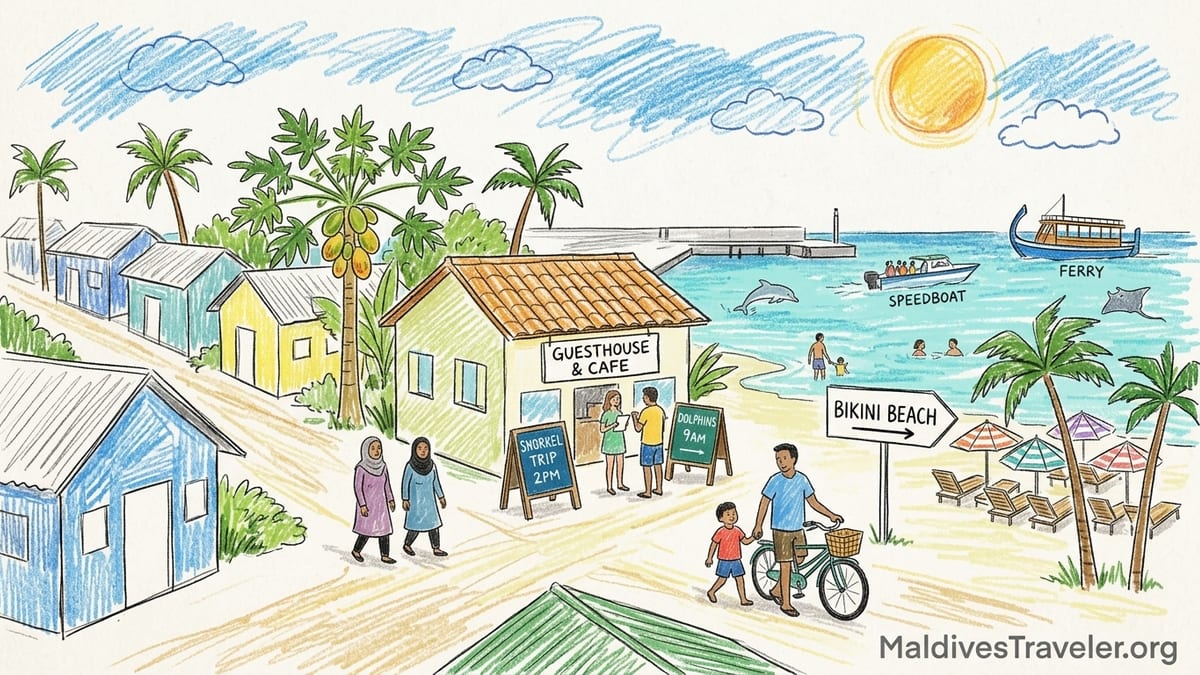
How Maldives Local-Island Guesthouses Work
On local islands across the Maldives, guesthouses occupy a middle ground between homestays and small hotels. They are licensed by the Ministry of Tourism as tourist guesthouses rather than resorts or liveaboards, which means they must meet basic standards for safety and amenities but typically remain family run. A 15 to 20 room property might be owned by a local family that also runs the café or excursion boat, so when you book, you are stepping into a small island business rather than an international chain.
Rates are generally far below what you would pay at a private resort. In low season it is still possible to find simple double rooms on islands such as Maafushi and Thulusdhoo for roughly the cost of a mid-range city hotel night, including breakfast, while newer, design-forward properties on Dhigurah or Ukulhas cost more but remain far cheaper than resort villas. Instead of all-inclusive pricing, many guesthouses offer breakfast only, with optional half-board or full-board add-ons that bundle set-menu dinners at an on-site or partner restaurant.
Because these islands are home to Maldivian communities, guests share the same streets, mosques and small shops as residents. Islamic law and local custom apply, so alcohol is not served on inhabited islands and swimwear is restricted to designated bikini beaches or boat excursions. In practice this means that distance to the bikini beach and the quality of the nearest house reef or sandbank excursion matter more than the size of your room, especially if you are coming for snorkelling or surfing.
Across all islands, transfers and activities run through a network of speedboats, public ferries and independent dive centres. Many guesthouses list specific transfer schedules from Velana International Airport, typically with late afternoon and sometimes evening speedboats. When comparing properties on any island, ask three questions up front: how many minutes to the bikini beach, whether they can bundle excursions or diving on site, and what time the last boat runs from the airport on your arrival day.
Maafushi: Biggest Choice and Easiest Logistics
Maafushi, in Kaafu Atoll, is the most developed local-island destination and has the largest concentration of registered guesthouses in the country. That scale translates into choice: a visitor can pick from basic guest rooms a few streets inland to beachfront properties directly facing the island’s main bikini beach. Walkable distances are one of Maafushi’s big advantages; even the most distant guesthouses sit roughly five to ten minutes on foot from the sand, while those along the northwestern shore are effectively on the beach, with sun loungers and umbrellas set up just across the sand track.
Meal plans on Maafushi range from simple bed-and-breakfast offerings at budget properties to full-board packages at larger guesthouses that blur into boutique hotels. Some places promote full-board as a way to control daily spending, bundling generous buffets or set menus that would otherwise cost a significant amount per day at separate restaurants. Because the island has several independent cafés and grill spots, guests who choose breakfast only can still keep costs predictable by sticking to casual eateries along the harbour and bikini beach strip.
Nearly every substantial guesthouse on Maafushi has an in-house excursion desk or a partnership with speedboat operators offering trips to nearby sandbanks, resort day visits, dolphin cruises and snorkelling reefs. You will see handwritten boards advertising half-day snorkel trips, sunset cruises and night-fishing in front of many reception areas. For divers, Maafushi works with a handful of established scuba centres that run daily two-tank trips and PADI courses, with free pick up from most guesthouses. Families benefit from the density of services: many properties offer triple or quadruple rooms, and a few mid-range options include small pools that give children a place to cool off when tides are high or the heat is intense.
Transfers are the simplest of any island in this guide. Shared speedboats connect Maafushi with the airport and the capital multiple times per day, and many guesthouses will add the cost to your invoice and reserve seats. For short holidays of three or four nights, Maafushi’s combination of frequency, price competition and sheer choice make it the most forgiving island if your flight is delayed or you are nervous about missing the last boat.
Thulusdhoo: Surf Vibe and Laid-back Guesthouses
Thulusdhoo, in North Malé Atoll, is the classic local-island choice for surfers thanks to its proximity to breaks such as Cokes and Chickens. That surf focus shapes the guesthouse scene. Accommodation is spread through the sandy lanes behind the shore, with many properties roughly five minutes’ walk from the bikini beach and surf passes. A few guesthouses and small villas sit closer to the water, but even an inland room will usually keep you within a short stroll of both the surf point and the main beach.
Most Thulusdhoo guesthouses sell stays on a bed-and-breakfast basis, with optional half-board to simplify life between surf sessions. Expect hearty breakfasts featuring Maldivian dishes like mas huni alongside eggs and toast. Dinner is often served communally on long tables under palm trees or in breezy courtyards, which suits the social surf crowd. Dedicated surf camps bundle boat transfers to the breaks, guiding and video coaching into multi-day packages, while more general guesthouses arrange individual boat rides on request.
Excursion desks on Thulusdhoo focus on surf boats, snorkelling at nearby reefs and sandbank picnics, with occasional manta or dolphin trips in season. A few properties maintain close relationships with dive schools that operate on or near the island, providing package rates for introductory dives and open water courses. Families who are not surfing will find the island quieter than Maafushi but more active than Fulidhoo, with a mix of small supermarkets, beach cafés and shaded spots where children can play. Most guesthouses can offer extra beds or interconnected rooms for parents and older kids, although purpose-built family suites are less common than on larger islands.
Reaching Thulusdhoo requires either a scheduled speedboat, which guesthouses can arrange, or the slower public ferry from Malé. The speedboat ride typically takes around half an hour and is straightforward even for first-time visitors. Once on the island, bicycles are handy for shuttling between the harbour, surf point and your guesthouse, but distances are still manageable on foot, especially given the flat terrain.
Dhigurah: Long Beach, Whale Sharks and Dive-focused Stays
Dhigurah, in South Ari Atoll, is a narrow island famous for its long talcum-soft beach and year-round whale shark excursions. The majority of guesthouses and small hotels cluster in the village at the northern half of the island. From there, a sandy path leads to the expansive bikini beach at the southern end, where sunbeds sit under casuarina trees and the turquoise lagoon stretches along several kilometres of sand. Depending on where you stay, the walk to the widest, quietest stretch of bikini beach can take 10 to 25 minutes, so location matters if you plan to move back and forth several times a day.
Dhigurah’s accommodation scene leans more towards boutique and dive-oriented guesthouses than bare-bones budget rooms. Many properties arrange daily whale shark and manta excursions, with shared boats heading out to the nearby channels that make South Ari famous among divers. Others work hand in hand with on-island dive centres, bundling multi-day dive packages or open water courses into room-and-activity deals. At several places, snorkellers can join the same boats as divers and spend time searching for whale sharks at the surface while the dive group explores deeper sites.
Meal plans here usually start with breakfast included. Some guesthouses add half-board or full-board options that bundle dinners featuring grilled fish, curries and Western dishes. As the island is more spread out, having meals on site can be convenient after a long day at sea, although there are a few independent cafés and bakeries near the harbour. Pools are still uncommon, but roof decks and shaded courtyards serve as social hubs in the evenings, when guests compare whale shark sightings and underwater photographs.
Reaching Dhigurah requires a domestic flight or speedboat from Malé, often via the nearby airport island of Maamigili. Many guesthouses coordinate shared speedboats that align with common international arrival times, but departures may be less frequent than to Maafushi. Once on the island, transfers from the harbour to your guesthouse are typically handled by pick-up truck or van, and staff often meet new arrivals at the jetty with a signboard.
Ukulhas and Rasdhoo: Reef Lovers’ Duo in North Ari
Ukulhas, in North Ari Atoll, has built a quiet reputation among snorkellers for its well-kept bikini beach and healthy nearshore reef. Guesthouses line the lanes just back from the island’s western shore, and many sit only one or two minutes’ walk from the sand. The main beach is broad enough that even at busy times guests can usually find a stretch of shade beneath palm trees. Because the house reef is so close to shore, many visitors spend much of their time simply drifting along the drop-off with a mask and fins rather than booking boat trips every day.
Most Ukulhas guesthouses focus on simple, comfortable rooms with breakfast included, plus optional dinners on the beach when weather allows. Half-board is popular with couples who want predictable daily costs, while budget travellers often mix guesthouse dinners with occasional meals at independent cafés. Excursions centre on snorkelling with turtles, visiting nearby sandbanks and, in certain months, manta trips to seasonal aggregation points. A handful of properties have particularly strong ties to local dive schools, making Ukulhas a good base for relaxed reef diving without resort prices.
Rasdhoo, also in North Ari, offers similarly easy access to strong snorkelling and diving but has a slightly livelier feel thanks to its position as the central island of a small atoll. Guesthouses are scattered around the grid of sandy streets, and while not all are directly on the beach, most sit within five to eight minutes’ walk of the main bikini beach. The island’s proximity to well-known dive sites means that many properties cater implicitly to divers, with rinse areas for gear, early breakfasts and flexible check-out times to match boat schedules.
Both Ukulhas and Rasdhoo are reached via scheduled speedboats from Malé or, in some cases, by combining a domestic flight with a shorter boat ride. Guesthouses on each island routinely manage transfers for their guests and can advise on whether a direct speedboat or a connection via another island makes more sense given flight arrival times. Families will find a growing number of rooms that can accommodate three or four people, but dedicated kids’ clubs and pools remain rare; these islands still prioritise reefs and quiet streets over built-up facilities.
Thoddoo and Fulidhoo: Green Retreats and Sandbank Escapes
Thoddoo, in Alifu Alifu Atoll, is one of the most fertile islands in the Maldives and feels different from others the moment you step ashore. Papaya and watermelon fields stretch behind the village, and guesthouses are interspersed among both homes and small farms. The bikini beach sits a short cycle ride or a 10 to 15 minute walk from most properties, at the edge of the agricultural plots, which adds to the sense of retreat when you reach the wide strand of sand and turquoise water.
Guesthouses on Thoddoo tend to emphasise gardens, courtyards and greenery rather than seafront locations. Many operate on a bed-and-breakfast basis, with the option of pre-booked dinners that make use of fresh island produce. Bicycles are usually available, either free or for a modest rental fee, and are the most pleasant way to move between your room, the beach and the small collection of cafés and juice bars near the harbour. Families appreciate the spacious plots and quiet backstreets, although pools are still the exception rather than the norm.
Fulidhoo, in Vaavu Atoll, is a smaller and sleepier island, often chosen by travellers seeking a low-key village atmosphere and easy access to nurse shark and stingray snorkelling sites. The island is compact enough that most guesthouses lie only a few minutes’ walk from the main beach and jetty. Distance to the bikini beach here is rarely an issue; the decision is more about whether you prefer a room closer to the harbour buzz or on a quieter backstreet with more shade.
On Fulidhoo, breakfast is standard and some properties offer home-style dinners featuring grilled reef fish and Maldivian curries. Excursion desks lean heavily into the atoll’s signature experiences: evening snorkels with nurse sharks, sandbank picnics on uninhabited islets, and drift snorkelling along channels known for abundant marine life. Because the island is so small, most guesthouses work with the same pool of boat captains and dive operators, but long-standing relationships can still mean earlier access to popular spots or more flexible timing.
Dharavandhoo: Gateway to Hanifaru Bay
Dharavandhoo, in Baa Atoll, is best known as the local-island base for trips to Hanifaru Bay, the UNESCO Biosphere Reserve where manta rays and, occasionally, whale sharks aggregate in plankton-rich waters during the southwest monsoon. The island also has a domestic airport, which gives it a different feel from ferry-linked destinations. Guesthouses cluster around the runway and main village streets, and although there is not an endless choice, the island hosts a significant number of registered properties for its size.
From most guesthouses on Dharavandhoo, the local bikini beach sits within a five to 10 minute walk. The beach itself is pleasant rather than spectacular, but almost everyone comes here for what lies offshore. During manta season, guesthouses focus on organising daily excursions to Hanifaru and neighbouring reefs, often with strict timing to match permits and tide conditions. Many properties work closely with specific dive centres that own fast boats and know the regulations, which can be an advantage when slots are limited at peak times.
Meal plans vary from basic breakfast-only stays to half-board packages, with some guesthouses coordinating meals at nearby cafés rather than running a full restaurant in-house. Because domestic flights can arrive throughout the day, flexible check-in and late-night snacks are common. Families and small groups will find a handful of larger rooms and interconnected units, and some properties provide rooftop terraces where guests can relax between boat trips. Pools are rare, but that is balanced by the focus on water-based activities in the surrounding biosphere reserve.
Reaching Dharavandhoo typically involves a short domestic flight from Malé followed by a two or three minute transfer to your guesthouse. The convenience appeals to travellers who want to minimise time on boats, especially during choppier months. Once on the island, you can walk almost everywhere, and guesthouse staff are accustomed to fitting activities around flight schedules so that visitors still manage a Hanifaru excursion even on shorter stays.
Comparing Key Factors: Beach, Meals, Excursions and Families
Viewed side by side, the islands in this guide offer distinct trade-offs. Maafushi and Thulusdhoo provide the shortest walks to bikini beaches from the widest range of guesthouses, along with the densest choice of restaurants and cafés. Dhigurah, Ukulhas, Rasdhoo, Thoddoo and Fulidhoo often require slightly longer or more scenic walks or cycles to the very best beach spots, but reward that effort with quieter sands and, in many cases, healthier nearshore reefs. Dharavandhoo, while compact, positions guests close to its modest beach but primarily serves as a launch point for offshore manta encounters.
Meal plans also follow a pattern. Larger, more established islands such as Maafushi and Dhigurah are where you are most likely to find full-board options that feel almost resort-like, with buffets and varied menus. On Thulusdhoo, Ukulhas, Rasdhoo, Thoddoo and Fulidhoo, breakfast plus optional half-board is more common, and guests mix guesthouse dinners with independent cafés to keep things interesting. Dharavandhoo sits somewhere in the middle, with some guesthouses running their own kitchens and others leaning on local eateries, especially outside peak manta months.
When it comes to excursions and diving, every island has access to strong operators, but their focus differs. Maafushi emphasises budget-friendly snorkelling, sandbanks and resort day trips. Thulusdhoo highlights surf boats and casual reef dives. Dhigurah specialises in whale shark and manta adventures alongside classic reef dives. Ukulhas and Rasdhoo focus on nearby reefs and relaxed diving culture, while Thoddoo and Fulidhoo stand out for sandbank escapes and nurse shark or stingray encounters. Dharavandhoo is the clear choice if Hanifaru Bay is the centrepiece of your itinerary.
Families should look first at room configurations and the overall village feel. Maafushi and Dhigurah offer the best selection of family rooms and small pools, along with reliable speedboat or domestic connections. Thulusdhoo, Ukulhas and Rasdhoo suit families comfortable with quieter evenings and less structured entertainment, relying on the beach and sea for most activities. Thoddoo and Fulidhoo feel particularly relaxed for younger children because traffic is minimal and distances are short, though facilities are basic. Dharavandhoo works well for older children and teenagers who can fully appreciate snorkelling with mantas and spending long days on boats.
The Takeaway
Choosing the best guesthouse on a Maldives local island starts with choosing the right island itself. Maafushi suits first-time visitors who value simple logistics, plenty of restaurant choices and a near-certainty of finding a room that fits their budget and group size. Thulusdhoo attracts surfers and travellers who like a sociable but not overwhelming atmosphere. Dhigurah appeals to ocean-focused guests who will happily walk a little farther to reach a spectacular beach and spend most days chasing whale sharks and mantas.
Ukulhas and Rasdhoo are ideal for reef lovers who want to slip into the water just off the main beach and spend hours snorkelling or diving without resort prices. Thoddoo and Fulidhoo offer a gentler pace, with greenery, agriculture and tiny-village life framing days built around sandbanks and simple meals. Dharavandhoo stands apart as the practical base for Hanifaru Bay, trading a modest local beach for fast access to one of the world’s most famous manta aggregation sites.
Across all these islands, the fundamentals are similar. Ministry-registered guesthouses provide clean, air-conditioned rooms, breakfast and access to the network of boats and dive centres that bring the Maldives’ marine world within reach. When booking, focus less on brand names and more on practical details: walking distance to the bikini beach, how excursions are organised, whether airport transfers align with your flight, and how well the room layout suits your group. Do that, and any of these islands can deliver the essential Maldivian combination of white sand, clear water and warm hospitality at a fraction of resort prices.
FAQ
Q1. Which Maldives local island is best for a first-time guesthouse stay? For most first-time visitors, Maafushi is the easiest starting point because it has the most frequent airport speedboat transfers, the widest range of guesthouses and plenty of cafés and excursion operators. That makes it forgiving if flights change and offers enough choice to suit most budgets.
Q2. How close are guesthouses to the beach on these islands? On compact islands such as Maafushi, Thulusdhoo, Fulidhoo and Dharavandhoo, many guesthouses sit within a five to ten minute walk of the bikini beach, and some are directly beachfront. On longer islands like Dhigurah or more agricultural islands like Thoddoo, you may walk 10 to 25 minutes or cycle to reach the best stretch of bikini beach from inland properties.
Q3. Can I get half-board or full-board at Maldives guesthouses? Yes, but availability varies by island. Maafushi and Dhigurah have the most guesthouses offering half-board and full-board packages with set-menu or buffet dinners. On Thulusdhoo, Ukulhas, Rasdhoo, Thoddoo, Fulidhoo and Dharavandhoo, breakfast plus optional half-board is more common, and many travellers mix guesthouse dinners with local cafés.
Q4. Are there family rooms and pools at local-island guesthouses? Many guesthouses on Maafushi and Dhigurah offer triple and quadruple rooms or interconnected units that work well for families, and a few mid-range properties have small pools. On smaller or quieter islands such as Fulidhoo, Thoddoo, Ukulhas and Rasdhoo, rooms are often set up for two or three people and pools are rare, so families should check room configurations carefully before booking.
Q5. How do airport transfers work for these islands? Transfers typically use a mix of scheduled speedboats, public ferries and domestic flights. Maafushi and Thulusdhoo rely mainly on regular speedboats from the airport and Malé, while Dhigurah and Dharavandhoo usually involve either a domestic flight to a nearby airport or a longer speedboat. Guesthouses almost always arrange transfers on request and can advise which option fits your flight time and budget.
Q6. Which islands are best for diving and whale shark or manta encounters? Dhigurah is one of the strongest choices for whale shark excursions, with daily trips to South Ari’s channels in season. Dharavandhoo is the main base for manta snorkelling at Hanifaru Bay when conditions are right. Ukulhas, Rasdhoo, Thulusdhoo and Maafushi all give access to good reef diving via partner dive centres, while Fulidhoo is known for nurse shark and stingray snorkelling.
Q7. Is alcohol available at Maldives guesthouses on local islands? No, alcohol is not served on inhabited local islands due to Maldivian law and cultural norms. Guesthouses on Maafushi and some other islands can arrange day trips to nearby resort islands or boats where alcohol is available, but within the village itself drinks are limited to soft drinks, juices and mocktails.
Q8. What should I look for when choosing a specific guesthouse? Focus on practical aspects rather than décor alone. Check how far the property is from the bikini beach, whether it has its own excursion desk or a strong partnership with a dive centre, how airport transfers are organised, and what type of breakfast or meal plan is included. Reviews that mention consistent hot water, reliable air conditioning and responsive communication are also valuable.
Q9. Are Maldives local-island guesthouses suitable for solo travellers? Yes, local-island guesthouses are well suited to solo travellers, particularly on Maafushi, Thulusdhoo, Dhigurah, Ukulhas and Rasdhoo, where shared excursions and communal dining areas make it easy to meet other guests. Smaller islands like Fulidhoo and Thoddoo can feel more secluded, which some solo travellers appreciate, but activity options may be more limited outside peak season.
Q10. How far in advance should I book a guesthouse on these islands? For peak travel periods, such as year-end holidays or school breaks, it is wise to book several months in advance on high-demand islands like Maafushi, Dhigurah and Dharavandhoo, especially if you need family rooms or specific dive packages. In shoulder seasons, many guesthouses still have availability closer to arrival, but early booking gives more choice of room types and locations.