

Staying on a Maldivian local island is very different from checking into an all inclusive resort. You are sleeping in someone’s village, not a private holiday bubble, and that means a different set of rules around swimwear, alcohol, dress and daily behavior. Visit Maldives and official travel advisories are clear that these rules are not optional. They shape everyday life on inhabited islands and are the framework that lets guesthouses exist alongside traditional communities. This guide explains, in practical terms, how to enjoy a local island stay while fully respecting local expectations.
Resort Islands vs Local Islands: Why the Rules Change
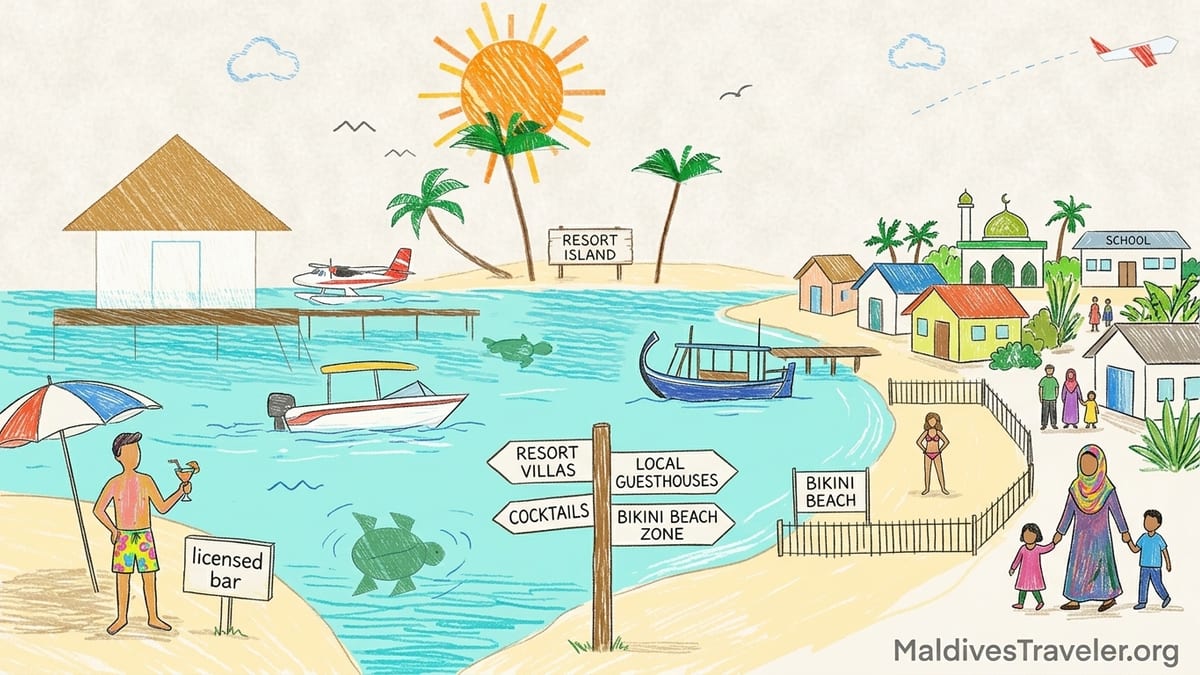
Most first time visitors picture the Maldives as a string of private resort islands where you can walk from villa to bar in a bikini, cocktail in hand. That picture is accurate for resort islands and licensed liveaboard boats, which operate under a separate set of permits. On these islands alcohol can be served to tourists and usual beachwear is the norm. The moment you step onto an inhabited local island like Maafushi, Thulusdhoo, Ukulhas or Dhiffushi, you enter a functioning Muslim community with its own council, mosque, school and family homes. Here, national laws and social norms about alcohol, dress and public behavior apply to visitors as much as residents.
Local islands opened to guesthouse tourism only in the past decade or so. Before that, tourists were largely kept on resort islands, separated from everyday Maldivian life. The current model tries to balance affordable, immersive stays with the values of communities that have lived on these islands for centuries. Understanding that context helps explain why you will find a bikini beach on one side of an island and women in headscarves walking children to school on the other. The rules preserve this balance so that guesthouses can keep operating without overwhelming local customs.
For travelers this means you can design two very different Maldives trips. A resort based stay might focus on spa treatments, all inclusive bars and dress how you like. A local island itinerary swaps that for small family run guesthouses, ferries instead of speedboats, and café meals in places where you will likely be the only foreigner. Both are valid ways to experience the country, but they come with different responsibilities.
Bikini Beaches and Swimwear: Where You Can and Cannot Strip Down
The single biggest adjustment for many visitors is that bikinis and normal Western swimwear belong only on designated areas, not on village beaches. On almost every tourist oriented local island there is a clearly marked “bikini beach.” This is a specific stretch of sand, often bordered by trees or simple fencing, where tourists are allowed to sunbathe and swim in bikinis, one piece swimsuits and standard men’s swim shorts. In Ukulhas, for example, the bikini beach sits on the western side of the island, facing the reef; in Maafushi, the main bikini beach is on the north side, close to many guesthouses; on Thulusdhoo you will find it near the main surf break.
Outside these zones you should switch to modest swimwear. On a local “family beach” where residents bathe and children play, foreign women are expected to cover shoulders and knees. Men usually wear at least knee length shorts and a T shirt or rash guard when they are not in the water. Many travelers solve this by wearing a light beach dress or long T shirt over their swimsuit as they walk from guesthouse to bikini beach, then removing it once they are inside the designated area. Others choose a burkini or long sleeved swimsuit set so that they feel comfortable both inside and outside the bikini beach.
Enforcement is usually gentle but firm. If you wander onto a residential beach in a bikini, a local woman might quietly gesture that your clothing is not appropriate, a café owner could ask you to cover up before sitting down, or a police officer may remind you of the rules. There are also islands that do not have a bikini beach at all, particularly those with very small or conservative communities. On such islands, guesthouses arrange daily boat trips to nearby uninhabited sandbanks or to resort islands so visitors can swim and sunbathe more freely. If your holiday plans depend on wearing a bikini on the beach, always confirm that your chosen island has a designated bikini beach before you book.
Alcohol Laws on Local Islands: What You Can Actually Expect
Maldives law and Visit Maldives guidance are explicit: alcohol is not available on local residential islands. You cannot buy beer or spirits in shops, you will not find wine at a beach café, and guesthouses are not allowed to sell or serve alcohol. This is not a question of an individual property’s policy; it is a nationwide legal restriction on inhabited islands. Alcohol you bring in your luggage will be confiscated by customs on arrival at Velana International Airport and stored until you depart.
In practice this means that a stay on a local island like Dhiffushi or Fulidhoo is a dry experience. Evening social life centers on coffee shops, juice bars and seaside swings rather than bars and beach parties. You might sit on beanbags at a shoreline café in Thulusdhoo with an iced coffee or fresh watermelon juice instead of a cocktail. Some travelers find the change refreshing; others miss being able to order a sundowner after a long day of snorkeling.
There are legal ways to access alcohol without breaking the rules of a local island. Many guesthouses can arrange day passes or evening boat transfers to nearby resort islands, where you can order drinks by the pool and return to your guesthouse afterward. In some areas licensed “floating bars” operate on boats anchored just outside the local island’s harbor. You take a small shuttle boat from the jetty to the vessel, have drinks on board, then shuttle back. Even in these cases, alcohol must stay on the resort or boat and cannot be brought back into the island village.
Travelers who imagine sneaking a bottle into their room or drinking on a quiet stretch of shore should be aware that the penalties can be serious. Being drunk in public or caught with alcohol on an inhabited island can lead to fines, confiscation and possible deportation. If having easy access to wine and cocktails is central to your idea of a holiday, a resort or liveaboard itinerary is a better fit than a guesthouse on a local island.
Dress Code in Villages, Streets and Public Spaces
On local islands, a simple rule helps: dress as you would when visiting a small town in a conservative Muslim country. That usually means shoulders and knees covered, no deep plunging necklines and nothing transparent in village streets or when visiting government offices or schools. For women, loose cotton trousers or a long skirt with a T shirt or light blouse works well. Men are fine in knee length shorts and a T shirt in most situations, though long trousers are advisable if you visit Malé’s more formal offices or plan to attend Friday midday prayers as an observer.
In daily life you will see a mix of styles among Maldivians themselves. In a place like Maafushi, many local women wear headscarves and long dresses, while some younger women in Male or more touristy islands may wear jeans and tunics. Men often wear shorts and football jerseys, especially in the evenings when they gather to play futsal or hang out by the harbor. The expectation for visitors is not to copy local dress exactly, but to avoid clothing that would feel revealing in that context. Crop tops, backless dresses, tight gym shorts and see through cover ups are best reserved for resort stays.
Guesthouses are a grey area. Inside your private room you can of course dress as you like, but common spaces such as lobbies, breakfast terraces and rooftops are still in view of staff, neighboring houses and sometimes the mosque. Many guesthouse owners politely ask guests to throw on a T shirt and shorts over swimwear when walking through the property or standing on balconies. On some islands, rooftop jacuzzis and small plunge pools are shielded by high walls so that guests can use them in swimwear without being visible to the village.
When you arrive, take a few minutes to notice what local women and men are wearing on the street, then adjust your wardrobe accordingly. Lightweight fabrics are essential in the tropical humidity; a long sleeve linen shirt or airy maxi dress will feel surprisingly comfortable and will spare you awkward conversations about clothing.
Ramadan on Local Islands: How Daily Life Changes
Spending part of your trip on a local island during Ramadan can be a rich cultural experience, but it comes with practical changes. During the month of fasting, Muslims in the Maldives do not eat or drink between dawn and sunset. Many cafés and small restaurants on islands like Gulhi or Rasdhoo stay closed during daylight hours and only open shortly before sunset. Government office hours shift, school days are shorter and the rhythm of the island moves to a slower pace during the heat of the afternoon.
Visitors are not expected to fast, but they are expected to be discreet. Eating, drinking or smoking in the middle of the street when everyone around you is fasting is considered insensitive. On most local islands you can still have breakfast at your guesthouse and discreetly drink water, but it is better to do so indoors, on balconies or in clearly tourist oriented spaces. Some guesthouses prepare packed lunches for day trips so that guests can eat on boats or uninhabited sandbanks away from the village.
At sunset, the atmosphere changes. Families gather in homes and cafés to break the fast with dates, sweet drinks and light snacks before evening prayers. You may be invited by a guesthouse owner to share the first meal of the evening, known as iftar. If you accept, arrive on time and dress modestly, especially if women from the family are present. On a small island you will also hear the call to prayer more frequently, and mosques can be especially busy after dark during Ramadan nights.
Because many Maldivians are up late for special Ramadan prayers, mornings can be quiet. Shops might open later than usual and some excursions may start a bit later in the day. If your priority is nightlife, full service restaurants and a packed schedule of day trips, you may prefer to avoid booking local island stays in the middle of Ramadan. If you are curious about local culture and do not mind adjusting your routine, it can be one of the most rewarding times to visit.
Mosques, Prayer Times and Everyday Etiquette
Every inhabited island has at least one mosque, and larger communities may have several. Their white walls and green roofs are often the most prominent structures in the village, and the call to prayer carries clearly across the island. As a visitor you are welcome to walk past, take photos of exteriors and quietly observe daily life, but you should treat mosque areas as you would a church or temple: with calm behavior, conservative dress and respect for worshippers’ privacy.
Non Muslim visitors are generally not invited to enter local mosques, though there are exceptions on certain islands for guided visits. If you are specifically invited inside by a local host, remove your shoes at the entrance, make sure your legs and arms are covered, and women should cover their hair with a scarf. Avoid walking in front of someone who is praying, keep your phone silent and never use flash photography inside a prayer hall.
Prayer times shape daily routines. Shops may briefly close around Friday noon prayer, and you might notice café televisions switching to religious programming before sermons. On Fridays public life slows; some islands reduce ferry schedules and boat captains prefer not to depart during key prayer windows. If you need to catch a transfer on a Friday, check with your guesthouse about exact departure times so you do not stand in the sun with luggage while crew members are at the mosque.
General village etiquette is straightforward: do not take close up photos of people, especially children and women, without asking; keep public displays of affection low key; and speak quietly near homes and the mosque, particularly during evening prayers. On a small island where everyone knows each other, word of a guest behaving badly travels fast, and the impact is felt by all guesthouses, not just yours.
Behavior on Inhabited Beaches and Around the Community
Even beyond clothing, how you behave on inhabited beaches matters. Village beaches are shared spaces where families gather, teenagers play football and elders sit in the shade of palm trees. Loud music from portable speakers, heavy drinking and rowdy games feel out of place here in a way they might not on a resort’s pool deck. If you want a party scene with DJ sets and late night dancing, look instead at resort islands or special events on liveaboard boats.
Simple courtesies help. If you are snorkeling from a local beach near the harbor, do not walk across a group of people sitting on the sand; find a different entry point. If children are curious and swim near you, treat them kindly but be mindful of boundary expectations in a conservative culture. When drying off, wrap in a towel or throw on a T shirt and shorts before walking back through the village. Leaving wet footprints in a bikini through the main street might draw stares even if no one says anything directly.
Environmental respect is also part of etiquette. Local islands do not have the same waste management systems as large resorts. Always pack out your rubbish from the beach and avoid leaving empty water bottles or snack wrappers behind. Cigarette butts are a particular problem on popular beaches; if you smoke, use an ashtray or a small portable container instead of flicking ash into the sand.
At night, keep noise down in residential lanes. Sound carries across small islands and a loud group talking on a balcony at midnight can easily keep half the neighborhood awake. Many guesthouses set quiet hours; following them is not just about being a good guest, it is about being a good temporary neighbor.
Planning Your Local Island Stay: Practical Examples
Putting all these rules together can feel abstract until you imagine a real itinerary. Take Maafushi as an example, one of the most popular local islands close to the capital. You might arrive by speedboat in the afternoon, check into a guesthouse on the northern side of the island, change into a one piece swimsuit and cover it with a loose beach dress. You walk five minutes along the main sandy street, passing a mosque and a school. At the edge of the bikini beach you slip off the dress, hang it on a palm tree and swim in clear water until sunset. In the evening you put on a T shirt and linen trousers and walk to a seafront café for grilled fish and a mango smoothie. You see no alcohol on the menu, and most of the staff head for prayers in between serving tables.
On a quieter island like Ukulhas in Ari Atoll, the rhythm is similar but slower. Your guesthouse owner points out the bikini beach, explains that breakfast starts a little later on Fridays due to prayers, and offers to arrange a day trip to a resort if you would like to have a glass of wine during your stay. You join a snorkeling excursion to a nearby uninhabited sandbank, where everyone swims in bikinis or boardshorts because there is no village watching from the shore. Back on the island you change into a long skirt and T shirt before strolling along the harbor, greeting local women sitting on traditional joali rope swings.
During Ramadan on a small island in Baa Atoll the day looks different again. Your guesthouse serves a quiet breakfast indoors so as not to draw attention. Shops stay closed until late afternoon. You spend the hottest hours resting in the shade or on a snorkeling trip where you can drink water discreetly on the boat. As sunset nears, the island wakes up. After the call to prayer, the streets fill with families carrying platters of food. Your host family invites you to share a plate of short eats, and you dress modestly and bring a small box of dates from Malé as a thank you gift.
In each of these examples, the patterns are similar: bikinis stay on the designated beach or boat, alcohol is accessed only off island, clothing in the village stays modest and behavior adapts to prayer times and local rhythms. Once you internalize those basics, you will find that local island travel feels relaxed and surprisingly easy.
The Takeaway
Choosing a Maldivian local island over a private resort is less about sacrificing comfort and more about accepting a different framework. Visit Maldives and official advisories draw a clear line: alcohol is not available on inhabited residential islands, and Western swimwear belongs on designated bikini beaches, uninhabited sandbanks or resorts, not on village shores. In exchange for following those rules, you gain access to a side of the Maldives where schoolchildren cycle along sandy lanes, fishermen mend nets at the harbor and café owners know every guest by name after two days.
If you value cultural connection, lower prices and a slower pace, a local island stay can be the most rewarding part of your trip. Pack lightweight, modest clothing, be ready to walk a few extra minutes to the bikini beach instead of swimming outside your door, and consider alcohol free evenings as a chance to notice the stars, the sound of the reef and the rhythm of island life. With a bit of preparation and respect, you can enjoy the same turquoise water and white sand the Maldives is famous for while fitting comfortably into the communities that call these tiny islands home.
FAQ
Q1. Can I drink alcohol on a Maldivian local island if I bring my own?
Bringing alcohol into the Maldives is not allowed, and any bottles found in your luggage will be held at the airport until you depart. Alcohol is simply not available on inhabited local islands, whether in shops, restaurants or guesthouses, so plan for a dry stay or arrange day trips to resort islands if you want a drink.
Q2. How do I know where the bikini beach is on a local island?
On most tourist friendly islands the bikini beach is clearly signposted and marked on simple maps provided by guesthouses. Staff will usually walk you there on your first day. If you do not see obvious signs, ask your host; if there is no designated bikini beach, assume that normal village beaches require modest clothing and plan to swim on boat trips instead.
Q3. What should women wear when walking around a local island village?
Lightweight outfits that cover shoulders and knees are ideal, such as loose trousers and a T shirt, a long skirt with a cotton blouse, or a maxi dress with short sleeves. You do not need to wear a headscarf, but very tight, short or low cut clothes will feel out of place in a conservative community.
Q4. Are men expected to follow a dress code on local islands too?
Yes. While expectations are usually a bit more relaxed for men, you should still avoid walking through the village shirtless or in very short swim trunks. Knee length shorts and a T shirt are fine in most settings, and long trousers are recommended for visits to Malé, government offices or observance of Friday prayers.
Q5. Is it disrespectful to visit a local island during Ramadan?
No. Tourists are welcome during Ramadan, but you should be sensitive to the fact that most locals are fasting. Avoid eating, drinking or smoking in public during daylight hours, expect some cafés to be closed until late afternoon, and be prepared for a slower rhythm of life during the day and busier streets in the evening.
Q6. Can I enter a mosque on a Maldivian local island?
In general, non Muslim visitors are not encouraged to enter local mosques, though there are exceptions when accompanied by a local guide or host. If you are invited inside, dress conservatively, remove your shoes, keep noise to a minimum and avoid taking photos of people at prayer.
Q7. What happens if I accidentally wear a bikini on a village beach?
In many cases a local resident, guesthouse owner or police officer will politely ask you to cover up or move to the designated bikini beach. Repeatedly ignoring such requests can lead to complaints, fines or being asked to leave the island, so it is best to apologize, change clothes and make sure you understand the island’s layout.
Q8. Are there any local islands without a bikini beach at all?
Yes. Some smaller or more traditional islands have chosen not to establish a bikini beach. Guesthouses on these islands typically organize daily excursions to nearby uninhabited sandbanks or resort islands where guests can wear standard swimwear. If beach time in a bikini is essential for you, confirm the situation with your accommodation before booking.
Q9. Can unmarried couples share a room on a local island guesthouse?
In practice many guesthouses do allow unmarried foreign couples to share a room and do not ask for proof of marriage. Public displays of affection are frowned upon, however, so it is wise to keep physical affection private and low key in public areas out of respect for local norms.
Q10. Is it safe to stay on a local island instead of a resort?
Most travelers find Maldivian local islands very safe, with low levels of petty crime and a strong sense of community. Standard precautions still apply: lock your room, avoid leaving valuables unattended on the beach and follow your guesthouse’s advice about swimming conditions and after dark walks, just as you would in any small coastal town.