


Island hopping in the Maldives is finally becoming realistic for independent travelers, but the geography still calls the shots. Atolls are scattered across hundreds of kilometers, public ferries run on limited schedules, and most inter-atoll jumps still funnel back through Malé. This guide focuses on a core set of well-connected local islands Maafushi, Fulidhoo, Dhigurah, Rasdhoo and Ukulhas and shows how to build simple, enjoyable 7, 10 and 14 day trips that follow real atoll routes instead of fantasy lines on a map.
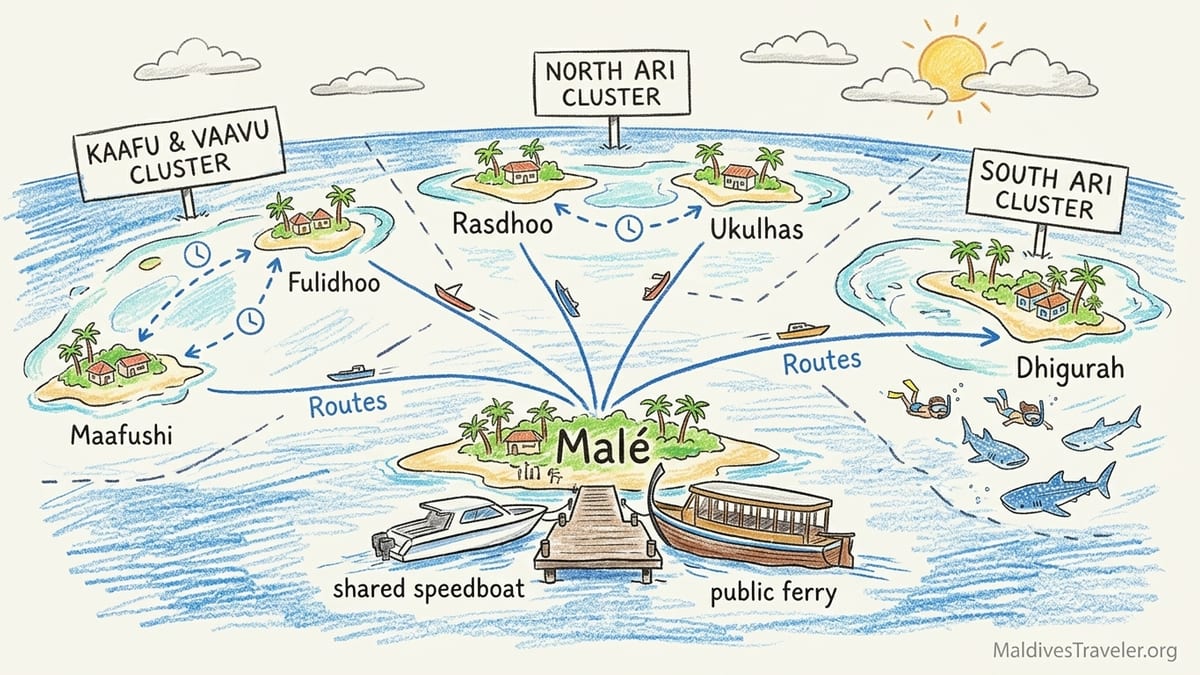
Understanding Atolls and Why Routes Matter
The Maldives is not one long chain you can casually ride from north to south in a straight line. It is a double row of coral atolls separated by deep channels. Each atoll is a cluster of islands ringed around a lagoon, and boat routes generally radiate between Malé and the atolls rather than hopping sideways from one atoll to another. That means you can easily combine several islands within a single atoll group, but moving between atolls often requires returning to Malé first.
The five islands most commonly used for island hopping Maafushi, Fulidhoo, Dhigurah, Rasdhoo and Ukulhas sit in three different administrative atolls. Maafushi is in Kaafu Atoll, close to Malé. Fulidhoo is in neighboring Vaavu Atoll, southeast of Malé. Rasdhoo and Ukulhas are in Alif Alif, also called North Ari Atoll, to the west, while Dhigurah lies further south in Alif Dhaal, or South Ari Atoll. Official atoll and island lists from Maldivian authorities and tourism maps confirm this spread across Kaafu, Vaavu and the two Ari atolls.
This geography explains why guidebooks that suggest hopping Maafushi to Dhigurah to Fulidhoo in a neat curve gloss over the reality that there is usually no regular boat directly connecting those islands. In practice, you either travel within one atoll cluster, or you accept that you will go back to Malé and change boats when you switch atolls. That does not make island hopping impossible, but it does mean you should keep your island count modest and build in transfer days.
For travelers, this structure has a positive side. Once you are in a given atoll, distances shrink dramatically. Rasdhoo to Ukulhas, for example, is a short shared speedboat hop across the top of North Ari, while Fulidhoo and Maafushi share a convenient same-day connection via Malé or through a scheduled inter-atoll speedboat. By thinking in terms of atoll clusters instead of long chains of individual islands, you can design trips that feel like a holiday rather than a never ending boat timetable.
Public Ferries vs Shared Speedboats in 2026
Two main transport options connect local islands in 2026 public slow ferries and faster shared speedboats. Public ferries remain the cheapest way to move between Malé and many guesthouse islands, with fares often in the range of a few dozen Maldivian rufiyaa the equivalent of only a few US dollars. For example, a recent public timetable lists Malé to Maafushi at around 90 minutes for a price roughly in the range of a couple of dollars per person, while Malé to Mahibadhoo in South Ari with a connection onwards to Dhigurah costs well under the price of a budget hotel night.
The trade off for these low prices is time and frequency. Public ferries normally travel at around 10 to 12 knots, stop at intermediate islands and may run only a few times per week on some routes. The Malé to Mahibadhoo boat, used by travelers heading to Dhigurah, is a good example, taking several hours and requiring you to connect to an onward local ferry that operates only on certain days. If you are on a tight schedule, these sailings can dictate the overall shape of your itinerary.
Shared speedboats are the backbone of most 2026 island hopping trips. They are run by private operators, depart from Malé or the airport jetty and connect to popular guesthouse islands such as Maafushi, Fulidhoo, Rasdhoo, Ukulhas and Dhigurah. A typical shared speedboat from the airport to Maafushi takes about 35 to 45 minutes and costs in the rough range of 20 to 30 US dollars one way. Malé to Fulidhoo usually takes about 1 hour 15 minutes, with prices around 40 to 60 dollars per person depending on the operator and season. Dhigurah is further, roughly 100 to 120 minutes from the airport by speedboat, and prices often sit in the 50 to 70 dollar bracket.
There are also a few scheduled inter-island speedboats which make specific island combinations far easier. Current route lists show, for instance, a speedboat connection that links Maafushi and Fulidhoo in about half an hour, and another cluster that runs Rasdhoo to Ukulhas to other North Ari islands. These inter-atoll or intra-atoll services are not universal, and new routes appear or disappear each season, so travelers still need to check current schedules with their guesthouses. In general, though, you can expect that it is reasonably straightforward to move between islands that appear together on speedboat booking sites, and much harder to jump between islands that rarely share the same route listings.
Core Atoll Clusters: How These Islands Actually Connect
Thinking in realistic clusters makes itinerary planning much easier. One obvious cluster is the South Malé and Vaavu area. Maafushi in Kaafu Atoll is one of the most developed local islands in terms of guesthouses and activities. Fulidhoo, in Vaavu Atoll just to the south, is smaller and quieter, with famous channels for shark and manta encounters nearby. Both are served daily or near daily from Malé by separate shared speedboats, and there is a scheduled speedboat that links Maafushi and Fulidhoo on certain days. In practice, this means you can visit Maafushi and Fulidhoo back to back without doubling through Malé, or you can always fall back on doing each leg via the capital if the direct boat is not running on your travel dates.
A second cluster is North Ari Atoll, officially Alif Alif. Rasdhoo, the administrative capital of the atoll, and Ukulhas, one of the larger inhabited islands, both appear on regular ferry and speedboat routes out of Malé. Guides to public ferries describe direct Malé to Rasdhoo boats that also reach nearby guesthouse islands, and shared speedboats from the airport jetty typically offer at least one or two daily departures to Rasdhoo and Ukulhas. Local transport maps and speedboat schedules show that Rasdhoo, Ukulhas and neighboring Mathiveri are tied together by a shuttle style speedboat, making combinations like Rasdhoo plus Ukulhas very practical.
South Ari Atoll, or Alif Dhaal, forms the third core cluster for island hopping. Dhigurah sits near the southern end of the atoll, in an area known for year round whale shark sightings. Official tourism statistics and atoll maps place Dhigurah in the same administrative unit as Mahibadhoo, Dhangethi and other established guesthouse islands. Transport wise, Dhigurah is accessible via a shared speedboat from Malé and the airport, and via slower public ferries that connect Malé to Mahibadhoo and then on to Dhigurah two or three times a week. Once you are in South Ari, you can often arrange local boats or shared speedboats between Dhigurah and neighboring islands, but these tend to be informal and arranged through your guesthouse, not fixed public services.
The key point is that there is no regular, simple public ferry that strings Maafushi, Fulidhoo, Rasdhoo, Ukulhas and Dhigurah into a single linear loop. Some travel blogs imply such a line exists, but actual schedules and traveler reports show the opposite. You can realistically combine Maafushi with Fulidhoo as a Kaafu plus Vaavu trip. You can realistically pair Rasdhoo with Ukulhas in North Ari. You can base a South Ari stay around Dhigurah and perhaps one other nearby island. To move between these clusters, you should expect to return to Malé or at least to the airport piers and change boats.
Sample 7 Day Island Hopping Itinerary
A week is enough time to experience two islands without turning your trip into a constant transfer. One concrete 7 day plan that fits 2026 routes pairs Maafushi and Fulidhoo in the Kaafu and Vaavu cluster. On Day 1 you arrive in Malé, walk or take the airport bus to the harbor and board a shared speedboat to Maafushi. After checking in to a midrange guesthouse, you can spend your first afternoon swimming at the bikini beach and booking excursions, from sunset dolphin cruises to scuba diving in nearby channels.
Days 2 and 3 can be dedicated to Maafushi based activities. Many operators on the island offer day trips to resort islands, sandbanks and snorkeling spots for approximately 25 to 60 dollars per person depending on the destination. A three dive package in 2026 typically runs around 150 to 220 dollars including gear, with popular sites such as Kandooma Thila for sharks and rays reachable in less than an hour by dive dhoni. Food is straightforward and reasonably priced, with cafes serving Maldivian curries, fresh fish and Western dishes at around 8 to 15 dollars a meal.
On Day 4 you transfer from Maafushi to Fulidhoo. If the direct scheduled speedboat is running on your travel day, you board in the morning and arrive in roughly 30 minutes, paying in the region of 40 to 50 dollars. If there is no direct boat, you check out early and ride the Maafushi to Malé speedboat, then connect in the late morning or early afternoon to a Malé to Fulidhoo departure. Either way, you should be on Fulidhoo by mid afternoon. The island is much quieter, with fewer than a dozen guesthouses and a compact village where you can walk from end to end in a few minutes.
Days 5 and 6 are for exploring Vaavu Atoll. Many guesthouses in Fulidhoo run half day snorkeling trips to reefs with nurse sharks and stingrays, and full day safaris that may combine sandbanks, channels and dolphin watching. Prices are slightly higher than on Maafushi due to smaller group sizes, commonly in the 50 to 100 dollar range for full day tours including lunch. In the evenings, you can watch locals play traditional bodu beru drums on the beach, or sit on the jetty as fishing boats unload their catch. On Day 7, you take a morning shared speedboat back to Malé or the airport, allowing a safe buffer of several hours before any afternoon or evening flight.
Sample 10 Day Itinerary: North Ari Focus
With 10 days, you can comfortably combine Rasdhoo and Ukulhas in North Ari Atoll while still allowing for weather delays and rest days. On Day 1, arrive in Malé and take a shared speedboat directly to Rasdhoo. The ride usually takes around 1 hour 15 minutes and costs in the region of 40 to 60 dollars. Rasdhoo village sits around a sandy football field, with guesthouses a short walk from the ferry jetty and a sheltered public beach where tourists can swim in swimwear.
Days 2, 3 and 4 can revolve around Rasdhoo’s marine life. Dive centers on the island are well known for hammerhead shark dives, usually scheduled at sunrise with a short boat ride to a nearby channel. Two tank dives are often priced around 90 to 130 dollars including basic gear. Non divers can join snorkeling trips that visit manta cleaning stations in season, or join half day excursions to neighboring islands with picnic lunches on sandbanks. Evenings tend to be low key, with simple local cafes and a few more polished restaurants attached to guesthouses.
On Day 5, transfer from Rasdhoo to Ukulhas. Instead of returning to Malé, you board a local shared speedboat that connects the two islands directly. These runs usually take around 30 to 45 minutes and cost roughly 20 to 30 dollars. Ukulhas is slightly larger than Rasdhoo, known for its environmental initiatives and a long, attractive beach on the western side of the island. Guesthouses range from budget rooms around 50 to 70 dollars per night to boutique properties over 150 dollars, depending on season.
Days 6 to 9 are based on Ukulhas. You can spend long days snorkeling from the house reef just offshore, where turtles and reef sharks are common, or join boat trips to nearby sandbanks. Some operators run day visits to resort islands within the atoll, giving you access to pools and bars for a fixed day use fee. Allow at least one unstructured day to simply enjoy the beach; North Ari itineraries often tempt travelers to pack in activities, but the real luxury is having nowhere you need to be. On Day 10, ride a shared speedboat back to Malé or the airport, accounting for weather and possible schedule changes.
Sample 14 Day Itinerary: Two Clusters, Three Islands
A two week trip allows you to experience two distinct atoll clusters without making the journey feel like a shuttle service. A realistic 14 day plan uses one week in North or South Ari and one week in the Kaafu and Vaavu area, with Malé as the switching point. For instance, you might combine Rasdhoo and Ukulhas with Dhigurah, or start with Maafushi and Fulidhoo before heading to Dhigurah. The critical rule is to limit yourself to three islands total so that you have at least three nights on each.
One concrete example is a Rasdhoo, Ukulhas and Dhigurah itinerary. Days 1 to 4 follow the earlier North Ari pattern arrive in Rasdhoo by speedboat, dive or snorkel for three full days and enjoy the village atmosphere. On Day 5, a short speedboat carries you to Ukulhas, where Days 6 and 7 are devoted to beach time and light activities. On Day 8 you return from Ukulhas to Malé, ideally on a morning speedboat arriving before midday. After a short break in the capital or at the airport, you connect to an afternoon shared speedboat to Dhigurah in South Ari. That second leg usually takes close to two hours, and prices reported by operators fall around 50 to 70 dollars per person.
Days 9 to 12 are dedicated to Dhigurah. The island is long and narrow, with a beautiful sandbar tail at its southern end that can take an hour or more to walk to. Guesthouses collaborate with local boat owners to offer whale shark excursions in the surrounding marine protected area. Trips often run in small groups, cost around 60 to 100 dollars and include snorkeling gear and snacks. Even if you are not a diver, you can join shallow reef snorkeling outings or rent a bicycle and explore the shaded interior lanes. Food prices are similar to other guesthouse islands, with set dinners in the 15 to 25 dollar range.
On Days 13 and 14 you make your way back to Malé. Most travelers choose a shared speedboat directly from Dhigurah to the airport, especially if they have a morning or early afternoon flight on Day 14. It is technically possible to include Maafushi or Fulidhoo as a short stop in the first half of this itinerary instead of a second North Ari island, but you should then drop Ukulhas or Rasdhoo to keep island counts low. That way, your 14 day journey remains a relaxed progression through two clusters rather than a frantic race against boat timetables.
Planning Tips: Keeping Island Counts Low and Days Flexible
The biggest mistake new visitors make when looking at a map is to assume that distances are small and that boats run like buses. In reality, channels between atolls can be choppy, fuel is expensive and boat operators tend to cluster services on routes they know they can fill. Transport sites in 2026 show plenty of daily speedboats between Malé and Maafushi, Fulidhoo, Rasdhoo, Ukulhas and Dhigurah, but far fewer boats directly linking those islands to each other. Reddit trip reports regularly mention having to route via Malé when jumping between Fulidhoo, Dhigurah and northern atolls, even if the islands look relatively close on a map.
A good planning rule is to think in blocks of three nights as a minimum stay per island. On a seven day trip, that gives you two islands at most. On a 10 day trip, two islands is still comfortable, and three is only realistic if they are tightly connected, like Rasdhoo and Ukulhas plus a final night near the airport. On a 14 day journey, three islands spread across two atoll clusters works well. More than that and you may find that you are spending one out of every three days packing, checking out and riding boats.
It is also important to factor in Maldivian realities such as Friday slowdowns. Public ferries and some speedboats do not operate on Fridays, the weekly holiday. If you depend on a specific public ferry to get from Malé to Mahibadhoo and then on to Dhigurah, for example, you need to verify that the sailing you want actually runs on your chosen date. Guesthouses are usually the best source of current timetable information; many will send you screenshots of the latest schedule or recommend trusted speedboat partners. Booking shared speedboats a few days in advance, especially in high season between December and March, is wise.
Finally, keep your budget and risk tolerance in mind. Relying on public ferries keeps costs extremely low but exposes you to weather cancellations and inconvenient departure times. Shared speedboats cost more per leg, but they reduce travel time and are more likely to operate even in moderate seas. Many travelers adopt a hybrid strategy, using a cheap public ferry in one direction when timing is convenient and a speedboat in the other when they need reliability, such as getting back to Malé in time for an international flight.
FAQ
Q1. Can I visit Maafushi, Fulidhoo, Rasdhoo, Ukulhas and Dhigurah all in one 10 day trip?
It is technically possible but not recommended. You would spend a large portion of your time in transit and often need to route back through Malé between clusters. Focusing on two or three islands within connected atolls creates a far more relaxed and realistic itinerary.
Q2. Do I always need to go back through Malé to change atolls?
In most cases, yes. The majority of scheduled speedboats and public ferries are hub and spoke services radiating from Malé and the airport. There are a few inter-island speedboats linking places like Maafushi and Fulidhoo or Rasdhoo and Ukulhas, but long diagonal routes between distant atolls are rare and often require chartering a private boat.
Q3. How much should I budget for speedboat transfers between local islands in 2026?
As a rough guide, plan on 20 to 30 US dollars per person for shorter hops such as Malé to Maafushi or Rasdhoo to Ukulhas, around 40 to 60 dollars for routes like Malé to Fulidhoo, and 50 to 70 dollars for longer runs such as Malé or the airport to Dhigurah. Prices vary by operator and season, so confirm current rates with your guesthouse.
Q4. Are public ferries reliable enough to plan a whole island hopping trip around them?
Public ferries are generally reliable but operate on limited schedules, sometimes only a few days a week on certain routes. They can also be canceled or delayed due to bad weather or holidays, especially on Fridays. Many travelers use public ferries for one or two long legs and rely on shared speedboats for more time sensitive connections.
Q5. Which two islands are best for a first 7 day Maldives island hopping trip?
For a straightforward first trip, pairing Maafushi and Fulidhoo works very well. Both have frequent links from Malé, there is often a direct speedboat between them, and together they offer a mix of lively guesthouse scene, easy excursions and quieter village life without complicated transfers.
Q6. Is it better to focus on North Ari or South Ari if I want marine life and diving?
Both areas are excellent. North Ari islands like Rasdhoo and Ukulhas are known for shark dives, mantas in season and accessible house reefs. South Ari, with islands like Dhigurah, is famous for more consistent whale shark sightings and a dense concentration of dive sites. Your choice can be guided by which specific wildlife experiences are more important to you.
Q7. How far in advance should I book speedboat transfers?
In high season from roughly December to March, it is wise to reserve shared speedboat seats at least several days before travel, particularly for routes to popular islands such as Maafushi, Fulidhoo, Rasdhoo, Ukulhas and Dhigurah. Shoulder and low season departures are often bookable a day or two in advance, but schedules can change, so staying in touch with your guesthouse is essential.
Q8. Are there luggage limits on Maldivian shared speedboats?
Most operators allow standard airline style checked and hand luggage without extra fees, but small boats have limited storage space. If you travel with very large or multiple suitcases, it is courteous to inform the operator in advance. Oversized items like surfboards or dive gear bags may incur a small surcharge or require specific boats.
Q9. Can I island hop with only cash, or do boats accept cards?
Some speedboat companies and guesthouses can process card payments, but connections occasionally rely on paying the boat crew in cash at boarding. Carrying enough Maldivian rufiyaa or US dollars for transfers and simple expenses is sensible. ATMs are available in Malé and on a few larger local islands, but not on every guesthouse island.
Q10. What is the best way to avoid missed connections when moving between clusters?
The safest strategy is to avoid same day critical connections, especially when switching atolls through Malé. Plan conservative gaps between boats, travel to your final island at least a day before any must do activity, and return to the capital the day before your international flight whenever possible. Building this buffer into 7, 10 and 14 day itineraries turns potential stress into simple downtime in Malé or at the airport island.