


Arriving in the Maldives and then trying to work out how to reach your local-island guesthouse can feel confusing very quickly. There is no single “Maldives ferry system,” timetables move around, Fridays work differently, and each atoll has its own patchwork of ferries, shared speedboats, private boats and domestic flights. This guide walks you through the real options that budget and mid-range travelers use in 2026, with concrete examples from Maafushi and Kaafu Atoll, North and South Ari, and Baa Atoll.
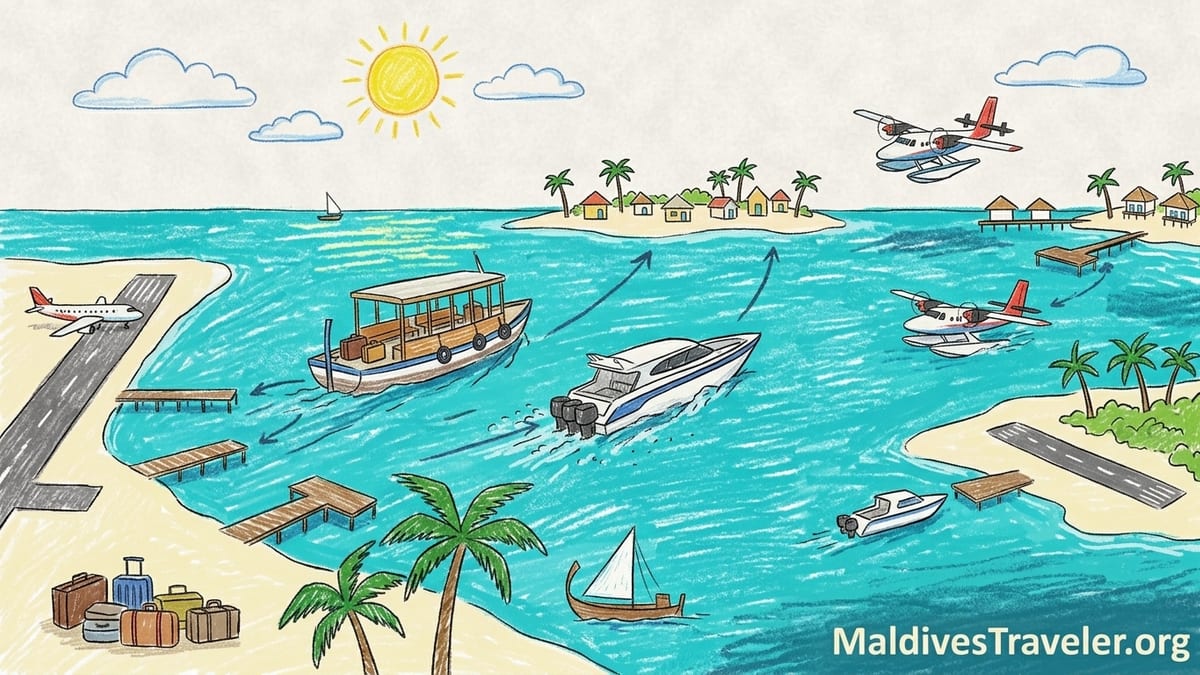
How Maldives Local Transfers Really Work from Velana Airport
Almost every international traveler lands at Velana International Airport, on the airport island of Hulhulé next to Malé. From here, you either stay on the water and continue by public ferry, shared or private speedboat, or you take a short domestic flight deeper into the atolls and then transfer again by boat. The right mix depends on your budget, your arrival time, and which atoll you are heading to.
Velana itself is a tiny island with its own jetties, a domestic terminal and a seaplane terminal. Many shared and private speedboats now collect passengers directly from the airport-side jetties so you do not always need to cross into Malé city. For example, operators serving Maafushi in South Malé Atoll generally meet guests in the arrivals hall and walk them to a nearby pier for a 30 to 45 minute ride to the island.
Public ferries and some inter-island services still depart from terminals in Malé city rather than the airport. If you are using a public ferry you normally ride the airport ferry or airport bus/bridge into Malé, then walk or taxi to the correct terminal. For budget travelers this extra step can be worth it because the fare can drop from around 25 to 35 US dollars per person on a shared speedboat to the equivalent of only a few dollars on a slow public ferry.
For more distant atolls such as Baa or Ari, domestic flights from Velana to small airports like Dharavandhoo in Baa Atoll or Maamigili in South Ari can save several hours of sea time. These flights are typically 20 to 30 minutes, followed by a short speedboat hop to your island. Local-island guesthouses in these atolls usually help combine domestic flights and onward boat transfers into a single itinerary.
Public Ferries: Cheapest Option with the Most Limits
Public ferries are run mainly by the state-owned Maldives Transport and Contracting Company and local councils. They are the cheapest way to move between atolls and from Malé to many local islands. A representative example is the Malé to Maafushi ferry. In mid 2026 travelers report paying the equivalent of roughly 2 US dollars for the 1.5 to 2 hour crossing from Malé city to Maafushi, compared with 25 to 35 dollars for a 30 minute shared speedboat on the same route.
The trade off is time and flexibility. Ferries run on fixed schedules that are not designed around international flights. The Maafushi route is typical: it normally runs once a day in each direction, Sundays to Thursdays, with no service on Fridays and a limited Saturday service. The departure from Malé to Maafushi is usually mid afternoon, which means it only works if your international flight lands by late morning and your luggage comes through on time. Fares are paid in local currency at the terminal or on board.
Ferries are also basic. Seating is simple benches or plastic seats, air conditioning may be minimal or absent, and there is no luggage handling in the way resort guests might expect. You carry your suitcase on, stash it where there is space, and keep an eye on it during the crossing. For short hops such as Malé to Maafushi, Gulhi or Thulusdhoo in Kaafu Atoll this is fine for most people, but few travelers choose ferries for long inter-atoll journeys that can stretch to 8 or 10 hours overnight.
The biggest operational limitation is Friday. In many atolls, including routes serving Maafushi and other Kaafu islands, the main public ferries do not run on Fridays at all. If you land on a Thursday evening and plan to use a public ferry on Friday, you may find there is simply no service and be forced to pay for a speedboat or spend a night in Malé. When planning, always check the most recent schedule via your guesthouse or the ferry booking portals, because timetables can change without much notice.
Shared Speedboats: The Workhorse of Kaafu and Ari
Shared speedboats are the backbone of local-island tourism in Kaafu Atoll, including Maafushi, and increasingly in parts of Ari Atoll. They are faster and far more frequent than public ferries, and significantly cheaper than chartering a private boat. A typical shared speedboat from the airport to Maafushi takes around 30 minutes and costs about 25 to 35 US dollars per person one way, with round trip discounts offered by some operators.
Operators such as established Maafushi-based tour companies publish fixed daily schedules. For example, one well known Maafushi operator advertises shared speedboats between the airport and Maafushi roughly from 9:00 in the morning through to 21:30 in the evening, with multiple departures in each direction. Adult fares are around 30 dollars one way, with reduced child fares and infants often traveling free. Other Kaafu islands like Thulusdhoo, Himmafushi and Fulidhoo have their own shared speedboat operators working to similar price bands, usually somewhere between 25 and 60 dollars per person depending on distance.
The big advantage of shared speedboats is how well they connect with Velana arrivals. If your flight from Europe lands at 14:00, for example, you can usually clear immigration and luggage by 15:30 and catch a 16:00 or 16:30 shared speedboat to Maafushi or your chosen island. Many guesthouses simply ask for your flight number and book you onto the next available departure. Boats typically leave from jetties near the airport and you board directly, so there is no need to cross the bridge to Malé city.
Shared speedboats do have capacity limits and they do not run 24 hours a day. Late night arrivals that land after the last shared boat departure may require a hotel night near the airport or in Malé, or a costly private charter. Boats may also be crowded during peak holiday seasons, with tight seating and limited room for oversized luggage. In rough monsoon seas even large speedboats can be bumpy, so travelers prone to seasickness should pack motion sickness tablets and keep luggage secure to prevent it shifting.
Private Speedboats: Flexibility for Groups and Awkward Arrivals
Private or chartered speedboats offer complete flexibility on timing and routing, but at a much higher price. Instead of paying per person, you pay per boat, typically quoted as a flat one way or return rate. For close-by islands in Kaafu Atoll such as Maafushi or Gulhi, recent examples show small private speedboats for up to 10 passengers priced around 250 to 450 US dollars one way, with larger boats that carry 20 to 30 passengers in the 600 dollar plus range.
For a couple, that price is usually hard to justify unless you are arriving very late at night, traveling with bulky gear like dive equipment or surfboards, or simply value privacy. For a group of six to ten, however, a private charter can be surprisingly cost-effective. A 450 dollar boat split between nine people works out at 50 dollars each, only modestly more than a shared boat, but with the benefit of running whenever your flight arrives and going directly to your guesthouse jetty.
Beyond Kaafu, private speedboats are sometimes the only realistic option for reaching smaller islands on a particular timetable. In North and South Ari Atolls, for instance, there are shared speedboats on fixed routes from Malé for popular local islands like Rasdhoo or Dhangethi, but schedules may not line up with your inbound flight. In those cases some guesthouses will suggest chartering a speedboat either all the way from the airport or from the nearest domestic airport after a short flight.
When you book a private speedboat, clarify in writing where the meeting point is at Velana, how long the captain will wait if your flight is delayed, and what surcharge applies for late night operations. Some operators add higher rates after midnight. Also check whether the price includes all taxes and fuel surcharges. For safety, insist on life jackets for every passenger and avoid overloading even if a captain suggests squeezing on extra people to reduce costs.
Domestic Flights Plus Boat: North Ari, South Ari and Baa Atoll
For North Ari, South Ari and Baa Atoll, domestic flights combined with short speedboat transfers can be the most efficient way to reach local islands, particularly when seas are rough or you want to avoid long hours on a boat. Velana Airport is connected to several small domestic airports including Maamigili, also called Villa International, in South Ari, and Dharavandhoo in Baa Atoll. Flight times are typically in the 20 to 30 minute range.
Take Baa Atoll as an example. To reach local islands near the famous Hanifaru Bay marine protected area, many independent travelers fly from Velana to Dharavandhoo Airport. The flight time is often listed at around 20 to 25 minutes. From Dharavandhoo, guesthouses arrange speedboat transfers of 10 to 20 minutes to islands with accommodation or directly to their own island if it has a jetty. Travelers choosing this route avoid the several hour speedboat journey from Malé to Baa, which can be uncomfortable during the southwest monsoon.
In South Ari, domestic flights to Maamigili allow connections to islands such as Dhigurah or Dhangethi where local guesthouses and whale shark tours are clustered. Again, flight time is around half an hour, with onward speedboat hops varying from 10 to 45 minutes depending on distance. For North Ari, options are more mixed. Some travelers choose shared or private speedboats directly from Malé to Rasdhoo or Ukulhas, which can take 1.5 to 2 hours. Others weave together a domestic flight to a nearby airport plus an inter-atoll speedboat arranged through a local operator, usually at a higher cost but with more resilience in bad weather.
Domestic flights are not cheap, especially when compared with a Kaafu shared speedboat. One way fares on local airlines for tourists can start in the low hundreds of dollars per person depending on route and season. However, when you factor in the time saved and the increased likelihood of flights operating during rough seas, they can be worthwhile for shorter trips or travelers who dislike boats. Most guesthouses in Baa and Ari can issue domestic tickets through their booking partners and build the cost into your overall stay.
Luggage, Weather Delays and Missed Connections
Luggage handling for local-island transfers is simpler than at resort seaplane terminals but still needs planning. On public ferries and shared speedboats you usually keep your bags with you or in a supervised pile near the stern. There is rarely a formal weight limit, but extremely large or heavy bags can be awkward to move on floating pontoons or narrow jetties. For domestic flights, airlines enforce stricter luggage limits, often around 20 kilograms of checked baggage plus a small carry-on for economy passengers, with excess charged per kilogram.
Weather is the most important variable for all sea transfers. From roughly May to October the southwest monsoon can bring strong winds and rough seas, particularly for routes that run across open water between atolls. Shared speedboats sometimes cancel or consolidate departures on short notice when conditions deteriorate. In these cases operators tend to prioritize safety and will either delay departures until waves subside or reroute via more sheltered channels, adding time to the journey but keeping the boat stable.
If bad weather disrupts your transfer and you miss your international flight, responsibility is generally limited. Shared and public operators may rebook you on the next available crossing or provide a partial refund, but they will not cover hotel nights in Malé or new flight tickets. Travel insurance that specifically covers missed connections due to local transport disruptions is strongly recommended. To reduce risk, many travelers schedule a buffer night near the airport before early morning long haul flights, particularly when returning from more distant atolls like Baa or South Ari.
Domestic flights are also affected by storms but are often less disrupted than boats, especially for moderate sea conditions. However, strong crosswinds or heavy rain can still lead to delays or cancellations, and the knock-on effect can be missed boat connections from the local airport. When booking complex itineraries, try to keep all segments for your arrival or departure day on a single confirmation handled by one guesthouse or agent so there is a clear contact point if plans unravel.
Booking: Through Your Guesthouse or Direct with Operators
For most travelers, the simplest way to arrange a transfer is to let the guesthouse handle it. In Maafushi and other popular Kaafu islands, nearly every guesthouse works with one or more shared speedboat operators. They will ask for your flight details, book seats on the next suitable departure, and sometimes bundle the transfer cost into your room rate or charge it on arrival in cash. In Baa and Ari, guesthouses typically also act as ticketing agents for domestic airlines and will combine flights and onward boats into a single quote.
Booking directly with operators can sometimes save a few dollars or give you more control over schedules, but it requires more legwork. Many speedboat operators use messaging apps and local booking sites rather than global platforms. When booking yourself, verify the latest schedule, confirm whether departures are from the airport jetties or Malé city, and ask explicitly about Friday service and any planned maintenance days.
One common pattern in 2026 is that Maafushi-based agencies offer online forms where you can choose between a shared speedboat or a private charter, select your date and time, and pay online by card. A typical form might display a shared speedboat at around 30 dollars per adult one way and 20 dollars per child, alongside a 450 dollar ten passenger private boat option. Once booked, you usually receive a voucher with instructions to meet a representative outside the arrivals door at Velana who will escort you to the boat.
For domestic flights, buying through the guesthouse or a Malé-based agent is still usually easier and sometimes cheaper than trying to book directly on airline websites, which are not always optimized for foreign cards or multi-leg itineraries. Ask for the flight number, departure time and baggage allowance in writing, and keep an eye on small schedule changes that can happen closer to travel dates.
Regional Examples: Maafushi / Kaafu, North Ari, South Ari and Baa Atoll
To see how these transport modes work in practice, it helps to look at how travelers actually reach a few popular clusters of local islands. In Maafushi and the surrounding Kaafu Atoll, shared speedboats are the default. A typical itinerary for a couple flying from Dubai to Malé would be to land around midday, clear immigration, meet a Maafushi tour company representative at the airport, and ride a 30 minute shared speedboat directly to Maafushi for roughly 30 dollars per person. Budget travelers arriving early enough might instead take the cheap airport ferry into Malé, have a quick meal, and board the mid afternoon public ferry to Maafushi for a fraction of the price, accepting the longer 90 minute to 2 hour crossing.
In North Ari, islands like Rasdhoo and Ukulhas see a mix of direct shared speedboats from Malé and more fragmented journeys. A backpacker staying in Rasdhoo might book a shared speedboat that leaves Malé or the airport in the late afternoon, taking around 1.5 hours and costing in the ballpark of 40 to 60 dollars per person one way. If their flight arrives too late for the last shared boat, they could either spend the night in Malé or pay for a private charter that might cost several hundred dollars for the boat, which becomes reasonable only when shared among a larger group.
South Ari illustrates how domestic flights and boats combine. To reach Dhigurah, a popular base for whale shark excursions, a common route is to fly from Velana to Maamigili on a 25 to 30 minute domestic flight and then continue by prearranged speedboat for another 20 to 30 minutes. The total travel time from Malé to Dhigurah can be under two hours once you factor in check in and waiting, compared with a longer sea crossing by direct speedboat. Guesthouses in Dhigurah routinely quote package prices for this combination, making it easier for first time visitors.
Baa Atoll, home to the UNESCO Biosphere Reserve and Hanifaru Bay, often involves a similar pattern but through Dharavandhoo. A traveler heading to a Baa local island might land at Velana in the afternoon, connect to an evening domestic flight to Dharavandhoo, and then take a 10 to 15 minute speedboat to their final island. Because manta ray season draws many visitors, flights and boats on this route can be busy, so booking several weeks ahead is advisable. In shoulder seasons when seas are calmer, some budget travelers opt instead for longer direct speedboats from Malé to Baa, trading comfort for cost savings.
FAQ
Q1. Can I reliably use public ferries to reach Maafushi and other Kaafu islands from Velana Airport?
Public ferries are reliable for those who plan around their limited schedules, but they do not run as frequently as shared speedboats and many routes, including the one serving Maafushi, do not operate on Fridays. You will need to transfer from the airport to Malé city first, then board the ferry at the correct terminal. For most short trips, travelers find shared speedboats more convenient.
Q2. How much should I budget for a shared speedboat from the airport to Maafushi?
As of 2026, typical shared speedboat fares between Velana Airport and Maafushi are in the range of 25 to 35 US dollars per adult one way, with some operators offering round trip discounts. Children usually pay a reduced fare and babies often travel free. Prices can vary slightly by operator and season.
Q3. Is a private speedboat worth the cost if I am traveling as a couple?
For a couple, a private speedboat is usually a luxury rather than a necessity, since the per person cost can easily exceed 100 dollars each on short routes and much more for distant atolls. It becomes better value for groups of four or more, late night arrivals after the last shared departure, or travelers with large amounts of luggage or specialized equipment.
Q4. How do domestic flights plus boat transfers compare to speedboats for Ari and Baa Atolls?
Domestic flights combined with short boat rides are faster and often more comfortable than long speedboat journeys to Ari and Baa, but they are usually more expensive. Flight times are around 20 to 30 minutes, with onward boat transfers of 10 to 45 minutes. Travelers who are short on time or prone to seasickness often prefer this option despite the higher cost.
Q5. What happens if bad weather cancels my speedboat and I miss my international flight?
If rough seas force a cancellation or delay and you miss your international flight, local operators generally only offer to move you to the next available boat or provide a partial refund. They do not cover hotel bills or new air tickets. Good travel insurance and scheduling at least one buffer night near the airport before long haul departures are the safest strategies.
Q6. Are there transfer services on Fridays in the Maldives?
Many public ferries do not operate on Fridays, particularly those serving local islands in Kaafu Atoll such as Maafushi. Shared and private speedboats do generally run on Fridays, although departure times may be reduced compared with other days. Always confirm Friday options in advance with your guesthouse or boat operator.
Q7. Should I book my transfers through my guesthouse or directly with operators?
For most visitors, booking through the guesthouse is simpler and often costs the same as booking direct. Guesthouses in places like Maafushi, Dhigurah or Baa Atoll routinely arrange shared and private speedboats as well as domestic flights, and they are better placed to react if schedules change. Independent booking can make sense for experienced travelers who want to compare multiple operators.
Q8. Are there luggage weight limits on local transfers?
On public and shared speedboats there are usually no strict weight checks, though extremely heavy or bulky luggage can be difficult to handle and may require extra fees on some routes. Domestic flights have clearer limits, often around 20 kilograms of checked baggage plus a small cabin bag, with excess baggage charged per kilogram. Check your ticket or confirmation for exact allowances.
Q9. How early should I arrive at the jetty or terminal before my boat departure?
For shared speedboats, arriving 20 to 30 minutes before the scheduled departure is usually enough, especially if your guesthouse has pre-booked seats. For public ferries, it is safer to be at the terminal at least 30 to 45 minutes early to buy tickets and find the correct boat. Domestic flight check in typically closes around 45 to 60 minutes before departure.
Q10. Can I move between local islands in different atolls without returning to Malé?
In some regions there are inter-atoll ferries and private or shared boats connecting neighboring atolls, but schedules can be sparse and changeable. Many travelers still find it simpler to route back through Malé or use domestic flights as a hub. If you want to link islands in different atolls, it is best to discuss realistic options with your guesthouses before you finalize bookings.