


The Maldives has a reputation for ultra-luxury resorts, but for many families the magic lies on local islands: places where children can run along village streets, chat to shopkeepers and still splash in lagoon-blue water. Choosing the right island matters, especially when you are juggling nap schedules, swim safety and transfer times after a long-haul flight. This guide compares Maafushi, Ukulhas, Thoddoo, Dhiffushi, Dhigurah and Dharavandhoo from a family point of view, with a focus on easy access from Malé, sheltered bikini beaches, guesthouses with family rooms and access to marine life that will keep older children wide-eyed for days.
How Local-Island Family Holidays Work in the Maldives
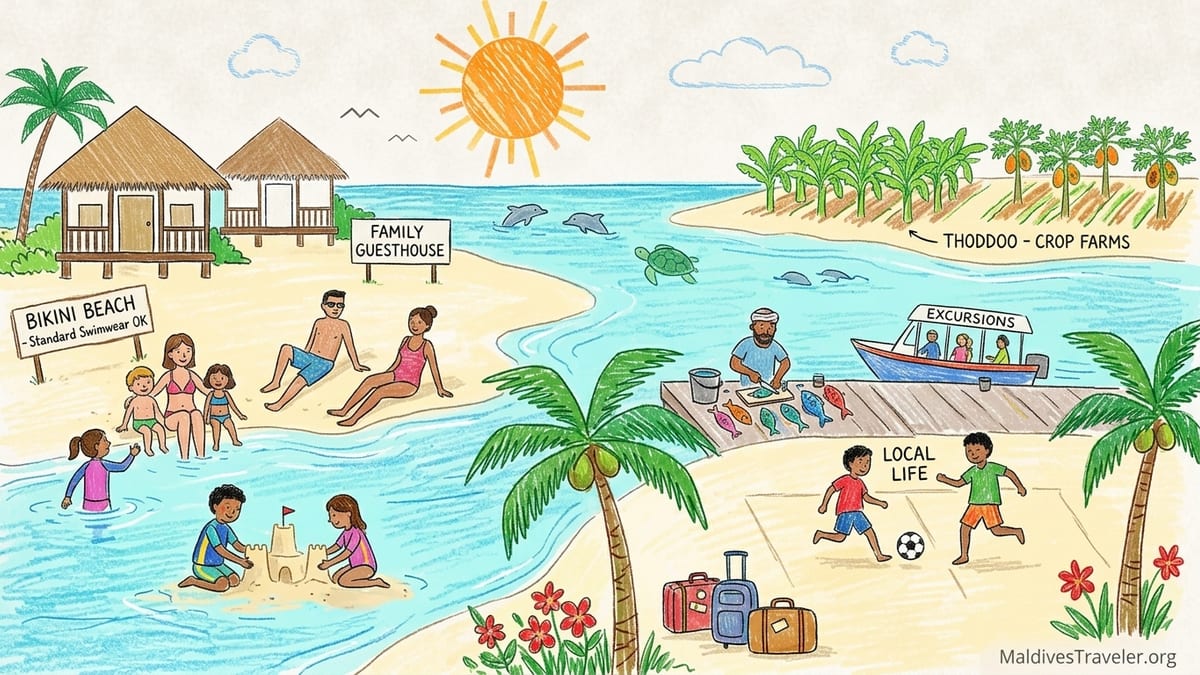
On Maldivian local islands, families stay in guesthouses rather than self-contained private resorts. You share the island with local residents, walk to small restaurants for meals and book day trips with independent excursion operators. For children, that can be a relief from formal resort environments: they can watch fishermen clean the day’s catch at the harbor or play football with local kids on a sandy field before heading back to air-conditioned comfort.
There are two important practical differences from resort islands. First, because the Maldives is a Muslim country, standard swimwear is only allowed on designated bikini beaches. Away from these areas, adults and teens should wear T-shirts and longer shorts, and small children are usually fine in a rash vest and shorts. Second, transfers rely on ferries or speedboats, and occasionally domestic flights, which can add hours to a travel day. For families, especially with younger kids, avoiding a long domestic flight after an overnight international journey can make or break the first two days of a holiday.
When choosing a family-friendly local island, parents usually weigh the same core factors: the length and cost of transfers from Malé, whether the swimming area is safely sheltered and shallow, the size of the bikini beach, the number of guesthouses that offer family rooms, how many restaurants are within walking distance, and what kind of excursions are available without exhausting boat rides. The islands below are popular because they tend to score well in several of these categories, while still offering clear water and palm-backed beaches that look exactly like the brochures.
Maafushi: Easiest First-Timer Island for Families
For a first family trip to Maldivian local islands, Maafushi in Kaafu Atoll is often the simplest choice. The island sits relatively close to Malé, with shared speedboats running frequently from the airport area and the capital. The crossing typically takes about 30 to 35 minutes by speedboat, which feels manageable even with over-tired toddlers and multiple suitcases. Parents avoid the additional check-in lines and waiting times that come with domestic flights, and can realistically be on the beach within a couple of hours of clearing immigration.
Maafushi’s main draw for families is convenience. There is a clearly defined bikini beach on the northern side of the island, with calm, shallow turquoise water and views across to resort islands. Many family-focused guesthouses, including properties that market themselves specifically to parents with children, sit a short walk from this stretch of sand, and some offer family rooms with one king bed and one or two twins. In practice, that means you can step straight from a ground-floor room onto the sand in under five minutes, which is useful for nap breaks or quick shade runs in the heat of the day.
The village streets behind the beach are dense with restaurants and cafes, so feeding a family is straightforward. Typical options range from budget-friendly Maldivian and Indian plates at small local cafes to more international menus serving pizzas, grilled chicken and fresh juice at tourist-focused spots along the waterfront. A family of four can often share two large pizzas and a salad for a reasonable price compared with resort dining, and most restaurants are relaxed about children wandering to watch the fish at the harbor between courses.
Excursions from Maafushi are varied and easy to book on arrival. Dozens of operators line the harbor, advertising half-day snorkel trips to coral gardens and turtle points, sandbank picnics, dolphin cruises and visits to nearby resort islands. For younger children, a two-hour dolphin cruise at sunset or a short reef-snorkel with life jackets is usually enough adventure. Older kids and teens can join full day trips that combine nurse shark snorkeling, sandbank time and lunch stops. Because Maafushi is such an established tourist hub, operators are used to working with families, often providing smaller lifejackets for children and flexible itineraries that can be cut short if someone gets tired.
Ukulhas: Clean, Compact and Calm for Younger Kids
Ukulhas, in Alif Alif Atoll, has a reputation among repeat visitors as one of the cleanest and best-kept local islands in the country. The island community has invested heavily in waste management and beach care, which parents notice quickly when pushing a stroller along the oceanfront path or watching small children dig in the sand. The main beach runs along much of the island’s western side, with a wide designated bikini section where the lagoon is shallow and usually calm, well suited to confident paddlers and children learning to snorkel in water that barely reaches their waist.
Transfers to Ukulhas give families a choice between simplicity and speed. The most straightforward option for most travelers is the direct shared speedboat from Malé, which generally takes around 90 minutes depending on sea conditions. This keeps the journey to a single boat ride with no extra domestic flight. Some itineraries link a domestic flight to the nearby Maamigili airport in Ari Atoll with a follow-on speedboat, but for families wary of multiple steps after a long international flight, the direct speedboat is usually the least stressful, especially if they coordinate arrival times in advance with their guesthouse.
Ukulhas feels quieter than Maafushi and has fewer guesthouses, which suits many families with younger children or those who dislike crowds. Several small, eco-focused properties offer family rooms with garden courtyards or connecting doors, and most are within a short walk of both the beach and the small main street. Everyday amenities include a couple of minimarkets where you can buy snacks, diapers and sunscreen, and a handful of restaurants and cafes that serve grilled fish, Maldivian curries, pasta and simple burgers. Prices are generally moderate, and children are welcome at all hours.
For families interested in marine life but not quite ready for the intensity of whale shark trips, Ukulhas is a comfortable stepping stone. Guided house-reef snorkel outings, which might cost a modest fee per person for a two-hour trip, introduce older children to turtles, reef fish and healthy coral a short boat ride from shore. Operators also offer relaxed half-day sandbank and picnic-island trips with shallow water, shade tents and barbecue lunches that appeal to children who want both swimming and time to play in the sand.
Thoddoo: Beach Time Meets Fruit-Farm Adventures
Thoddoo, also in Alif Alif Atoll, is one of the Maldives’ agricultural powerhouses, famous for its watermelon and papaya farms. For families, that mix of beach and countryside can be surprisingly rewarding. Mornings often start with a cycle or ten-minute walk through sandy tracks lined with banana plants and papaya trees on the way to the bikini beach on the island’s western side. Many guesthouses offer bicycles for rent at low daily rates, and older children enjoy the sense of independence that comes with pedaling down quiet farm lanes wearing flip flops and swimsuits under their T-shirts.
Transfers from Malé to Thoddoo are typically on shared speedboats that take about 70 to 80 minutes, depending on the operator and sea conditions. Prices for these boats are generally mid-range by Maldivian standards, while slow ferries may still exist on some days for those on tight budgets and with very patient children. Most guesthouses help families book their seats and provide up-to-date schedules, which is important because departures can change between seasons.
Thoddoo’s bikini beach is large by local-island standards, backed by dense greenery so it still feels wild in places. The entrance from the village side can be a few minutes’ walk along a path that passes fruit farms, which many children find as memorable as the beach itself. The lagoon here is usually calm and clear, with a soft sandy bottom underfoot in the shallow areas and deeper sections where older kids can practice snorkeling. Parents often appreciate that the beach is big enough to find quieter pockets even in high season.
Guesthouses on Thoddoo range from small family-run houses to boutique properties with several room types, including dedicated family rooms with multiple beds and private terraces. Nightly rates for a family room are typically lower than equivalent accommodation on resort islands, leaving more budget for boat excursions. Daily life is pleasantly simple: a few local cafes serve Maldivian staples such as fish curry and roshi, while tourist-oriented spots add grilled chicken, fresh juices and fruit plates stacked with the island’s own produce. For excursions, families can book gentle snorkeling trips, turtle-watching outings and sandbank picnics that depart from the harbor, usually lasting half a day and returning in time for younger children’s early dinners.
Dhiffushi: Shallow Lagoons and a Laid-Back Pace
Dhiffushi, in Kaafu Atoll north of Malé, is another strong option for families who prioritize safe, shallow water. The island sits inside a broad lagoon, which creates long stretches of ankle to waist-deep turquoise water that are ideal for small children who prefer splashing and paddling to deeper swimming. Parents can sit under the shade of palm trees or simple umbrellas while younger kids play at the water’s edge and older siblings practice snorkel skills close to shore under supervision.
Access from Malé is relatively straightforward. Public ferries generally take between two and three hours, suitable for those on tight budgets who are not in a rush. Shared speedboats typically do the journey in roughly 40 to 45 minutes, which many families see as a good compromise between price and convenience. The shorter crossing compared with more distant atolls helps reduce the risk of children feeling seasick or restless, but parents should still bring water, snacks and a light jacket in case the air-conditioned cabin feels cool.
Dhiffushi’s village streets retain a relaxed, low-rise feel, with a scattering of guesthouses and small hotels. Some properties offer connecting rooms or suites with separate sleeping areas for children, and all are within walking distance of the beach given the island’s small size. A handful of cafes and restaurants line the shoreline, offering simple grilled fish, fried rice dishes, burgers and fresh juices. Minishops sell essentials such as bottled water, juice boxes, biscuits and basic toiletries, useful when traveling with children who have specific snack preferences.
Excursion options from Dhiffushi cover the classic Maldivian favorites. Guesthouses typically arrange half-day snorkeling trips to nearby reefs known for colorful fish and occasional turtles, with life jackets available for less confident swimmers. Sandbank visits and sunset dolphin cruises are popular with families, as they involve relatively short boat rides out into the surrounding lagoon. Because of the lagoon’s geography, some snorkeling points are only a short distance from the island, which can be reassuring for parents who want the option to return quickly if younger children become tired or overwhelmed by the open sea.
Dhigurah and Dharavandhoo: Marine-Life Hotspots for Older Kids
For families with older children and teenagers who can handle longer journeys and are enthusiastic snorkelers, islands such as Dhigurah in South Ari Atoll and Dharavandhoo in Baa Atoll offer exceptional marine-life experiences. These islands are gateways to some of the Maldives’ most famous encounters, including whale shark and manta ray snorkeling. In both cases, parents need to balance the reward of these wildlife experiences with the reality of transfer times and the additional cost or complexity of domestic flights compared with nearer-atoll islands.
Dhigurah is a long, narrow island with a beautiful beach that stretches for several kilometers and a sandbank at one end. It sits very close to an area of South Ari Atoll known for year-round whale shark sightings, which makes it a dream destination for keen teenage snorkelers who are confident in deeper water. Speedboat transfers from Malé typically take around 90 minutes or longer depending on conditions, and there is also the option of a domestic flight to the nearby Maamigili airport followed by a short speedboat ride. These extra steps usually make Dhigurah better suited to families whose children are old enough to manage a multi-stage journey without meltdowns.
On Dhigurah, guesthouses and small hotels cater heavily to snorkelers and divers, with daily whale shark trips and manta excursions during season. These trips often last several hours and involve repeated entries and exits from the boat, which is exciting for strong swimmers but can be tiring for younger children. Older kids and teens who are confident snorkelers, comfortable wearing fins and able to follow instructions about staying close to guides tend to get the most from these outings. Families often book a mix of high-adrenaline whale shark trips and gentler lagoon snorkeling days to pace energy levels.
Dharavandhoo, in Baa Atoll, offers a different kind of marine experience. The island sits near Hanifaru Bay, a UNESCO Biosphere Reserve famous for seasonal manta ray aggregations. Access usually involves a domestic flight from Malé into Dharavandhoo’s small airport, followed by a short transfer to town-based guesthouses. For many families, the domestic flight is an extra cost and logistical step that only makes sense if older children are genuinely interested in wildlife and able to handle early-morning or tide-dependent excursion times. Restrictions in the protected area also mean encounters are carefully managed, which is positive from a safety and environmental perspective but may feel structured for younger kids.
Both Dhigurah and Dharavandhoo work best as part of trips for families who already have some local-island experience or who are comfortable building a travel day around domestic flight schedules. Younger children might find the long transfer days and multiple steps exhausting, and parents should be prepared with snacks, motion sickness remedies and flexible expectations. In return, older children often come away with enduring memories of swimming alongside giant plankton-feeding animals, experiences that can spark long-term interest in marine conservation and ocean science.
Comparing the Islands: Transfers, Beaches and Day-to-Day Ease
When parents compare these islands side by side, three categories usually stand out: transfer simplicity, beach and swimming conditions, and day-to-day logistics such as food options and excursions. For the easiest transfers that avoid domestic flights entirely, Maafushi, Dhiffushi, Ukulhas and Thoddoo all rely on speedboats and, in some cases, slower ferries. Maafushi and Dhiffushi are closest to Malé in Kaafu Atoll, typically requiring under an hour by shared speedboat, which suits families arriving on late-morning or early-afternoon international flights. Ukulhas and Thoddoo sit further out in Ari Atoll but still keep transfers to around 70 to 90 minutes by speedboat, usually in one leg.
In terms of beaches, families with small children often prioritize wide, gently shelving bikini beaches and shallow lagoons. Maafushi offers a designated bikini beach with calm water, though it can feel busy in peak season. Ukulhas and Thoddoo both have longer stretches of sand, with Ukulhas gaining praise for cleanliness and Thoddoo for its mixture of greenery and beach. Dhiffushi’s lagoon setting provides long areas of very shallow water where small children can paddle with minimal waves, making it a strong choice for cautious swimmers. Dhigurah’s expansive beach and sandbank appeal more to confident older kids who enjoy walking and exploring.
Day-to-day ease is largely about how much you can do on foot and how many choices you have. Maafushi has the busiest scene, with the greatest concentration of guesthouses, restaurants and excursion desks, which is ideal for families who like options and do not mind a more built-up feel. Ukulhas and Thoddoo offer a quieter, more village-like atmosphere but still provide enough cafes, minimarkets and guesthouses that you never feel stranded. Dhiffushi sits somewhere in between, with a laid-back field-of-palm-trees atmosphere and a handful of eateries. On Dhigurah and Dharavandhoo, life revolves strongly around excursions, so they suit families who are happy to spend multiple days on boats rather than hopping between different cafes or beach corners.
Excursion variety is also a factor in choosing an island. From Maafushi and Dhiffushi, you can book classic Maldives excursions such as turtle snorkel trips, sandbank picnics and dolphin cruises on almost any day in high season, often by comparing prices posted along the harbor. Ukulhas and Thoddoo offer similar experiences, sometimes with a stronger focus on house-reef snorkeling and nearby uninhabited islands. Dhigurah and Dharavandhoo stand out specifically for megafauna encounters, which can be thrilling for teenagers but less relevant if you are traveling with a three-year-old whose main priority is building sandcastles.
The Takeaway
For many families planning a first or second trip to the Maldives, local islands provide an affordable, culturally grounded alternative to resort stays, without losing the turquoise water and white sand that define the country. The key is matching the island to your children’s ages and your own tolerance for transfers. Maafushi is usually the simplest starting point, with fast speedboat links from Malé, a busy town-like feel and abundant restaurants and excursion options. Ukulhas and Thoddoo offer cleaner, quieter environments with large bikini beaches and a village atmosphere, while Dhiffushi combines shallow lagoons with a slower pace that suits long, lazy days.
Islands such as Dhigurah and Dharavandhoo are best reserved for trips with older children and teenagers who are eager snorkelers and can handle longer journeys and boat-based days in search of whale sharks and manta rays. Parents who keep transfer times short for younger kids, choose islands with safe, shallow swimming areas and stay within walking distance of a sizable bikini beach usually find that island life unfolds easily: breakfast, beach, a simple lunch, an afternoon swim, then a sunset stroll through sandy streets before an early night.
Whichever island you pick, the most successful Maldives family trips tend to have a similar feel in retrospect. Children remember chasing tiny crabs at the waterline, eating fresh watermelon under palm trees, watching reef fish dart around their legs in waist-deep water and falling asleep to the sound of ceiling fans after long days outdoors. Parents remember that everyone spent more time barefoot than online, that the transfers were just manageable enough, and that local island life turned the Maldives from an adults-only fantasy into a genuinely welcoming family destination.
FAQ
Q1. Which Maldives local island is best for a first family trip? For most first-time families, Maafushi is the easiest starting point because it has frequent speedboats from Malé, a clear bikini beach, many guesthouses with family rooms and plenty of restaurants and excursion operators within walking distance.
Q2. Are speedboat transfers safe for young children? Speedboat transfers are a standard way to move between Malé and local islands, and operators routinely carry families, but seas can be choppy at times so parents should plan around calmer morning crossings when possible, bring motion sickness remedies for sensitive children and confirm that life jackets in children’s sizes are available on board.
Q3. Which island has the calmest, shallowest water for small kids? Dhiffushi stands out for its broad lagoon of ankle to waist-deep water, while the bikini beaches on Ukulhas, Thoddoo and Maafushi also offer generally calm, shallow areas that suit small children under supervision, especially in light wind conditions.
Q4. Do we need to take a domestic flight to visit a good family island? No, many of the best family-friendly local islands such as Maafushi, Dhiffushi, Ukulhas and Thoddoo are reachable by speedboat from Malé without a domestic flight, which keeps transfers simpler and often cheaper for families with younger children.
Q5. Which islands are best if my teenagers want to see whale sharks or mantas? Dhigurah in South Ari Atoll is a strong choice for whale shark snorkeling with confident teenage swimmers, while Dharavandhoo in Baa Atoll is a good base for manta encounters in the nearby biosphere reserve when conditions and regulations allow tours to operate.
Q6. How easy is it to find family rooms on local islands? On popular islands like Maafushi, Ukulhas and Thoddoo, several guesthouses offer family rooms with multiple beds or connecting doors, but availability can be limited in peak seasons, so it is wise to book early and confirm the exact bedding configuration directly with the property.
Q7. What should children wear away from the bikini beach? Away from designated bikini beaches, everyone should dress modestly in respect of local customs, which means T-shirts and knee-length or longer shorts for adults and older children, while younger kids are usually fine in a rash vest and shorts when walking through the village.
Q8. Are there enough food options for picky eaters? On the better-developed islands such as Maafushi, Ukulhas, Thoddoo and Dhiffushi, cafes and restaurants commonly serve simple dishes like pasta, fried rice, grilled chicken and pizza alongside Maldivian food, and minimarkets stock familiar snacks, so most picky eaters can find something they like.
Q9. Is it practical to combine two local islands in one family trip? Combining two islands is feasible if you keep transfers reasonable, for example pairing Maafushi or Dhiffushi with a quieter island such as Ukulhas or Thoddoo, but with younger children many parents prefer to stay in one place to avoid repeated packing and boat rides.
Q10. How far in advance should families book guesthouses and transfers? For school holiday periods and the dry season from roughly December to April, families are better off booking guesthouses and arranging speedboat seats several months in advance, particularly if they need family rooms or are traveling with infants who require specific transfer timings.