


The central Maldives question in 2026 is no longer simply which resort to book, but whether you should stay on a local island at all. Guesthouses on inhabited islands such as Maafushi, Thulusdhoo or Dhigurah now compete directly with classic one‑island resort stays, often at a fraction of the price. Choosing between them changes not just your budget, but the entire feel of your trip: what you wear to the beach, whether you can order a cocktail at sunset, how much privacy you have and how easily you meet Maldivians in everyday life. This guide breaks down the real differences so you can decide between a local island, a private resort, or a smart split stay that gives you the best of both.
How the Maldives Is Set Up: Local Islands vs Resort Islands
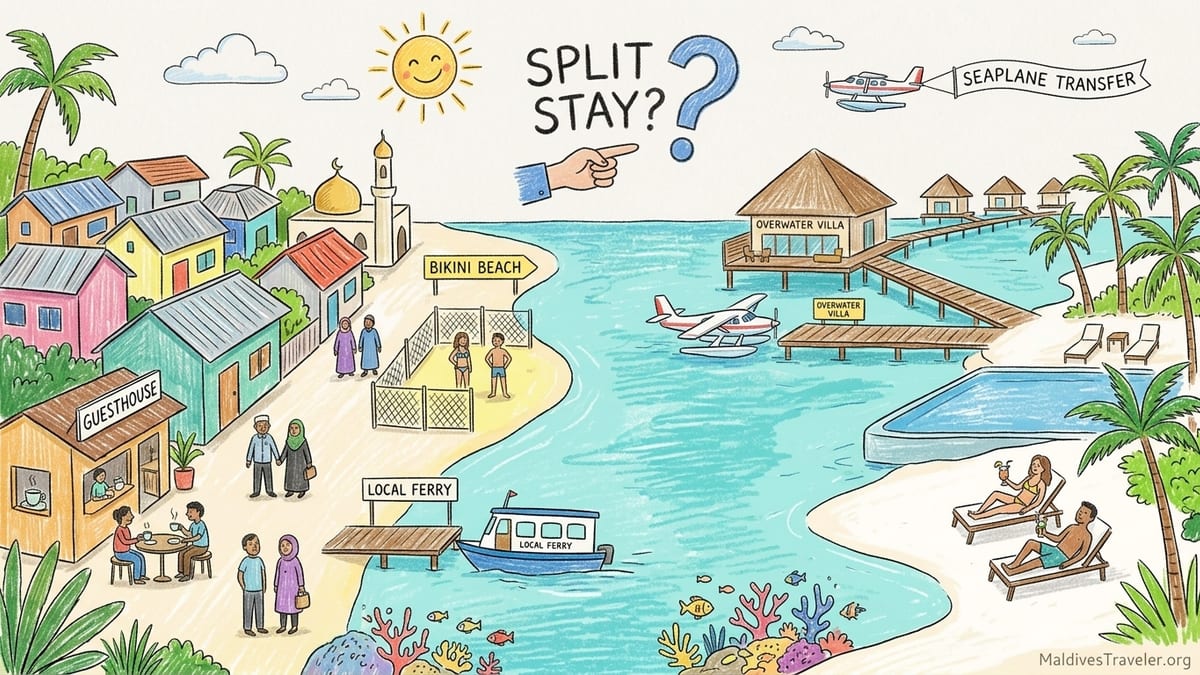
The Maldives is a chain of more than a thousand coral islands grouped into atolls, with a strict distinction between inhabited “local” islands and stand‑alone resort islands. On local islands, Maldivians live, work, go to school and attend mosques; guesthouses and small hotels operate alongside family homes and local cafes. Resort islands, by contrast, are leased to individual hotel companies and function as self‑contained bubbles, usually with just one resort per island and no resident local community.
For visitors, this separation matters because it governs what is permitted. The Maldives is a Muslim country, and alcohol sales and topless sunbathing are forbidden on inhabited islands by law. Alcohol is served only on resort islands and a handful of offshore “floating bars,” while swimwear is restricted to designated bikini beaches on local islands. On resorts, you can walk from villa to bar in a swimsuit and order wine with dinner without thinking about rules; on local islands, you are moving through a real village with its own rhythms, customs and expectations.
Geography also shapes logistics. Almost every resort requires a private transfer from the international airport in Malé by speedboat, seaplane or a mix of domestic flight plus boat, all arranged by the resort on fixed schedules. Local islands, particularly in the central atolls, are linked by cheaper public ferries and shared speedboats that also serve residents. That is why travelers planning a tighter‑budget trip often anchor their itinerary on local islands within speedboat reach of Malé, then selectively add a resort stay if budget allows.
Understanding this basic structure makes the trade‑offs clearer: local islands trade some freedoms and convenience for big cost savings and cultural immersion, while resorts trade higher prices for simplicity, privacy and the classic bare‑foot luxury postcard experience.
Trip Costs: Guesthouses vs Resorts, Transfers and Overwater Villas
Accommodation costs are where the gap between local islands and resorts becomes most visible. In 2026, a clean, air‑conditioned guesthouse or small hotel room on a well‑known local island such as Maafushi, Thulusdhoo or Ukulhas typically starts around 60 to 120 US dollars per night for two people with breakfast, rising to roughly 150 dollars for the best‑located beachfront rooms in high season. Budget travelers routinely build ten‑night trips for under 1,200 to 1,500 dollars in room costs by combining a couple of these islands.
At resorts, even entry‑level beach villas on four‑star islands near Malé commonly start around 350 to 600 dollars per night in shoulder season for two people on bed and breakfast, with five‑star properties frequently sitting in the 700 to 1,200 dollar range or more. Overwater villas, which many visitors picture when they think “Maldives,” add another jump: 2026 price tracking across mainstream five‑star brands shows many standard water villas pricing between roughly 1,200 and 2,500 dollars per night before taxes in popular months, with ultra‑luxury names charging far more. A seven‑night stay that mixes four nights in a beach villa and three nights in an overwater suite can easily reach 5,000 to 7,000 dollars for accommodation alone, even before flights.
Transfer costs amplify this difference. Local islands within a couple of hours of Malé are served by public ferries that cost the equivalent of only a few US dollars per person each way, along with shared speedboats that typically run around 30 to 60 dollars per person per trip depending on distance and operator. Many travelers heading to Dhigurah or Thulusdhoo, for example, book a shared boat organized by their guesthouse and pay under 200 dollars in total transfers across a multi‑island itinerary.
Resorts have no such public alternative. Most quote mandatory transfer packages that appear on your final bill. Recent 2026 rate compilations show shared speedboat transfers averaging around 250 to 300 dollars per adult for a round trip to nearby atolls, and seaplane transfers averaging roughly 600 dollars per adult return once taxes and fuel surcharges are counted. A couple flying by seaplane to a resort in the outer atolls can therefore spend 1,200 dollars or more on transfers alone. When you divide your budget, it is common to find that a week on local islands, including all inter‑island boats and several excursions, costs less than the transfers plus two or three nights in a mid‑range resort.
Beaches, Bikini Rules, Alcohol and Everyday Atmosphere
On resort islands, the beach is effectively an extension of your hotel. You can walk the shoreline in a swimsuit anywhere except within the immediate vicinity of staff housing or mosques, and private decks often give you direct lagoon access. Alcohol is served at bars and restaurants and included at no extra charge if you buy an all‑inclusive package. Sunset cocktails by the pool, champagne at breakfast or a bottle of wine with dinner are easy to fold into the day without thinking about logistics or legality.
Local islands feel very different. Because these are home to Maldivian families, modest dress is expected throughout the village areas. You can swim in a bikini only on designated stretches of sand usually marked as a bikini beach. These zones are often screened from view and signposted, but they may be smaller than resort beaches and can feel busy at peak times, particularly on highly developed islands like Maafushi. Away from the bikini beach you will need to cover shoulders and knees; lightweight dresses, T‑shirts and loose trousers work well in the heat.
Alcohol is not sold on inhabited islands at all. If you stay in a guesthouse on Thulusdhoo or Rasdhoo and want a drink, your realistic options are to go without, bring zero‑alcohol alternatives or arrange a short evening boat trip to an offshore bar boat if one is anchored nearby. Some local‑island visitors embrace this as a chance to reset their relationship with alcohol; others find that the absence of a sundowner ritual changes the mood of the holiday more than they expected. If having a glass of wine on your terrace defines vacation for you, a resort or at least a resort segment becomes much more attractive.
The trade‑off is a richer sense of place. On local islands you hear the call to prayer, see children walk to school, join locals in tiny haruge tea houses and eat at simple roshi and curry eateries where a filling meal might cost under 10 dollars. Evenings are quieter but more authentically Maldivian: you might chat with your guesthouse host about fishing conditions or join a barbecue on the beach. On resorts, the atmosphere is curated and international, closer to a luxury hotel anywhere with palm trees, albeit in a spectacular setting.
Privacy, Overwater Villas, House Reefs and Snorkeling
Privacy is one of the strongest arguments for resort stays. Many four‑ and five‑star properties intentionally keep villa counts low relative to island size, so that you can walk the beach without seeing more than a handful of other guests. Beach villas are often tucked behind vegetation with their own loungers on the sand, and overwater villas sit in arcs over the lagoon with direct ladder access to the sea. On some islands, sunset‑side water villas like those at Hurawalhi or Kagi command a premium for views and privacy.
Local‑island guesthouses vary widely. A few higher‑end boutique properties on islands like Dhigurah, Ukulhas or Keyodhoo offer spacious rooms, rooftop pools and direct bikini‑beach access, but many guesthouses are built along narrow streets with balconies or small courtyards rather than true private beachfront. On busier islands, beach chairs can be fairly close together and day‑trip boats may anchor off bikini beaches during peak hours. If your dream is to feel completely alone with the ocean outside your door, local‑island stays will rarely match the seclusion of a mid‑ or high‑end resort.
Snorkeling and diving quality depends mostly on the house reef and surrounding channels, not on whether the island is local or a resort. Some resort islands, particularly those in Ari and Baa atolls, have excellent reefs straight off the beach where you can see turtles and reef sharks within minutes. Others are mostly sand and require boat trips to reach good coral. Similarly, many local islands sit alongside healthy reefs, and guesthouses sell daily snorkeling excursions to manta cleaning stations, whale shark hotspots or outer‑reef sites. Dhigurah is a strong example: its long sandspit is famous for whale shark trips into South Ari atoll, and budget guesthouses there run similar excursions to nearby resorts’ dive centers but at much lower prices.
Overwater villas themselves remain almost exclusively a resort product. There are a few hybrid concepts where a resort sits next to or across a channel from a local island, but true stand‑alone water villas with buggies running along jetties are part of the one‑island resort model. If sleeping above the water is non‑negotiable, you will need some resort nights. The main cost decision then becomes how many nights you devote to that splurge vs more affordable beach or guesthouse nights before or after.
Food, Culture and Daily Life: What You Actually Do Each Day
On resort islands, your day naturally revolves around the property’s restaurants and scheduled activities. Breakfast is usually a generous buffet; lunch and dinner might be served in multiple outlets ranging from beach grills to Italian or Japanese venues. Prices reflect the isolated setting: a simple burger or pizza can run 25 to 35 dollars, and a three‑course dinner for two with drinks at an a la carte restaurant can easily pass 150 to 200 dollars. All‑inclusive packages bring predictability but add substantially to the nightly rate; 2026 pricing studies show that upgrading from half‑board to all‑inclusive can cost as much as or more than upgrading from a beach to an overwater villa at some properties.
Local islands offer simpler, cheaper and more local food. Guesthouse breakfasts often include Maldivian mashuni, a mix of tuna, coconut and chili eaten with flatbread, alongside eggs, toast and fruit. You might pay 5 to 10 dollars for a plate of grilled fish at a basic cafe, and 1 to 2 dollars for short eats like samosas or fried fish balls. Newer boutique properties now run small beachfront restaurants that cater to visitors with good coffee, smoothie bowls and Western dishes priced closer to resort levels, but you can easily keep daily food costs for two people under 40 to 60 dollars if you eat where locals do.
Culturally, local islands feel more like slow small‑town travel. You may walk along sandy streets lined with pastel houses, watch bodu beru drumming performances organized by your guesthouse, or join a fishing trip with a local captain whose day job is supplying reef fish to Malé. Religious life is visible, and shops may close briefly during prayer times or for public holidays. On resorts, cultural experiences are curated for visitors, such as Maldivian nights with buffet spreads and dance shows. These can be enjoyable introductions, but they are very different from buying fruit at a harbor market or chatting with your host family about monsoon changes.
Daily rhythm also differs. Resorts operate on “island time,” sometimes an hour ahead of Malé to stretch daylight, with activity boards listing yoga classes, sunset cruises and spa bookings. You rarely need to think about ferry timetables or shop hours. On local islands, you are more aware of schedules: making sure you catch the 7:30 shared speedboat to your next island, or that you return your snorkel gear before the dive shop closes. Some travelers love this mix of structure and independence; others prefer the frictionless feel of a resort where everything is on‑site.
Excursions, Activities and Hidden Costs
Excursions exist in both worlds but are priced very differently. A typical half‑day snorkeling trip from a resort, visiting two or three nearby reefs with guide and equipment, can cost 90 to 150 dollars per person. Whale shark or manta ray safaris often run higher. A sunset dolphin cruise with canapes and drinks might be quoted at 80 to 120 dollars per person. Add spa treatments, which frequently exceed 150 dollars per hour at five‑star properties, and it is easy to spend several hundred dollars a day on activities on top of your room and meal plan.
On local islands, guesthouse operators and independent boat owners run very similar excursions, especially in atolls known for big marine life. A half‑day group snorkeling trip from Maafushi might be priced around 25 to 50 dollars per person, including basic gear, while whale shark trips from Dhigurah commonly fall under 80 to 100 dollars per person. Fishing trips, sandbank picnics and even resort‑day passes are routinely advertised outside guesthouses. Quality can be more variable than at professional five‑star dive centers, so reading recent reviews and asking about safety gear like life jackets and radios is sensible, but the price gap is hard to ignore.
Transfers between islands are another hidden line item. Within the local‑island network, moving from Malé to Maafushi and later on to Fulhadhoo or Rasdhoo can often be stitched together with shared speedboats and occasional public ferries for well under 200 dollars total for a couple over a 10‑day trip. By contrast, some travelers have reported quotes exceeding 2,000 dollars for private speedboat charters just to visit a specialty underwater restaurant or distant resort for lunch from another island, especially when long waiting times for the boat are factored in. Planning your itinerary to avoid unnecessary hops between far‑flung atolls keeps costs manageable whichever style you choose.
Taxes and service charges are worth factoring into your comparisons. Resorts typically add a 10 percent service charge and 16 percent goods and services tax to almost everything, from room rates to cocktails and spa treatments, plus a government green tax per person per night. Local guesthouses and cafes also charge tax and green tax but at much lower base prices, so the absolute impact is smaller. When travelers on forums break down why their resort bill ended up 30 or 40 percent higher than they expected, these add‑ons plus transfers and excursions are usually the explanation.
Who Should Choose a Local Island, Who Belongs on a Resort, and When to Split
A local‑island base works best for independent travelers who value immersion and value over pampering. If you are comfortable dressing modestly away from the bikini beach, skipping alcohol or saving drinks for a few resort days, and navigating basic logistics like ferries and shared speedboats, you can stretch your budget very far. Honeymooners on a tighter budget often build two weeks split among Dhigurah, Thulusdhoo and Ukulhas, spending on longer whale shark and manta trips instead of high nightly rates. Solo travelers and digital nomads also appreciate the social feel and lower restaurant bills on local islands.
On the other hand, many people will be genuinely happier at a resort, even once they understand the cost. If this is your once‑in‑a‑decade honeymoon and you dream about walking barefoot from an overwater villa deck into a turquoise lagoon, ordering room‑service breakfast on a floating tray and having staff remember your name at the bar, a resort delivers that emotional hit. Couples who see cocktails, wine and long lazy pool days as central to their holiday often find the alcohol ban on local islands frustrating. Families with young children may prefer kids’ clubs, medical staff on call and 24‑hour restaurants to the more ad hoc arrangements on local islands.
Split stays are increasingly popular because they solve the either‑or dilemma. A common pattern in 2026 is to land in Malé, head straight to a local island reachable by shared speedboat for four or five nights, then finish with three nights in a resort either by speedboat or seaplane. For example, a couple might spend five nights on Thulusdhoo surfing and snorkeling from a 90‑dollar‑a‑night guesthouse, then move to a mid‑range resort like Cinnamon Dhonveli or Kagi in an overwater villa for the final three nights before flying home. This keeps the overwater villa splurge to a manageable slice of the budget while still delivering the full resort experience at the end.
To decide your own mix, start from non‑negotiables. If you must have daily wine, unlimited bikini‑beach freedom and maximum privacy, prioritize resorts and trim the trip length if necessary. If you would rather travel longer, see more than one island and spend on wildlife trips over nightly rates, anchor on local islands and add just enough resort time to satisfy the overwater‑villa dream. In practice, many travelers report that four or five nights in a resort is plenty once they see the bill for food and drinks, making a week on local islands plus a shorter resort finale a very workable compromise.
How to Plan in 2026: Practical Booking Tips and Realistic Budgets
Whichever route you choose, planning with 2026 prices in mind will prevent sticker shock. Long before you press “book,” collect quotes that include room, transfer and taxes for the exact dates you are considering, then compare that to a model local‑island itinerary with realistic excursion and food costs. Resort price trackers and tour operators now publish sample week‑by‑week cost breakdowns that can give you ballpark figures: for instance, a seven‑night package at a four‑star resort with a mix of beach and water villas plus speedboat transfers might total around 5,000 to 6,000 dollars for two in low season, but jump much higher for peak festive weeks.
For a primarily local‑island trip, many couples report spending in the region of 120 to 200 dollars per day all‑in for two people, including a guesthouse, meals, a shared excursion every couple of days and inter‑island transfers. That puts a 10‑night trip somewhere near 1,500 to 2,000 dollars excluding international flights. Adding three nights in a mid‑range resort water villa at, say, 1,200 dollars per night plus 600 dollars total in seaplane transfers pushes the overall budget closer to 6,000 dollars, but with a very different feel than spending all 13 nights at that rate.
Booking approaches differ too. Resorts are easiest to book through major booking platforms, specialist Maldives travel agencies or directly with the hotel, which may offer bundled transfer and meal‑plan promotions. Local guesthouses, especially newer boutique ones, also advertise on big booking sites, but many still rely on direct messaging for shared‑boat schedules and packages that include excursions. Reading very recent reviews matters: a bikini beach that was quiet three years ago might now sit in front of a construction site, while a once‑basic guesthouse may have added a rooftop plunge pool and better soundproofing.
Finally, build slack into your schedule. Seaplanes operate in daylight hours only and can be delayed by weather; public ferries on local routes do not run every day and may be canceled for rough seas. Avoid planning a night on a far‑flung local island immediately before an early‑morning international flight, and consider spending your last night near Malé, either at a resort close to the airport or on Hulhumalé, to absorb any disruptions. The Maldives rewards unhurried travel; giving yourself room for weather and schedule changes keeps the experience relaxing rather than stressful.
FAQ
Q1. Is a local island in the Maldives really that much cheaper than a resort?
Yes, in most cases. A good local‑island guesthouse for two with breakfast can cost less than 100 to 150 dollars per night, while mid‑range resort villas often start several times higher, and transfers, alcohol and activities are also much more expensive at resorts.
Q2. Can I drink alcohol on a Maldives local island if I am a tourist?
No. Alcohol is not sold on inhabited local islands, regardless of your nationality. You can only drink legally on resort islands or special offshore bar boats, so if sunset cocktails matter to you, plan at least some resort nights.
Q3. Are bikini beaches on local islands as nice as resort beaches?
They can be beautiful, with clear water and white sand, but they are usually smaller, may be busier and are restricted zones rather than the whole shoreline. Resorts generally offer wider, quieter beaches with more privacy and direct access from your villa.
Q4. How much should I budget for seaplane or speedboat transfers to a resort?
For 2026, shared speedboat transfers to nearby atolls often run around 250 to 300 dollars per adult round trip, while seaplane transfers commonly cost about 600 dollars per adult round trip once taxes are added, so a couple can easily spend 500 to 1,200 dollars on resort transfers alone.
Q5. Do local‑island guesthouses include excursions like whale shark trips?
Not usually in the base room rate, but almost all can arrange excursions such as snorkeling, sandbank visits and whale shark or manta trips at extra cost, typically much cheaper than resort‑run equivalents when priced per person.
Q6. Is it safe and culturally appropriate to stay on a local island as a couple?
Yes, provided you respect local customs. Married and unmarried couples can share rooms, but you should dress modestly away from the bikini beach, avoid public displays of affection in the village and be mindful around prayer times and mosques.
Q7. Can I do a day visit to a resort while staying on a local island?
Sometimes. A few resorts sell day‑pass packages that include transfers, lunch and limited access to facilities, and some local guesthouses can arrange these. However, private transfer quotes can be very expensive, so it often makes more sense to book at least one or two nights at the resort instead.
Q8. How many nights should I spend in an overwater villa?
For many travelers a short stay of two to four nights is enough to enjoy the experience without overwhelming the budget. You can combine those nights with cheaper beach villas or local‑island guesthouses before or after to balance cost and comfort.
Q9. Will I miss out on Maldivian culture if I only stay at a resort?
You will see less everyday local life. Resorts may offer Maldivian‑themed evenings and staff interactions, but you will not experience village streets, local cafes or ordinary island routines in the same way as you would on a local island.
Q10. What is the best way to split a stay between a local island and a resort?
A practical pattern is to start with four to six nights on a local island within shared‑speedboat reach of Malé, focusing on snorkeling and exploring, then end with two to four nights at a resort, ideally one that uses the same transfer route, so you minimize backtracking and extra transport costs.