


The Maldives is usually sold as an overwater-villa dream, but some of its most exciting underwater encounters sit right off the beaches of lived-in local islands. For independent travelers, islands like Dhigurah, Dharavandhoo, Rasdhoo, Fulidhoo, Ukulhas and Thulusdhoo offer serious snorkeling and diving at a fraction of resort prices, with guesthouses, local cafés and bikini beaches just a few minutes’ walk from world-class reefs. The key is choosing the right base for the kind of water time you want, from easy house-reef snorkeling to current-heavy shark channels.
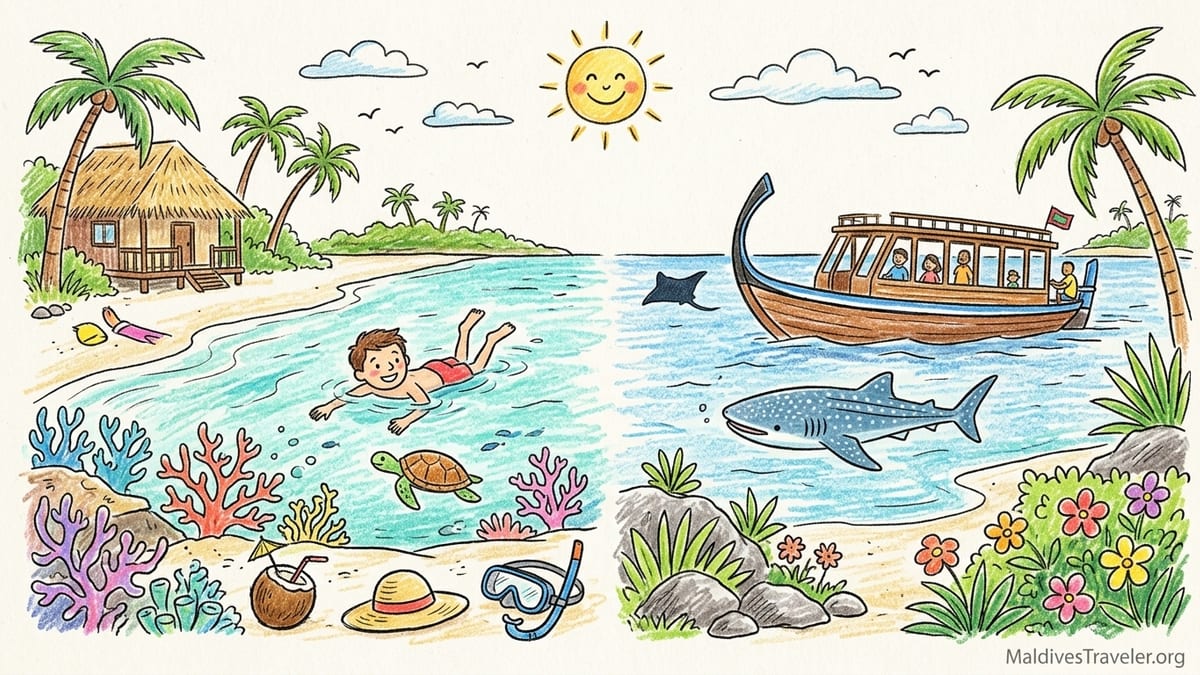
How to Choose the Right Maldives Local Island for the Water You Want
Before comparing individual islands, it helps to split experiences into four practical buckets: shore snorkeling you can do any day from the beach, boat-based snorkeling that depends on marine-life hotspots, beginner-friendly diving, and advanced sites with strong currents or deep profiles. On a short Maldivian trip you are unlikely to do everything, so knowing which islands really excel in each category avoids expensive transfer hops and disappointment.
Shore snorkeling means you can wake up, walk from your guesthouse to a bikini beach, and be over coral in minutes. Islands with a healthy house reef or easy-access drop-off, such as Ukulhas, are ideal if you want daily, low-effort time in the water without booking a boat every morning. In practice, this is also what keeps costs down, because you are not paying 40 to 70 US dollars per person for each excursion.
Boat-dependent encounters, on the other hand, are what make places like Dhigurah or Dharavandhoo special. Nobody swims to the whale-shark feeding grounds of South Ari or the manta aggregation of Hanifaru Bay. Instead, local dive and excursion centers run scheduled trips, and you build your days around their departure times. This is where choosing the right island in the right atoll really matters, because you want short boat rides to increase your actual water time.
For diving, the divide is similar. Some islands are perfect if you are newly certified or even planning to take your Open Water course, with easy inner-reef sites and limited current. Others, such as Rasdhoo and Fulidhoo, are firmly in “serious diving” territory, with famous channel dives, early-morning hammerhead or shark runs and the need to be comfortable in blue water. Choosing a local island that matches your experience level, and being honest with local dive guides about your comfort with currents, will make or break your trip.
Dhigurah: South Ari’s Local-Price Base for Whale Sharks
Dhigurah, in South Ari Atoll, has become the number-one local island recommendation for travelers focused on whale sharks. It sits right on the edge of the South Ari Marine Protected Area, a stretch of outer reef where these huge but gentle sharks are encountered year-round. Day boats from resorts travel here daily just for the chance of a single sighting. On Dhigurah, you are already in the neighborhood, which means shorter boat rides, more time in the water and lower excursion prices per trip compared with resort-based tours.
Whale shark experiences here are almost always boat-based. Guesthouses typically advertise half-day excursions that cost in the region of 60 to 100 US dollars per person, including gear, with a mix of snorkeling and sometimes a drift over a coral reef on the way back. A common pattern is a morning briefing at the dive center, a 20 to 40 minute boat search along the reef edge, then a quick “go, go, go” as the crew spots a shadow under the surface. Expect to enter the water several times and swim hard, since the sharks cruise at a steady pace.
For snorkeling-only visitors, Dhigurah’s own lagoon and nearshore reef offer pleasant swims, but the standout is still the boat excursion into the Marine Protected Area. Strong swimmers who are comfortable jumping repeatedly from a moving boat and dealing with some chop will get the best from it. Families with younger children or non-swimmers can instead opt for gentler half-day trips that combine a look for whale sharks with sandbank stops and turtle snorkeling on quieter reefs.
Divers can book specific whale-shark scuba trips, but most first-timers prefer staying at the surface where encounters tend to last longer and there is more freedom to move. If you are newly certified, local dive shops will often suggest starting with easy reef dives to get used to Maldivian conditions before attempting any deeper or current-affected sites in the atoll. Dhigurah works particularly well as a mixed group base: keen snorkelers chase whale sharks while less confident swimmers relax on the broad sand spit or book short lagoon sessions.
Dharavandhoo: Manta Season and Baa Atoll’s Biosphere Reserve
Baa Atoll, north of the capital region, is globally known for Hanifaru Bay, a sandy-bottomed pocket of reef that becomes a magnet for feeding manta rays from roughly June to November. Dharavandhoo is the main local island for travelers who want to experience this phenomenon without staying at a luxury resort. With a domestic airport, multiple guesthouses and several dive centers, it functions as a small hub during manta season, and many operations run daily boats to the bay when conditions align.
Hanifaru Bay itself is snorkel-only and strictly regulated, so this is a classic example of boat-dependent snorkeling. You join a licensed operator, ride 15 to 30 minutes to a park entry point, and have a timed window in the water as mantas funnel in to feed on plankton clouds. On busy days, you might share the bay with several other boats, but the actual moment you slide in beside a swirling column of rays feels anything but crowded. Expect costs to start from around 80 to 120 US dollars per person for a dedicated Hanifaru trip, reflecting permit fees and boat time.
Outside the bay, Dharavandhoo offers more flexible snorkeling. The house reef off the island has coral slopes and cleaning stations where mantas and reef fish gather, and guesthouses often organize shorter, cheaper outings there for 30 to 50 US dollars per person. This is a gentler option for less confident swimmers or for days when the bay is closed due to weather or low manta activity. Guided night snorkeling with fluorescent torches is also sometimes offered, which can be good for macro life and shy reef creatures.
For divers, Dharavandhoo is best suited to those with at least a handful of logged dives. Sites like Dharavandhoo Corner sit at the edge of atoll currents, and while local guides choose conditions carefully, you should be ready for drift dives and mid-water descents. During peak manta season, dive operators focus on cleaning stations and outer reefs where mantas circle above divers. Beginners can complete Open Water courses here, but if mantas are your main goal it is often smarter to arrive already certified so you can spend your dives on signature sites rather than training skills in the lagoon.
Rasdhoo: Hammerheads, Channels and Serious Diving
Rasdhoo, the single inhabited island of Rasdhoo Atoll just off North Ari, is synonymous in dive circles with early-morning hammerhead shark dives. The outer reef and channels here funnel colder, nutrient-rich water up from depth, which attracts pelagics and keeps the shark population healthy. Local dive operators routinely schedule dawn trips to a site commonly known as Hammerhead Point, where divers drop into blue water at around 25 to 30 meters, hover, and scan the haze for silhouettes of scalloped hammerheads cruising past.
This is very much an advanced experience. Currents in and around Rasdhoo’s channels can be strong and changeable, and the hammerhead dive itself often takes place away from the reef, with few visual references and a premium on good buoyancy control. Most dive centers require at least an Advanced Open Water certification and recent deep-dive experience, and they may ask guests to do a regular reef dive first to assess comfort levels. It is not the place to try scuba for the first time.
That said, Rasdhoo also offers less intimidating sites. Wall dives and sheltered thilas within the atoll give beginners and intermediate divers the chance to see abundant reef fish, turtles and whitetip reef sharks without battling heavy current. Prices for a two-tank boat trip from local dive shops typically fall in the 90 to 140 US dollar range, depending on equipment rental and fuel costs, which makes it competitive with many resort dive centers while offering more intense diving than nearby beginner-focused islands.
Snorkelers visiting Rasdhoo should be realistic about what the island offers. There are pleasant house-reef sections accessible from the beach, but the headline encounters here are almost all scuba-based. Many guesthouses still organize dolphin cruises or turtle snorkeling trips for mixed groups, yet this is fundamentally a diver’s island. If your party includes non-divers who want to be in the water for hours every day without boats, another island with easier shore snorkeling may be a better match.
Fulidhoo: Vaavu Atoll’s Sharks, Channels and Night Thrills
Fulidhoo, in Vaavu Atoll, has built a strong reputation among divers and underwater photographers for its shark life and dramatic channels. Vaavu’s narrow, deep passes carry oceanic water into the atoll, and sites close to Fulidhoo offer high-adrenaline drifts with grey reef sharks, whitetips and eagle rays. Advanced divers in particular are drawn to channels such as Miyaru Kandu, where descending to the edge of the pass and hooking in allows you to watch schools of pelagics hang in the current.
One of the most talked-about experiences based out of Fulidhoo is year-round diving with large numbers of nurse sharks at dedicated sites where the animals are habituated to divers. These dives usually take place in the late afternoon or at night, and involve kneeling on the sandy bottom as broad-bodied nurse sharks glide within arm’s length. It is essential to go with a reputable operator that manages group behavior carefully and brief guests on not touching or harassing the sharks. Expect to pay similar rates to daytime diving, with an extra supplement for night operations.
Beginners can and do learn to dive in Fulidhoo, but it is important to understand that many of the signature sites are current-exposed and better suited to divers with a bit of experience. Local centers often start new divers on calm lagoon thilas and sheltered reefs before offering channels. If you are newly certified and traveling with more advanced buddies, a realistic plan might be to spend your first couple of days on easy reefs, then join one or two moderate channel dives under close supervision rather than jumping straight into maximum-flow conditions.
For snorkelers, Fulidhoo delivers decent reef life on boat trips, but daily shore snorkeling is not its primary selling point. There are shallow sandy areas perfect for swimming and beginner practice, yet the healthiest coral and the best chance of bigger fish sit a speedboat ride away. This makes it an excellent base for dedicated divers, underwater photographers and shark enthusiasts, while casual holiday snorkelers may find more value on islands with standout house reefs.
Ukulhas: Easy House-Reef Snorkeling for Every Day in the Water
Ukulhas, in North Ari Atoll, has become a favorite among budget-conscious travelers who are more interested in relaxed daily snorkeling than in chasing high-adrenaline dives. The island is known for its relatively good environmental management and long bikini beach, and crucially, for having a house reef that can be reached directly from shore in a few fin kicks. For visitors who want to just walk out and be over coral, this is one of the most practical choices.
In real terms, this means you can keep your costs low while still spending hours in the water. Many guesthouses lend masks and fins for free or for a modest daily charge, and you can plan your snorkeling sessions around the light rather than around a boat schedule. Mornings with low wind usually bring the clearest visibility, and it is common to see turtles grazing on seagrass, schools of reef fish, and the occasional reef shark cruising the drop-off just by staying close to the beach.
Ukulhas-based excursion centers do run boat trips, often to manta cleaning stations in season or to sandbanks and nearby reefs in the wider Ari region. Prices are generally competitive, starting in the 40 to 70 US dollar range for half-day snorkeling tours with equipment. The difference compared with more boat-dependent islands is that these are optional extras rather than the main way you will access the water. If you wake up to rain or choppy seas, you can easily postpone a sandbank outing without feeling like you have lost your only water time for the day.
Divers will find a mix of easy and moderate sites accessible from Ukulhas, but this is not an atoll hotspot in the same sense as Rasdhoo or Fulidhoo. The island suits travelers whose top priority is simple, repeatable snorkeling and beach time, perhaps with young children or non-swimming relatives. Its house-reef focus also makes it a good choice if you are planning a longer stay of 10 days or more, where the ability to get in the water independently matters more than ticking off specific bucket-list species.
Thulusdhoo: Combining Accessible Diving with Iconic Surf Breaks
Thulusdhoo, in North Male Atoll, is widely known in the surf world as the home of the Cokes and Chickens reef breaks, which draw intermediate and advanced surfers during the main swell seasons. For travelers, this translates into a lively local island scene with surf camps, guesthouses and a handful of dive shops catering to people who want to split their time between waves and reefs. It is one of the closest local islands to Male by speedboat, making transfers straightforward for shorter holidays.
Underwater, Thulusdhoo’s diving is more moderate than the channel-heavy atolls further afield. Local dive centers visit nearby reefs with healthy coral gardens, turtles and reef sharks, and conditions are often suitable for beginners or those completing an Open Water course. Visibility can be excellent in the dry season from roughly January to April, and typical two-tank trips cost in the 90 to 130 US dollar range from local operations, similar to other islands.
For snorkeling, Thulusdhoo has calm lagoon areas and house-reef spots that are pleasant rather than spectacular. Many surf-focused visitors are happy with occasional afternoon snorkels between sessions on Cokes or Chickens, while non-surfers may join half-day trips to outer-reef snorkeling sites. As on most inhabited islands, there is a designated bikini beach where swimwear is allowed, while the rest of the shoreline follows local dress norms, something to keep in mind if you are planning spontaneous swims.
The big appeal of Thulusdhoo is the ability to mix activities. A typical week might see three mornings of surfing, two dive days and a couple of lazy snorkeling afternoons. Guesthouses often sell combined surf-and-dive packages, with daily boat transfers to the breaks, simple full-board meals and optional dives on off days. This makes it particularly attractive for groups where some members surf, some dive and others simply want a relaxed island with a bit of everything.
Building Your Personal Water-Activity Plan
When you put all six islands side by side, a pattern emerges. Dhigurah is the clear choice for travelers whose non-negotiable goal is to see a whale shark, with a strong focus on boat-based snorkeling and a bonus of resort-quality sandbanks nearby. Dharavandhoo is the seasonal manta specialist, best from about June to November, with Hanifaru Bay excursions defining many itineraries. Rasdhoo and Fulidhoo stand out as diver-centric islands with demanding channels and signature shark dives, while Ukulhas and Thulusdhoo cater more to travelers who want easy daily water access and a good mix of activities.
If your priority is easy shore snorkeling with minimal logistics, Ukulhas belongs at the top of your list, with Thulusdhoo as a runner-up that adds good-value diving and surfing. For serious divers confident in currents and deeper profiles, Rasdhoo and Fulidhoo offer the most intense underwater action, from hammerheads to sharky passes and night dives with nurse sharks. Newer divers can still enjoy these islands by working closely with local guides to select gentler sites, but should not feel pressured into joining advanced dives just because they are famous.
Travelers planning their first Maldives trip often underestimate transfer time. Dhigurah, Dharavandhoo, Rasdhoo and Fulidhoo all require either domestic flights or longer speedboat rides from Male, which can add a few hundred dollars per person to your budget. Thulusdhoo and Ukulhas are typically reachable by scheduled speedboats at more modest prices, making them friendlier choices for shorter, cost-sensitive stays. In all cases, it is wise to confirm current transfer schedules and prices with your guesthouse before booking international flights, since timetables can change seasonally.
Finally, remember that conditions matter. Whale sharks in South Ari are present year-round, but surface visibility can drop during rough weather. Manta activity at Hanifaru peaks in specific months, yet any given day may still be quiet. Currents in Rasdhoo or Vaavu can be gentle one day and roaring the next. Building some flexibility into your itinerary, allowing two or three possible days for each marquee excursion, gives you a much better chance of catching these animals at their best.
The Takeaway
Choosing the best Maldives local island for snorkeling and diving is less about finding a single “perfect” destination and more about matching one island’s strengths to your own priorities and comfort level in the water. Dhigurah delivers the most reliable access to South Ari’s whale sharks, Dharavandhoo sits at the doorstep of Baa Atoll’s manta-filled biosphere reserve, Rasdhoo and Fulidhoo reward confident divers with serious channels and sharks, while Ukulhas and Thulusdhoo offer everyday reef time combined with straightforward logistics and land-based comforts.
By separating easy shore snorkeling from boat-only encounters, and beginner diving from current-heavy sites, you can design a trip that feels exciting rather than intimidating. Whether that means learning to snorkel over Ukulhas’s house reef, drifting with mantas off Dharavandhoo, or rolling into blue water at Hammerhead Point depends on what makes you happiest in the ocean. With the right match, a local-island stay in the Maldives can give you the same world-class marine life as the big-name resorts, with more local flavor and a far more manageable bill.
FAQ
Q1. Which local island is best for year-round whale shark encounters? Dhigurah in South Ari Atoll is the most reliable local-island base, with frequent boat trips into the South Ari Marine Protected Area where whale sharks are seen in all seasons.
Q2. When is the best time to visit Dharavandhoo for manta rays at Hanifaru Bay? The main manta season typically runs from around June to November, when plankton builds up and large numbers of mantas gather in Hanifaru Bay for feeding.
Q3. Is Rasdhoo suitable for beginner divers? Rasdhoo has some beginner-friendly reef sites, but its most famous dives, such as Hammerhead Point and certain channels, involve depth and current more appropriate for advanced divers.
Q4. Can non-divers still enjoy Fulidhoo? Yes, non-divers can join snorkeling excursions and relax on the beaches, but Fulidhoo’s real strength is its channel and shark diving, so dedicated snorkelers might prefer an island with a stronger house reef.
Q5. Which island is best if I want easy daily snorkeling without booking boats? Ukulhas is a top choice, as its house reef is easily reached from shore, allowing you to snorkel directly from the bikini beach whenever conditions are calm.
Q6. Is Thulusdhoo a good option for combining surfing and diving? Thulusdhoo is ideal for that mix, offering access to the well-known Cokes and Chickens surf breaks along with nearby reefs suitable for beginner and intermediate divers.
Q7. How much should I budget for a typical snorkeling excursion from a local island? As a rough guide, half-day snorkeling excursions from local islands often cost between 40 and 100 US dollars per person, depending on distance, fuel prices and whether special permits are required.
Q8. Do I need advanced certification for manta dives around Dharavandhoo? Many manta-focused dives are manageable for Open Water divers, but having an Advanced certification improves your access to deeper or more current-exposed sites and gives dive centers more flexibility in site choice.
Q9. Are currents in the Maldives dangerous for snorkelers? Currents can be strong, especially near channels, but guided snorkel trips choose safer sites and times; independent snorkelers should stay close to shore, avoid channel mouths and follow local advice.
Q10. Can I learn to dive on a Maldives local island or should I arrive already certified? You can learn on several islands, including Dharavandhoo, Fulidhoo and Thulusdhoo, but arriving certified lets you spend more of your trip on signature dives rather than on training sessions in the lagoon.