


Local island holidays in the Maldives have grown up. What started as a handful of simple guesthouses has become a competitive market of fully packaged stays that bundle accommodation, transfers and excursions, plus optional resort nights and serious dive time. If you want lagoon blues without a five-star price tag, understanding how these packages work in 2026 can save you hundreds of dollars and a lot of logistical hassle.
How Local Island Packages Work in 2026
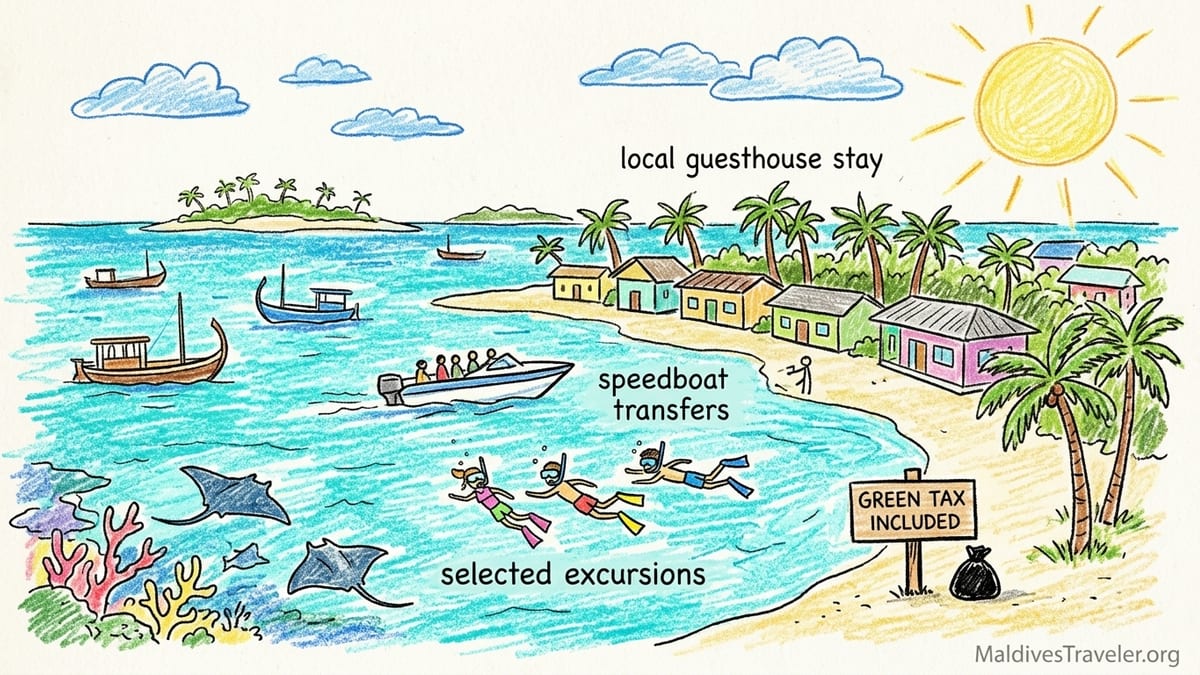
On inhabited islands across the Maldives, guesthouses and specialist agencies now sell complete holiday packages that look and feel much closer to resort offers than a few years ago. Instead of booking a room, separate speedboats and day trips yourself, you can buy a five to ten night bundle that covers your stay in a local guesthouse, all speedboat transfers from and to Malé, selected excursions and taxes. Operators like IM Maldives, Aquaventure Maldives in Addu and small island guesthouses in Baa, Ari and South Malé atolls advertise these as “local island escapes” or “guesthouse adventure” packages aimed squarely at travelers who want a simple, fixed price.
Typical offers range from around 900 to 1,300 US dollars per person for five to seven nights in 2026, based on shared double rooms and shared speedboat transfers. A recent Baa Atoll five-night local island adventure from a Malé-based agency, for example, was sold at about 950 US dollars per person in low season with accommodation, breakfast, a manta-ray snorkel trip in season and a couple of half-day excursions included. Prices climb when you add more meals, diving or private transfers, but the key selling point is clarity: you know your core costs and schedule before you land at Velana International Airport.
These packages are especially attractive if you are unfamiliar with inter-island transport timetables or if your flight times do not line up cleanly with public ferries. Many guesthouse owners will now suggest a package first, then quote room-only as the alternative. For a first visit, or when traveling with children, there is real value in having someone else coordinate your airport meet-and-greet, the right speedboat departure and an excursion schedule that fits the local tides and weather.
What Is Included: Rooms, Meals, Taxes and Green Tax
Most local island holiday packages clearly indicate which meals are included and whether taxes and mandatory fees are already factored into the headline rate. In the Maldives, you pay Tourism Goods and Services Tax, often shortened to TGST, on most tourism services, and Green Tax per person per night. Since January 2025, Green Tax has doubled for most categories, including resorts and larger guesthouses. Small guesthouses with 50 or fewer rooms on inhabited islands generally charge around 6 US dollars per person per night in Green Tax, while bigger properties and resorts collect about 12 US dollars per person per night. Children under two are usually exempt, but families should always check the small print.
The simplest way to compare packages is to ask three direct questions before you book: does the price already include TGST and service charge on the room, are all Green Tax payments covered, and are taxes on transfers and excursions included or added at the end. Some serious local operators now explicitly advertise “17 percent TGST, 10 percent service charge and applicable Green Tax included” on their dive and stay bundles, which means the price you see is close to the amount you will pay on check-out. Others quote a net rate and add TGST and Green Tax on top. The difference can easily reach several hundred dollars for a week-long stay for a couple.
Meal plans vary from bed and breakfast to full board. Local guesthouse packages that position themselves as stress-free often include breakfast and dinner, with lunch left flexible for days spent out on the water. Some, like family-run guesthouses on Hangnaameedhoo or Dhigurah, sell full board fishing or snorkeling packages where all three meals are included, often home-cooked Maldivian food eaten alongside the owners or other guests. When you compare offers, calculate what you would realistically spend on meals if they were not included. On most local islands, a simple meal in a café might cost 5 to 10 US dollars. Over a week, half-board that is priced 20 to 25 US dollars more per person per day than bed and breakfast can still be good value.
Guesthouse + Transfer + Excursion Bundles
Classic local island holiday packages are built around a guesthouse stay, shared speedboat transfers and a handful of included excursions. Asia Inn on Hangnaameedhoo, for instance, promotes deals that include return speedboat transfers from Malé (about 80 minutes each way), all meals and a set of excursions such as a sandbank picnic, guided snorkeling on nearby reefs, dolphin watching and sunset fishing. Another example is a four-night Maafushi or Omadhoo guesthouse package that includes breakfast, a snorkeling excursion, a combined sandbank and dolphin cruise, and a traditional fishing night, but leaves lunches and dinners free so guests can try local cafés.
These bundles work best if you want variety without decision fatigue. Having your first reef snorkel, a sandbank afternoon and a dolphin cruise already confirmed in your program means you can still book extra activities locally if the weather is good and your budget allows. In practice, standalone excursions on popular islands like Maafushi often run between 25 and 60 US dollars per person for half-day shared trips with snorkel gear and soft drinks. When a package folds two or three such trips into the overall price, plus transfers, you usually pay less than organizing every element after arrival.
Logistics are also more forgiving with packages. If a public speedboat schedule changes, it is the guesthouse or local agent that rearranges your transfer, not you refreshing Facebook pages and WhatsApp numbers from abroad. This can be especially useful during Ramadan or outside the high season, when some independent boat operators run fewer services. For many travelers, that peace of mind is worth a modest premium compared with piecing together room-only rates and individual shared speedboat tickets.
Half Board Stays vs Full Packages
Not every traveler needs a fully bundled experience. Many local islands now have enough cafés and small restaurants to make bed and breakfast or half board a sensible choice, especially if you prefer flexibility and do not mind planning your own days. Dhigurah in South Ari Atoll, for example, has beachfront coffee shops, juice bars and simple eateries where you can eat well for 10 to 15 US dollars per person. On an island like this, a half-board guesthouse stay combined with pay-as-you-go excursions from different operators can be more rewarding than an all-inclusive style package.
Half-board packages typically mean breakfast and dinner at your guesthouse, with water and sometimes soft drinks included. Lunch is either taken in town or on the boat during a day trip. In cost terms, you can use a simple rule of thumb. On a local island with several dining options, if a half-board rate is 15 to 20 US dollars more per person per night than a bed and breakfast rate, and dinner is buffet-style or a generous set menu, it is usually fair value. If the uplift is 30 US dollars or more per person and the island has plenty of cheap cafés, you might save money by going bed and breakfast and eating out.
There is also a cultural angle. Staying on a local island means you are in a Muslim community, with normal Maldivian life happening around you. Alcohol is not served in island cafés and you dress modestly away from designated bikini beaches. For some guests, taking more meals in the community rather than at the guesthouse adds to the experience. Others are happier with predictable dinners on-site, especially families with small children. When speaking with operators, be frank about your priorities. Many are willing to tweak meal plans or swap one included excursion for another to better fit your style.
Dive Packages and Who They Suit
For certified divers, local island dive-and-stay packages can be among the best-value ways to experience Maldivian reefs, channels and manta cleaning stations. Operators like Dhiguveli on Dhigurah, Muraka Diving in Addu Atoll, Aveyla Manta Village in Baa Atoll and Aquaventure in Addu partner directly with nearby guesthouses to offer bundled stays with a set number of boat dives. A typical offer in 2026 might be seven nights in a guesthouse on full board with ten guided boat dives for around 1,300 to 1,600 US dollars per diver, depending on season, room category and equipment rental.
What is usually included in these dive packages is accommodation in a simple but comfortable room with air conditioning and private bathroom, breakfast, lunch and dinner, daily boat trips to local dive sites, tanks, weights and the services of dive guides. Some deals include full rental equipment, while others price it separately to accommodate divers who travel with their own gear. Taxes and Green Tax may or may not be folded into the advertised total, so divers should confirm before booking. Transfers from Malé are sometimes part of the package, especially in Addu where domestic flights and local transfers combine, but in other cases you pay for your own speedboat or domestic flights on top.
Dive packages are usually worth it if you plan at least ten dives over a week. Buying single boat dives à la carte can cost 60 to 90 US dollars per tank on local islands once TGST and service charge are added, plus extra for full gear. Bundles that work out at about 50 to 70 US dollars per dive including accommodation and food represent strong value. They also guarantee your spot on the boat during popular manta and whale shark seasons, when last-minute availability can be tight. If you only want to dive two or three times, however, a general guesthouse package with one optional dive day bought locally will be more economical.
Split Stays: Local Island Plus Resort
A growing trend in 2026 is the split stay that combines a few nights on a local island with two or three nights in a private resort. Several Maldivian and European operators now sell explicit “guesthouse plus resort” packages, sometimes marketed to honeymooners or couples who want both house reef luxury and a taste of village life. An example is a nine or ten night bundle where you spend five or six nights in a guesthouse on a South Malé atoll island like Guraidhoo or Maafushi, then transfer by speedboat to a nearby resort such as Adaaran Club Rannalhi or another mid-range property in the same atoll for three or four nights.
Specialist dive operators have created similar concepts that pair a dive-focused local island with a more relaxed resort at the end. A dive center might offer ten boat dives over five days while you stay in a guesthouse on the local island, followed by a few nights at a resort that shares or neighbors the same house reef. This format is appealing if you want world-class diving, but a quiet, fully catered finish to the trip. Because the transfers between local island and resort are often short speedboat hops, package providers can keep logistics simple and group the costs into a single quote.
Financially, these split stays are advantageous when the operator can leverage contracted resort rates that are lower than what you might find as an individual through general search engines. You might see a combined local island plus four-star resort offer starting around 2,000 to 2,500 US dollars per person for eight or nine nights in shoulder season, including shared speedboat transfers, breakfast and dinner throughout and at least one or two excursions on the local island. Booking the same elements yourself can sometimes be cheaper in raw numbers, but you then carry the risk if delayed flights cause you to miss a transfer leg or if a resort adjusts its compulsory transfer rates after you have already committed to the guesthouse.
Speedboat Transfers and When Packaging Is Worth Paying For
Speedboat transfers are one of the biggest variables in the cost and comfort of a Maldives local island holiday. Shared scheduled boats between Malé and islands like Maafushi, Dhigurah or Omadhoo usually cost between about 25 and 60 US dollars per person one way for journeys lasting one to two hours, depending on distance and operator. Public high-speed ferries on government routes can be cheaper, but they follow fixed schedules and do not always align neatly with international arrivals and departures. Private speedboats can be very expensive, with recent quotes of roughly 600 US dollars or more for a thirty-minute segment plus waiting fees, pushing a return airport transfer for a family into four-figure territory.
Packaging your transfers through a guesthouse or agent is usually worth paying for if your flight arrives late in the afternoon, if you are connecting to a farther atoll, or if you are combining more than one island or a resort with a local stay. Many public speedboats do not operate late at night, and domestic flights plus speedboats can become complex to coordinate as a visitor. When transfers are inside a package, the operator is responsible for adjusting boat bookings or overnighting you in Malé if a flight is delayed and you cannot safely reach your island on the same day.
As a rule of thumb, if the bundled package price is only 70 to 100 US dollars per person higher than the total you calculate for separate room-only, shared speedboat tickets and two standard excursions, the convenience and risk management usually justify the premium. Once the gap widens to several hundred dollars per person, especially on islands close to Malé with frequent boats, independent booking can be attractive for experienced travelers willing to monitor timetables and accept a little uncertainty. Families with young children, first-time visitors and divers with tight schedules should lean toward packaged transfers.
Snorkeling, Day Trips and Add-ons
Snorkeling and general excursions are where many local island operators differentiate their packages. A basic guesthouse bundle may include one reef snorkeling trip and a sunset cruise, while more activity-focused offers fold in sandbank picnics, manta or whale shark safaris in the right season, bioluminescence night walks on islands like Vaadhoo and cultural walking tours through island villages. Equipment such as masks, snorkels and fins might be provided free, rented for a modest daily fee or included only on the first outing, so it is important to clarify this before you book if you are not bringing your own gear.
On popular local islands, guesthouses will often collaborate with one or two trusted excursion boats but will also help guests join trips with other operators if there is space. It is common for a couple to join a shared half-day snorkeling trip with up to ten or twelve people for a per-person price. Private trips for a small group or family can often be arranged at a negotiated flat rate, which can be cost-effective for four or more people. Some operators also offer day visits to nearby resorts that allow local island guests to use resort pools, beaches and sometimes all-inclusive food and drinks for a fixed day-pass fee, reached by a short speedboat hop arranged by your guesthouse.
When you evaluate packages, look not only at the number of excursions but at their type and seasonality. A manta-ray snorkel safari is only valuable if your travel dates fall inside the usual migration season for that atoll, while a dolphin cruise can run almost year-round. If your package includes three excursions but they are all variations of the same reef snorkel, you might be better off taking a cheaper bundle with fewer included trips and booking a specialty whale shark or manta excursion separately once you arrive and can see the current conditions.
The Takeaway
Maldives local island holiday packages in 2026 give travelers far more choice than even a few years ago. You can now pick from simple guesthouse plus transfer bundles, half-board local stays, intensive dive packages and clever split trips that stitch together village life with a private resort finale. The key to booking smart is understanding what is genuinely included, how Green Tax and TGST are treated in the quote and how much value you place on having your speedboats and basic excursions pre-arranged.
For first-time visitors, short stays, families and serious divers who want a predictable schedule, paying for a well-constructed package usually makes sense. Experienced island hoppers with flexible dates and a willingness to manage transfers may still save by mixing separate guesthouse bookings, public ferries and à la carte excursions. In every case, ask detailed questions about taxes, transfers and what happens if your flight changes before you commit. Done right, a local island holiday can deliver the Maldivian lagoon and reef experience at a fraction of typical resort-only prices, while also putting your travel spend directly into island communities.
FAQ
Q1. Are Green Tax and TGST usually included in Maldives local island packages?
Many 2026 packages do include Green Tax, TGST and service charge in the advertised total, but not all. Always ask the operator to confirm in writing whether nightly Green Tax per person, tourism GST on rooms, transfers and excursions, and any service charges are already built into the price or will be added on top at payment.
Q2. How much should I budget for shared speedboat transfers to a local island?
For islands within one to two hours of Malé, shared scheduled speedboats usually cost in the region of 25 to 60 US dollars per person one way. More remote atolls or combinations of domestic flights and speedboats cost more. When a package offers return transfers within that usual price band and takes care of scheduling, it is often more convenient than trying to arrange everything yourself.
Q3. Is a guesthouse package cheaper than booking everything separately?
It depends on the island, season and how many excursions are included. On high-demand islands, buying a package that bundles accommodation, transfers and two or three trips often works out slightly cheaper than booking each item à la carte, especially once taxes are considered. On islands with many competing operators and plentiful boats, independent booking can be similar or a little cheaper if you are comfortable organizing the logistics.
Q4. When is a dive package better value than paying per dive?
If you plan to do around ten or more dives in a week, a dive-and-stay package that combines a guesthouse room, meals and a fixed number of boat dives is usually better value than paying for individual dives. The per-dive cost typically drops, and you gain a guaranteed boat spot and simpler budgeting. For just a couple of dives, it is usually more economical to book dives locally while staying on a standard guesthouse package.
Q5. Can I drink alcohol on a Maldives local island holiday?
Local islands are home to Muslim communities, so cafés and guesthouses on the island do not serve alcohol. Some operators offer day trips or sunset cruises to boats anchored in special zones or to nearby resorts where alcohol is permitted. If access to alcoholic drinks is important every day, consider a split stay that includes several nights in a resort.
Q6. What is the difference between half board and full board on local islands?
Half board normally includes breakfast and dinner at your guesthouse, while lunch is taken in island cafés or on excursions. Full board adds lunch, often with water and sometimes soft drinks included. On islands with plenty of cheap eateries, half board gives flexibility. On quieter islands with few restaurants, full board or an all-inclusive style package may be more convenient.
Q7. Are split stays with both guesthouse and resort complicated to arrange?
Package operators that specialize in split stays typically handle the coordination between guesthouse and resort, arranging the correct speedboats and any domestic flights. This makes the experience relatively seamless for guests. If you book each element independently, you will need to double-check transfer timings and may face extra costs if a delayed flight causes you to miss a privately booked boat.
Q8. How many excursions should I expect in a typical guesthouse package?
In 2026, many five to seven night local island bundles include two to four shared excursions. A common mix might be one reef snorkeling trip, one sandbank or picnic island visit and one dolphin or sunset cruise. Higher-priced activity packages might add manta or whale shark safaris, fishing trips or cultural tours.
Q9. Are Maldives local island holidays suitable for families with children?
Yes, many guesthouses cater specifically to families with larger rooms, flexible meal times and child-friendly excursions in calm lagoons. Booking a package that includes transfers and at least a couple of simple outings can make the trip smoother. Check how Green Tax is applied to children and ask about life jackets and snorkeling safety for younger kids.
Q10. How far in advance should I book a Maldives local island package?
For high season months from roughly December to March and for popular atolls with whale shark or manta seasons, booking two to six months in advance is sensible, especially for dive packages and split stays that include resorts. In shoulder and low seasons, you may find good value closer to your travel dates, but it is still wise to secure transfers and core accommodation at least a few weeks ahead.