


The Maldives may be the world’s most aspirational honeymoon, but it is also one of the easiest places to overspend without realizing it. Packages bundle overwater villas, adults-only islands, private pools, seaplane transfers and romantic “honeymoon extras” in ways that look irresistible on a glossy brochure. The challenge for couples planning a 2026 trip is working out which offers deliver genuine value and which are mostly soft perks wrapped in romantic language. This guide breaks down real-world resort and package examples across budgets, so you can compare like for like and put your money where it matters most.
How Maldives Honeymoon Pricing Really Works in 2026
Before comparing individual resorts, it helps to understand how pricing is built. A Maldives honeymoon from the United States usually combines long-haul flights, a resort stay and a final transfer by speedboat, domestic flight or seaplane from Malé. For a week in an overwater villa at a five-star resort with seaplane transfers and a solid meal plan, many 2026 bookings land around 6,000 to 12,000 dollars per person including flights, with packages at ultra-luxury properties easily exceeding 20,000 dollars per couple for land arrangements alone.
On the ground, your package cost is driven by a few key choices: resort tier, villa category, board plan and transfer type. A mid-market overwater villa at an all-inclusive resort such as Hurawalhi Maldives will price very differently from a giant water villa with slide and butler at Soneva Jani, but both are still “overwater villas in the Maldives.” Across the market, a seven-night stay for two in an overwater bungalow at an upscale resort commonly ranges from roughly 9,000 to 14,000 dollars including taxes and transfers, while high-end and flagship luxury stays can run from about 18,000 dollars up to 35,000 dollars or more, depending on wine, spa and excursions.
Taxes and fees also matter. Most resort quotes now show Maldives goods and services tax of around 17 percent and a 10 percent service charge, plus the nightly Green Tax per person. Some agencies advertise “all taxes included” package totals, while many resort websites state villa and transfer prices before adding these lines. A package that looks cheaper at first glance can end up more expensive once you add seaplane tickets and taxes that a competing agency already included.
Finally, seasonality shifts value. Shoulder-season offers across May to September 2026 at major honeymoon resorts often include 20 to 35 percent discounts on villa rates, free nights and partial transfer discounts. A property such as Conrad Maldives Rangali Island, for example, has promoted seaplane transfer discounts and long-stay offers around selected 2026 dates, which can move a package from aspirational to achievable for many couples. Booking windows and travel dates matter as much as the resort name on your confirmation.
Overwater Villas vs Beach Villas: What You Really Pay For
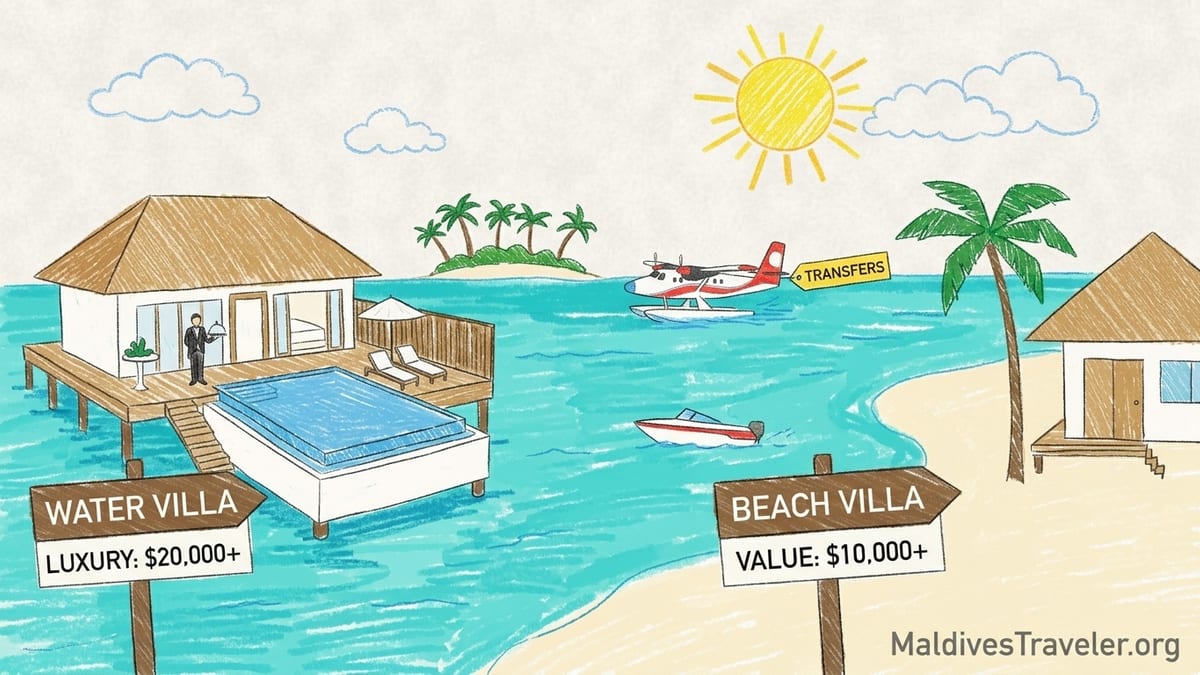
For many couples, the overwater villa is non-negotiable. However, it is worth understanding exactly what you pay for compared with a high-quality beach villa. At mid-market and upper-upscale resorts, the price gap between an entry-level beach villa and an entry-level overwater villa for a seven-night stay can easily reach several thousand dollars. For example, sample 2026 pricing at popular islands shows packages where a beach villa with half board for a week might sit closer to 6,000 to 8,000 dollars for two, while an equivalent overwater villa with the same inclusions sits in the 9,000 to 12,000 dollar band once taxes and transfers are counted.
The monetary difference typically buys you direct lagoon access, more privacy from passing guests and the “walk-on-water” experience that defines many Maldives honeymoon photos. Inside the villa, layouts and finishes are often similar to beach categories within the same resort: king bed, indoor-outdoor bathroom, coffee machine and deck loungers. You are paying a premium mainly for location, scarcity and the Maldives fantasy, not necessarily for additional square footage or better finishes, unless you step up again to a pool villa.
At the luxury end of the market, overwater suites with private pools, slides and roof decks push prices sharply higher. At Soneva Jani, for instance, six-night packages that include large water villas with private pools and butler service can run into the high five figures depending on travel season and add-ons. In this range you are not only buying the overwater setting but also expansive indoor and outdoor space, personalized service and access to high-end dining and experiences that are not available at mid-range islands.
One smart compromise for many honeymoons is a split stay between categories. Some 2026 agency packages are built around three or four nights in a beach villa followed by three or four nights in an overwater villa, which trims the overall cost while still delivering the iconic photos and experience. Ask your agent to cost this explicitly: the savings compared with seven nights over water can often fund a serious spa splurge or a pair of premium excursions.
Adults-Only vs Mixed-Age Resorts: When Privacy Is Worth the Premium
Adults-only or adults-focused resorts in the Maldives continue to be especially popular with honeymooning couples who value quiet pools, slower evenings and fewer family facilities. Hurawalhi Maldives, for example, consistently markets itself as an adults-only escape with an all-inclusive plan, an underwater restaurant and strong snorkeling. Reviews and current packages highlight its position as a sweet spot for couples who want a modern villa, good food and minimal children around, at prices that are significant but generally lower than the most famous ultra-luxury names.
Another route is to choose a small, intimate island that is not formally adults-only but is marketed more toward couples than families. Resorts such as Milaidhoo Maldives and several boutique five-star islands limit villa counts and children’s facilities, which naturally tilts the guest mix toward adults. Prices for these can rival or exceed high-end family-friendly brands, but for a honeymoon where the island atmosphere matters as much as the villa, this can be money well spent.
By contrast, large international-branded resorts with kids’ clubs can sometimes be secured at a discount compared with adults-only islands in the same atoll. Couples who travel outside major school holiday periods often find that these mixed-age resorts feel mostly adult in practice, especially at quiet overwater jetties. For example, some honeymooners have reported attractive 2026 package pricing at big-name properties like Le Méridien Maldives or Hilton Amingiri, where the all-inclusive or half-board upgrade plus overwater villa can undercut more intimate islands by a few thousand dollars for a week.
When deciding whether “adults-only” is worth a premium, be specific about what you care about: is it zero children at breakfast, or is it simply no splashy kids’ pools near your villa? Ask your agent or the resort sales team about the usual guest mix in your intended month, whether any adults-only zones exist on mixed-age islands, and how many villas are reserved for couples versus families. A higher nightly rate for an adults-only property makes more sense if it also comes with a stronger all-inclusive plan, better reef access and honeymoon extras that you would otherwise pay for separately.
Private Pools and All-Inclusive Plans: Where the Real Value Hides
Private pools are one of the most confusing line items in Maldives pricing, because they can double-count value already provided by the lagoon. On many overwater villas, the plunge pool is a photogenic extra rather than a practical necessity. Pool villas can cost 20 to 40 percent more than non-pool equivalents at the same resort, which over a seven-night stay often means an extra 2,000 to 5,000 dollars for two people. That differential alone can cover a large fraction of your food, drinks and spa costs at a non-pool category.
The picture changes if you will actually use the pool daily, or if you are selecting a beach villa. A private beach pool offers more privacy than swimming in the shared main pool or lagoon, particularly at denser islands. At the ultra-luxury level, such as Soneva Jani or high-end villas at resorts like Conrad Maldives Rangali Island, the pool is integrated into a much larger outdoor living space that becomes the center of daily life, which makes the surcharge more defensible. Think of the pool here as a core part of the villa rather than an ornamental add-on.
Board plans are another major lever. Generous all-inclusive or “platinum” packages at selected resorts bundle daily a la carte dining at multiple restaurants, premium drinks, minibar items, non-motorized water sports and sometimes even one spa treatment or select excursions. At adults-focused islands such as Hurawalhi, traveler reports and package brochures consistently describe the all-inclusive plan as the default value proposition, especially for honeymooners who want to relax without checking every bill. While the nightly rate is higher than room-only, an all-inclusive plan can be better value than paying for three a la carte meals and cocktails every day.
By comparison, half board or breakfast-only plans at luxury resorts can look cheaper upfront but lead to sizeable on-site bills. A realistic food and beverage spend for two at an upscale Maldives property can easily range from 300 to 700 dollars per day once you add lunches, wine and the occasional special dinner. When comparing package offers, always request or estimate a total trip cost that includes your likely spending on meals and drinks under each plan. An all-inclusive overwater stay that appears pricier per night may end up hundreds or even thousands of dollars less expensive overall than a room-only rate once you factor in the full week.
Honeymoon “Extras” With Real Monetary Value
Almost every Maldives resort advertises honeymoon benefits, but not all are created equal. The most valuable extras are those that replace something you would have paid cash for anyway. Spa credits are a prime example. A standard 60-minute couples massage at a five-star island spa often runs in the range of 300 to 500 dollars for two. Some luxury brands, including top-tier resorts such as Soneva Jani during specific campaigns, have promoted complimentary 60-minute spa sessions for honeymooners staying a minimum number of nights. If you know you will book at least one treatment, this perk has a very concrete cash value.
Transfer discounts are another powerful but often overlooked benefit. Seaplane or domestic transfers for a couple can total over 1,000 dollars on many routes. Periodic offers at resorts like Conrad Maldives Rangali Island have included 20 to 25 percent discounts on seaplane transfers or even bundled transfers in higher-tier “ultimate” packages. On a seven-night booking, a 25 percent discount on seaplane tickets is frequently worth several hundred dollars in your pocket, sometimes more than the value of all the champagne and fruit platters combined.
Genuinely valuable honeymoon extras also include meaningful dining upgrades: a complimentary private beach dinner with a full three-course menu and house wine, or an underwater or specialty restaurant experience that would normally cost hundreds of dollars for two. At some adults-only or romance-focused resorts, honeymooners staying a qualifying number of nights receive one of these dinners included. If you would have booked a special dinner anyway, it is worth treating this perk as cash-equivalent in your comparisons.
Finally, look closely at any free-night offers tied to honeymoon or romantic stays. A “stay seven, pay five” offer during a 2026 shoulder-season window can be worth thousands of dollars in villa savings if you planned a full week stay. Various resorts, from midrange favorites to ultra-luxe names, release these promotions at certain times of year. The trick is to verify that the nightly rate used in the promotion is not heavily inflated, and that taxes and transfers are clearly stated alongside the free-night calculation.
Perks That Are Mostly Decorative (But Still Nice)
At the other end of the spectrum are honeymoon benefits that feel special but carry very little real cash value. Welcome amenities are the most common example. A fruit platter, small box of chocolates and a bottle of sparkling wine in your villa on arrival might retail for 40 to 80 dollars in a resort boutique, but the marginal cost to a five-star property is far lower, which is why it is so widely offered. It is a lovely touch, but not a deciding factor between two 10,000 dollar packages.
Turn-down flower decorations, heart-shaped bed art and petal trails around your bathtub are similarly low-value from a monetary perspective. They can be a sweet surprise on the first or last night, and some couples cherish the photos, but the staff time and materials are minor costs for the resort. When an offer highlights “romantic turndown with bubble bath” as a headline benefit without more substantial perks, it is a sign that the honeymoon package is mostly a marketing wrapper around a standard rate.
Symbolic experiences such as vow-renewal style ceremonies, cake cuttings or simple photo certificate presentations are also often priced far above their tangible costs. Some honeymoon packages include a basic beach ceremony at no additional charge for couples who stay a minimum number of nights, while more elaborate ceremonies carry separate fees. Unless you specifically want the ceremonial experience, these are not usually where you should focus your budget.
Finally, note that some resorts limit honeymoon benefits to couples who present a recent marriage certificate, often stipulating that the stay must fall within 6 to 12 months of the wedding date. Missing this detail can mean losing all honeymoon extras. While the individual items may be modest in isolation, losing a complimentary romantic dinner, spa discount and welcome amenities together can still remove several hundred dollars of value that you assumed were included.
Real-World Package Examples From Mid-Market to Ultra-Luxury
To make the differences concrete, consider how current 2026 packages line up across the market. At the mid to upper-mid range, adults-only or adults-focused resorts such as Hurawalhi Maldives are offering four to seven-night all-inclusive packages in overwater villas that typically fall between the high four figures and low five figures for two, depending on season and flight routing. These usually include seaplane transfers, a broad all-inclusive dining and drinks plan, snorkeling access and a set of honeymoon basics like a bottle of sparkling wine, small cake and bed decoration.
Step up one tier and you find packages such as a two-island honeymoon at Conrad Maldives Rangali Island, which is often sold through specialist agencies with flexible villa combinations. A seven-night stay split between a beach villa on one island and a water villa on the other, with breakfast and possibly enhanced dining or credit inclusions, regularly falls in an approximate range of 8,000 to 20,000 dollars for two once taxes and transfers are fully included. Promotions can push the lower end into reach for more couples, especially in shoulder season, while premium overwater pool villas and extensive dining add-ons can quickly approach or exceed the upper ranges.
At the very top end, properties like Soneva Jani and similar ultra-luxury islands price their packages as fully bespoke, with large overwater pool villas, personal butlers, in-villa breakfasts, private cinema nights and a wide selection of included experiences depending on the offer. Six- to seven-night stays for two often inhabit the high five-figure territory once you fold in taxes, seaplane or speedboat transfers, and a realistic spend on premium wines and spa. These are the trips that can easily surpass 20,000 dollars per couple, especially in peak months and in the more extravagant villa categories.
What matters for buyers is not just the headline price band but the ratio of inclusive value to likely on-site extras. A mid-market package that wraps in seaplane transfers, all meals, drinks and one or two experiences can be better value than a slightly cheaper room-only offer at a more prestigious brand that leaves you paying out of pocket for every cocktail, spa visit and excursion. When comparing, ask each provider to summarize exactly what a realistic total trip cost would look like for two adults who enjoy one activity and at least one or two drinks each per day.
How to Read the Fine Print and Compare Like for Like
Honeymoon offers are often written in poetic language, but your best defense against unpleasant surprises is to translate them into a simple table. For each resort or package you are considering, note room type and size, whether it is overwater or beach, whether a private pool is included, the meal plan, the type of transfer and whether that transfer is included, discounted or charged separately. Then add the list of honeymoon extras and mark which items replace something you would have paid for, such as a spa session or private dinner, and which are purely decorative.
It is also wise to double-check validity dates and eligibility. Many of the most attractive 2026 promotions specify travel periods, minimum stays and booking deadlines. Others restrict benefits to honeymooners who can provide proof of marriage within a stated number of months. If you are traveling for a delayed honeymoon or anniversary, confirm in writing which benefits will still apply. Some resorts extend the same extras to anniversary couples within 30 days of the date, while others are stricter.
When dealing with travel agencies that specialize in Maldives honeymoons, ask whether their package totals already include all applicable taxes, service charges and Green Tax, as well as any seaplane or speedboat transfers. Several reputable operators now emphasize all-in pricing so that the total you see is what you pay. This makes it much easier to compare with resort-direct quotes that sometimes break out components separately. If a quote seems significantly cheaper than competitors, look carefully at whether the transfers and taxes are missing.
Finally, think about the non-financial aspects that will shape your experience: house reef quality, island size and vibe, noise levels, and how many restaurants you can realistically enjoy in a week. A slightly simpler villa at a resort with an excellent reef and strong all-inclusive plan often delivers a more satisfying honeymoon than a prestigious name where you are constantly trimming restaurant choices to keep the bill under control. Let your budget guide the package structure, but let your priorities guide the island choice.
The Takeaway
Maldives honeymoon resort packages in 2026 span a wide spectrum, from relatively attainable overwater weeks at mid-market all-inclusive islands to ultra-luxury water villas that can cost more than a car. The key to choosing well is understanding how much of what you are paying is for the core stay and how much is tied up in soft romantic extras. Overwater villas and private pools are worth the premium if they align with how you will genuinely spend your time, but for many couples, smart compromises such as a split stay or a beach pool villa can unlock the same magic at a lower total cost.
Adults-only resorts, generous all-inclusive plans, spa credits, seaplane discounts and truly special dinners are the benefits that most reliably add monetary value. Heart-shaped petals, souvenir certificates and arrival chocolates are delightful, but they should never be the deciding factor in a five-figure purchase. As you compare 2026 offers, focus on inclusive value, clarity on taxes and transfers, and the specific honeymoon benefits that will replace out-of-pocket spending.
Take the time to gather a few competing quotes built around the same dates, villa category and meal plan, and ask each provider to spell out exactly what is and is not included. With that side-by-side view, the Maldives becomes less of a financial mystery and more of a set of informed choices. Done thoughtfully, your honeymoon can deliver the overwater fantasy, romantic extras and peace of mind without drifting thousands of dollars beyond what you intended to spend.
FAQ
Q1. How much should we budget for a 7-night Maldives honeymoon in 2026?
For a week in an overwater villa at a good five-star resort with seaplane transfers and a solid meal plan, many couples land between roughly 12,000 and 24,000 dollars in total for two, including international flights from major US gateways. Ultra-luxury islands and very premium villa categories can push the land portion alone well beyond 20,000 dollars per couple.
Q2. Are overwater villas always worth the extra cost over beach villas?
Overwater villas charge a significant premium for lagoon access, privacy and the classic Maldives aesthetic rather than dramatically better interiors. If you have a tight budget, consider splitting your stay between a beach villa and an overwater villa. This can save several thousand dollars across a week while still giving you the iconic overwater experience for part of the trip.
Q3. Do we really need a private pool if our villa is over the ocean?
Overwater plunge pools are often more of a visual luxury than a necessity, because you already have direct access to the lagoon. They can add 20 to 40 percent to the villa price at some resorts. If you are happy swimming in the sea and main pool, you may prefer to trade the pool surcharge for better dining, spa or longer stay options.
Q4. What are the most valuable honeymoon extras to look for in a package?
The highest-value honeymoon extras are those that replace things you would pay for anyway: spa credits or complimentary couples massages, meaningful seaplane or speedboat transfer discounts, fully included private dinners at specialty venues and free-night promotions that genuinely reduce your nightly room cost. These perks can each be worth hundreds of dollars and sometimes collectively save over a thousand.
Q5. Which honeymoon perks are mostly decorative rather than financial?
Amenities like fruit baskets, a bottle of basic sparkling wine, rose-petal decorations, novelty cakes and printed certificates are charming but low in monetary value. They should be seen as pleasant touches rather than deciding factors between two expensive packages, especially when compared with more substantial inclusions like spa time or dining upgrades.
Q6. Is an adults-only resort essential for a romantic Maldives honeymoon?
Adults-only resorts offer a reliably quiet atmosphere and can be ideal if you want to avoid children entirely. However, smaller couple-focused islands and large resorts visited outside school holidays can also feel mostly adult in practice. If an adults-only label commands a big premium, weigh it against other factors such as reef quality, restaurant choice and inclusions in the package.
Q7. Are all-inclusive plans in the Maldives good value for honeymooners?
At resorts with strong all-inclusive packages that cover multiple restaurants, quality drinks and some activities, honeymooners who enjoy cocktails and restaurant-hopping often get excellent value and more peace of mind. At very high-end resorts, however, all-inclusive options can be rare or limited, and half board with a realistic food and beverage budget may make more sense.
Q8. How important are transfer inclusions and discounts when comparing offers?
Transfers can be a major hidden cost. Seaplane flights or domestic transfers for two often exceed 1,000 dollars, so packaged offers that include or discount transfers can be significantly better value than similar-looking rates that charge them separately. Always verify whether the quoted package is land-only or includes the full round-trip transfer to the island.
Q9. Do we need a recent marriage certificate to receive honeymoon benefits?
Many resorts require a marriage certificate and specify that the stay must fall within a certain number of months from the wedding date, often 6 to 12 months, for full honeymoon benefits. Some extend similar perks to anniversary trips within a set window. Check the policy in advance and be prepared to present documentation at check-in.
Q10. How far in advance should we book a Maldives honeymoon package?
For peak months such as December to March, it is wise to start planning 9 to 12 months ahead to secure preferred overwater villa categories and early-booking promotions. For shoulder seasons like May to September, booking 6 to 9 months in advance usually gives a good balance of choice and access to discounts, though last-minute deals sometimes appear for flexible travelers.