


Overwater villas in the Maldives have become the defining image of barefoot luxury: a private deck, your own ladder into the lagoon, and often a plunge pool framing an endless horizon. In 2026, demand is so strong that resorts from Vakkaru to Sun Siyam Vilu Reef are still adding new overwater categories. Yet not all stilted villas are created equal, and in some situations paying extra for one is actually the wrong move. This guide explains how to compare real-world overwater options on pools, lagoon depth, reef access and privacy, then shows when a simpler beach villa will quietly deliver a better stay.
How Overwater Villas Are Evolving in 2026
Overwater accommodation in the Maldives has shifted from novelty to core inventory. Early pioneers like Mirihi, which opened with overwater bungalows in the late 1980s, proved that guests would pay a premium to sleep above the lagoon. Today, across the archipelago, it is common for half or more of a resort’s keys to stand on stilts. That popularity has not plateaued. New categories continue to appear, and in 2026 overwater villas are becoming larger, more private and more pool-focused.
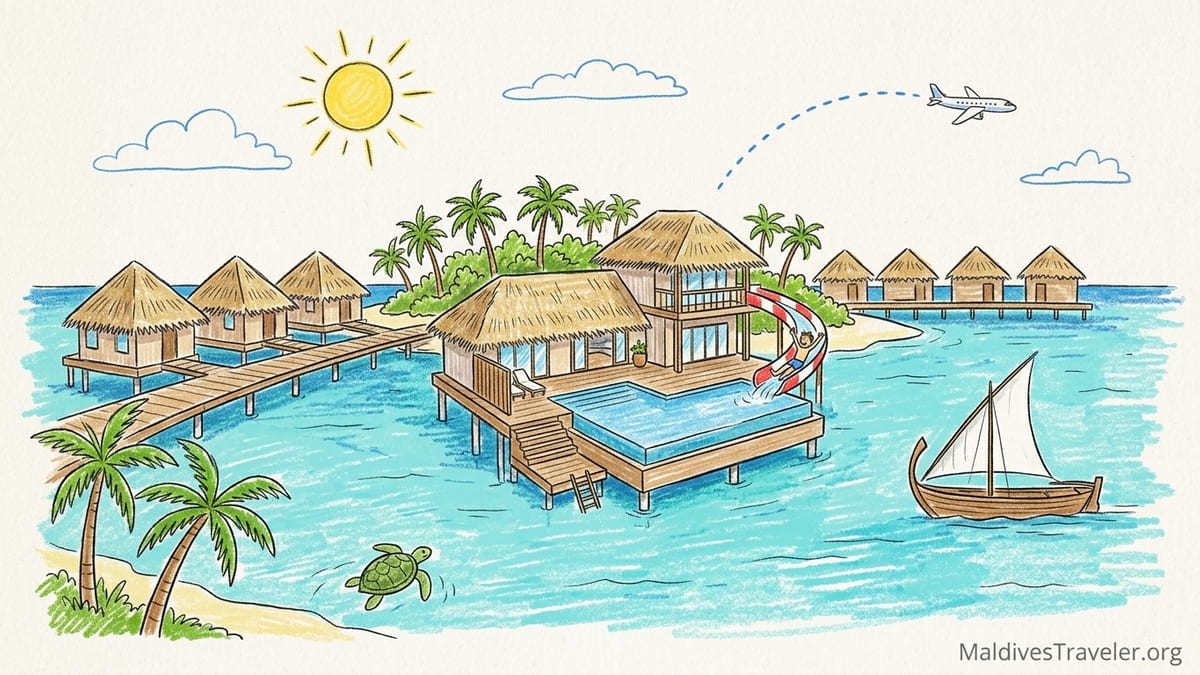
Several high-end resorts are actively investing in new overwater stock this year. Vakkaru Maldives in Baa Atoll has announced a new Overwater Villa with Pool category, with upgrades and additional pools rolling out across select villas from late May through October 2026 and new 165 to 200 square metre pool villas bookable from October 2026 onwards. Sun Siyam Vilu Reef in Dhaalu Atoll has added 50 Ocean Signature Villas with Pool and Slide, launched in June 2026 as part of an expanded overwater portfolio. Both moves underline that overwater villas are not a passing trend but a long-term pillar of Maldivian luxury.
At the very top end, ultra-villas like the sprawling overwater residences at Soneva Jani or the water retreats at Gili Lankanfushi have set benchmarks for deck size, private pools and direct reef access. Even mid-range properties now feel pressure to offer at least one overwater category with a plunge pool and a generous sundeck. For travellers, the upside is more choice than ever, but also more product names and marketing language to decode before booking.
Against that backdrop, understanding the specifics of pool dimensions, lagoon depth, orientation and children’s policies has become essential. Two villas described as “overwater pool suites” can feel entirely different in real life: one might have knee-deep turquoise water under the deck and a broad, shaded terrace, while another may sit over choppy, chest-deep blue water with little privacy from neighbours. The following sections break down how to read between the lines and match a villa’s design to your own style of Maldives holiday.
Private Pools, Deck Size and Real Usable Space
For many guests, the pool is now non-negotiable. The question is not whether there is a private pool but how big it is and how it integrates with the deck. A compact plunge pool might be roughly the size of a large hot tub, ideal for cooling off but not for laps. At the other extreme, some resorts build long, narrow infinity pools that span most of the villa frontage. Vakkaru’s new Overwater Pool Villas, for example, are around 200 square metres in total with a sizeable 55 square metre pool and roughly 135 square metres of terrace, which gives enough space for double daybeds, loungers and an outdoor dining corner without feeling cramped.
Deck layout matters as much as raw size. At strongly design-led properties such as JOALI Maldives or Patina Maldives, house overwater villas tend to have a wide deck with multiple zones: shaded seating under a roofed pergola, open sunbathing space, steps to the lagoon and sometimes an outdoor shower. This zoning makes the villa usable throughout the day, even in strong sun or passing showers. By contrast, some older jetty builds devote much of the frontage to the pool, leaving only narrow strips of decking to walk around it. That looks dramatic in photos but can feel impractical if you want to spread out as a couple or family.
Pricewise, a private pool typically adds a noticeable step. It is common for an entry-level overwater villa without pool at a quality five-star resort to start around 900 to 1,200 US dollars per night in shoulder season, while an otherwise similar villa with pool on the same jetty may start closer to 1,300 to 1,700 dollars. At ultra-luxury addresses like Soneva Jani or Cheval Blanc Randheli, the uplift can be several thousand dollars a night. The key is to think about how often you will actually use the pool. If you are planning two or three excursions, long dives and hours of lagoon swimming, a large deck with great lagoon access may matter more than extra square metres of water you rarely step into.
Another subtle factor is privacy around the pool. At some resorts, the higher-category pool villas sit at the outer ends of the jetties, often facing open ocean with minimal through-traffic, which suits honeymooners and those who sunbathe a lot. In other cases, a “pool villa” might be positioned midway down a busy jetty, fully visible from the boardwalk. When a resort map is available, look for where pool categories are clustered and how exposed they will be to passing golf buggies and other guests.
Lagoon Depth, Direct Water Access and Orientation
The romance of an overwater villa depends heavily on what is under the deck. Some resorts sit on wide, sandy lagoons with shallow, turquoise water that stays around waist-deep for a long distance. Guests who stay in the overwater villas at Holiday Inn Resort Kandooma, for instance, appreciate the smooth, sandy entry that lets you wade straight from your ladder without reef shoes. Surfers also prize Kandooma for its proximity to the Kandooma Right surf break, roughly 50 metres from the island, which adds real-world value if you plan to spend hours in the waves rather than on a sun lounger.
Other properties, especially those closer to outer atoll edges or deep channels, have much steeper drop-offs. The jetty might begin above pale sand but end above deep blue water where the lagoon moves swiftly and the seabed is several metres down. This can be stunning for confident swimmers and snorkellers, since fish life tends to increase near drop-offs, but may be uncomfortable for anyone who prefers to stand. During the southwest monsoon, when seas are choppier, ladders in these locations can be difficult to use and less safe for older travellers.
Orientation is another overlooked consideration. Resorts often design one side of the jetty to face sunrise and the other to face sunset. A resort like Anantara Kihavah, known for cinematic sunsets, will see its sunset-facing overwater villas book faster and carry a premium in high season. For early risers who like yoga or coffee outdoors before breakfast, a sunrise villa facing the calm, pale light of the morning might be more appealing and marginally cooler in the afternoon. Orientation also affects wind exposure: depending on the season’s prevailing winds, one side of the jetty can be breezier, which helps with natural cooling and insect control but may bring more wind noise at night.
When comparing options, ask specific questions: How deep is the water at low and high tide under my villa category? Is the seabed mostly sand or coral heads? Which direction do the decks face, and does that change the view? Trip reports, recent drone videos and independent 2026 overwater rankings are useful here, as they often mention details like “no water shoes needed” or “strong currents on the outer jetty.” These details are difficult for a brochure to capture but make a big difference once you arrive.
Reef Access and Snorkelling vs Tranquil Sandbank Lagoons
Overwater villas are often marketed as snorkeller’s dreams, but the reality varies widely. A resort with a strong house reef, such as Anantara Kihavah or some Baa Atoll islands, may allow you to swim from the villa ladder, fin over a belt of sand and be above coral gardens within a few minutes. Enthusiasts particularly value jetties that end close to the drop-off, where you can spot turtles, sharks and rays without booking a boat trip. Independent guides often rate overwater pool villas at such resorts higher because they combine the comfort of a private plunge pool with serious underwater life directly below.
Conversely, islands built in very broad, shallow lagoons might have little or no coral near the overwater villas. Sandbanks and seagrass replace bommies and branching coral, which can still be beautiful in a minimalist way but is not “reef snorkelling.” In those cases, the resort usually organises boat trips or shuttles to an outer reef wall. This pattern is common at newer, flatter islands designed for families who want wide sandy beaches and calm, paddling-friendly shallows rather than a steep, dramatic reef edge.
It is also important to separate “reef access” from “reef health.” Many Maldivian reefs are still recovering from bleaching events and variable water temperatures. A villa that is technically near the drop-off may overlook coral that is patchy or dominated by rubble and algae. When recent guests and 2026 resort reviews praise a “9 out of 10 house reef,” they are usually talking about both proximity and condition: dense, living coral, good fish biomass and satisfying snorkel loops that can be done straight from the jetty.
If snorkelling is a top priority and budget allows, look for resorts that pair overwater pool villas with a well-rated house reef and clear entry points from the villa jetty or nearby beach. Soneva Jani’s water retreats, Gili Lankanfushi’s villas and the overwater categories at JA Manafaru, where every villa has a private pool and the house reef is easily reached, are examples frequently cited by travellers who spend hours in the water each day. If, on the other hand, your ideal holiday centres on floating in calm, sandy shallows and enjoying spa treatments, then a very reefy drop-off may be less important than a sheltered lagoon with little current.
Privacy, Jetty Layout and Distance From Island Facilities
Privacy in an overwater villa depends on three things: spacing between villas, orientation of decks and visibility from the main island or nearby jetties. High-density developments place villas close together with railings and low dividers, which means neighbours can sometimes see directly onto your deck or into your pool. More exclusive builds, such as the overwater pool villas at Vakkaru or the large residences at Gili Lankanfushi, usually space villas farther apart and angle them so that decks face away from the boardwalk and passing traffic.
End-of-jetty villas tend to be the most private and are often marketed as “sunset water villas,” “ocean pool villas” or “residences.” These have open views on three sides and fewer neighbours, but they can be windier and feel slightly more exposed to waves. The trade-off is that you may walk five to ten extra minutes back to the island’s restaurants or spa, which in the tropics is not insignificant. Guests at mid-sized islands often mention that an overwater villa at the far end of a jetty adds roughly 2,000 to 3,000 extra steps a day compared with a centrally located beach villa.
Distance from island facilities is where the dream sometimes clashes with reality. At intimate properties where everything is close together, being on the jetty feels only marginally farther away. On larger, elongated islands with multiple jetties, being in an overwater villa can mean a hot walk or buggy ride to breakfast, the kids’ club or the main pool. Some recent travellers at mid-range all-inclusive resorts noted that they loved the overwater sunsets but eventually tired of the multiple buggy calls needed each day to shuttle children to activities.
For adults-only getaways, choosing a villa on a quieter, adults-focused jetty or the side of the island that attracts fewer families can transform the experience. Resorts like Anantara Veli, which is adults-only, or adults-focused wings within mixed-use islands, are popular precisely because the overwater section tends to feel calm and undisturbed. On family islands, by contrast, the jetties closest to the main pool and restaurants will inevitably have more footfall and noise. When you book, it is worth requesting villas in the outer half of the jetty if privacy is a priority and you are comfortable with the extra walking.
Children Policies, Family-Friendly Overwater Villas and Safety
One of the most overlooked aspects of Maldivian overwater villas is how strict many resorts are about children. A large proportion of islands either prohibit children under a certain age in overwater categories or require parents to sign waivers. For example, some family-friendly brands note in their documentation that overwater villas lack safety guards suitable for infants and ask parents of young children to sign disclaimers before confirming such bookings. Other high-end properties quietly discourage water villas for under-5s and straightforwardly recommend beach pool villas instead.
At the same time, demand from families who want the overwater experience has pushed several resorts to design specific family overwater villas. These might include a lower, enclosed kids’ bedroom, child-safe railings and alarms on sliding doors. Centara’s family-focused properties, for instance, have dedicated family overwater villas with children’s bedrooms and safety-conscious layouts. Holiday Inn Resort Kandooma offers two-bedroom overwater villas that suit older children who are competent swimmers, combining a large shared deck with layered supervision options. It is also now common to see four-guest or even six-guest overwater villas at islands like JA Manafaru and other multi-bedroom water suites.
As a rule of thumb, if your children are under around eight years old or not confident in deep water, a beach villa or beach pool villa is usually more practical, even if the resort technically allows kids in overwater units. Young children can run straight onto the sand, build castles under your eye and paddle in very shallow water without ladders or currents. Overwater villas require constant vigilance around pool edges, open railings and deck stairs, which can become stressful over a week-long stay.
For families with teenagers or strong swimmers, however, an overwater villa can be a highlight of the trip. Many family travellers describe evenings spent in the plunge pool watching reef sharks and rays cruise under the deck lights, then taking ladders down for a quick night snorkel before dinner. To make that work, choose a resort that explicitly welcomes families in overwater categories, ideally with a lifeguard presence on the main jetty and clear signage about tides and currents. Also budget for the fact that most larger overwater villas for four or more guests come at a significant price premium compared with two adjoining beach rooms.
Beach Villa vs Overwater Villa: When the Upgrade Is Not Worth It
With so much marketing focused on overwater bungalows, it can feel almost irresponsible not to book one. Yet in several common scenarios, a beach villa is a smarter choice. One clear case is for very young families. Resorts and independent Maldives specialists regularly point out that for children under five, beach villas are not only safer but also easier for daytime naps, shade and spontaneous play. The sand acts as a vast, soft play area and you can sit on your terrace while children explore within a very shallow zone.
Another scenario is where your budget is tight and the upgrade would consume funds you might otherwise spend on experiences. At many mid-range five-star resorts, a week in an entry-level beach villa might cost roughly 30 to 40 percent less than in an overwater pool villa during the same period. If you drop from 1,500 to 1,000 dollars per night by choosing a beach villa, you may free up 3,500 dollars over a week. That difference can buy a couple of excellent diving trips, a private sandbank picnic, a spa package and perhaps a seaplane transfer upgrade or an extra night on the island.
Privacy is a third reason not to chase the overwater dream at all costs. Because beach villas are often hidden by dense vegetation and set back from shared paths, they can feel more secluded than overwater villas that line an exposed jetty. Some honeymooners actually prefer a well-designed beach pool villa surrounded by palms to a water villa where neighbours and passing buggies can see the deck. Particularly on larger, more built-up islands, you may hear more generator hum and restaurant activity from overwater villas near the hub, while beach villas facing the quieter side of the island enjoy a surprisingly peaceful setting.
Finally, consider how you personally use space. If you are the kind of traveller who likes hammocks under trees, shady nooks to read in and soft sand underfoot, the tactile pleasures of a beach villa may outweigh the visual drama of a deck over water. Independent 2026 resort comparisons often note that guests who book both categories back-to-back on the same stay sometimes end up favouring the beach segment, describing the overwater nights as “gimmicky but fun” and the beach nights as genuinely restful. The best compromise, where budget allows, is a split stay: three or four nights in a beach villa to decompress and explore the island, followed by two or three nights in an overwater villa to capture the archetypal Maldives photos and sunsets.
High-Ticket Overwater Villa Comparisons for 2026
When you look at the Maldivian market in 2026, a few standout overwater offerings illustrate the trade-offs between private pools, lagoon quality, reef access and privacy. At the ultra-luxury end, Soneva Jani’s Water Retreats with Slide range from roughly 400 to over 1,400 square metres, each with a private pool and decks that spill directly into a sprawling lagoon. The water here is shallow and sandy, perfect for leisurely swims, and the villas are so widely spaced that privacy is almost guaranteed. The compromise is that serious reef snorkelling usually requires a boat trip, and nightly rates often run into the multiple thousands of dollars, even outside peak season.
Gili Lankanfushi, another favourite among overwater purists, offers rustic-chic villas with large decks and private pools in certain categories, set above a lagoon known for its clear water and good reef access. The house reef is close enough that many guests snorkel directly from villa jetties. Privacy is enhanced by generous spacing and the option of standalone residences accessible only by boat. Travellers who prize reef access and a barefoot, sustainable aesthetic often find Gili’s overwater villas a better fit than the more architecturally bold but lagoon-focused designs at other high-end properties.
Vakkaru Maldives, sitting inside the Baa Atoll UNESCO Biosphere Reserve, is a timely example of 2026 upgrades. Its new and enhanced Overwater Pool Villas, around 165 to 200 square metres with a significant portion dedicated to an infinity pool and terrace, appeal to couples and families who want a sophisticated, contemporary design and solid snorkelling outings. Being in a biosphere reserve usually means richer marine life, and while the best coral may require a short swim or boat ride, the combination of deck pool, view and lagoon access is compelling. These villas typically price as high-ticket options but sit below the most extravagant private island rates, making them targets for milestone trips.
On the upper-mid-scale side, the newly expanded Ocean Signature Villas with Pool and Slide at Sun Siyam Vilu Reef demonstrate how competitive the mid-tier has become. The resort has added 50 new overwater villas in 2026, mostly one-bedroom units with private pools and fun slides that give direct access to the sea. Here, the emphasis is on playful design and family appeal: the lagoon is generally calm and swimmable, and the villas are close enough to island facilities that long buggy rides are not necessary. There may be less absolute privacy than at ultra-luxury, widely spaced properties, but rates are relatively accessible for travellers aiming for a high-impact, overwater-and-pool experience without entering ultra-premium price brackets.
The Takeaway
In 2026 the Maldives is more firmly than ever the world’s capital of overwater living. New launches at resorts such as Vakkaru and Sun Siyam Vilu Reef confirm that demand for villas on stilts, especially with private pools, is not slowing. Yet for individual travellers and couples planning a honeymoon or anniversary, the choice is less about chasing the most dramatic villa and more about matching very specific design features to the way you travel.
If you value reef snorkelling above all else, focus on jetties close to a healthy drop-off and villas that make it easy to slip into the water several times a day. If you are travelling with young children, a beach pool villa may quietly outperform even the most photogenic overwater suite, thanks to its shade, space and simpler safety profile. For privacy, look at jetty endpoints, spacing and orientation, not just marketing labels. And when budget is finite, remember that a smaller or simpler overwater category, or even a beach villa, may free up funds for the ocean experiences that truly make a trip memorable.
Ultimately, the best overwater villa is not the one that looks the most impressive on social media but the one whose lagoon depth, deck layout, pool size and distance from the island’s heart align with your own vision of a perfect Maldivian day. With careful reading of resort maps, honest assessment of how you like to spend your time and a willingness to balance beach and overwater nights, you can turn marketing vocabulary into a villa choice that feels effortless from the moment you step off the jetty.
FAQ
Q1. Are overwater villas in the Maldives worth the premium over beach villas?
For many couples and photographers they are, because of the unique views, direct lagoon access and sense of novelty. However, if you care more about shade, easy access to facilities, value for money or travelling with very young children, a spacious beach villa or beach pool villa can be better overall and significantly cheaper.
Q2. How deep is the water under most overwater villas?
It varies by resort and even along the same jetty. In shallow lagoon settings the water at low tide might be knee- to waist-deep under your deck, while at outer-atoll or channel-facing jetties it can quickly drop to several metres. Before booking, ask the resort for approximate depth at low and high tide for your chosen villa category.
Q3. Can children stay in overwater villas in the Maldives?
Policies differ by resort. Some prohibit children below a certain age from overwater categories, others allow them only with signed waivers, and a growing number offer specially designed family overwater villas with safer railings and kids’ bedrooms. If your children are very young or non-swimmers, a beach villa is generally recommended even if the resort allows an overwater booking.
Q4. Is a private pool on an overwater villa really necessary?
Not necessarily. A pool is a wonderful bonus if you plan to spend long, lazy hours on your deck or travel during hotter months. But if you intend to snorkel or dive most days, or are watching your budget, choosing a non-pool overwater villa or a beach pool villa can be a smart compromise that still delivers the Maldives experience.
Q5. Which is better, a sunrise or sunset overwater villa?
It depends on your routine. Sunset-facing villas offer golden-hour views and often book first with honeymooners, but they can be hotter in the late afternoon. Sunrise-facing villas are cooler later in the day and suit early risers who enjoy quiet mornings on the deck. Orientation also influences wind exposure and sometimes the view of other jetties.
Q6. How important is reef access when choosing an overwater villa?
If snorkelling is a priority, reef access is very important. Villas near a healthy house reef let you step down from your deck and be over coral and fish within minutes, saving time and money on boat trips. If you mainly want calm, sandy shallows for floating and paddling, then a reef drop-off is less critical than a sheltered lagoon with gentle currents.
Q7. Are overwater villas noisy because of waves and wind?
They can be. Overwater structures often amplify the sound of waves hitting stilts and the rush of wind under the deck, especially during windy periods. Some guests find this soothing, while light sleepers may prefer beach villas, which are cushioned by sand and vegetation. Reading recent trip reports for your travel month can give clues to seasonal noise levels.
Q8. How far are overwater villas from restaurants and facilities?
On compact islands it may be only a few minutes’ walk, but on larger resorts an end-of-jetty villa can mean a 10 to 15 minute walk or regular buggy rides to reach restaurants, the spa or kids’ club. If you value quick access, request a villa closer to the island hub or consider a centrally located beach villa instead.
Q9. Is it a good idea to split the stay between beach and overwater villas?
Yes, for many travellers this is ideal. Starting in a beach villa lets you adjust, explore the island and often save a little nightly cost, then finishing with two or three nights overwater delivers the iconic experience and photos. Split stays also highlight the strengths of each category without locking you into either for your entire trip.
Q10. When is paying for an overwater villa actually a bad idea?
It is often a poor choice if you are travelling with toddlers, on a tight budget, planning to spend most days off-island on excursions, or if you prefer shaded gardens and absolute privacy over open-deck living. In those cases, a well-situated beach or beach pool villa typically provides more comfort and value, even if it looks less dramatic in pictures.