


The Maldives has quietly become one of the world’s strongest family resort markets. Where it was once all about honeymoon water villas, 2026 sees an impressive line-up of islands built around kids’ clubs, shallow lagoons, flexible family villas and transfers designed with tired toddlers in mind. Choosing the right island now means comparing practical details such as overwater villa age limits, medical facilities and meal plans, not just postcard views. This guide looks at how the best family-focused resorts stack up, with concrete examples from current standouts including Villa Park and Centara Mirage Lagoon Maldives.
How to Read the Maldives as a Family Destination in 2026
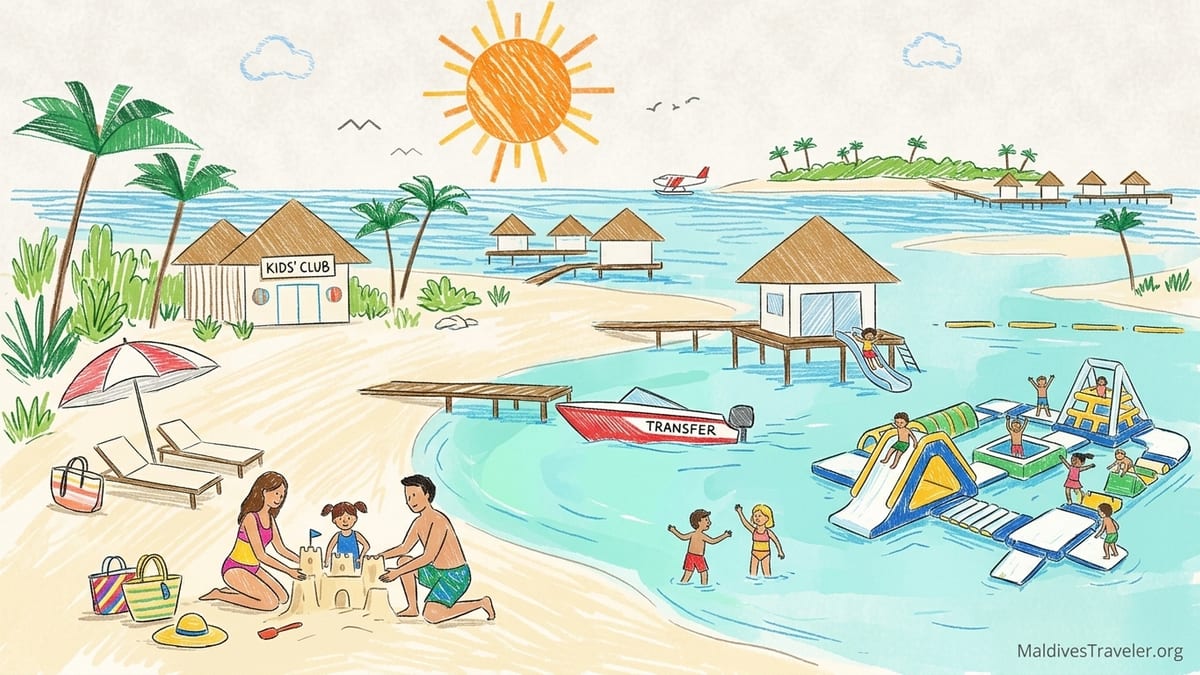
For families, the Maldives is less about finding the most glamorous island and more about finding the right combination of safety, space and sanity. Local travel planners and resort comparisons now routinely weigh lagoon depth, kids’ club age ranges, room configurations and transfer times together, instead of simply labelling properties “family-friendly.” Resorts that do best with parents of young children tend to offer genuinely shallow swimming zones, structured childcare, and a mix of beach and overwater accommodation so you can adapt as your kids grow.
The 2026 market has a clear family segment, with properties such as Villa Park in South Ari Atoll and the new Centara Mirage Lagoon Maldives in North Malé Atoll being highlighted specifically for family travel by regional specialists. These resorts are deliberately designed around multi-generational stays: think wide beaches where the water stays ankle to waist deep for dozens of metres, mini waterparks or floating playgrounds, and villa categories that sleep four to six without having to pay for two fully separate rooms.
At the same time, not every Maldivian resort is suitable for children. Many islands remain adults-only, and others place firm age limits on overwater villas because the decks have open railings and ladders dropping straight into deep channels. Families drawn by the iconic idea of a water bungalow need to look carefully at age rules and safety features, and often start their trip in a beach villa before switching to overwater once everyone is rested and oriented.
Transfers also matter more than most glossy brochures admit. A 20-minute speedboat from Malé International Airport can feel manageable with a jet-lagged three-year-old, while a 40 to 45 minute seaplane ride, with weight limits and fixed daylight-only schedules, can be a stressful start. For that reason many of the strongest family islands are clustered in North and South Malé Atolls, or on domestic flight routes with short onward speedboat hops.
Kids’ Clubs, Teen Activities and Babysitting: What Really Differs
One of the biggest differentiators between Maldivian family resorts is the kids’ club. Some islands offer only a playroom with a few toys and ad hoc supervision, while others run structured, age-banded programmes from late morning through late afternoon. At Siyam World, for example, “Kidz World” provides complimentary supervised activities from age three up to almost twelve, with craft sessions, outdoor play and themed events that allow parents to disappear to the spa or house reef without guilt.
Teen offerings are more uneven. High-end family resorts such as Niyama and One&Only Reethi Rah have separate teen zones or lifestyle clubs where older kids can hang out without being lumped in with toddlers, often combined with watersports, DJ lessons or surfing. At more midrange islands, teens tend to fall back on shared activities like snorkelling excursions, floating waterparks or beach volleyball. Siyam World’s floating waterpark, for example, is a natural teen magnet because it is included for all villa categories and pairs well with the resort’s highly social atmosphere.
Babysitting is another point where the details matter. Many Maldivian resorts can arrange babysitters in villas or around the island, but pricing and notice requirements vary. Expect to pay roughly the equivalent of a mid-range European city hourly rate, with higher surcharges after midnight. Parents travelling with babies or toddlers should ask in advance whether babysitters are resort staff trained in childcare or simply general staff doing overtime. At more family-focused properties, the teams are used to bottle-feeding, nap routines and early bedtimes, which can make the difference between a real date night and one spent worrying.
Medical support is often overlooked when comparing kids’ clubs, but it is crucial if you have under-fives. Many leading family islands now advertise an on-site clinic and visiting or resident doctor, with speedboat access to a larger hospital in Malé if needed. When a resort combines that with a kids’ club that accepts younger children and a genuinely shallow lagoon, it becomes much easier to justify the long-haul flight with a toddler.
Shallow Lagoons and Beach Safety: Toddlers vs Confident Swimmers
Not all Maldivian lagoons are equal. Some islands sit on deep channels with sharp drop-offs and stronger currents, better suited to adults and confident snorkellers. Families with toddlers and early swimmers are better off on broad sandbanks and enclosed lagoons where water remains below the waist for a long distance from shore. Specialists point to islands in North and South Malé Atolls, and parts of South Ari, as having some of the safest family zones, with calm water protected from ocean swells.
Villa Park, for example, has long been noted for its wide beaches and shallow, sand-bottomed lagoon zones that stay calm even when the ocean outside the reef is choppy. Families typically base in beach villas here so small children can move between sand and sea without climbing stairs or negotiating coral rubble. For parents who like to watch from a lounger while toddlers paddle in ankle- to knee-deep water, this kind of layout is invaluable compared with steep, erosion-prone shorelines.
Newer family-centric concepts such as Centara Mirage Lagoon Maldives go a step further by engineering protected swimming areas behind seawalls or in semi-enclosed lagoons. The goal is to guarantee shallow water conditions in a clearly defined family zone, while still letting stronger swimmers and teens access deeper reef areas on guided trips. Resorts frequently pair these lagoons with splash pads or small waterparks close to shore, so siblings of different confidence levels can stay near each other without one being bored or put at risk.
For older children and teens who can swim well, islands with a mix of shallow entry and easy house-reef access can be ideal. Resorts like Siyam World and various South Ari atoll properties combine broad beaches on one side with channels to the reef on the other, giving more confident kids a natural playground of snorkelling and paddleboarding without taking younger siblings too far from shore. When comparing options, families should ask how long it takes to wade out to chest-deep water and whether there are sharp corals underfoot, rather than relying solely on brochure photos.
Family Villas, Connecting Rooms and Overwater Age Rules
Villa layouts across the Maldives vary widely, which is why serious family travellers now focus on whether children can sleep in the same unit without paying for two separate villas. Many resorts have introduced two-bedroom beach villas or family suites that sleep four to six with a shared living space and one or two bathrooms. Villa Park, for instance, offers sizeable family rooms and beach villas where children can occupy twin beds or sofa beds in a semi-partitioned area without losing proximity to parents.
Centara Mirage Lagoon Maldives is designed around multi-bedroom beach houses and overwater pool villas that accommodate larger families, including four-bedroom beach houses suited to extended families or groups of friends travelling together. This kind of configuration reduces the per-person cost compared with booking multiple stand-alone villas and simplifies bedtime routines when children span several age groups. It also makes it easier to arrange in-villa babysitting because there is communal indoor space where kids can play while parents slip out for dinner.
Connecting rooms are another practical solution, especially for families with teens who need a bit of privacy but are not ready for a completely separate villa. Many Maldivian brands, from midscale all-inclusive to five-star, now list guaranteed connecting configurations, often pairing two beach rooms or a beach villa with a smaller garden or interior room. Parents should ask whether connecting doors are internal and lockable from the parents’ side, as some older inventories rely on adjacent terraces rather than true interconnecting layouts.
Overwater villas are where policies diverge the most. Because decks often have open railings and direct ladder access to deep water, many resorts impose minimum age limits, commonly eight or twelve years old, for children sleeping in overwater categories. Some allow younger children only with a signed waiver, while others prohibit them altogether for safety. Even within the same resort, rules can vary: an entry-level water villa closer to shore might be open to younger families with strict supervision, whereas high-category villas with slides or higher elevation can carry tighter restrictions. Before promising an overwater stay to your kids, confirm age rules for the exact category you plan to book and ask whether rollaway beds or sofa beds are permitted for children in that room type.
Waterparks, Slides and High-Energy Islands
For many families in 2026, the Maldives is no longer just about quiet beaches. Resorts with waterparks, slides and activity programmes have surged in popularity, particularly for school-age children and teenagers. Siyam World is a headline example, promoted for its extensive floating waterpark positioned just off the main beach and its range of overwater villas with private slides dropping straight into the lagoon. These “wow factor” features often justify a premium over simpler beach resorts, especially for families who worry their kids might be bored on a tiny, low-key island.
Centara Mirage Lagoon Maldives similarly leans into entertainment with a colourful water play area, themed pools and a heavily programmed schedule of games and shows. These islands feel more like full-scale family resorts than quiet castaway escapes, with music at the main pool, social restaurants and kids visibly outnumbering honeymooners at peak school holiday times. Parents who thrive on energy and organised fun tend to love them, while those seeking solitude may prefer a more traditional island with just a small splash pool and simple playground.
Slides and waterparks come with their own safety questions. Resorts usually impose height or age limits for certain features, and lifeguard coverage can vary from near-constant to quite light. Families should ask about life jackets, shaded seating for supervising adults, and whether water features close during bad weather. Slides from overwater villas, now present at several resorts, can also be subject to age rules and require close supervision, as the landing area is generally deep water even on islands with otherwise shallow lagoons.
These energetic islands often pair their waterparks with robust teen activity menus: organised football on the sand, paddleboarding sessions, group snorkelling trips and sometimes even music or dance workshops. When advertised clearly, this can help older kids feel that the resort is “for them” and not just built around younger siblings, which is critical on a trip where everyone is sharing close quarters for a week or more.
Meal Flexibility, All Inclusive and Medical Facilities
Meal plans present another key comparison point between family islands. All-inclusive plans are common across the Maldives, but they are not identical. Some cover only buffet meals at a main restaurant and a narrow list of drinks, while others include a generous choice of à la carte venues and snacks that better match picky eaters and teens who graze all day. Siyam World’s premium all-inclusive, for instance, includes multiple restaurant options and access to a broad pool of activities, but with some conditions about kids dining from children’s menus at certain outlets.
Families who prefer flexibility might choose half board or full board instead of strict all inclusive, particularly if they plan naps in the villa or have very young children who eat little. In these cases, a resort with kitchenettes in family villas or reliable in-villa dining can be more useful than endless cocktail lists. When comparing cost, parents should factor in typical buffet prices for children, whether kids under a certain age eat free and if teens are charged as adults. Some family resorts allow children under 11 to stay and sometimes eat free when sharing with parents, which can materially reduce the final bill.
Medical facilities are a quiet but crucial differentiator. Resorts that court families frequently feature a small clinic with a nurse and doctor available during set hours, plus on-call support for emergencies. Access to Malé’s larger hospitals by speedboat or domestic flight is standard, but travel time and cost vary. Parents of children with allergies, asthma or other chronic conditions should confirm what medications are stocked on the island, whether refrigeration is available in-room for medicines, and how evacuation procedures work after dark if seaplanes are grounded.
For infants and toddlers, baby amenities can make or break a stay. Family-focused islands often provide cots, high chairs, bottle sterilisers and baby baths, and sometimes even baby food or formula brands familiar to international travellers. These inclusions reduce both packing and stress, and they often correlate with better-trained kids’ club staff and more flexible kitchen teams who will adapt dishes to suit young palates or allergies without fuss.
Transfers: Speedboat vs Seaplane for Families
Transfer type has an outsized impact on how family-friendly a Maldivian resort feels, even if the island itself is perfect. Speedboats serve North and South Malé Atolls and some nearby islands, usually taking 10 to 45 minutes from the airport and operating around the clock in reasonable weather. For families landing late at night or with children prone to motion sickness or sensory overload, stepping straight onto a speedboat can be far less stressful than navigating seaplane terminals and weight restrictions.
Centara Mirage Lagoon Maldives exemplifies this approach, advertising a speedboat transfer of around ten minutes from Malé, with child pricing that is lower than typical seaplane fares. Many family specialists now highlight similar speedboat-accessible options such as Hard Rock Hotel Maldives and SAii Lagoon at Crossroads, where the logistics are simple and the travel day is short. While speedboats can be bumpy in rough seas, crossings are quick, and families avoid the daytime-only constraints that sometimes force overnight stays in Malé on either end of a trip.
Seaplane transfers, operated mainly by carriers such as Trans Maldivian Airways, open up more remote atolls but can be a mixed blessing with children. Flights are usually capped at around 20 to 45 minutes in the air, but add check-in, waiting at a separate terminal and potential stops at other islands en route. Noise levels are high, aircraft cabins are compact, and luggage allowances can be stricter than on the international leg. With older kids or teens, the experience can feel like an adventure. With a jet-lagged toddler who has already spent 15 hours on long-haul flights, it can feel overwhelming.
Domestic flights plus speedboat combinations fall somewhere in between. They use regular turboprop aircraft on fixed schedules, often in the evening, followed by a shorter boat ride to the resort. These can work well for families comfortable with one more plane but keen to avoid seaplanes, especially if it allows them to reach a quieter atoll at a lower transfer cost. When choosing between transfer types, it is worth pricing them explicitly for a family of four and asking your agent to calculate the total travel time from landing in Malé to reaching your villa door.
The Takeaway
By 2026, the Maldives is one of the most nuanced family resort markets anywhere, with islands that feel closer to sophisticated beachside theme parks sitting alongside quiet castaway retreats that simply add a low-key kids’ club. Families choosing where to stay need to think beyond the stock images of overwater bungalows and focus instead on the practical details: how shallow the lagoon is, whether there is a doctor on the island, what age the kids’ club starts at, whether teens will have enough to do, and how long the transfer will really take.
Resorts like Villa Park and Centara Mirage Lagoon Maldives showcase how far the destination has come, with thoughtful villa layouts, purpose-built family zones and transfers that suit real-world travel schedules with children. Other islands, from high-energy Siyam World with its floating waterpark and slide villas to more traditional beach-focused resorts with generous family suites, let parents tune the atmosphere to their own tastes.
Ultimately, the best Maldivian resort for your family is the one where everyone can relax. For some, that means a short speedboat ride to a mid-size island with a gentle lagoon, buffet comfort food and a kids’ club that handles everything from crafts to sandcastle competitions. For others, it means splurging on a multi-bedroom beach house at a high-end island with a dedicated teen zone and gourmet dining. What unites the best choices is that they treat children not as an afterthought, but as core guests, with safety and flexibility built into everything from villa design to transfer planning.
FAQ
Q1. Are young children allowed in overwater villas in the Maldives?
Policies vary by resort and even by room category. Many islands set a minimum age, often eight to twelve years, for children in overwater villas because of open railings and direct access to deep water. Some allow younger children with signed waivers, while others require families with under-eights to stay in beach villas. Always check the exact age rules and safety features, and consider starting your stay in a beach villa before moving overwater for a night or two.
Q2. Which transfer type is best for families, speedboat or seaplane?
For most families, especially with toddlers, a short speedboat ride of 10 to 30 minutes from Malé is the least stressful option. Speedboats run more flexibly and avoid the noise, weight limits and daytime-only schedules of seaplanes. Seaplanes can be exciting for older kids and teens, but they add waiting time at a separate terminal and can feel intense after a long international flight. If you have very young children or arrive late, a speedboat-accessible resort is usually easier.
Q3. How important is a shallow lagoon when travelling with small children?
For non-swimmers and toddlers, a genuinely shallow lagoon is crucial. Islands with wide, sand-bottomed areas where the water stays ankle to waist deep for a long distance from shore make supervision far easier and reduce the risk of sudden drop-offs or strong currents. Resorts such as Villa Park and dedicated family concepts like Centara Mirage Lagoon Maldives have built their reputations partly on safe, shallow swimming zones that parents can monitor from the beach.
Q4. Do Maldivian family resorts offer proper kids’ clubs and teen activities?
Many do, but the depth of programming varies. Dedicated family islands usually run structured kids’ clubs from mid-morning to late afternoon with crafts, beach games and occasional evening events. Some, such as Siyam World or high-end brands like Niyama, add teen lounges, water-based adventures and sports tournaments. When comparing resorts, check minimum ages, opening hours, whether lunch is included and what is offered for teenagers who may not want to join younger children.
Q5. Can I find family villas or connecting rooms easily in the Maldives?
Yes. Most family-oriented resorts now offer two-bedroom beach villas, family suites or guaranteed connecting rooms. Villa Park, for example, provides spacious family rooms and beach villas where children sleep in the same unit as parents. Centara Mirage Lagoon Maldives and similar new-build resorts go further with three- or four-bedroom beach houses designed for larger families. Ask specifically for floor plans and confirmation that connecting doors are internal and lockable from your side.
Q6. Are babysitting services available at Maldives resorts?
Babysitting is widely available but usually charged by the hour and must be booked in advance. At family-focused islands, sitters are often kids’ club staff accustomed to nap schedules, bottle-feeding and bedtime routines. Less family-centric resorts may only offer ad hoc babysitting from general staff. Expect higher rates after midnight and minimum booking periods. If you plan several date nights, it can be worth choosing a resort that explicitly markets professional childcare.
Q7. What kind of meal plan works best for families?
All-inclusive can be good value for families who spend most days on the island and have older kids or teens with big appetites. However, not all all-inclusive plans are equal. Some limit you to one buffet restaurant and a short drinks list, while others include à la carte venues and snacks. Half board or full board can suit families with young children who nap often or eat simple meals. Look for kids-eat-free policies, children’s buffet sections and early dining hours that fit with bedtime.
Q8. How do medical facilities work on remote resort islands?
Many family-oriented resorts have a small clinic with a nurse and visiting or resident doctor, plus arrangements with hospitals in Malé for more serious cases. Transport is typically by speedboat or domestic flight, as seaplanes do not fly at night. Before you travel, ask what services the island clinic provides, which medications are stocked and whether your villa has a fridge suitable for storing medicines. Comprehensive travel insurance that covers medical evacuation is essential.
Q9. Is the Maldives a good choice for families on a budget?
The Maldives is rarely a low-cost destination, but careful choices can keep it within reach. Speedboat-accessible resorts avoid high seaplane fares, and family villas or connecting rooms can be better value than two separate villas. All-inclusive packages help control food and activity costs, especially when children sleep and eat free up to a certain age. Travelling outside peak school holidays and watching for shoulder-season promotions can further bring prices closer to mid-range tropical destinations.
Q10. How many nights should a family spend in the Maldives?
For most families travelling long-haul, five to seven nights is a good sweet spot. It allows time to recover from jet lag, settle into a routine with the kids’ club and enjoy a mix of beach time and excursions without anyone getting bored. Shorter stays can work for those combining the Maldives with another country in the region, but in that case it is especially important to choose an island with easy speedboat transfers so you are not spending a large share of the trip in transit.