


In Haa Alif Atoll, the northern frontier of the Maldives, the choice of private-island resort is unusually focused on two names: JA Manafaru and Hideaway Beach Resort & Spa. Both promise castaway seclusion, serious snorkeling and big-villa luxury, yet they deliver quite different versions of the far‑north escape. If you are deciding where to spend a once‑in‑a‑decade honeymoon or a rare family splurge, the nuances between these two islands matter a great deal more than a glossy brochure might suggest.
Island Size, Atmosphere and Privacy
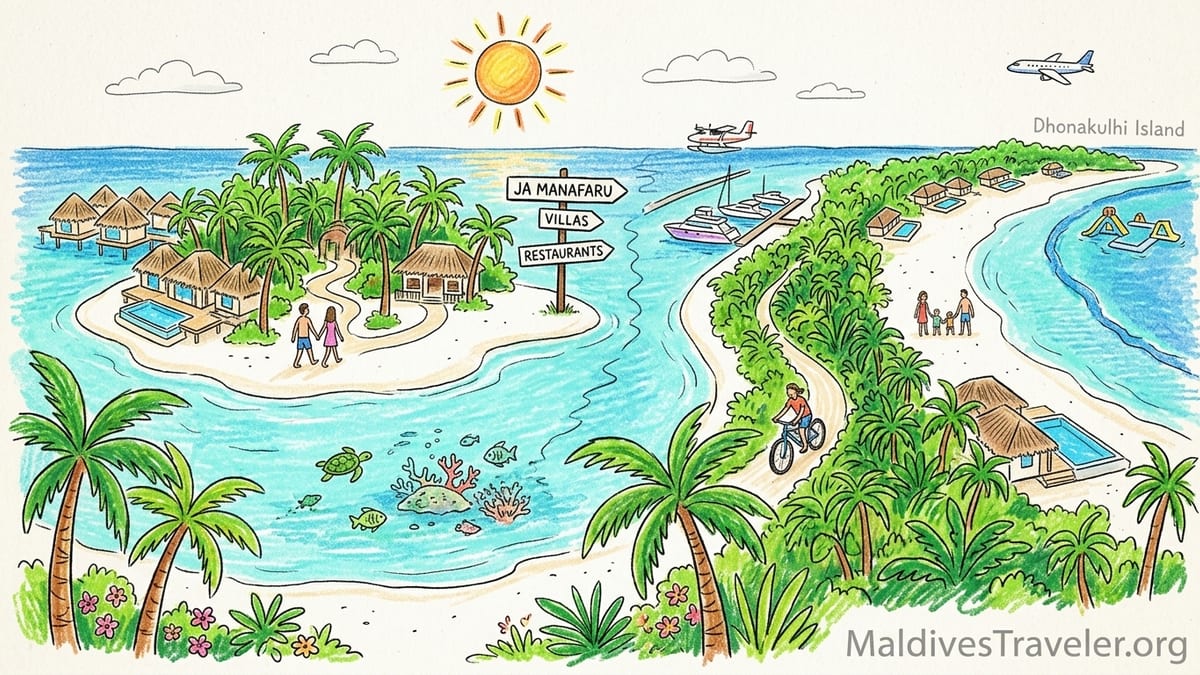
JA Manafaru sits on a compact 35‑acre island at the very northern edge of the Maldives, about 320 kilometers from Malé. With 84 villas tucked among palms and along the lagoon, it feels intimate and easy to navigate on foot, barefoot from one side to the other in under 10 minutes. The mood is soft and polished: carefully groomed beaches, neat sand paths, and just enough space between villas that you feel cocooned but still aware of other guests. Think buttoned‑down tropical elegance rather than wild castaway.
Hideaway Beach Resort & Spa, on Dhonakulhi Island, is one of the largest private resort islands in the country at roughly 297,000 square meters with around 103 to 110 villas scattered across a crescent of sand and forest. You need the bicycles that come with every villa to get around. Distances are longer, vegetation is denser, and the sense of separation between areas of the island is much more pronounced. Privacy here is created by scale: long stretches of empty beach, winding jungle paths, and villas set so far back that you may rarely see neighbors outside of restaurants.
In practice, this means JA Manafaru suits travelers who like everything close at hand: couples who want to stroll to breakfast, pop back to the villa, then wander to the spa without thinking about logistics. Hideaway, by contrast, feels like a miniature archipelago in itself. Families with energetic kids, repeat Maldivians who crave a bigger playground, or guests staying 8 to 10 nights often appreciate that they can spend days exploring new corners of the island without repeating the same walk.
On pure privacy, Hideaway has the edge for those who prioritize not being seen: pool decks screened by thick foliage, wide buffers between villas, and multiple quiet beach pockets where you can realistically sunbathe for an hour without another guest passing. JA Manafaru is still discreet, but the smaller footprint and more centralized layout naturally mean you will cross paths with other guests more often.
Beach Villas vs Overwater Villas
Every villa at JA Manafaru comes with a private pool, from entry‑level beach units to the sprawling three‑bedroom residences. The Beach Villas feel classically Maldivian: thatched roofs, warm wood, outdoor bathrooms and lush screened gardens that open onto a gentle, swimmable beach. Couples often comment that you can wake up, slide open the doors and be in the lagoon within seconds, with enough greenery that you do not feel on display. For families, the larger Two Bedroom Beach Pool Villas create a private compound with shaded daybeds, a sizable pool and direct sand access.
JA Manafaru’s overwater villas are set on a curved jetty facing open ocean. They lean into refined, contemporary styling: light woods, big glass doors, and sundecks with small infinity pools. Snorkeling from the deck is tidal and more for a quick dip than all‑day reef action, but the combination of pool, ladder to the sea and uninterrupted horizon views works extremely well for honeymooners. In real terms, many couples choose a split stay here: five nights in a Beach Pool Villa for lagoon access and then two or three in an overwater villa for the “Maldives postcard” finale.
Hideaway Beach’s accommodation story is about size and variety. There are around ten villa categories, and even the lead‑in beach category is considerably larger than many Maldivian equivalents. Most villas beyond the very base category include private pools, and some multi‑bedroom residences, especially in the Signature Collection, are closer to homes than hotel rooms, with living rooms, dining spaces and large lap pools. If you want the kids asleep in their own wing while you swim under the stars without worrying about noise, Hideaway’s inventory is purpose‑built for that scenario.
Overwater villas at Hideaway sit off a long jetty with near‑constant ocean views. The Ocean Villas with Pool are particularly popular with couples who want both privacy and space: think huge decks with full‑sized private pools, steps into a clear lagoon, and interiors big enough that a rainy day does not feel like a compromise. Because the island is larger, these villas feel more remote from the rest of the resort than at JA Manafaru; if you are seeking a cocoon where you barely leave your room except for dinner, that separation can feel like a luxury in itself.
Beaches, House Reefs, Snorkeling and Diving
Both islands boast natural beaches with fine white sand, but their marine topography differs noticeably. JA Manafaru is ringed by 360‑degree beaches and has a vibrant house reef just off shore. For most guests, the easiest entry points are from marked access channels where you swim out through sandy shallows before reaching the drop‑off. Marine life includes reef fish, the occasional turtle, and small reef sharks commonly spotted cruising at the edge of the reef. For confident swimmers, this makes a strong “from the beach” house reef that is enough to occupy a keen snorkeler for several days, though it is not among the most intense coral walls in the Maldives.
Hideaway Beach is defined by its unusual double house reef: two parallel reef structures separated by a natural channel that also shelters the island’s private marina. Practically, this gives snorkelers several different reef faces to explore without taking a boat. Beginners can stay close to the inner reef with calmer water and easy exits, while more experienced swimmers can venture towards the outer reef where the drop‑off is steeper and fish life thicker. Guests routinely report seeing schools of reef fish and frequent turtles, and operators describe year‑round snorkeling conditions that remain attractive even in windier seasons.
For diving, both resorts partner with professional dive centers and offer PADI courses, boat dives and equipment rental. The far‑north Haa Alif location means less dive‑boat traffic than in the central atolls; that often translates into quieter sites where you may be one of only a few boats on a channel. In practice, divers deciding between the two will notice more of a difference in logistics than in underwater scenery. From JA Manafaru, many sites are a short boat ride away and trips are organized in small groups. From Hideaway, the presence of the marina and sheltered harbor means dive boats can depart efficiently in a wider range of conditions, which can be reassuring if you are visiting in the shoulder months and want to maximize time in the water.
If snorkeling from your villa is a non‑negotiable priority, Hideaway’s double reef and the entry points near many beach and water villas make it the more reliable option. If you are happy to walk a few minutes to a marked entry and combine that with boat trips, JA Manafaru’s reef is still strong enough to satisfy most casual and intermediate snorkelers, especially when paired with its gentler lagoon for relaxed swimming.
Marina, Watersports and On‑Island Activities
One of Hideaway Beach Resort’s signature features is its fully functional private marina, among the first of its kind in the Maldives. The marina sits in the natural channel that cuts through the island’s reef, forming a protected harbor for yachts and excursion boats. In practice, this opens up more seamless yacht charter options, fishing trips and private cruising for guests who either arrive by private vessel or want to hire one locally. It also means watersports boats can come and go without being at the mercy of surf on an open‑reef pass.
JA Manafaru does not have a marina but offers a full slate of lagoon‑based watersports: stand‑up paddleboards, kayaks, jet skis, wakeboarding, and towable inflatables are typically available, along with sunset cruises and dolphin‑watching trips. The smaller island footprint means shorter transfer times from villa to jetty, and the resort’s calmer inner lagoon is ideal for first‑time paddleboarders or families with younger children who want to keep activities relaxed and close to shore.
Hideaway adds extra hardware on the water side, including a floating waterpark in the lagoon that is a hit with school‑age children, along with kiteboarding and more adventurous snorkeling safari routes that start directly from the island. If your idea of the Maldives involves not just reclining on a daybed but also daily activities like jetski tours, sea‑bobbing or guided reef discovery, the combination of marina, double reef and larger lagoon at Hideaway gives it a clear edge as an activity hub.
Away from the water, both islands offer spas, fitness centers, tennis courts and standard resort pastimes such as cooking classes or Maldivian culture evenings. JA Manafaru’s more compact layout makes these facilities feel central and easy to drop into spontaneously. Hideaway’s are more scattered, which enhances the sense of wandering between “neighborhoods” but does mean you plan your day a bit more, especially if you are moving kids between the villa, kids’ club and sports courts.
Families, Kids’ Clubs and Multi‑Generational Trips
Despite their remote, romantic locations, both JA Manafaru and Hideaway Beach are fundamentally family‑friendly. JA Manafaru offers a kids’ club and family‑oriented villas with private pools and easy beach access. The relative compactness of the island is a practical advantage with younger children: you can walk from your villa to the kids’ club in just a few minutes, pop back for forgotten sunscreen, and never feel too far from your own room if a nap is needed. Staff are used to tailoring simple activities, such as sandcastle building or hermit crab “races,” and the calm lagoon is forgiving for first swims with floaties.
Hideaway’s Tender Hearts Kids Club is larger and more developed, reflecting the resort’s emphasis on longer stays and multi‑bedroom villas. There are indoor and outdoor play areas, splash features and organized activities ranging from crafts to simple marine biology sessions. For a family of five or six, the multi‑bedroom villas in the Signature Collection or the large Family Villas allow grandparents, parents and children to share one expansive residence with multiple bathrooms and a deep pool, something that can be difficult to replicate at smaller islands without booking two separate villas.
For teenagers, Hideaway’s scale is a draw: bicycles, the waterpark, more room to roam and an activity program that can realistically fill a week without repetition. A 15‑year‑old who might feel cabin fever on a tiny island can ride between the sports court, kids’ club and beach hangouts here. At JA Manafaru, the vibe for older kids is gentler; they may end up joining staff for informal football games or snorkeling sessions, but the island naturally feels quieter and more couple‑sided once younger families are in bed.
In real booking patterns, families who prioritize simplicity and short walks often gravitate to JA Manafaru, especially for trips of five to six nights. Families planning 10 to 12 nights with a wide age spread, or those traveling with grandparents in tow, commonly find Hideaway’s villa configurations and larger activity menu worth the extra logistics.
Dining, All‑Inclusive Plans and Overall Value
JA Manafaru offers seven food and beverage outlets for its 84 villas, ranging from a main all‑day restaurant to specialty venues focused on, for example, Maldivian‑inspired cuisine or international grills. For a relatively small island, the variety is a strong point; over a week you can realistically eat somewhere different each night without the menus feeling repetitive. The resort frequently packages half‑board and sometimes soft all‑inclusive options with international flights in European and Middle Eastern markets, which can help keep spending predictable.
Hideaway Beach has multiple restaurants as well, including a main buffet restaurant, beachside grills and Asian‑influenced dining. Here the emphasis skews slightly more to hearty, family‑friendly dishes alongside finer options. The island’s larger guest count means buffets feel more extensive, and seating areas more spread out; you can opt for a livelier section near show kitchens or quieter corners by the sand. All‑inclusive plans at Hideaway tend to be more comprehensive, often bundling not only meals and many drinks but also some non‑motorized watersports and discounted or set‑price excursions, depending on the season and agency packaging.
From a value perspective, nightly rates for entry‑level villas at both properties typically fall into a similar upper‑mid luxury band for Haa Alif, though Hideaway’s wider range of room categories often creates tactical opportunities. For example, during certain shoulder periods, you may find a promotion on a large Beach Residence at Hideaway that brings it close in price to a smaller pool villa at JA Manafaru. Conversely, JA Manafaru sometimes positions very competitive packages on its Beach Pool Villas that, when combined with half‑board, come out lower overall than piecing together villa plus a la carte dining at Hideaway for the same dates.
In concrete terms, couples looking at a seven‑night stay in early spring will often see sample packages where JA Manafaru on half‑board and Hideaway on a comprehensive all‑inclusive land at similar total figures once you factor in food and drink. The meaningful difference becomes not so much the base rate as what is actually bundled into your plan: whether premium cocktails are included, which specialty restaurants count towards all‑inclusive, and whether activities like sunset cruises are discounted or full price. Working with a Maldives‑specialist agent who can lay out two itemized sample budgets is particularly valuable when choosing between these two resorts.
Transfers, Access and True Door‑to‑Door Cost
Both JA Manafaru and Hideaway Beach are served by seaplane transfers from Velana International Airport in Malé, along with domestic flight plus speedboat combinations that sometimes operate in low‑visibility conditions or at night. The distance is significant in both cases: roughly 280 to 320 kilometers north, which usually means a seaplane flight of around 50 to 75 minutes depending on routing and intermediate stops. For most travelers, the experience feels like a scenic sightseeing flight over coral atolls, but it adds both time and cost to the trip.
Industry‑wide, seaplane transfers for remote luxury resorts in 2026 frequently fall into the range of several hundred US dollars per person for a round trip, with children sometimes charged at a reduced rate. Online discussion boards and tour operators commonly advise guests to budget transfer costs in the same broad band for both JA Manafaru and Hideaway, rather than expecting one to be dramatically cheaper. The more relevant differences tend to revolve around schedules: whether your international arrival time meshes with same‑day seaplane connections or requires an overnight in Malé, and whether return flights allow a relaxed breakfast on departure day or a dawn wake‑up.
Hideaway’s marina adds extra flexibility for guests arriving via private jet to Maafaru Airport in Noonu Atoll or for those chartering private seaplanes and yachts, which can dock directly in the island’s harbor. JA Manafaru is more straightforward for guests following the classic path of scheduled international flight plus shared seaplane. In practical terms, if you are traveling with young children, minimizing long layovers is as important as the time spent in the air itself, so it is worth asking your agent to compare exact seaplane timings and potential domestic routes for your specific arrival date at each resort.
When comparing total cost, it is essential to look beyond published nightly rates and include transfers, taxes, meal plans and expected incidentals. A couple might, for example, see a slightly higher base villa rate at JA Manafaru but a package that includes half‑board and somewhat lower seaplane rates in a given promotion, ending up with a lower final invoice than a seemingly cheaper villa at Hideaway once all‑inclusive supplements and transfers are included. Conversely, a family of four that expects to eat and drink extensively throughout the day may find Hideaway’s broader all‑inclusive inclusions reduce bill shock at checkout, justifying a higher upfront outlay.
The Takeaway
For many travelers, the decision between JA Manafaru and Hideaway Beach Resort & Spa is less about which is “better” in absolute terms and more about which interpretation of Haa Alif Atoll’s remoteness feels right for their particular trip. JA Manafaru is the polished, compact island where everything is within barefoot walking distance, every villa has a private pool, and the atmosphere feels quietly luxurious without being showy. It is especially appealing to couples planning a honeymoon or anniversary in the 6 to 8‑night range, and to families who want an easy‑to‑navigate island with a strong but not demanding house reef.
Hideaway, on the other hand, is the large, slightly wilder cousin: a sprawling island with a double house reef, a full marina, bigger villas and long, empty beaches where you may not see another guest for stretches of the day. It shines for longer stays, for multi‑generational families needing two or three bedrooms under one roof, and for serious snorkelers who want to enter the water from different points day after day without repeating the same route. If your mental picture of the Maldives includes bicycles under palm trees, a waterpark for the kids and deep‑set privacy, Hideaway aligns closely with that vision.
If you lean toward intimate glamour, curated dining and not having to think too hard about distances, JA Manafaru is likely to feel like the “right” north‑atoll choice. If you want space, variety and a reef‑centric lifestyle with as much or as little activity as you care to add, Hideaway Beach Resort & Spa is the more natural fit. Either way, choosing between these two Haa Alif icons means you have already done the hardest part: narrowing your far‑north Maldivian fantasy down to two very strong contenders.
FAQ
Q1. Which resort is better for a honeymoon, JA Manafaru or Hideaway Beach?
For most honeymoon couples, JA Manafaru edges ahead thanks to its intimate scale, consistently private pool villas and polished, romantic atmosphere. Hideaway is also excellent for honeymoons, especially if you want a very large overwater villa and long empty beaches, but its size and family focus can make it feel more like a mixed‑purpose island than a pure couples’ hideaway.
Q2. Which island has better snorkeling directly from the beach?
Hideaway Beach generally offers stronger and more varied snorkeling right from shore, thanks to its double house reef and multiple easy entry points. JA Manafaru still has a good house reef that satisfies most casual snorkelers, but Hideaway’s layout, with inner and outer reef faces, tends to keep keener snorkelers busier over a week‑long stay.
Q3. Is one resort significantly more expensive than the other?
Base villa rates are broadly comparable in the same season, and transfer costs are in a similar band, so neither is consistently cheaper. Real price differences usually come from promotions and how meal plans are bundled. A detailed quote that includes transfers, taxes and meal plans for your exact dates is the only reliable way to see which will be more economical for your trip.
Q4. Which resort is better for families with small children?
For toddlers and younger children, JA Manafaru’s compact layout and calm lagoon make day‑to‑day life easy, with short walks between villa, kids’ club and restaurants. Hideaway is better suited to older children and teens who will use the bikes, waterpark and larger kids’ club, although families of all ages can be happy at either resort with the right villa choice.
Q5. How long are the transfers from Malé to each resort?
Typical seaplane flights to both JA Manafaru and Hideaway Beach take roughly 50 to 75 minutes, depending on routing and any intermediate stops. Domestic flight plus speedboat combinations can have similar overall durations once airport waiting times are included, so the real difference often lies in how well your international arrival and departure times align with seaplane schedules.
Q6. Which resort has larger villas overall?
Hideaway Beach offers a wider spread of very large villas, especially in its multi‑bedroom beach residences and Signature Collection units, which can feel more like private homes. JA Manafaru’s villas are generously sized by international standards and every one has a pool, but Hideaway has the edge if your priority is maximum indoor and outdoor space.
Q7. Do both resorts offer all‑inclusive packages?
Hideaway Beach is well known for comprehensive all‑inclusive plans that often include meals, many drinks and some activities or watersports. JA Manafaru tends to focus on half‑board and more limited all‑inclusive options that may be available through certain markets or agents. If full all‑inclusive is essential, Hideaway generally has the clearer, more inclusive offering.
Q8. Which resort has the better beach?
Both islands have natural white‑sand beaches with direct villa access, and neither suffers from the heavy sea walls or reclaimed sandbanks seen in some busier atolls. JA Manafaru feels more uniformly groomed and easy to swim from, while Hideaway offers longer, more varied stretches, including wide, often empty sections where you can walk for several minutes without seeing anyone.
Q9. Is one resort easier to reach with a late‑night international arrival?
Because both lie far north of Malé, late‑night arrivals can sometimes require an overnight stay near the airport before seaplane transfer the next morning. In some cases, Hideaway’s combination of domestic flight plus speedboat or its private transfer options via Maafaru can add flexibility, but these solutions depend heavily on schedules and availability, so it is best to have your agent check both properties for your exact arrival time.
Q10. If I am a serious diver, which resort should I choose?
Both resorts offer professional dive centers and access to uncrowded Haa Alif dive sites. Hideaway’s marina and sheltered harbor can make departures smoother in mixed weather, giving it a slight operational advantage. However, for most recreational divers focusing on reef and channel dives a few times during their stay, the choice between the two is better made on villa style, reef access for snorkeling and overall island atmosphere.