


Haa Alif Atoll, at the northern edge of the Maldives, feels like the country in wide angle. Palm‑lined local islands, a handful of private resorts and storied historical sites sit scattered across glassy channels far from the busy central atolls. For first-time visitors willing to travel a little longer from Malé, this remote region offers quieter reefs, more authentic village life and a strong sense of place that can be harder to find in the country’s better-known resort hubs.
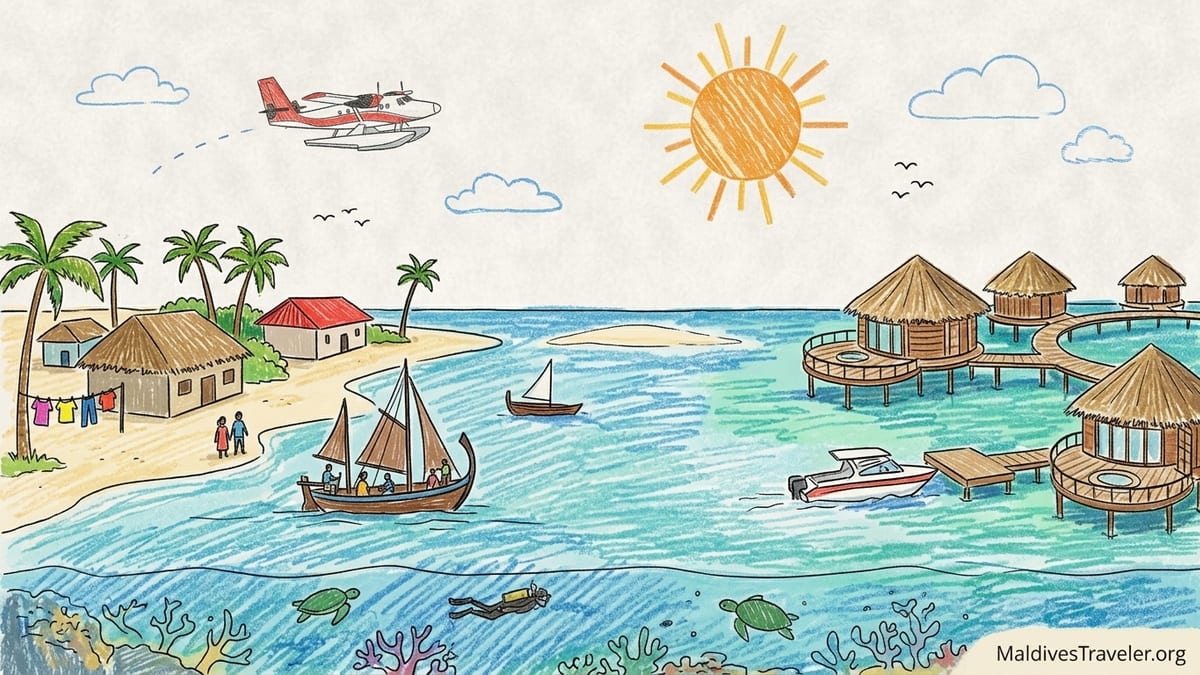
Why Haa Alif Atoll Belongs on Your Maldives Shortlist
Haa Alif, also known as North Thiladhunmathi, is the Maldives’ northernmost atoll, around 300 to 320 kilometers from Malé. It has dozens of inhabited and uninhabited islands but only a small number see tourists, which immediately sets it apart from resort-heavy atolls such as Ari or Baa. Instead of a dense ring of private islands, you find a working atoll where fishing boats and inter-island ferries share the lagoon with the occasional dive dhoni and resort launch. For many travelers, that balance between everyday Maldivian life and low‑key tourism is the main appeal.
The remoteness shapes every part of the experience. Transfers from Malé typically involve a domestic flight plus speedboat, or a long direct seaplane. That adds time and cost, but it also means fewer day‑trippers, less boat traffic on the reefs and a quieter atmosphere overall. If your vision of the Maldives is empty sandbanks, long uninterrupted house reefs and evenings where the loudest sound is the surf, Haa Alif delivers more consistently than central atolls built up around tourism.
Haa Alif also gives you an unusually broad range of experiences in one region. You can base yourself on a local island such as Hoarafushi, Dhidhdhoo, Kelaa, Vashafaru or Utheemu to explore village life and nearby sandbanks on a modest budget, then add a few nights on a private island such as Manafaru or Dhonakulhi to tick off the archetypal Maldivian villa‑over‑the‑lagoon stay. That mix is harder to arrange in some southern atolls where local accommodation and high‑end resorts are more geographically separated.
What you will not find in Haa Alif is nightlife in the city sense. There are no big clubs, and even resort entertainment tends to revolve around live acoustic music, beach barbecues and stargazing rather than late‑night venues. If you want rooftop bars and shopping malls, you are better off adding a night in Malé or Hulhumalé. Haa Alif is about long horizons, slow days and quietly absorbing what life is like at the periphery of this island nation.
Private Resorts vs Local Islands in the Far North
First‑time visitors often start by choosing between a private island resort and a “local island” stay in a village that now welcomes guests in small hotels and guesthouses. In Haa Alif you can realistically combine the two, but it helps to be clear on what each offers. Private resorts such as JA Manafaru on Manafaru Island or the resort on Dhonakulhi are self‑contained islands with no permanent local population. Stays are typically all‑inclusive or half‑board, alcohol is freely served, and facilities can include multiple restaurants, a spa, dive center and kids’ club on one compact island.
Local islands such as Dhidhdhoo, Hoarafushi, Kelaa, Vashafaru and Utheemu are inhabited Maldivian communities that have opened guesthouses and small hotels. On Dhidhdhoo, the atoll capital, properties like Dhidhdhooinn Beachview or similar guesthouses typically offer a few rooms, simple half‑board or breakfast‑only rates and the chance to join everyday activities such as watching evening football on the island pitch or visiting local cafés. These islands follow national laws on dress and alcohol: bikinis are restricted to designated “bikini beaches,” and alcohol is not served on local islands, which can surprise resort‑only travelers.
In price terms the gap is significant. Many Haa Alif guesthouses quote starting rates in the range of modest mid‑market hotel prices per night for a double room with breakfast, depending on season. A night at a private island like JA Manafaru, which sells itself as a five‑star hideaway with beach and overwater villas, can be several times that amount per villa, especially in peak months from December to March. That difference shapes the crowd: local islands draw independent travelers, divers and culturally curious couples, while private resorts skew toward honeymooners, families and those seeking an easy, curated stay.
The experience on the ground also feels distinct. On Manafaru or Dhonakulhi, waking up means walking straight from an overwater deck into clear lagoon and spending the day between spa treatments, snorkel sessions and sunset cocktails at an overwater bar. On Kelaa or Hoarafushi, mornings might begin with the sound of the island mosque, children cycling along sandy lanes and fishermen unloading the night’s catch. Evenings are more about chatting with guesthouse owners over a plate of mashuni (tuna and coconut salad) than dressing for a designer restaurant. Neither is “better,” but they are very different ways to encounter Haa Alif.
Island-by-Island: Hoarafushi, Dhidhdhoo, Kelaa, Vashafaru, Utheemu, Manafaru and Dhonakulhi
Hoarafushi has grown in prominence since Hoarafushi Airport opened nearby, giving the atoll a new domestic gateway. For travelers, that means you can often fly from Malé to Hoarafushi in under an hour and transfer by a short speedboat or even a local boat to your guesthouse. The island itself is long and narrow with a mix of residential areas and beaches; guesthouses arrange excursions to nearby sandbanks and snorkeling spots that lie within a short boat ride. You are unlikely to find high‑rise buildings here: accommodation is generally low‑slung, with shaded courtyards and simple rooms suited to divers and long‑stay visitors.
Dhidhdhoo is the administrative capital and one of the busier local islands in Haa Alif. It has schools, small shops, government offices and a harbor that sees regular ferries and supply boats, so it feels more like a small town than a sleepy village. Guesthouses such as Dhidhdhooinn Beachview give you a base within walking distance of local cafés, a mosque and the island’s beaches. For visitors, Dhidhdhoo works well as a hub for day trips: operators can arrange snorkeling excursions into the channels to look for turtles and reef sharks, fishing trips at sunset or visits to quieter neighboring islands.
Kelaa and Vashafaru, further east, are often cited by Maldivians as islands with particularly attractive beaches. Kelaa has a broad, white lagoon side with long stretches of sand, while Vashafaru’s coastline combines reef‑fringed shallows with sections that open directly to the ocean, which can bring stronger currents and better snorkeling. Guesthouses on these islands are fewer than in Dhidhdhoo, which keeps things quiet. You might walk for long periods on the beach without seeing anyone beyond a few local families picnicking under the palms on Fridays.
Utheemu stands apart for its history. The island is famous as the birthplace of Sultan Mohamed Thakurufaanu, a national hero who led the resistance against Portuguese occupation in the 16th century, and visitors can tour Utheemu Ganduvaru, the preserved wooden palace where he lived. The complex, with its dark timber rooms and coral stone walls, gives a rare physical sense of pre‑resort Maldives. Combining a stay on Utheemu or a nearby island with a guided visit to the palace turns a beach holiday into a deeper introduction to Maldivian identity and politics.
On the resort side, Manafaru and Dhonakulhi represent two of the atoll’s established private‑island stays. JA Manafaru on Manafaru Island offers around 80‑plus villas, including both beachfront and overwater categories, along with several restaurants, a spa and a house reef that guests can reach directly from shore or via short boat rides. Dhonakulhi, an island ringed by a wide turquoise lagoon, hosts its own upscale resort property with a similar focus on villas, fine dining and curated excursions. Both serve as good examples of how Haa Alif’s private islands lean into seclusion: there are no neighboring resorts in direct view, and many guests report feeling as if they have the ocean largely to themselves.
Beaches, Reefs and Diving in the Far North
One of Haa Alif’s strongest cards is its marine environment. As a relatively low‑density tourism atoll, it sees fewer boats and divers than places such as North Malé or Ari, which helps keep many reefs in good condition. House reefs around islands like Manafaru and Dhonakulhi often drop steeply into deep blue channels where strong currents sweep nutrients through, attracting reef fish, turtles and, at certain times of year, larger pelagics. Local islands, too, benefit from nearby patch reefs and thilas that can be reached in 15 to 30 minutes by dhoni.
Dive centers on resorts like JA Manafaru and on some larger local islands offer trips for all levels, from beginner courses to advanced drift dives. Typical excursions might include two‑tank morning dives on outer reef walls, where visibility can extend tens of meters on clear days, and afternoon trips to shallower sites suitable for those building experience. While Haa Alif is not currently marketed with the same manta‑ray reputation as Baa Atoll’s Hanifaru Bay, operators report seasonal sightings of mantas and eagle rays at cleaning stations in the atoll, especially during times of strong currents and plankton movement. Sharks, mainly reef species such as blacktip and grey reef sharks, are regularly seen.
For non‑divers, snorkeling is excellent and, on many islands, accessible straight from the beach. On Kelaa or Vashafaru, you may simply wade out from the designated bikini beach and find yourself over coral heads alive with parrotfish and anemonefish within minutes. Resorts such as Manafaru typically provide complimentary snorkel gear and mark the safest routes across the lagoon. Local guesthouses often organize half‑day trips to outer reefs, sometimes combining them with a stop at an uninhabited sandbank for a picnic lunch. Because boat traffic is still relatively light, many visitors comment on how peaceful these excursions feel compared with more developed atolls.
The beaches themselves vary from long, gently shelving sand ideal for families to narrower strips on islands where erosion is more of an issue. On Dhidhdhoo and Hoarafushi, community efforts and simple coastal structures help protect sections of shoreline, while resort islands invest in ongoing beach management to keep their lagoon sides broad and swimmable. Regardless of where you stay, reef‑safe sunscreen, respect for coral and awareness of currents are essential. Local guides will advise on where it is safe to swim given the tide and season.
Tracing Maldivian History in Utheemu and Beyond
Although visitors usually arrive in Haa Alif for its water and sand, the atoll also offers one of the country’s most important historical sites. Utheemu Ganduvaru, the wooden palace on Utheemu Island, is closely associated with Sultan Mohamed Thakurufaanu, who led a prolonged resistance against Portuguese rule in the 1500s. Walking through its low‑roofed halls and courtyards, you step into a world of carved timber, lacquered furniture and coral‑stone construction techniques that predate the modern resort era by centuries. Guides from the island can explain the story of the campaigns launched from these shores and how they shaped Maldivian national identity.
For travelers interested in history, a typical visit might combine the palace with a walk around Utheemu’s narrow lanes, where traditional houses with enclosed courtyards still stand beside newer concrete homes. You may pass small boatyards where craftsmen work on wooden dhonis using tools and methods passed down across generations. It is a very different side to the Maldives than the sleek overwater villas and designer interiors that dominate marketing brochures, and it rewards visitors who slow down and ask questions.
Other islands in Haa Alif also offer glimpses into local heritage, albeit less formally. In Dhidhdhoo, for example, community centers sometimes host bodu beru drumming performances for festivals, and older residents can point out historic mosques or cemeteries built with carved coral stone. On Kelaa and Vashafaru, you may see traditional fishing boats returning with tuna and reef fish, a reminder that for many families the ocean is a livelihood rather than a leisure space. Choosing a local guide or guesthouse that actively supports cultural activities is a practical way to ensure your visit contributes to preserving these stories.
It is worth remembering that Haa Alif’s relative isolation has long shaped its history. Being so far from Malé meant that news, rulers and foreign powers all arrived later here than in the central atolls, and local communities have often had to be self‑reliant. That sense of distance, once a challenge, now becomes a draw for modern travelers seeking locations that still feel different from place to place, even within the same country.
Getting There: Domestic Flights, Seaplanes and Speedboats
Reaching Haa Alif from Malé takes longer than traveling to popular central atolls, and planning your transfers carefully is part of making the most of a first visit. There are three main options: direct seaplane, domestic flight plus speedboat, or a combination that includes local ferries if you have ample time. Many high‑end resorts such as JA Manafaru package transfers with their stays, arranging a seaplane of around 70 to 90 minutes from Malé or a domestic flight of roughly 50 to 60 minutes to airports such as Hoarafushi, Hanimaadhoo or Kulhudhuffushi followed by a 10 to 45 minute speedboat ride, depending on the final island.
For local‑island stays, travelers commonly book scheduled domestic flights with Maldivian or other local carriers between Malé’s Velana International Airport and Hoarafushi or Hanimaadhoo, then continue by speedboat or local boat. Schedules change seasonally, but in practice you can often connect the same day if your international flight lands in Malé by early afternoon. Late‑night arrivals may require an overnight stay in Malé or Hulhumalé before flying north. Prices for domestic flights fluctuate, but many travelers report paying a mid‑range regional airfare per person one way when booking through guesthouses or agents, with additional charges for luggage.
Once in Haa Alif, inter‑island transfers are usually by hired speedboat, resort launch or, more slowly, by public ferry. For example, a private speedboat from Hoarafushi to Dhidhdhoo or Kelaa might take between 30 and 60 minutes depending on sea conditions, with costs shared between passengers. Guesthouses often coordinate these transfers in advance and group bookings where possible to keep costs down. Public ferries are much cheaper but depart less frequently and take longer, so they suit travelers with flexible itineraries who enjoy the slow rhythm of local travel.
Compared with hopping a short resort speedboat from Malé to a nearby atoll, these multiple legs can feel like a journey in themselves. Many visitors find that the payoff comes the moment they look out over the atoll from a low‑flying domestic plane, seeing long strings of sandbars and reefs that are clearly less built‑up than those closer to the capital. If you value easy access above all, Haa Alif might not be the right choice. If the idea of traveling to the outer edges of the country appeals, the added time can become part of the story.
How Haa Alif Differs from Ari and Baa Atolls
Ari and Baa are two of the Maldives’ most famous atolls, known respectively for a dense cluster of resorts and for world‑class manta‑ray encounters at sites such as Hanifaru Bay. They are also relatively central and easier to reach from Malé, which has driven rapid tourism growth. Haa Alif, by contrast, has fewer resorts and many more local islands hosting small‑scale guesthouses. That means you are more likely to share a beach with local families than with guests from the neighboring five‑star property, and more likely to hear the call to prayer than a DJ set after sunset.
In practical terms, Ari and Baa offer a wide choice of resorts across budget ranges, with highly polished transfer logistics and frequent seaplane connections. Competition keeps standards and prices varied, and you can usually find everything from entry‑level all‑inclusive resorts to ultra‑luxury private islands within the same atoll. Haa Alif’s resort choice is narrower and skewed toward the upper end, with properties such as JA Manafaru or the resort on Dhonakulhi focusing on seclusion and high service levels. For mid‑range travelers, this often nudges the decision toward local‑island guesthouses rather than private islands.
Underwater, the differences are more about feel than absolutes. Ari and Baa can see dozens of dive boats crowding famous sites in peak season, while in Haa Alif you may share a channel or thila with only one or two other groups, if any. Marine life is broadly similar, though specific aggregations like Baa’s mantas are more predictable in their home atolls. Many divers appreciate the relative quiet of Haa Alif’s sites, along with the sense that reefs are still recovering from recent warming events without the added pressure of heavy boat traffic.
Culturally, Haa Alif’s distance from Malé helps preserve local rhythms. Days are organized around fishing, school and prayer times rather than flight schedules, and tourism often slots in around those routines rather than displacing them. On Dhidhdhoo or Hoarafushi, visitors quickly become familiar faces, and chances to join for a game of football, a fishing trip or a plate of fried reef fish at a family gathering come more naturally. For travelers looking beyond the classic honeymoon bubble, that makes Haa Alif an appealing alternative or complement to the better‑known atolls.
The Takeaway
Choosing Haa Alif Atoll for a first trip to the Maldives is a conscious decision to trade convenience for character. Instead of a short speedboat from Malé to a polished resort cluster, you commit to a longer journey north by plane and boat, knowing that what waits at the far end is a quieter, more spacious version of the country. Empty sandbanks, uncrowded reefs and evenings under dark, star‑heavy skies are standard rather than special‑occasion experiences.
The atoll invites a slower style of travel. You might spend several days based on a local island such as Dhidhdhoo, Hoarafushi or Kelaa, getting to know your guesthouse hosts and exploring nearby reefs, then finish with a few indulgent nights on a private island like Manafaru or Dhonakulhi. Along the way, detours to Utheemu’s historic palace or to working harbors offer snapshots of Maldivian life that rarely appear in resort brochures. For travelers who value authenticity, marine life and a sense of geographic edge, Haa Alif more than justifies its place on the map.
Haa Alif is not for everyone. If you want numerous resort options, the shortest possible transfer and a nightlife scene, central atolls such as Ari or Baa are likely to suit you better. But if you are happy to wake early for a domestic flight, step onto a small island jetty with little more than the sound of waves and the smell of the sea, and accept that you are far from the capital in every sense, then the Maldives’ far north may feel exactly like the Maldives you were hoping to find.
FAQ
Q1. How long does it take to reach Haa Alif Atoll from Malé?
Most visitors reach Haa Alif in around 1.5 to 3 hours of combined flying and boating, depending on whether they use a direct seaplane or a domestic flight plus speedboat.
Q2. Is Haa Alif Atoll suitable for a first trip to the Maldives?
Yes, as long as you are comfortable with a longer transfer and a quieter atmosphere. It is ideal for travelers who prioritize reefs, authenticity and space over nightlife.
Q3. What is the difference between staying on a local island and a private resort in Haa Alif?
Local islands offer guesthouses, lower prices and more contact with everyday Maldivian life but no alcohol and modest dress norms on public beaches; private resorts are more expensive, serve alcohol and provide a self‑contained, fully serviced environment.
Q4. Can I combine a local-island stay with a private resort in one trip?
Yes. Many travelers spend several nights on a local island such as Dhidhdhoo or Hoarafushi, then transfer by speedboat to a private island like Manafaru or Dhonakulhi for a few nights of luxury.
Q5. Are the reefs and diving better in Haa Alif than in Ari or Baa Atoll?
The marine life is broadly comparable, but Haa Alif tends to have fewer boats and divers at popular sites, so the experience often feels quieter and more relaxed than in the busier central atolls.
Q6. Is alcohol available in Haa Alif Atoll?
Alcohol is available on private resort islands such as Manafaru and Dhonakulhi but is not served on inhabited local islands, in line with Maldivian law.
Q7. What should I wear on local islands like Dhidhdhoo or Utheemu?
On local islands, modest clothing that covers shoulders and knees is recommended in villages. Swimwear is reserved for designated bikini beaches and excursions.
Q8. When is the best time of year to visit Haa Alif Atoll?
Weather is generally driest and seas calmest from about December to April, which is also the busiest and most expensive period. The rest of the year can bring more rain and wind but also fewer visitors and softer prices.
Q9. Are there ATMs and shops on the islands in Haa Alif?
Larger islands like Dhidhdhoo typically have basic shops and at least one ATM, but smaller islands and resort islands may not, so carrying some cash and confirming payment options in advance is sensible.
Q10. Is Haa Alif Atoll family-friendly?
Yes. Private resorts often have kids’ clubs and family villas, while local islands provide safe, low‑traffic environments. Families should plan transfers carefully and choose properties that can provide child‑friendly meals and activities.