


Far to the north of the better-known resort atolls, Haa Alif feels like the Maldives before mass tourism. Fishing boats outnumber speedboats, mosques rise above coconut groves, and coral reefs lie just a short dhoni ride from quiet village harbours. For travellers willing to go beyond the postcard resorts, the inhabited islands of Utheemu, Kelaa, Vashafaru, Hoarafushi and Dhidhdhoo offer a rare mix of history, everyday island life and access to some of the country’s least crowded lagoons and sandbanks.
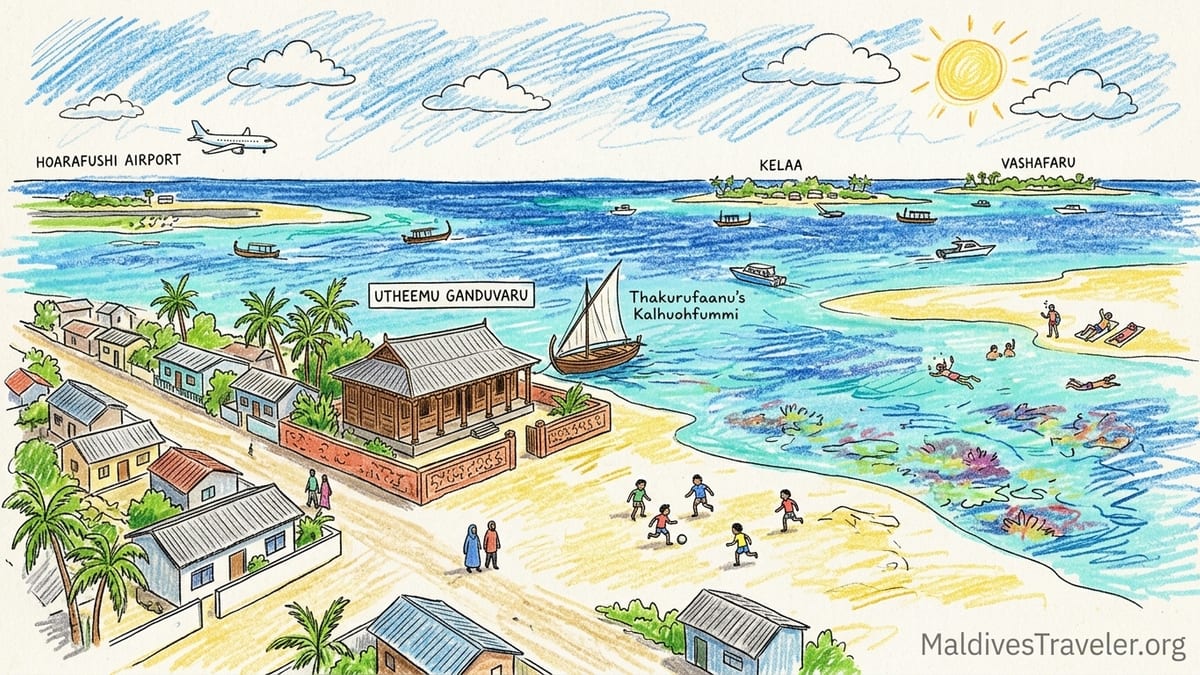
Why Haa Alif Atoll Belongs on Your Maldives Shortlist
Administratively known as Haa Alif, this is the northernmost atoll of the Maldives, closer to India’s Lakshadweep Islands than to the capital Malé. It has only a handful of resorts but more than a dozen local islands with guesthouses, which means visitors encounter normal Maldivian life alongside world-class reefs. Compared with central atolls, development is limited and the lagoons feel quieter, especially outside local holiday periods.
Most travellers reach Haa Alif via a domestic flight from Malé to Hoarafushi Airport, usually taking 50 to 60 minutes, then transfer by speedboat to their chosen island. Typical one-way fares on these domestic flights can sit in the range of 150 to 250 US dollars per person depending on season and how early you book, while shared speedboat hops between islands often cost the equivalent of 10 to 30 US dollars. Public ferries operate on some routes at lower prices, but schedules can be infrequent and are best treated as part of a slow-travel plan rather than a tight itinerary.
Haa Alif is well suited to travellers who like to base themselves on a lived-in island and make day trips by boat. The cluster of Utheemu, Kelaa and Vashafaru on the eastern rim, and Dhidhdhoo and Hoarafushi further west, provides a natural island-hopping route. Small guesthouses, home-style Maldivian meals, and snorkeling trips to nearby sandbanks are the norm, rather than large buffet resorts and spa complexes. It is an atoll where a stroll through a village at sunset can be as memorable as an afternoon on a reef.
Utheemu & Utheemu Ganduvaru: History at the Edge of the Indian Ocean
For many Maldivians, Utheemu is a name that evokes pride rather than beaches. This small island is the birthplace of Sultan Mohamed Thakurufaanu, the 16th-century leader who fought a long guerrilla campaign against Portuguese occupiers and later became sultan. His wooden family residence, Utheemu Ganduvaru, is one of the country’s most important historical sites, with carved coral stone walls, timber columns and a traditional bathing well that offer a rare glimpse of pre-modern Maldivian life.
Inside the complex, visitors typically walk barefoot across polished wooden floors, guided by a local caretaker or community guide who explains how Thakurufaanu and his brothers left Utheemu by night in their sailboat and struck Portuguese garrisons across the archipelago before returning to hide at remote islands. Displays are simple, often just old household objects and preserved rooms, but the atmosphere is powerful. It is one of the few places in the Maldives where you can physically step into a story that shaped the nation.
Although Utheemu is first and foremost a heritage stop, it is not simply a museum island. A small population lives here, and at least one guesthouse has opened in recent years, giving the option to spend a night or two. This can be particularly rewarding for travellers who want to photograph the Ganduvaru in softer early morning light, or attend evening prayers at the nearby mosque. Overnight stays also allow you to combine the palace visit with a relaxed swim from the island’s natural beaches and a picnic on one of the close reefs or sandbanks used by locals.
In practical terms, Utheemu works very well as both a day trip and a short-stay destination. If you are mainly interested in the history, you can base yourself in nearby Kelaa or Dhidhdhoo and come by speedboat or hired dhoni for a few hours. However, if Maldivian culture and traditional architecture are central to your trip, budget at least one night on the island. Expect simple, air-conditioned rooms rather than resort-style facilities, and bring modest clothing that covers shoulders and knees for walking through the village and visiting the Ganduvaru.
Kelaa: Coconut Groves, Local Life and Easy Day Trips
South of Utheemu, Kelaa is one of the larger inhabited islands in Haa Alif, known among Maldivians for its broad coconut groves and calm village atmosphere. From above, Kelaa stretches in a long, green finger, backed by lagoon shallows and protected by an outer reef. On the ground, sandy lanes run between family compounds, and children play football on open fields in the late afternoon. It feels like a textbook example of a northern Maldivian community island.
Kelaa has several licensed guesthouses and small inns, giving travellers a wider choice of room categories compared with some neighbouring islands. Many visitors pick Kelaa as a base for three to five nights because it is relatively easy to arrange boat trips in different directions. One day you might take a 20 to 40 minute dhoni ride to snorkel on a reef drop-off where turtles graze; another day you could cross to Utheemu to tour the Ganduvaru; on a third, you might simply ask your guesthouse host to arrange a picnic on an uninhabited sandbank at low tide.
Staying on Kelaa is particularly appealing for budget-conscious travellers and families. Room rates at local guesthouses in Haa Alif often start around 50 to 80 US dollars per night for a double in the low season, with breakfast included, and slightly more in peak holiday periods. A typical half-day snorkeling trip shared with a few other guests might cost 30 to 50 US dollars per person, including equipment and soft drinks. These prices vary, but they tend to be noticeably lower than equivalent excursions from resort islands further south.
Because Kelaa is an inhabited island with a conservative, predominantly Muslim community, there are some practical rules worth highlighting. Alcohol is not served, and swimwear must be modest except on designated tourist beaches that your guesthouse will point out. Evening life is low-key, revolving around cafés that serve hedhikaa, the local fried snacks, and sweet tea rather than live music. For travellers who value immersion in everyday life and quiet evenings over nightlife, this pace is often a highlight.
Vashafaru: Lagoon Blues and Low-Key Island Stays
Smaller and more intimate than Kelaa, Vashafaru is wrapped in pale turquoise shallows and sandbars that shift with the tides. The island has gained a quiet reputation among repeat visitors to the Maldives for its wide, uncrowded beaches and easy access to nearby snorkeling spots. A handful of small guesthouses operate here, some right behind the palm line, with a very short walk from room to lagoon.
Because accommodation capacity on Vashafaru is limited compared with larger islands, it often suits travellers who prefer a homestay feel. Room stock runs to just a few dozen beds across multiple properties, and owners are frequently involved in day-to-day hosting. Guests might join a family for a simple tuna and coconut curry dinner, or share the beach with just a handful of local children in the late afternoon. This scale also helps keep the main bikini beach relatively quiet.
Vashafaru works well as a base if your priority is lagoon time rather than island-hopping. Many guesthouses offer packages that include daily snorkeling trips to nearby reefs or half-day sandbank visits. For example, a couple staying three nights might purchase a bundle that combines accommodation, breakfast and two excursions for a price that often undercuts a single night at a mid-range resort elsewhere in the country. Boat rides to outer reefs are usually short, which is helpful if you are travelling with younger children who tire quickly.
For most itineraries, Vashafaru is worth staying on rather than treating purely as a quick excursion. The ambience of waking up to village sounds, walking past the mosque on your way to the beach, and watching fishermen prepare their boats at dawn cannot be compressed into a brief stop. That said, if you are already based on Kelaa or Dhidhdhoo and are short on time, a full-day boat trip combining Vashafaru’s lagoon and a couple of nearby sandbanks is still a memorable option.
Hoarafushi & Dhidhdhoo: Gateways, Reefs and Everyday Atoll Life
Hoarafushi has grown in importance since the opening of its domestic airport, which sits on reclaimed land just off the main island. For most travellers arriving from Malé, this is the first point of contact with Haa Alif. The settlement itself has several guesthouses and small cafés, and functions as a working hub for the western side of the atoll, with ferries and speedboats fanning out to other islands. While Hoarafushi’s natural beaches are narrower than those of Kelaa or Vashafaru, it is a good place to spend a night at the start or end of a trip, especially if your flight schedule does not connect neatly with onward boats.
Dhidhdhoo, designated as the atoll’s capital, lies further south and serves as an administrative and commercial centre. Government offices, a larger school and shops stocking a wider range of goods make it feel busier than most neighbouring islands. You are more likely to find small electronics, fresh fruit from Malé and clothing here than on smaller islands, which makes Dhidhdhoo a useful resupply point during a longer stay in Haa Alif. Guesthouses tend to be distributed along the island’s inland streets, with easy walking access to the harbour and the main mosque.
For visitors, both Hoarafushi and Dhidhdhoo are best understood as functional bases and local experience hubs rather than pure beach destinations. They are excellent spots to meet boat captains, arrange custom trips to outlying reefs or sandbanks, and observe how the atoll works day to day. An early morning walk around either harbour reveals fish being auctioned straight off the boats, cargo being loaded for secondary islands, and schoolchildren commuting along sandy alleys on bicycles.
Saying that, there is still good time-in-the-water to be had. Many local boat operators based in Hoarafushi and Dhidhdhoo advertise snorkeling or diving excursions that leave directly from the harbour, often heading to channels where currents attract pelagic species. Prices vary by distance and fuel cost, but a private half-day charter for a small group can sometimes be arranged for a figure that, split between friends or family, works out no more than a guided lagoon trip in more developed atolls. These towns are worth at least one overnight stop, more if you are an independent traveller piecing together your own island-hopping route.
Reefs, Sandbanks and Uninhabited Islands: How to Choose Your Day Trips
One of the main reasons to base yourself on local islands in Haa Alif is the relative ease of reaching uninhabited islands and reefs that see far fewer visitors than those nearer Malé. Many sandbanks here emerge only at low tide, forming temporary white spits surrounded by clear water, while others are more persistent, with a fringe of low vegetation. Your guesthouse or a local tour operator can usually suggest options based on the day’s wind and tide conditions.
When selecting which excursions to prioritise, it helps to think in three categories. Outer-reef snorkeling trips usually involve a slightly longer boat ride to the edge of the atoll, where the lagoon drops into deeper water and coral walls attract turtles, reef sharks and schools of fish. Lagoon sandbank trips are shorter and more relaxed, ideal for swimming in shallow water and picnicking on soft sand. Visits to uninhabited “picnic islands” sit somewhere in between, offering a patch of vegetation for shade and often a reef that starts just a few fin kicks from shore.
Costs fluctuate with fuel prices, but as a real-world reference, travellers commonly report paying in the region of 80 to 150 US dollars for a private half-day excursion boat from a Haa Alif island, including guide, snorkel gear and soft drinks, with lower per-person rates when trips are shared among several guests. Some guesthouses build one or two excursions into multi-night packages, which can represent better value than booking everything à la carte. It is worth asking about exact inclusions, especially whether lunch, drinking water and equipment are provided, so you can avoid unexpected add-ons.
Because Haa Alif is still relatively undeveloped for tourism, you will not always find glossy brochures or fixed-price kiosks. Decisions are often made in conversation at the harbour or through messaging apps before arrival. This informality can be part of the charm, but it also places some responsibility on travellers to ask about safety equipment, such as life jackets, and to be clear about timing. Sea conditions can change quickly, particularly during the southwest monsoon months, and responsible boat captains may postpone or shorten trips if wind or swell picks up.
Where to Stay vs What to Visit by Boat
For most itineraries that focus on Utheemu, Kelaa, Vashafaru, Hoarafushi and Dhidhdhoo, a practical approach is to choose one or two islands as bases and treat the others as day-trip destinations. Kelaa and Vashafaru lend themselves naturally to multi-night stays thanks to their beaches and spread of small guesthouses. Many travellers spend three to four nights on one of these, then add a night in Utheemu for the historical experience, and finish with a night near the airport on Hoarafushi to simplify departure logistics.
Utheemu, although it offers at least one guesthouse, is particularly suited to short, focused stays of one or two nights. This gives enough time to visit Utheemu Ganduvaru at different times of day, speak with local guides, and perhaps attend evening prayers at the mosque, while still relying on another island for a wider choice of dining and excursions. Day trippers from Kelaa or Dhidhdhoo can certainly appreciate the palace in a few hours, but staying overnight deepens the sense of place.
Dhidhdhoo and Hoarafushi work best as logistical and cultural stops rather than as your only beach destinations. Spending one or two nights in Dhidhdhoo allows you to see the atoll’s administrative centre in action, stock up on supplies and organise boat transfers. Hoarafushi is particularly useful on arrival and departure days because of the airport. If your domestic flight lands late or leaves early, staying nearby relieves pressure on same-day boat connections, which can be disrupted by weather or schedule changes.
Shorter visits by boat are ideal for islands whose main draws can be experienced in a half or full day: touring Utheemu Ganduvaru, beach time and snorkeling at Vashafaru if you are staying elsewhere, or a harbour-side afternoon and fish market visit in Dhidhdhoo. Many travellers also allocate at least one full day exclusively to reefs and sandbanks, without setting foot on another inhabited island at all. Combining these elements, a compact but satisfying Haa Alif itinerary might run six to eight nights, split between two islands and two or three boat days.
Practical Tips for Travelling Around Haa Alif Atoll
Planning a trip in Haa Alif requires a bit more coordination than booking a straightforward resort stay in central Maldives, but the rewards can be substantial. Most travellers start by choosing their primary base, then consult that guesthouse or hotel about the easiest route from Malé. Often this involves a domestic flight to Hoarafushi followed by a pre-arranged speedboat, which your host can bundle into your room booking. Public ferries can be used to move between some islands, but their schedules may change and they typically run only a few days a week, so check timings close to your travel dates.
On the ground, life is informal but conservative. Dress standards are modest away from designated tourist beaches: shoulders and knees covered for both men and women when walking through the village or visiting mosques. Bikinis are generally reserved for signed tourist beaches or boat trips, and alcohol is restricted to resort islands and liveaboard vessels, not local communities. Cash in Maldivian rufiyaa is useful for cafés and small shops, although larger guesthouses often accept card payments. ATMs are not guaranteed on every island, so withdrawing at the airport or in Dhidhdhoo when you pass through is advisable.
Connectivity and services can feel more limited than in central atolls. Mobile data coverage is usually good around inhabited islands, but speeds can drop during bad weather, and some smaller guesthouses rely on mobile hotspots for Wi-Fi. Power cuts occasionally occur, though most properties have backup systems to keep essential services running. These small inconveniences are part of the trade-off for staying in a region where reef traffic is light and where an evening walk might involve more greetings from residents than other visitors.
As with any marine-focused destination, timing matters. Northern Maldives can be visited year-round, but conditions for snorkeling and boat trips are often calmest outside the peak of the monsoon shifts, with many travellers favouring periods between roughly January and April and again around October and early November. That said, prices for domestic flights and guesthouses vary through the year and can spike around regional holidays, so it is wise to book early once you have fixed your dates, especially for smaller islands like Vashafaru where rooms are few.
The Takeaway
Haa Alif Atoll is not the Maldives of overwater villas and choreographed sunsets. Instead it offers something rarer: an archipelago where village life, national history and clear lagoons intersect at a human scale. Utheemu’s Ganduvaru connects you to Sultan Mohamed Thakurufaanu’s fight for independence, while Kelaa and Vashafaru provide mellow, beach-centred bases for days of snorkeling and sandbank picnics. Dhidhdhoo and Hoarafushi add the working rhythm of an atoll that still depends on fishing boats and cargo dhonis as much as on tourism.
If you value conversation with your hosts as much as poolside cocktails, are happy to dress modestly away from the beach, and do not mind a slightly more complex journey in exchange for quieter reefs, Haa Alif rewards the effort. Choosing one or two islands to stay on and treating the rest as day trips lets you experience the best of each: Utheemu’s heritage, Kelaa’s greenery, Vashafaru’s lagoon, Hoarafushi’s gateway role and Dhidhdhoo’s everyday bustle. It is a corner of the Maldives that still feels, in many ways, like a living archipelago rather than a curated stage set.
FAQ
Q1. How do I get to Haa Alif Atoll from Malé?
Most travellers take a domestic flight from Malé to Hoarafushi Airport, which usually takes under an hour, then transfer by speedboat or local boat to their chosen island.
Q2. Which Haa Alif island is best to stay on for first-time visitors?
For a first visit, many travellers choose Kelaa or Vashafaru as a main base because they combine good beaches, several guesthouses and easy access to reefs and day trips.
Q3. Is Utheemu better as a day trip or an overnight stay?
If you mainly want to see Utheemu Ganduvaru, a day trip from a nearby island is sufficient, but staying one night allows a deeper experience of the island’s history and atmosphere.
Q4. Are there resorts as well as guesthouses in Haa Alif?
Yes, there are a few private-island resorts in the atoll, but Utheemu, Kelaa, Vashafaru, Hoarafushi and Dhidhdhoo are primarily local islands with small guesthouses rather than large resorts.
Q5. How expensive are boat trips to reefs and sandbanks?
Costs vary, but private half-day excursions from local islands in Haa Alif often fall in the range of about 80 to 150 US dollars per boat, with lower per-person prices on shared trips.
Q6. Can I wear a bikini on these local islands?
Bikinis are generally allowed only on designated tourist beaches and during boat trips. Around villages, visitors should wear modest clothing that covers shoulders and knees.
Q7. Is alcohol available on Utheemu, Kelaa, Vashafaru, Hoarafushi or Dhidhdhoo?
No, alcohol is not served on these inhabited local islands. It is usually available only on resort islands and some liveaboard boats under Maldivian regulations.
Q8. What is the best time of year to visit Haa Alif Atoll?
The atoll can be visited year-round, but many travellers prefer the calmer conditions often found from roughly January to April and again around October and early November.
Q9. Do I need to book excursions in advance?
It is wise to discuss your plans with your guesthouse before arrival, but many trips are arranged locally after you get there, depending on weather, tides and other guests’ interest.
Q10. Is Haa Alif suitable for families with children?
Yes, especially islands like Kelaa and Vashafaru with gentle lagoons, though parents should be comfortable with simple, low-key accommodation and the absence of big resort-style kids’ clubs.