


Haa Alif Atoll, the northernmost atoll in the Maldives, is where the country still feels remote, sleepy and wonderfully local. Here, on the islands of Kelaa and Vashafaru, you can wake to the sound of roosters, snorkel on reefs visited more by turtles than tourists, and watch the Milky Way instead of overwater-villa lights. The surprise is that you no longer need a five-star resort budget to experience this far-north magic. Carefully structured guesthouse holiday packages are opening Haa Alif to independent travelers who want seclusion, soft-sand sandbanks and serious snorkeling without the resort price tag.
Why Choose Haa Alif Atoll for a Local Island Holiday
Haa Alif Atoll, officially Northern Thiladhunmathi, sits at the very top of the Maldivian archipelago and feels a world away from the busy central atolls. The atoll’s inhabited islands, including Kelaa and Vashafaru, are small communities where fishing, coconut palms and coral-stone mosques still set the rhythm of daily life. Compared with popular local islands closer to Malé, visitor numbers here remain low, which means quieter beaches, less boat traffic and reefs that still feel wild.
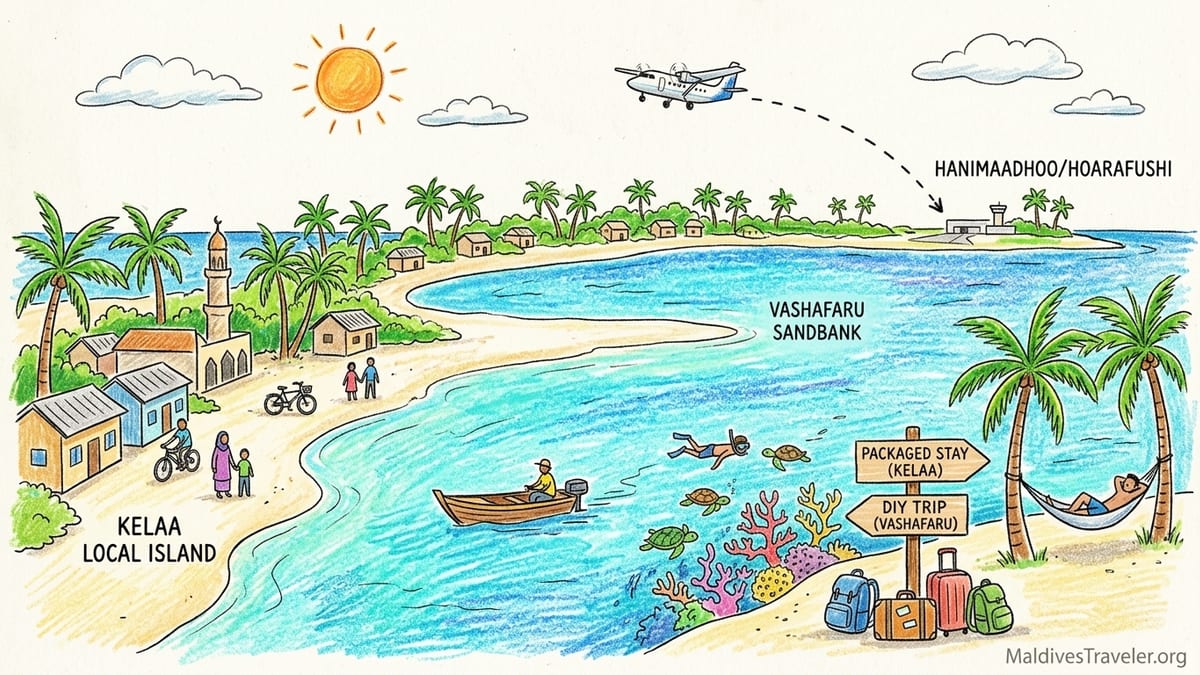
Reaching Haa Alif typically involves a domestic flight from Malé to one of the northern airports such as Hanimaadhoo or Hoarafushi, followed by a short speedboat ride on to your island. As of 2026, resorts in the atoll quote domestic flight transfer rates starting around 200 US dollars per adult return from Malé to Hanimaadhoo or Hoarafushi, which gives a sense of the base cost you are working with when planning a local-island trip that uses the same airports. Once you factor in guesthouse rates that often begin around 70 to 100 US dollars per night including breakfast, the far north can still come out significantly cheaper than a typical resort holiday of the same length.
Unlike resort islands, Kelaa and Vashafaru are real villages, with mosques, schools and small shops. Travelers stay in licensed guesthouses rather than overwater villas, and activities are organized either directly by the guesthouse team or through small local operators. This is crucial when you start comparing holiday packages, because on these islands your guesthouse is usually your main gateway to diving, snorkeling, sandbanks and fishing.
For travelers who want to trade swim-up bars and buffets for long, empty beaches and genuine contact with Maldivian culture, Haa Alif’s local islands offer one of the country’s most compelling value propositions. The question is whether you should buy a bundled guesthouse package or assemble the pieces yourself.
Kelaa: Seven-Day Guesthouse Packages in the Far North
Kelaa lies on the northeastern edge of Haa Alif and has grown into one of the atoll’s more established local-island destinations. The island is relatively large by Maldivian standards, with wide coconut groves, long beaches and a quiet interior of sandy lanes. Several guesthouses operate here, and at least one of them actively sells seven-day holiday packages aimed at travelers flying in from Malé.
A typical example is Summer Home Kelaa, a guesthouse that openly advertises week-long stays with bundled accommodation, meals and experiences. One current package is priced at roughly 1850 US dollars for seven nights, quoted as including all meals. While individual inclusions can change seasonally, packages like this generally combine a private or double room, three meals per day, and a selection of island activities such as guided snorkeling, sandbank or picnic-island visits and local fishing trips. Extra nights are usually charged at a flat nightly rate, sometimes under 100 US dollars with the same meal plan.
Room-only rates on Kelaa, for instance at properties like Holiday Home Kelaa, often start in the region of 200 to 250 US dollars per night at published rates for standard rooms, with periodic discounts reducing that for longer stays or low season. When you compare this to a seven-night package that also includes three meals per day, it becomes clear that bundled offers can bring the effective nightly cost down to a more manageable mid-range level, particularly once you price out meals and a couple of excursions purchased separately.
Kelaa’s appeal for a week-long stay lies in its balance of comfort and remoteness. Guesthouses typically offer air conditioning, private bathrooms and decent Wi-Fi, but step outside and you are on an island where most people still travel by bicycle and where the biggest daily commotion is likely to be a school football game. For many travelers, a seven-day package provides the right structure in a place where timetables, ferries and inter-island transfers can otherwise feel opaque from overseas.
Vashafaru: Sandbanks, House Reefs and Flexible Bundles
Vashafaru is smaller and more intimate than Kelaa, located a little further west in Haa Alif Atoll. It is known for its long white beach, turquoise lagoon and a shifting sand spit that forms an almost cinematic sandbank just off the island. Visitor numbers are even lower here than in Kelaa, and the few guesthouses on the island lean heavily into snorkeling, sandbanks and traditional fishing experiences as their core selling points.
Guesthouses such as My House Maldives and Casa Mia Inn position themselves as bases for exploring the surrounding reefs and uninhabited islets. They can arrange excursions to nearby sandbanks for picnics and swimming, half-day snorkeling trips to sites like Turtle Point, and island-hopping by boat to uninhabited islands with simple barbecues on the beach. Diving is usually organized through small local centers that know the atoll’s channels and reef walls, where manta rays and dolphins are frequently reported during the right seasons.
Rather than fixed seven-night packages, Vashafaru guesthouses often operate with a more modular approach. A traveler might book a room at My House Maldives from around 80 US dollars per night with breakfast, then add a meal plan and excursions once on the island or through email beforehand. Sample excursion price ranges published for Vashafaru suggest that shared snorkeling trips might fall in the ballpark of 40 to 70 US dollars per person, with sandbank or uninhabited-island picnics priced higher depending on group size and inclusions like lunch.
This flexibility suits travelers who prefer to keep their schedule open. If a few days turn out windy or you simply feel like more hammock time, you can opt out of certain excursions and pay only for what you actually do. However, it also demands more involvement in planning and budgeting, as you will need to keep track of how quickly snorkeling trips, fishing outings and extra meals add up across a week.
Getting There: Domestic Flights, Speedboats and Realistic Costs
Whether you choose Kelaa or Vashafaru, your journey from Malé has several moving parts. The standard route is a domestic flight of around 45 to 50 minutes to Hanimaadhoo or Hoarafushi, followed by a speedboat ride of perhaps 20 to 60 minutes depending on your final island. Domestic airlines publish base fares that vary with season and demand, and resorts in the atoll commonly quote return transfer packages beginning around 200 US dollars per adult for their guests, which provides a useful benchmark for what local-island visitors might expect when guesthouses book similar flights on their behalf.
From the domestic airport, your guesthouse typically organizes either a private or shared speedboat transfer. In the central atolls, shared speedboats for tourists often range upwards of 180 US dollars per adult for a relatively short airport to island return transfer. In the far north, distances between the domestic airport and islands like Kelaa or Vashafaru are generally shorter than the Malé to outer-atoll runs but still significant enough that fuel costs matter, so it is reasonable to expect onward round-trip boat transfers to take a noticeable chunk of your budget, especially if the boat is chartered just for one couple or family.
Public ferries and slower local boats exist but usually require overnight stops and are rarely practical for a one-week holiday. On some routes, reaching Haa Alif solely by scheduled ferry from Malé can involve a full day on the water and an additional night on an intermediate island, saving money but costing significant time and flexibility. For most travelers on a limited schedule, the value sweet spot is a guesthouse-arranged domestic flight and speedboat combination that aligns closely with their international arrivals and departures.
From a budgeting perspective, it is safe to assume that getting to and from Haa Alif will likely cost several hundred US dollars per person by the time domestic flights and local boats are included. This is where packages that fold transfers into the overall price can offer both convenience and, in some cases, savings compared with piecing together flights and boats independently.
What Do Kelaa and Vashafaru Packages Actually Include?
On Kelaa, established seven-day guesthouse packages typically structure your holiday around a clear set of inclusions. At Summer Home Kelaa, for example, a representative week-long offer at roughly 1850 US dollars has been promoted with accommodation in a double room, all meals and at least a core selection of excursions. While specific line items may change, it is common for such packages to include a couple of guided snorkeling trips to nearby reefs, one picnic or sandbank excursion, and a traditional sunset fishing outing. Some packages also throw in complimentary bicycle use, basic snorkeling gear and simple cultural touches such as island tours or visits to historical sites.
Domestic flights and speedboat transfers are sometimes bundled into these Kelaa packages, especially when marketed through overseas agents, but not always. When transfers are included, the headline price can look high at first glance, but a closer breakdown often reveals that much of the cost is absorbed by the domestic-flight component rather than the guesthouse itself. Travelers should request a clear itemization of how much of the package fee goes to flights, boats, accommodation, meals and excursions before deciding whether the bundle offers genuine savings.
On Vashafaru, guesthouses like My House Maldives and Casa Mia Inn tend to advertise their room rates and excursion prices separately, then offer informal bundles when guests request a full-board plus activity plan. A traveler might, for example, agree on a package that combines seven nights’ accommodation, three meals daily, two snorkeling excursions, one sandbank picnic and one fishing trip for a negotiated per-person fee. In practice, this often works out as a discount on the total that would be paid if each excursion and meal were priced at the full à la carte rate.
Because Vashafaru has multiple small guesthouses but no large resort infrastructure, most organized activities are inherently low-density experiences. A “group” snorkeling trip might consist of only four or six people, while a sandbank picnic could end up being almost private on quieter weeks. This is one of the underappreciated advantages of booking activity bundles on these islands: even packaged excursions still feel like bespoke outings rather than mass tourism.
Packages vs DIY: Which Option Really Saves Money?
To understand whether packages beat booking everything separately, it helps to sketch out a realistic scenario. Imagine two travelers planning seven nights on Kelaa. A stand-alone room rate around 200 to 240 US dollars per night with breakfast for a comfortable guesthouse could easily total 1400 to 1680 US dollars for the week. Add lunches and dinners at perhaps 15 to 25 US dollars per person per meal, and the food bill might swell by another 400 to 600 US dollars for two people. Three or four excursions purchased individually could add several hundred dollars more, especially if one or two are sandbank or full-day trips.
By contrast, a seven-night package at roughly 1850 US dollars that includes accommodation, all meals and a basic excursion lineup starts to look compelling for a couple, particularly if transfers are either included or arranged at cost. Even if you add separate domestic flights on top, the incremental difference between building your entire week from scratch and taking a targeted package can easily narrow to a few hundred dollars, and sometimes the package wins outright once the value of included excursions is accounted for.
On Vashafaru, where entry-level room rates around 80 US dollars per night with breakfast are lower, the calculus shifts slightly. A seven-night stay for two might cost around 560 US dollars in accommodation. Adding full-board at a modest daily rate and three or four excursions at typical prices could still keep the total well below what many mid-range Maldivian resorts charge for accommodation alone. In this context, a fully bundled package might offer only limited additional savings over careful DIY planning, but it can simplify payments and often unlock small discounts or complimentary extras such as free snorkel gear or a bonus sunset cruise.
Overall, packages on Kelaa tend to deliver clearer headline value because the base accommodation is comparatively more upscale and expensive, so bundling meals and activities meaningfully reduces the effective nightly rate. On Vashafaru, where nightly room costs are already low, the financial advantage of a package is often modest, and the main benefit lies in convenience and the ability to lock in your core experiences in advance.
Experiences: Diving, Snorkeling, Fishing and Sandbanks Compared
Both Kelaa and Vashafaru are surrounded by the deep-blue channels and coral reefs that make the Maldives legendary among divers and snorkelers. In practice, the way you access these experiences is heavily mediated by your guesthouse and its partners, which is why their excursion menus matter when assessing packages.
Kelaa’s guesthouses commonly offer guided snorkeling trips to nearby reef slopes where you can expect to see reef fish, hard and soft corals, and, in the right season, the occasional turtle or eagle ray. Sandbank excursions are a particular highlight, with small groups taken to narrow strips of white sand that appear to float in the lagoon. Some operators also arrange day trips to uninhabited islands for barbecues and swimming, as well as traditional handline fishing at sunset. Diving is generally possible through local centers in the wider atoll, though divers should confirm in advance whether on-site gear rental and guiding services are available during their travel dates.
Vashafaru is especially well known among Maldivophiles for its sandbank, which can form as a long, curving spit off the island depending on winds and currents. Guesthouses organize short boat rides of 10 to 15 minutes to reach these sandbanks, where guests can swim, snorkel and picnic in almost complete isolation. The island’s house reef offers easy-access snorkeling, and frequent excursions target nearby sites like Turtle Point, as well as channels where manta rays and dolphins are sometimes spotted. Fishing trips, dolphin cruises and even resort day visits to neighboring private islands can usually be arranged with some notice.
When excursions are bundled into packages, travelers gain the security of knowing their key experiences are both scheduled and prepaid. On undeveloped islands where there may be only one or two boats suitable for tourist trips, this can be an important hedge against the risk that bad weather, mechanical issues or last-minute demand from other guests might limit availability. That said, travelers who like to decide activities day-by-day will appreciate the freedom that Vashafaru’s more flexible, pay-as-you-go model allows.
Which Island Suits Which Traveler?
Choosing between Kelaa and Vashafaru is less about which is objectively better and more about your travel style. Kelaa, with its established seven-day packages, suits travelers who enjoy a bit more structure. If you prefer knowing that your transfers, meals and a core set of excursions are locked in before you leave home, Kelaa’s current package landscape is likely to feel reassuring. It particularly suits couples or families who want to minimize decision-making on arrival and who value slightly larger guesthouse properties with more facilities on-site.
Vashafaru, meanwhile, appeals to travelers who are comfortable with a looser plan and who want the option to build their own experience once they see the weather and the sea conditions. Backpack-style travelers, underwater photographers and repeat visitors to the Maldives often gravitate here, drawn by relatively low nightly rates, uncrowded reefs and the island’s striking natural sandbank. Vashafaru’s guesthouses can still assemble semi-formal bundles that include meals and a handful of excursions, but the tone is more “let’s design your week together” than “here is a fixed itinerary.”
Families and first-time visitors who worry about the learning curve of domestic flights and remote islands might find that Kelaa’s packaged offers reduce logistical anxiety, while seasoned travelers who have already visited easier-to-reach atolls may enjoy the added independence that Vashafaru encourages. In both cases, you trade resort comforts such as pools and spas for simpler but more authentic surroundings.
Crucially, neither island is suited to travelers seeking nightlife or alcohol. As with all inhabited local islands in the Maldives, alcohol is not sold or served, and evenings are typically quiet affairs centered on beach walks, conversation and stargazing. Those who want to mix a few days on a local island with resort-style amenities sometimes split their holiday, spending a week on Kelaa or Vashafaru and then transferring to a nearby resort island for two or three nights.
The Takeaway
For travelers who dream of the Maldives’ remote northern atolls but are deterred by high-end resort prices, Kelaa and Vashafaru in Haa Alif Atoll offer a compelling alternative. Kelaa’s seven-day guesthouse packages provide a clear, predictable framework that folds accommodation, meals and excursions into one price, making budgeting straightforward and often delivering real value once you account for domestic flights and boat transfers. Vashafaru, on the other hand, keeps nightly rates low and lets you build your own mix of snorkeling, sandbanks, fishing and diving as you go, with guesthouses ready to assemble informal bundles on request.
In many cases, especially on Kelaa, well-constructed packages do beat the cost of booking a comparable guesthouse, meals and a similar slate of excursions separately, or at least come close enough that the added convenience is worth a modest premium. On Vashafaru, where base accommodation is more affordable, the gap between packages and DIY narrows, and the choice often comes down to how much planning flexibility you want.
Whichever island you choose, success in the far north hinges on communication. Before you book, ask guesthouses to send a detailed breakdown of what their packages include, how transfers are handled and what extra costs you should budget for, from dive gear rental to service charges. With that clarity in hand, Haa Alif Atoll can deliver exactly what many resort-weary travelers are seeking: big skies, luminous reefs, a sense of real Maldivian village life and a price tag that finally brings the far north within reach.
FAQ
Q1. How do I reach Kelaa or Vashafaru from Malé?
Most travelers fly on a domestic airline from Malé to Hanimaadhoo or Hoarafushi, then continue by guesthouse-arranged speedboat to Kelaa or Vashafaru. Your guesthouse can usually book both legs and coordinate timings with your international flights.
Q2. Do guesthouse packages on Kelaa usually include domestic flights?
Some seven-day packages on Kelaa include domestic flights and speedboat transfers, while others quote them separately. Always request a written breakdown so you can compare the package price with the cost of booking flights and boats on your own.
Q3. Is it cheaper to book everything separately on Vashafaru?
Because room rates on Vashafaru are relatively low, building your own itinerary with separate bookings for accommodation, meals and excursions can be very cost effective. However, guesthouses may offer small discounts or added extras if you agree a semi-bundled plan in advance.
Q4. What kind of excursions can I expect in Haa Alif Atoll?
Common excursions include guided snorkeling on nearby reefs, sandbank or picnic-island trips, sunset or night fishing, dolphin cruises and, where available, scuba diving with local centers. Some guesthouses also arrange day visits to nearby resort islands for an added fee.
Q5. Are Kelaa and Vashafaru suitable for first-time visitors to the Maldives?
Yes, provided you are comfortable taking a domestic flight after your international arrival. Kelaa’s structured packages are particularly reassuring for first-timers, while Vashafaru suits those who are happy with a more flexible, independent style of travel.
Q6. Can I buy alcohol on Kelaa or Vashafaru?
No. Both Kelaa and Vashafaru are inhabited local islands, and alcohol is not sold or served. If you want to drink during your trip, you would need to add a separate stay on a resort island or liveaboard that holds the appropriate license.
Q7. How many days should I plan for a far north local-island holiday?
A seven-night stay is ideal for the far north. It allows time to recover from flights, settle into island life, enjoy several excursions and still leave a buffer for any weather-related changes to your plans.
Q8. Is Wi-Fi reliable on Kelaa and Vashafaru?
Most guesthouses on both islands offer Wi-Fi, though speeds and reliability can fluctuate. Travelers who need consistent connectivity for work often buy a local data SIM in Malé as a backup.
Q9. What should I pack for a local island in Haa Alif Atoll?
Pack light, breathable clothing, a modest swimsuit or rash vest for use near villages, reef-safe sunscreen, a hat, sunglasses, and if possible your own mask and snorkel. Respecting local dress codes is important away from designated bikini beaches.
Q10. Is it realistic to combine a stay on Kelaa or Vashafaru with a resort?
Yes. Many travelers spend a week on a local island and then transfer by boat to a nearby resort for two or three nights of added comfort. Your guesthouse or resort can usually assist with arranging the inter-island transfer, though this may incur extra cost.