


Haa Alif Atoll, the northernmost atoll of the Maldives, feels a world away from the busier central atolls. Fewer resorts, quieter lagoons and healthy reefs make it a strong choice for travelers who care as much about what lies underwater as the view from their villa. Timing your trip matters, though. Seasonal changes in wind, rain, visibility and plankton all shape what you will see and how much you will pay. This guide walks through the best months for beaches, diving, snorkeling and manta encounters in Haa Alif, and how those patterns translate into real-world resort prices.
Understanding Haa Alif’s Seasons: Monsoons, Not “Summer vs Winter”
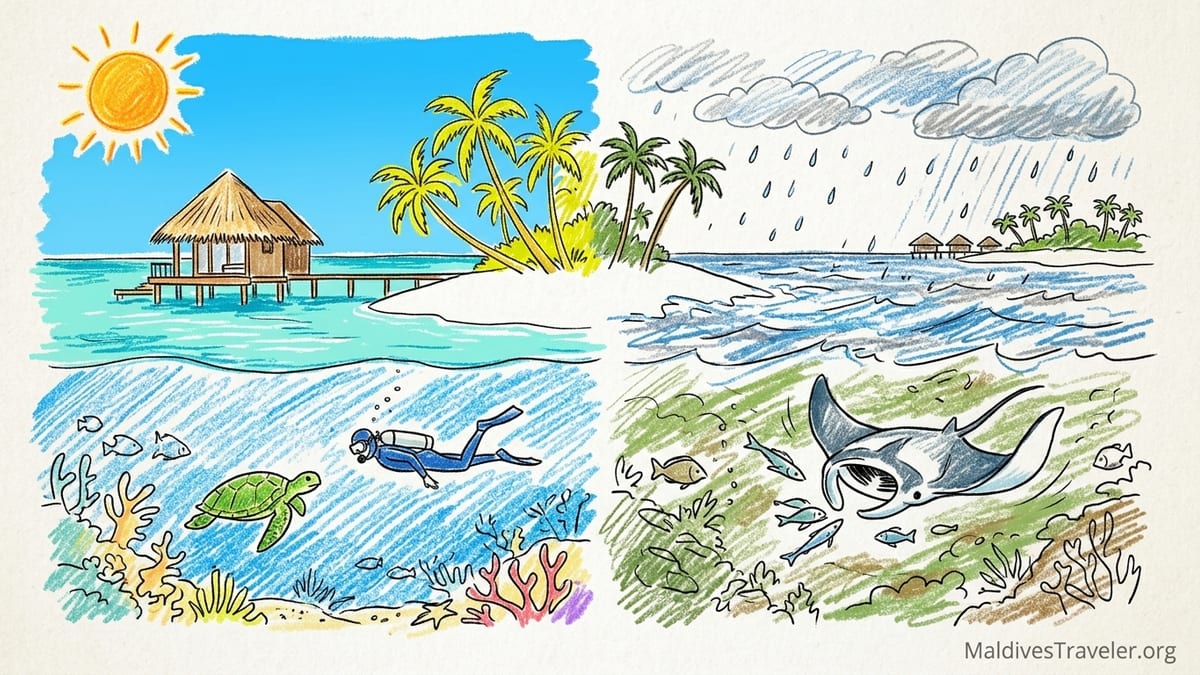
Haa Alif Atoll sits just north of 7 degrees latitude, which means it is warm and humid all year. Daytime temperatures typically sit in the high 20s Celsius, around the low 80s Fahrenheit, in every month. What really changes through the year is not temperature but wind direction, rainfall patterns and how clear or plankton rich the water is. Like the rest of the Maldives, Haa Alif is shaped by two main monsoon regimes rather than classic four seasons.
From roughly December to April, the northeast monsoon brings drier, more stable conditions. Skies are often clearer, the seas are calmer and rainfall totals are relatively low in the northern atolls. Climate records for Haa Alif show average monthly rainfall under about 70 millimeters in January, February and March, climbing into the 60s in April before the wetter phase starts. In real terms, that often translates into many sunny days with brief showers rather than long grey spells.
The southwest monsoon from May to November increases cloud cover, wind and rain. Through June, July and August, typical monthly rainfall in Haa Alif climbs well above 200 millimeters, with June often the wettest month of the year. You can still get blue-sky days in this period, but they are punctuated more frequently by squalls, especially in the afternoon or at night. Sea conditions are more mixed, with choppier crossings on longer speedboat rides and a higher chance of short-lived disruptions for excursions.
For divers and snorkelers, the key seasonal detail is how those monsoon winds move currents and plankton. During the northeast monsoon, clearer oceanic water tends to dominate on one side of each atoll, which is why guides in the far north often talk about “good side” visibility shifting with the season. That is also why the same reef can feel like two completely different dive sites in January versus August.
Best Overall Months for Beach Weather
If you are choosing Haa Alif first and foremost for sunbathing, lagoon swims and overwater villa decks, the priority is steady sunshine and calmer seas. In practice that means the heart of the northeast monsoon, from late December through March, with November and April acting as shoulder months that can be excellent in some years and more mixed in others.
January, February and March usually deliver the most reliable combination of clear skies, long sunny spells and relatively low rainfall in Haa Alif. Resorts such as JA Manafaru or The Barefoot Eco Hotel typically describe this as their prime “blue sky” period, when house reefs are bathed in strong light and most sunset cruises sail in flat seas. Air humidity remains high, but the lighter winds and reduced cloud cover make beaches feel particularly inviting. Snorkelers find the shallows bright and easy to navigate, with plenty of time each day to explore without watching approaching squalls.
November and April can also be rewarding for beach focused trips. In November, the southwest monsoon is easing and rainfall averages in Haa Alif drop significantly compared with the mid-year peak. You may still encounter a few passing thunderstorms, but you are more likely to enjoy long sunny windows than in June or July. April often feels like an early wet season month in the atoll: warmth and humidity rise and showers become more common, yet many days still start and end in sunshine. For travelers who accept a little more weather risk in exchange for slightly softer prices, these shoulder months can be a good compromise.
By contrast, June through August generally bring the most unsettled beach weather. The combination of heavier rainfall, stronger winds and occasionally rougher seas can limit how much time you want to spend on long sandbank trips or exposed sandbars. For some guests that matters little, especially if they are focused on diving or content with spa time and reading on a covered deck. For others, especially those imagining consistently calm turquoise shallows for small children to splash in, this is not the ideal window.
Diving Seasons: Visibility, Currents and Site Choice
PADI materials frame the Maldives, including the far northern atolls, as year round dive destinations. That description holds for Haa Alif. Water temperatures stay around 28 to 30 degrees Celsius through the year and local dive operators run boats in most months. The difference from season to season is not whether you can dive, but what conditions you are likely to experience and which species you are most likely to encounter.
The northeast monsoon period from about December through April is widely regarded by northern atoll dive centers as the peak window for visibility. Operators based in Haa Alif describe this as the time of “clear blue” water, particularly on the ocean facing edges and many channel entrances. It is common to hear reports of visibility extending 25 to 30 meters or more on good days, which suits wide angle photography and big scenery dives on walls and thilas. Currents tend to be moderate rather than extreme, though channels can still run fast enough to require negative entries on some dives.
By contrast, the southwest monsoon months of May to November often feature more suspended plankton, slightly reduced visibility and stronger, more variable currents in parts of Haa Alif. Visibility can fall into the mid-teens of meters, especially on windier days or in more exposed channels. While that is still very workable for most divers, it gives the underwater landscape a different character. Hard coral structures are less visible at a distance, but the increased nutrients can draw in schooling fish and pelagic visitors to certain channel mouths.
Crucially, site choice by local guides shifts with the season. In the dry months, dive plans in Haa Alif often emphasize clear water sites and walls where reef sharks, turtles and schooling fusiliers are easy to spot from far off. During the wetter months, more dives may target cleaning stations and known plankton pockets where mantas or other filter feeders are likely to patrol. The same resort might highlight calm inner lagoon reefs suitable for beginners in January, yet promote more channel and corner dives for experienced guests in August.
Snorkeling and Manta Possibilities
Snorkeling in Haa Alif is possible through the year, as long as winds and local currents cooperate. Unlike some busier central atolls, house reefs in the far north remain relatively quiet and in many cases healthy, so simply having time in the water can be rewarding even without headline species. For inexperienced swimmers or families, the northeast monsoon from December to April is usually the most comfortable period. Lagoon surfaces are flatter, visibility is higher and access ladders from overwater villas see less surge.
Manta ray encounters in Haa Alif, however, are more closely tied to plankton and monsoon driven patterns. Research on manta distribution in the northern Maldives has found a strong seasonal signal in and north of Haa Alif, with more regular sightings in the northeast monsoon months when visibility is also highest. Dive centers in the atoll often talk about “right season, right corner” when planning manta focused excursions, targeting cleaning stations and corners that sit in the path of productive currents.
For snorkelers hoping to see mantas from the surface in Haa Alif rather than on scuba, the ideal compromise is often late in the northeast monsoon or around the transition periods. On many years, February to April and again October to early November can bring a mix of decent surface visibility and enough plankton to interest filter feeders. Operators may organize dedicated manta boat trips in those windows, motoring 30 to 40 minutes from resort jetties to favored reefs and channel edges. Guests should be prepared for flexibility, since even in prime months, manta activity is never guaranteed and trips are often scheduled with only a day or two of notice based on conditions.
Outside those windows, snorkel manta encounters in Haa Alif are more opportunistic. In the peak of the wet season, visibility near the surface can be reduced by blooms of plankton and increased wave action, which can make it harder to spot mantas from deck level. Divers on the bottom may still enjoy spectacular passes, while snorkelers see only shifting shapes in green tinted water. Travelers who care deeply about surface level manta interaction may want to balance Haa Alif with a side trip to a specialized aggregation site elsewhere in the Maldives, while still timing their Haa Alif stay for its own more predictable conditions.
Currents, Skill Levels and Choosing When to Learn
Diving in Haa Alif can range from very gentle to surprisingly demanding depending on site and season. During the main northeast monsoon period, many sheltered reefs within the atoll lagoon offer mild currents, making them suitable for Discover Scuba dives or Open Water training. Visibility in these months helps new divers feel more comfortable, since they can see the bottom, their instructor and the reef structure clearly. Resorts with in house PADI centers often schedule entry level courses heavily between December and March for that reason.
Advanced divers tend to seek out channel entrances and exposed corners, where tidal flows can be strong regardless of monsoon. In the dry season, these sites often combine excellent visibility with brisk but predictable currents that lend themselves to classic drift dives. A guided descent along a corner such as Baarah or Utheemu side reefs can involve hooking in at 20 meters to watch grey reef sharks, jacks and tuna working the blue water, then drifting along the wall as the current eases. These profiles suit divers who are comfortable with negative entries and mid water ascents.
In the southwest monsoon months, currents at exposed sites can become more erratic as wind driven surface chop interacts with tidal flow. Entry level courses may still run, but instructors are more likely to select very sheltered reefs and inner lagoons for key skills, postponing channels until students have more experience. For certified but relatively inexperienced divers, this is a period to be honest on check in forms and let guides know if they prefer gentler sites. Many Haa Alif operators specifically group dives by experience level and will steer less confident guests to protected bommies when offshore corners are running fast.
For travelers deciding when to schedule a first certification, the simplest guidance is that December through March usually offers the smoothest learning curve. Surface conditions make boat rides more comfortable, entry and exit points are easier to manage and visibility is forgiving when mask skills are still developing. Those who must travel in mid year can still learn, but should choose a resort with a strong training focus and be prepared for schedule tweaks if wind or rain occasionally disrupts plans.
Resort Pricing by Season in Haa Alif
Because Haa Alif sits far from the busy central atolls, it has fewer properties and a narrower spread of price points. You will find a handful of standalone resorts and a small number of local island guesthouses rather than long chains of branded five star islands. Even so, prices move clearly with the monsoon cycle. Broadly speaking, late December through March is high season, November and April are shoulder months, and May through early October are low or value seasons, especially for longer stays.
At the upper end, overwater pool villas at a five star resort in Haa Alif often sit well above 1000 US dollars per night including taxes in January and February, sometimes more once meal plans are added. During peak holiday weeks around late December and early January, minimum stay rules and festive surcharges can push those numbers significantly higher, which is why many couples with flexible dates aim for mid January or early March instead. In return, you benefit from the most stable beach weather and the clearest typical diving conditions.
By late April or May, nightly rates at the same properties often soften noticeably. It is common to see entry level beach villas in Haa Alif priced several hundred dollars per night lower than in February, particularly on longer stay promotions. Travel periods from June through September can deliver some of the best value for money on accommodation, with packages that include half board or even basic all inclusive at prices that would only cover bed and breakfast in peak season. Many repeat visitors who are comfortable with the chance of mixed weather deliberately target these months to stretch their budget.
Guesthouses on inhabited islands in Haa Alif follow the same rough pattern on a smaller scale. Simple rooms that might cost 80 to 120 US dollars per night including breakfast in July can climb noticeably from late December to March when domestic demand and limited capacity combine. For budget conscious divers, that makes mid year an appealing time, especially if they plan to spend long hours underwater where rain matters less than currents and visibility. In all seasons, factoring in the additional cost of domestic flights or long speedboat transfers from Malé is important, as Haa Alif sits at the northern end of standard transfer routes.
Matching Your Priorities to the Calendar
The best time to visit Haa Alif Atoll depends less on a single “perfect” month and more on what you want from your trip. Travelers who picture long days on the sand, flat turquoise water and minimal interruption from showers will be happiest anchoring their plans between late December and March. Those who come primarily to dive channels, accept slightly lower visibility but hope for busy fish life and more dynamic conditions may find May to November satisfying, especially if they value lower resort rates as much as sunshine hours.
If manta rays are high on your wish list, focusing on the northeast monsoon and its shoulders makes sense. Late January to April and again around October to early November tend to balance visibility and plankton in a way that favors manta activity in Haa Alif. Coordinating closely with your resort’s dive center or excursion team is key, as they will know which local cleaning stations are active in any given week and can recommend whether to bring a snorkel, a camera rig or simply patience on the boat deck.
For mixed groups, such as families or friends where some dive and others simply want a comfortable beach break, February and March are often the sweet spot. These months deliver stable beach weather, clear snorkeling, reliable dive visibility and a still active high season atmosphere at resorts, without the peak festive pricing of late December and early January. Booking six to nine months ahead for those periods is advisable, as Haa Alif’s small resort count means prime room categories can sell out early.
Ultimately, the relative remoteness of Haa Alif works in its favor across all seasons. Even in popular months, dive boats are rarely crowded and many reefs see only a handful of groups each day. In value season, you may find yourself sharing a channel wall with only your guide and a pair of turtles. If you calibrate your expectations to the likely weather, there is no truly bad month to be here, just different shades of good.
The Takeaway
Haa Alif Atoll rewards travelers who match their timing to their priorities. For classic postcard beach weather, long clear days and the most forgiving conditions for new divers and snorkelers, the northeast monsoon months from late December through March are strongest. For experienced divers more focused on dynamic currents, fish life and stretching their budget in quieter resorts, the southwest monsoon period from May to November opens up attractive value, provided they are comfortable with intermittent rain and more variable visibility.
The northern location of Haa Alif means slightly drier averages than some southern atolls in certain months, but it still follows the broader Maldivian pattern of shifting winds and plankton flows. Rather than searching for a single perfect week, think in bands: peak dry season for beaches, shoulder seasons for balance between price and conditions, and wet season for value and adventurous diving. With that mindset, you can choose the month that best aligns with your own mix of sun loungers, channel hooks and manta dreams.
FAQ
Q1. What is the best overall month to visit Haa Alif Atoll for beach weather?
For the most reliable sunshine and calm seas, February is often the strongest single month, closely followed by January and March.
Q2. When are diving conditions in Haa Alif Atoll typically at their best?
The clearest visibility and calmest seas usually occur from December through April during the northeast monsoon, with January to March especially good.
Q3. Is Haa Alif really a year round dive destination?
Yes. Water temperatures stay warm all year and dive centers operate in every month, though visibility, currents and marine life focus shift with the seasons.
Q4. When is the best time to see manta rays in Haa Alif?
Manta encounters are more likely in the northeast monsoon and its shoulders, roughly from late January to April and around October to early November.
Q5. Which months are cheapest for resorts in Haa Alif Atoll?
Resort rates are usually lowest from May through early October, especially in June, July and September, outside major school holidays.
Q6. Is June a bad time to visit Haa Alif Atoll?
June often brings higher rainfall, more wind and choppier seas, but diving still runs and prices are softer, so it suits value focused, flexible travelers.
Q7. Are currents too strong for beginners in Haa Alif?
Not generally. Instructors choose sheltered reefs for training, especially from December to March, and reserve stronger channel sites for more experienced divers.
Q8. How far in advance should I book a January or February trip?
For peak season dates, especially overwater villas, booking six to nine months ahead is sensible given the small number of resorts in Haa Alif.
Q9. Will rain ruin a trip during the wet season?
Rain in the southwest monsoon usually comes as short, intense showers rather than days of constant drizzle, so most activities still run around passing squalls.
Q10. Is Haa Alif suitable for a first time Maldives visit?
Yes. It offers classic Maldivian lagoon scenery with fewer crowds, strong house reefs and a clear seasonal pattern that makes planning straightforward for first timers.