


Far in the north of the Maldives, Haa Alif Atoll feels a long way from the polished resort circuit of the central atolls. Here, life still revolves around fishing, family compounds and mosque courtyards, yet a small but growing number of guesthouses now welcome independent travelers. Choosing the right island is crucial, especially if you want to base yourself in one place rather than hop around blindly. Kelaa, Vashafaru, Utheemu, Hoarafushi and Dhidhdhoo each offer a very different flavor of the atoll, from white sand sandbanks and house reefs to royal history and everyday Maldivian life.
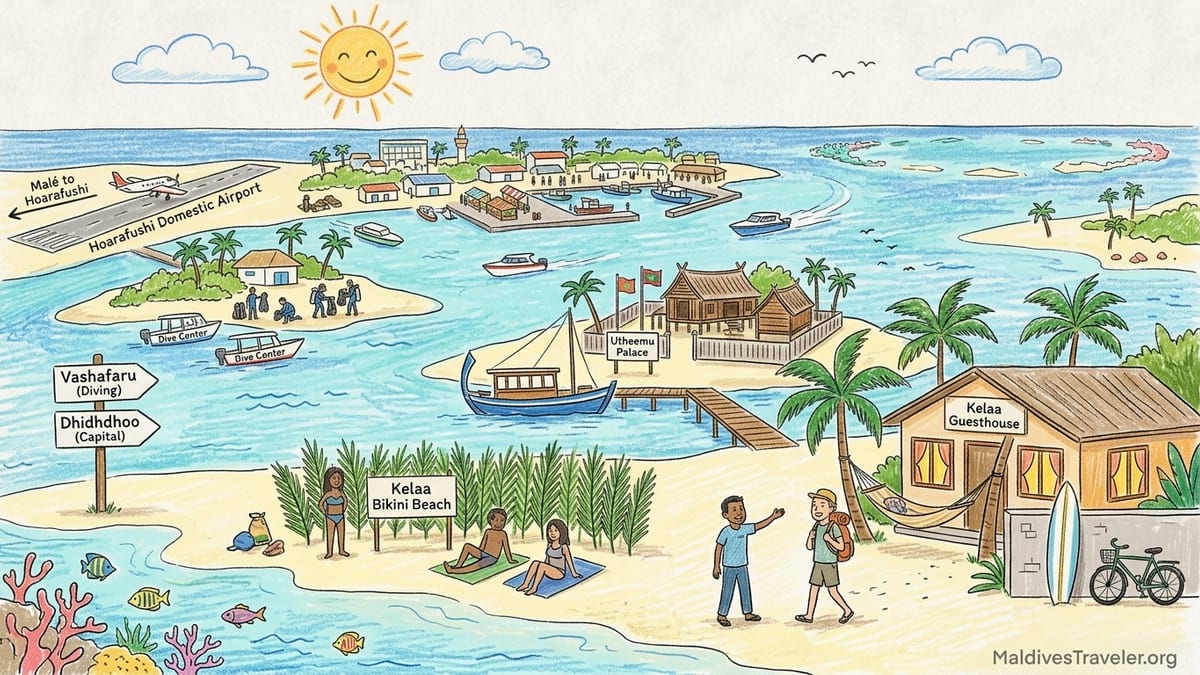
How Haa Alif Atoll Works For Guesthouse Travelers
Haa Alif is the northernmost administrative atoll of the Maldives, a scatter of low coral islands spread across the Ihavandhippolhu and Thiladhunmathi reef systems. It sits roughly 320 to 350 kilometers north of Malé, which means travel times and transfer costs are higher than to popular central atolls. The upside is fewer crowds, more authentic island life and reefs that still feel relatively untouched compared with some southern chains.
For guesthouse travelers, the atoll functions around a few key hubs. Hoarafushi has the domestic airport that links the region to Malé, while Dhidhdhoo serves as the atoll capital with banks, shops and public offices. Smaller islands such as Kelaa, Vashafaru and Utheemu focus more on beaches, fishing and heritage. A typical trip might involve flying Malé to Hoarafushi, then taking a local speedboat to your chosen island and staying several nights in a small family-run guesthouse.
Every inhabited island has its own rules and customs around tourism. Outside designated “bikini beaches,” visitors must follow Maldivian dress codes and wear modest clothing that covers shoulders and knees. Alcohol is not sold on local islands, and daily life follows the rhythm of the call to prayer. If you come expecting resort-style nightlife you will be disappointed, but if you are looking for calm beaches, friendly hosts and a sense of place, Haa Alif is a compelling alternative.
Across these five islands, guesthouses tend to be small. Many have between 4 and 10 rooms, often converted from family homes. You will rarely find infinity pools or elaborate spas, but you will often eat a home-cooked breakfast of mas huni and roshi, head out on a locally skippered fishing boat, and finish the day with tea in a shaded courtyard listening to island gossip carried on the wind.
Kelaa: Long Beaches and Slow, Relaxed Stays
Kelaa lies on the eastern rim of Haa Alif and is one of the larger inhabited islands in the atoll. Travelers are drawn here for its long, gently curving beaches, shallow lagoons and a layout that encourages walking and cycling. Many guesthouses sit a few sandy lanes back from the shore, so you can stroll to the sea in under five minutes yet still feel part of the village. For those planning a week or longer, Kelaa works well because you can settle into routines rather than chasing a checklist of sights.
Guesthouse supply on Kelaa is modest but growing. Properties typically offer simple air-conditioned rooms, private bathrooms and an on-site kitchen. A typical double room might cost somewhere in the range of 60 to 100 US dollars per night including breakfast, depending on season and inclusions. Dinner is often available for an additional fee, with grilled reef fish, rice, salads and occasional curries featuring tuna, chicken or vegetables. Because restaurant choice is limited, most guests end up eating where they sleep, which in turn makes for close relationships with hosts.
Kelaa usually has a designated bikini beach on a quieter stretch of shoreline. Expect a screened or signposted section where tourists can sunbathe and swim in regular swimwear, while elsewhere you will need to cover up. The lagoon is shallow, making it good for long, lazy swims and for families with children. Local operators can arrange low-key excursions such as sunset cruises, sandbank picnics or visits to nearby uninhabited islands, but the atmosphere here is less about ticking off activities and more about reading in a hammock, walking the beach at sunrise and watching local kids play football at dusk.
Reaching Kelaa typically involves flying from Malé to Hoarafushi airport and continuing by speedboat. In practice, many travelers will pre-arrange this with their guesthouse, which can bundle the domestic flight and boat transfer or at least advise on schedules. Because of its size and modest infrastructure, Kelaa is best suited to travelers who are happy with slow days and a relaxed, beach-first focus rather than intensive diving or nightlife.
Vashafaru: For Divers, Snorkelers and Marine Excursions
Vashafaru sits on the eastern edge of Haa Alif and has quietly positioned itself as one of the atoll’s most active islands for marine excursions. Several guesthouses operate here, including small beachfront properties and inland family homes with a handful of rooms. Official lists show multiple licensed guesthouses, which means a decent choice for such a remote island. Typical nightly rates are broadly similar to Kelaa, but packages often include guided snorkeling, fishing trips or boat transfers, reflecting its more activity-focused clientele.
The island’s key asset is access to dive and snorkel sites. Vashafaru Dive and Water Sports, a dedicated dive center on the island, runs PADI courses and daily boat dives to nearby thilas and walls. Certified divers can expect classic northern Maldives conditions: channels with strong currents, reef overhangs lined with soft corals and the chance of encounters with grey reef sharks, turtles and schooling jacks. Beginners can sign up for Discover Scuba Diving experiences or full Open Water courses over several days, combining study sessions with confined water training in the lagoon and boat dives on sheltered reefs.
For non-divers, house reef snorkeling is a highlight. Some guesthouses organize half-day trips to nearby reefs where you might drift above coral bommies, spot green turtles and, in certain seasons, swim alongside harmless nurse sharks. Evening fishing trips in traditional dhonis are common, with your catch grilled for dinner. On land, Vashafaru has a bikini beach area facing the lagoon where tourists can relax in swimwear. The beach is smaller than Kelaa’s but tends to feel intimate, especially when only a few rooms on the island are occupied.
Vashafaru’s village is compact, with a few small cafés and local tea shops where you can buy short eats such as fish buns, samosas and sweet bites for a few Maldivian rufiyaa. As with most local islands, alcohol is not available, and evenings revolve around casual chats, stargazing and perhaps a film on a laptop rather than bars or clubs. Overall, Vashafaru suits divers, snorkelers and active travelers ready to spend much of their time on the water, using the island as a practical yet friendly base.
Utheemu: Royal History and Culture at the Edge of the Atoll
Utheemu is one of the most historically significant islands in the Maldives and a compelling choice for travelers interested in culture rather than only beaches. It is known as the birthplace of Sultan Mohamed Thakurufaanu, a national hero who led resistance against Portuguese influence in the 16th century. The preserved wooden palace complex, Utheemu Ganduvaru, along with an old mosque and ancient cemetery, gives the island a tangible sense of the country’s past that is rare elsewhere in the atolls.
Staying on Utheemu in a guesthouse allows you to experience this heritage without rushing through on a day trip. A small number of guesthouses serve visitors, usually converted family houses with simple rooms and communal dining areas. Because capacity is limited, it is wise to book well ahead, especially if you are visiting during Maldivian school holidays when domestic tourism peaks. Prices are in the same ballpark as other Haa Alif islands, but what you are paying for here is access to guides who know the stories behind each timber beam and coral stone wall.
Daytime often begins with a guided walk through the palace compound and old mosque complex. Local guides explain how the royal family once used the various wooden halls, how storms and salt have weathered the beams, and why the island remains a symbol of independence across the country. Photography is typically allowed in most areas, though some religious spaces may have restrictions, so it is wise to check with your guide. Outside of the heritage sites, Utheemu’s sandy streets are quiet, with few shops beyond basic groceries and a couple of teashops selling snacks and drinks.
There is usually a small beach area suitable for swimming, and some islands designate a limited bikini beach stretch, but Utheemu is less about extended sunbathing and more about context. It works particularly well as a two or three night stop for travelers who have already stayed on a more beach-focused island like Kelaa or a marine-focused island like Vashafaru. Transfers typically involve flying to Hoarafushi and continuing by boat, often with a stop in another island such as Dhidhdhoo or Kelaa along the way, arranged by your guesthouse.
Hoarafushi: Domestic Airport Convenience and Stopover Stays
Hoarafushi has become a transport hub for the far north since the opening of its domestic airport. The airstrip handles flights from Malé and links Haa Alif to the wider Maldivian network, making it a key entry and exit point for guesthouse travelers. If you prefer to minimize long boat transfers or are trying to connect tight schedules, basing yourself on Hoarafushi for at least one night on arrival or departure can simplify logistics considerably.
The island itself is larger and more urban-feeling than tiny sandbar islets, with a grid of streets, public buildings and modest local businesses. Guesthouse options here tend to be practical rather than boutique, aimed at travelers looking for clean rooms, reliable air conditioning and quick access to the pier or airport. Pricing is similar to other islands, though some properties may offer discounted one-night transit rates for guests who book onward services such as boat transfers.
Hoarafushi has beaches, though they are not as broad or postcard-perfect as Kelaa’s or as focused on bikini areas as those of more tourism-oriented islands. You can expect a designated bikini beach section but should not plan on endless uninterrupted sand. On the other hand, the surrounding waters still offer decent snorkeling and simple excursions, and some guesthouses can arrange short “mini-safaris” to nearby uninhabited islands where you can enjoy clearer lagoons and sandbanks for a day.
From a traveler’s perspective, the main advantage of Hoarafushi is convenience. Domestic flights save hours compared with overnight ferries, and having your guesthouse a short drive from the terminal removes stress if weather disrupts boat schedules. Many travelers combine a night or two here with a longer stay on another island: for example, flying into Hoarafushi, sleeping there on arrival, then taking a morning speedboat to Kelaa or Vashafaru arranged by the guesthouse. This approach builds some buffer into your trip while still allowing you to see more of the atoll.
Dhidhdhoo: Local Capital, Everyday Life and Island Services
Dhidhdhoo is the administrative capital of Haa Alif Atoll and one of its more populous islands. That status brings a different feel from smaller village islands. Instead of only sandy lanes and coconut groves, you will find government offices, a small hospital, a bank branch, a harbor busy with fishing boats and supply vessels, and streets lined with shops selling everything from mobile phone credit to clothing and hardware. For travelers who like to understand how a region actually functions day to day, Dhidhdhoo offers an instructive base.
Guesthouses here range from simple beachview houses with four or so rooms to slightly larger properties. Descriptions often highlight the island’s authenticity, noting that mass tourism has not yet arrived and that guests should expect more interaction with residents than polished resort-style service. A typical stay might cost around 70 to 100 US dollars per night for a double room with breakfast, with optional half-board or full-board upgrades. Because there are more independent cafés and snack bars on Dhidhdhoo than on smaller islands, you can also eat out relatively easily, trying everyday Maldivian dishes such as hedhikaa snacks, fish curry and sweet tea at local prices.
Dhidhdhoo has beach areas, and some guesthouses emphasize their proximity to the shore. Depending on current regulations, there may be a small designated bikini beach section or arrangements to take guests by boat to a nearby picnic island where swimwear is unrestricted. The surrounding waters offer snorkeling and boat excursions, but the main attraction remains the feel of the island itself. You can watch fishermen unloading their catch in the harbor at sunrise, observe schoolchildren in uniform walking home at midday, and sit in public squares where elders gather to talk politics and fishing conditions.
Because Dhidhdhoo is a hub, it often appears on inter-island boat routes, making it a useful base for those who do want to visit nearby islets on day trips without constantly changing accommodation. Your guesthouse or local agents can arrange transfers to Utheemu, Kelaa or other islands, as well as half-day outings to sandbanks and snorkeling spots. Overall, Dhidhdhoo suits travelers who value services and everyday local life over perfect beaches, and who are comfortable with a slightly busier, more functional island environment.
Bikini Beaches, Dress Code and Cultural Sensitivity
Across Haa Alif, the rules around swimwear and behavior are shaped by Maldivian law and Islamic customs. On all inhabited local islands, tourists are required to dress modestly outside designated beach areas, meaning shoulders and knees covered for both men and women. Light cotton trousers, long shorts, T shirts and loose dresses work well in the tropical climate. Within designated bikini beaches, visitors can wear regular swimwear, though thongs and very revealing clothing may still be frowned upon.
Kelaa, Vashafaru, Hoarafushi and Dhidhdhoo typically maintain clearly marked bikini beach areas, as guesthouses rely on these to attract foreign visitors. The standard arrangement is a signposted stretch of sand a short walk or bicycle ride from the main village, often with a few shade structures and sunbeds provided by guesthouse operators. On Utheemu and other heritage-focused islands, arrangements may be more limited or low key, and some guesthouses instead emphasize half-day trips to nearby uninhabited islands where dress is more relaxed.
Regardless of the island, respectful behavior goes a long way. Avoid loud music near mosques, ask before photographing people, and be mindful that during Ramadan, when many locals fast during daylight hours, cafés may shorten opening hours and public eating should be discreet. In return, you can expect a warm welcome. It is common for guesthouse hosts to invite long-staying visitors to local events, such as bodu beru drumming evenings or informal football matches on dusty pitches.
For couples and families, it is worth remembering that the Maldives is conservative. Public displays of affection are limited, and same sex relationships are not recognized by law. While tourist areas are often discreetly tolerant, especially on bikini beaches and boats, it is safer to keep affection low key in public spaces and follow your host’s guidance on what feels appropriate on their island.
Transfers, Practicalities and Choosing Your Island
Reaching Haa Alif generally involves a domestic flight and a boat transfer. The typical route is Malé to Hoarafushi airport on a domestic airline, then a speedboat organized by your guesthouse onward to Kelaa, Vashafaru, Utheemu or Dhidhdhoo. Flight schedules can change seasonally, so it is wise to coordinate with your guesthouse before booking international tickets. Many properties offer to book domestic flights on your behalf or at least advise on the best times to connect.
Boat transfers between islands can take from 20 minutes to over an hour, depending on distance and sea conditions. Shared speedboats, when available, keep costs down, while private charters offer flexibility at a higher price. As a rough guide, travelers can expect to spend a noticeable portion of their budget on internal transport when visiting the far north, sometimes as much as several hundred US dollars per person for return domestic flights and multiple boat legs. Building a cushion day in Malé or Hoarafushi at the start or end of your trip helps buffer against weather-related delays.
When choosing a single base, think about your priorities. If you want long beaches and time to unwind with a book, Kelaa is a natural fit. Divers and keen snorkelers should look to Vashafaru, where dive centers and marine excursions are central to the experience. History and culture enthusiasts will get the most from Utheemu, especially when paired with a good local guide. Those who value seamless logistics or have short trips might prefer Hoarafushi. Travelers keen on watching daily Maldivian life and having easy access to services should consider Dhidhdhoo.
It is entirely possible to combine two islands in one trip without excessive moving around. For example, a traveler might spend five nights on Kelaa for beaches and relaxation, then transfer to Utheemu for two nights of history before flying out via Hoarafushi. Another might base themselves on Dhidhdhoo for a week, using it as a hub for day trips to other islands while enjoying the relative convenience of shops and services. The key is to plan transfers in advance, confirm bikini beach and excursion options with your chosen guesthouse, and accept that in this remote atoll, a slower pace is part of the charm.
The Takeaway
Haa Alif Atoll rewards travelers willing to trade resort polish for genuine encounters and raw seascapes. Kelaa, Vashafaru, Utheemu, Hoarafushi and Dhidhdhoo each highlight a different dimension of the north Maldives: from barefoot days on broad beaches and drift dives on coral walls to evenings in palace courtyards and mornings watching the atoll capital come to life.
For a single relaxed base with strong beach appeal, Kelaa stands out. If your heart is set on diving and marine life, Vashafaru is hard to beat. Those curious about Maldivian history and identity will find Utheemu uniquely compelling, while Hoarafushi’s airport and location suit short, logistics focused trips. Dhidhdhoo completes the picture as a lived in island capital where guesthouses share space with real day to day life.
Whichever island you choose, expect modest guesthouses rather than lavish villas, simple local cafés instead of cocktail bars, and more conversations with fishermen than with resort staff. In return, you will gain a grounded sense of how Maldivians live in one of the ocean’s most scattered nations and carry home memories shaped not just by turquoise water, but by the people and stories of this northern atoll.
FAQ
Q1. Which Haa Alif island is best if I only want to stay on one guesthouse island?
If you want beaches and a relaxed pace, Kelaa is a strong all round choice. For diving, choose Vashafaru. For history, Utheemu. For convenience, Hoarafushi. For services and local life, Dhidhdhoo.
Q2. Do all these islands have a bikini beach?
Most have a designated bikini beach area, particularly Kelaa, Vashafaru, Hoarafushi and Dhidhdhoo. On more heritage focused Utheemu, arrangements may be more limited, with some guesthouses emphasizing trips to nearby picnic islands for unrestricted swimming.
Q3. How expensive are guesthouses compared with resorts?
Guesthouses in Haa Alif typically cost a fraction of resort stays, often somewhere around 60 to 100 US dollars per night for a simple double room with breakfast, compared with several hundred dollars or more in many private resorts.
Q4. Is it easy to arrange diving and snorkeling from every island?
Vashafaru is best equipped for diving, with an established dive center offering PADI courses and daily dive trips. Other islands can usually arrange snorkeling and simple excursions, but may have fewer options or rely on independent boat owners rather than full service dive shops.
Q5. How do I get from Malé to these Haa Alif islands?
Most travelers fly from Malé to Hoarafushi on a domestic airline, then continue by speedboat to Kelaa, Vashafaru, Utheemu or Dhidhdhoo. Guesthouses typically help coordinate both flight timings and boat transfers.
Q6. Can I buy alcohol on these local islands?
No. Alcohol is not sold on inhabited local islands in the Maldives. It is available only at resort islands and liveaboard boats, so visitors to guesthouse islands should not expect bars or alcoholic drinks.
Q7. Which island is best for seeing everyday Maldivian life?
Dhidhdhoo, as the atoll capital, offers the most complete picture of daily life, with a harbor, hospital, bank, shops and government offices. Kelaa and Hoarafushi also feel very lived in, while Vashafaru and Utheemu are smaller and quieter.
Q8. Is it appropriate to wear shorts and T shirts away from the beach?
Yes, as long as your clothing is modest and covers shoulders and knees. Think lightweight long shorts or trousers and regular T shirts. Swimwear is only acceptable on designated bikini beaches or during excursions.
Q9. How long should I stay in Haa Alif Atoll?
A week allows for a relaxed stay on one island with time for several excursions. Ten days or more gives space to combine two islands, such as Kelaa plus Utheemu or Vashafaru plus Dhidhdhoo, without feeling rushed.
Q10. Is island hopping within Haa Alif complicated?
It requires planning, but guesthouses and local agents can arrange shared or private speedboats between islands. Many travelers pick one main base and add a second island for a shorter stay to balance logistics with variety.