


Haa Alif Atoll sits at the far northern tip of the Maldives, and reaching its islands and resorts requires one extra layer of planning beyond your international flight into Malé. With Hoarafushi Airport now operating regular domestic services and nearby Hanimaadhoo and Kulhudhuffushi acting as alternative gateways, understanding how these domestic flights, speedboat legs and occasional seaplane options fit together can save you hours of waiting and reduce the risk of missed connections. This guide breaks down the real-world routes, timings and practical details for travelers heading from Malé to Haa Alif’s resorts and local islands.
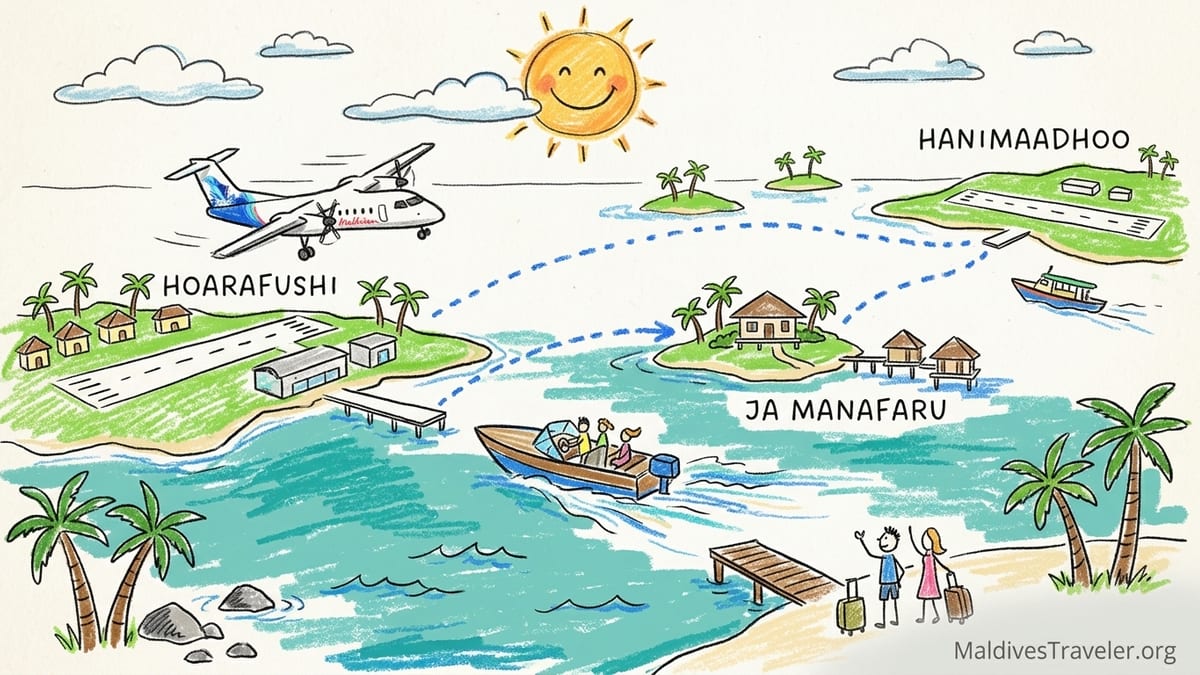
Understanding the Northern Gateway: Hoarafushi, Hanimaadhoo and Kulhudhuffushi
Haa Alif is the northernmost atoll of the Maldives, so even after landing at Malé’s Velana International Airport you are still around 320 kilometers away from most resorts here. For years, the main entry point for the far north was Hanimaadhoo Airport in neighboring Haa Dhaalu Atoll, which runs frequent Maldivian domestic flights from Malé. Hoarafushi Airport, on the inhabited island of Hoarafushi in Haa Alif, is a newer domestic airport that now takes direct Malé flights and shortens the onward boat ride for several resorts.
In practice, many itineraries still use a mix of gateways. A resort might prefer to route guests into Hanimaadhoo because it has more daily Malé connections, then complete the journey by speedboat north into Haa Alif. Some properties will use Hoarafushi whenever the schedule lines up, but fall back to Hanimaadhoo or even Kulhudhuffushi in Haa Dhaalu when weather, aircraft rotations or occupancy push them to adjust transfer plans.
Kulhudhuffushi, on the eastern side of Haa Dhaalu Atoll, has also become a useful secondary domestic airport for the wider northern Maldives. A few Haa Alif transfer programs list it as an alternative domestic point, especially when coordinating chartered or shared speedboats that can reach the atoll in under an hour. As a traveler you usually do not choose between these airports yourself; the resort or guesthouse confirms which combination of domestic flight plus boat makes the most sense for your actual arrival time.
The key concept to keep in mind is that “Malé to Haa Alif” almost always means “Malé to a northern domestic airport, then a boat to your island.” The exact domestic airport can be Hoarafushi, Hanimaadhoo or occasionally Kulhudhuffushi, and the final leg can be a 10 minute hop or a 45 minute ride across open channel, depending on where you are staying.
Malé to Hoarafushi: Core Route, Airlines and Typical Timings
The primary direct route into Haa Alif is the Malé to Hoarafushi domestic service. Local carrier Maldivian operates these flights, typically using Dash 8 turboprop aircraft configured for around 50 passengers. Recent schedules show a flight time of about 55 to 70 minutes between Velana International Airport and Hoarafushi, with one or more daily services depending on season and day of the week.
Frequencies vary, but it is common to see at least one afternoon or late afternoon departure from Malé to Hoarafushi on busy travel days. For example, recent timetables have included an afternoon Maldivian flight arriving in Hoarafushi with enough daylight to allow onward speedboat transfers to nearby resorts such as JA Manafaru. Flight times and days of operation do change seasonally, so treat any sample schedule as indicative rather than guaranteed.
From the traveler’s perspective, Hoarafushi has two main advantages. First, it is physically within Haa Alif Atoll, so many resorts are closer by boat than from Hanimaadhoo. JA Manafaru, for instance, is about 10 minutes by speedboat from Hoarafushi, compared with roughly 40 minutes or more if routed via Hanimaadhoo. Second, arriving into Hoarafushi generally means a shorter total travel day, especially if your international flight lands in Malé early enough to connect to an afternoon domestic sector without long gaps.
There are some tradeoffs. Hoarafushi currently has fewer daily flights than Hanimaadhoo, so if you land into Malé in the late evening or on a quiet weekday, it may not be possible to connect the same day. In that case the resort might automatically switch you to a Hanimaadhoo routing or recommend an overnight in Malé or Hulhumalé, then put you on a morning domestic flight the next day. All of this is coordinated in the background once you have shared your international flight details.
When Resorts Use Hanimaadhoo or Kulhudhuffushi Instead
Hanimaadhoo, located one atoll south in Haa Dhaalu, remains a major northern hub with a dense pattern of Maldivian domestic flights from Malé, and in some periods limited regional international services as well. It typically sees several departures per day, with a scheduled flight time of around 50 to 60 minutes from Malé. Many Haa Alif resorts and guesthouses still list Hanimaadhoo as their default access point because it provides more flexibility around late arrivals, early departures and operational disruptions.
As an example, a traveler booked to a Haa Alif guesthouse on Kelaa or Vashafaru might be confirmed on a Malé to Hanimaadhoo domestic flight arriving in the early afternoon. From there, the property’s speedboat meets guests at the small terminal jetty for a 20 to 35 minute transfer north to the island. If that same guest were routed via Hoarafushi, the boat ride could be shorter, but only if a convenient Malé to Hoarafushi flight was operating near their arrival time.
Kulhudhuffushi, in the eastern part of Haa Dhaalu, is a smaller but increasingly useful option. Some transfer fact sheets for Haa Alif properties list Kulhudhuffushi as a backup domestic airport, particularly when charters or shared speedboats are already running between it and northern resorts. In one example, a resort suggests that if Hoarafushi flights do not align, guests can be rerouted to Kulhudhuffushi with a roughly 45 minute speedboat leg completing the journey.
In practice you might see your confirmation mentioning more than one possible domestic airport, such as “Transfers may operate via Hoarafushi, Hanimaadhoo or Kulhudhuffushi depending on your arrival time and operational considerations.” That wording is normal. It reflects the reality that northern domestic schedules are dynamic and that resorts regularly adjust which gateway they use to get you to the island as smoothly and safely as possible.
Domestic Flight + Speedboat: How the Combined Transfers Work
Most Haa Alif itineraries follow a similar pattern: international flight into Malé, domestic flight to a northern airport, then resort-organized speedboat to your final island. Although you can theoretically buy the domestic flight separately, in practice the resort almost always bundles the domestic ticket and boat together in a single transfer charge and manages the whole sequence on your behalf.
Here is how it usually looks step by step. After clearing immigration and customs at Velana, you emerge into the arrivals hall where resort representatives wait with name boards. If you are staying at a resort such as JA Manafaru, the representative will escort you to a dedicated lounge or seating area, handle check in for your Maldivian domestic flight, and advise you of the expected departure time. Your luggage is tagged through to the domestic sector and, in many cases, directly to the resort boat at the far end.
When the domestic flight is ready, staff guide you to the small domestic terminal, usually a short walk or buggy ride from the international arrivals area. The flight itself is around 55 to 60 minutes to Hoarafushi, Hanimaadhoo or Kulhudhuffushi, with cabin conditions similar to a regional commuter flight anywhere else in the world. At the northern airport, you walk from the aircraft into a small terminal where resort or guesthouse staff are waiting. They collect you and your bags, walk you to the harbor or jetty, and you board a speedboat for the final stretch.
Speedboat legs vary but are typically between 10 and 45 minutes. For instance, Hoarafushi to JA Manafaru is often quoted at about 10 minutes. Hanimaadhoo to several Haa Alif islands, including Kelaa and local guesthouse islands, is usually 20 to 35 minutes depending on sea conditions. Kulhudhuffushi to Haa Alif resorts can be 40 to 50 minutes across open sea. Boats are open or semi enclosed speedboats with bench seating, generally with lifejackets and basic safety gear; seas can be choppy in the northeast monsoon, so motion sensitive travelers may want medication or to sit further aft.
Seaplane Alternatives for Haa Alif Resorts
While domestic flight plus speedboat is the primary access for Haa Alif, a small number of high end resorts in the far north also offer seaplane transfers from Malé, especially during peak season. These operate on shared charters with Trans Maldivian Airways or Manta Air and can significantly shorten total travel time by skipping the domestic airport and speedboat legs altogether.
For example, some packages at JA Manafaru for stays of a week or longer have, at times, included complimentary seaplane transfers between Malé and the resort for specific travel windows. In those cases, guests are routed from the international terminal to a seaplane lounge at a separate pier near Velana, then board a Twin Otter seaplane for a roughly 70 to 90 minute direct flight that lands on a floating platform near the resort. A short boat shuttle covers the final few hundred meters to the island.
Seaplane seats are more expensive than domestic flights and schedules are more sensitive to daylight. Aircraft do not fly in the dark, so resorts with seaplane transfers usually require international arrivals into Malé before mid afternoon, often around 15:00, and departures from Malé after mid morning, often after 09:00, to safely connect. Late evening arrivals or very early morning departures almost always push guests back to domestic flight plus speedboat combinations or require an overnight in Malé or Hulhumalé.
The decision between seaplane and domestic plus speedboat is therefore a balance of time, cost and timing. Seaplanes can be scenic and direct but come at a premium and are restricted by daylight. Domestic routes are generally more robust against weather or light constraints and can operate after dark, but you add at least one extra boarding and a boat transfer to your day. When booking, ask your resort which mode they are currently using for Haa Alif and how that aligns with your flight times.
Connecting From International Flights: Cutoffs, Buffers and Minimum Times
One of the most important planning decisions for a trip to Haa Alif is how your long haul flights line up with the domestic or seaplane schedule. Resorts and airlines in the Maldives work with rough connection guidelines rather than fixed guaranteed minimum connection times, but a few practical rules of thumb apply. For domestic flights, many resorts are comfortable booking same day connections for international arrivals landing up to around 21:00, as domestic sectors can operate into the evening.
For seaplanes, the cutoffs are stricter. Many resorts advise that guests should land in Malé no later than mid afternoon, often around 15:00, to guarantee a same day seaplane transfer, and that departure flights from Malé should leave after about 09:00 to allow a morning seaplane back. If you land at 17:30 from Europe, for example, a direct seaplane to Haa Alif will not be possible that day and you will either be rerouted via a later domestic flight and speedboat or asked to overnight near the airport.
In all cases it is wise to allow at least two to three hours between scheduled international arrival and domestic or seaplane departure. That buffer covers immigration queues, baggage reclaim, the transfer from the international side of Velana to the domestic or seaplane terminal, and the possibility of minor delays. As an example, if you arrive from Doha at 08:50, a domestic departure to Hanimaadhoo or Hoarafushi around 11:30 is usually comfortable, while a 09:40 domestic sector might feel rushed on a busy morning.
Most resorts will ask you to provide your confirmed international flight details at least seven days before arrival. They then use this information to book you onto an appropriate domestic or seaplane sector, adjusting your routing between Hoarafushi, Hanimaadhoo and Kulhudhuffushi as needed. If you change your international flights after this point, inform the resort immediately so they can try to rebook the domestic sector and avoid missed connections.
Baggage Rules, Missed Transfers and Overnight in Malé
Domestic flights and seaplane services in the Maldives typically have tighter baggage allowances than international long haul carriers. For many Maldivian domestic sectors, the standard free allowance is in the region of 20 kilograms of checked luggage plus about 5 kilograms of hand luggage, though the exact figure varies by ticket type and carrier. Seaplanes are often similar or slightly stricter, given the weight sensitive nature of small aircraft. Excess baggage is usually accepted for an additional per kilogram fee, but it may travel on a later flight if the aircraft is full.
Because of these limits, resorts often remind guests ahead of time to pack efficiently and distribute weight across bags. A family carrying multiple large suitcases at 32 kilograms each from Europe may have no issue on their international sector, but find themselves paying notable excess charges on the domestic hop to Hoarafushi or Hanimaadhoo. Soft sided bags are easier to handle in small domestic holds and on speedboats than very hard shell cases.
Missed transfers are uncommon but do happen, usually because of significant long haul delays or weather disruptions. If your international flight lands too late to catch the last domestic or seaplane sector of the day, the usual solution is an overnight stay in Malé or nearby Hulhumalé. Airport and resort staff will help you arrange a room at a transit hotel or small guesthouse, with simple taxi or shuttle transfers across the causeway from the airport island. The next morning you return to the airport at a pre agreed time to take the first available domestic or seaplane flight.
If you suspect mid journey that you will miss your planned connection, contact your resort as soon as you have updated information from the airline. They may be able to switch you from a seaplane to a later domestic flight, rebook you onto a different northern airport, or coordinate with partners to secure an additional speedboat transfer. Travel insurance that covers missed connections and extra hotel nights can help offset costs if the delay is due to external factors like weather or airline technical issues.
Real World Resort and Island Examples in Haa Alif
To make the route combinations more concrete, it helps to look at specific islands and how they are currently served. JA Manafaru, one of the signature luxury resorts in Haa Alif, commonly uses a domestic flight from Malé to Hoarafushi followed by a 10 minute speedboat transfer. However, its transfer information also notes that Hanimaadhoo or Kulhudhuffushi may be used as alternative domestic airports, with longer boat rides of around 40 to 45 minutes if circumstances require.
Local islands such as Kelaa and Vashafaru, which host a growing number of guesthouses, usually rely on Malé to Hanimaadhoo domestic flights followed by 20 to 35 minute speedboats. For example, a typical journey might involve a morning arrival into Malé from Istanbul, a midday domestic hop to Hanimaadhoo, and an early afternoon speedboat to Kelaa, arriving in time for check in and a sunset beach walk. If the Hanimaadhoo flight is full or disrupted, some guesthouses may reroute guests via Hoarafushi with a different boat leg.
Smaller islands like Hoarafushi itself and nearby inhabited communities are directly served by the domestic airport there. Visitors staying in village guesthouses on Hoarafushi usually take the Malé to Hoarafushi flight and then walk or take a very short local transfer to their accommodation. The presence of the airport has opened up the atoll to more budget friendly stays and dive trips, not just five star resorts.
Across all these examples, the unifying theme is flexibility. The names of the domestic airports may shift from your booking confirmation to your final travel documents as resorts adapt to seasonal schedules, but from a guest point of view the experience remains similar: you are met on arrival, guided to the correct counter or lounge, taken on a one hour domestic flight, and then sped across turquoise water to your final island.
The Takeaway
Reaching Haa Alif Atoll is more involved than getting to a resort near Malé, but with the right information it does not need to be stressful. Hoarafushi has given the far north a dedicated domestic gateway, shortening transfers to several key resorts, while Hanimaadhoo and Kulhudhuffushi remain important alternatives that keep itineraries resilient when schedules, weather or daylight change.
For most travelers, the most effective approach is to choose the resort or island that best suits your style and budget, then let its transfer team orchestrate the combination of domestic flight and speedboat, or seaplane where available. Share your international flight times early, travel with reasonably light and flexible luggage, and build comfortable buffers into your arrival and departure days.
Once you understand that Malé to Haa Alif is really Malé to a northern domestic airport plus a short boat ride, the puzzle pieces fall into place. With expectations set around timing, baggage and the possibility of an overnight near Malé in the event of delays, you can focus on what actually matters: waking up the next morning on a quiet island in the far north of the Maldives, surrounded by clear water and a very long way from your departure airport.
FAQ
Q1. How long does it take to travel from Malé to a Haa Alif resort?
The core journey is usually around two and a half to four hours door to door, including a one hour domestic flight to Hoarafushi or Hanimaadhoo and a 10 to 45 minute speedboat transfer, but the total can be longer if you have significant waiting time between sectors.
Q2. Do I need to book the domestic flights from Malé to Hoarafushi or Hanimaadhoo myself?
In most cases no. Resorts and guesthouses in Haa Alif typically book domestic or seaplane sectors on your behalf once you send them your international flight details, and they bundle these into a single transfer charge that includes the speedboat leg.
Q3. Which is better for Haa Alif, flying into Hoarafushi or Hanimaadhoo?
Hoarafushi is closer to several Haa Alif resorts and can shorten the boat ride, while Hanimaadhoo usually has more frequent flights from Malé. Most properties use whichever airport best fits your arrival time on the day, so it is less about choosing yourself and more about allowing the resort flexibility.
Q4. Are there direct seaplanes from Malé to Haa Alif Atoll?
A limited number of high end resorts in Haa Alif occasionally offer direct seaplane transfers from Malé, often in partnership with Trans Maldivian Airways or Manta Air. These are usually more expensive than domestic flights and are restricted to daylight hours, so not all itineraries or travel dates will offer them.
Q5. What happens if my international flight is delayed and I miss the last domestic connection?
If you miss the final domestic or seaplane sector of the day because of a delay, the usual solution is to overnight in Malé or Hulhumalé and travel to the atoll on the first available flight the next morning. Your resort or guesthouse can assist in arranging a nearby hotel and rebooking the domestic or seaplane transfer.
Q6. How strict are baggage limits on domestic flights and seaplanes?
Baggage allowances are generally lower than on long haul flights, often around 20 kilograms of checked luggage plus a small hand luggage allowance. Excess baggage is usually accepted at an extra per kilogram fee and may be loaded on a later flight if the aircraft is weight limited, so packing light and avoiding multiple very heavy suitcases is recommended.
Q7. Can I stay on Hoarafushi or Hanimaadhoo islands themselves instead of a resort?
Yes. Both Hoarafushi and Hanimaadhoo have local guesthouses that cater to divers and independent travelers. In that case your transfer is simply the domestic flight to the island’s airport plus a very short vehicle or boat ride to the guesthouse instead of a longer private speedboat to a resort island.
Q8. Is it safe to travel by speedboat at night in the northern atolls?
Licensed transfer operators and resorts run night speedboat transfers regularly, particularly when connecting with late domestic flights. Boats are equipped with navigation lights, GPS and lifejackets, but seas can be choppier and visibility lower than by day, so some travelers prefer to schedule arrivals that allow for daytime crossings when possible.
Q9. How far in advance should I send my flight details to the resort?
Most properties ask for your full international flight itinerary at least seven days before arrival, and earlier is better during peak season. This lead time allows them to secure seats on the appropriate domestic or seaplane sectors and to plan the correct boat schedule from Hoarafushi, Hanimaadhoo or Kulhudhuffushi.
Q10. Is it worth planning a stop in Malé or Hulhumalé before heading to Haa Alif?
If your flights create long gaps between arrival and the next domestic sector, or if you are concerned about jet lag, planning a pre or post stay in Malé or Hulhumalé can make the trip feel less rushed. Many travelers choose to arrive a day early, explore the capital or relax on Hulhumalé’s beaches, then take a late morning domestic or seaplane north to Haa Alif.