


Far in the north of the Maldives, Haa Alif Atoll still feels like the frontier. Boat traffic is lighter, channels are wider and shallower than in many central atolls, and encounters with sharks, turtles and seasonal mantas often happen with only a handful of divers in the water. For travelers choosing a base in this region, three names keep coming up: ultra-private JA Manafaru, spacious Hideaway Beach Resort & Spa on Dhonakulhi, and the lived-in local island of Vashafaru with its PADI dive centers. Each offers a very different way to access the same wild underwater world. This guide compares them side by side so you can decide which northern hub best matches your skills, expectations and budget.
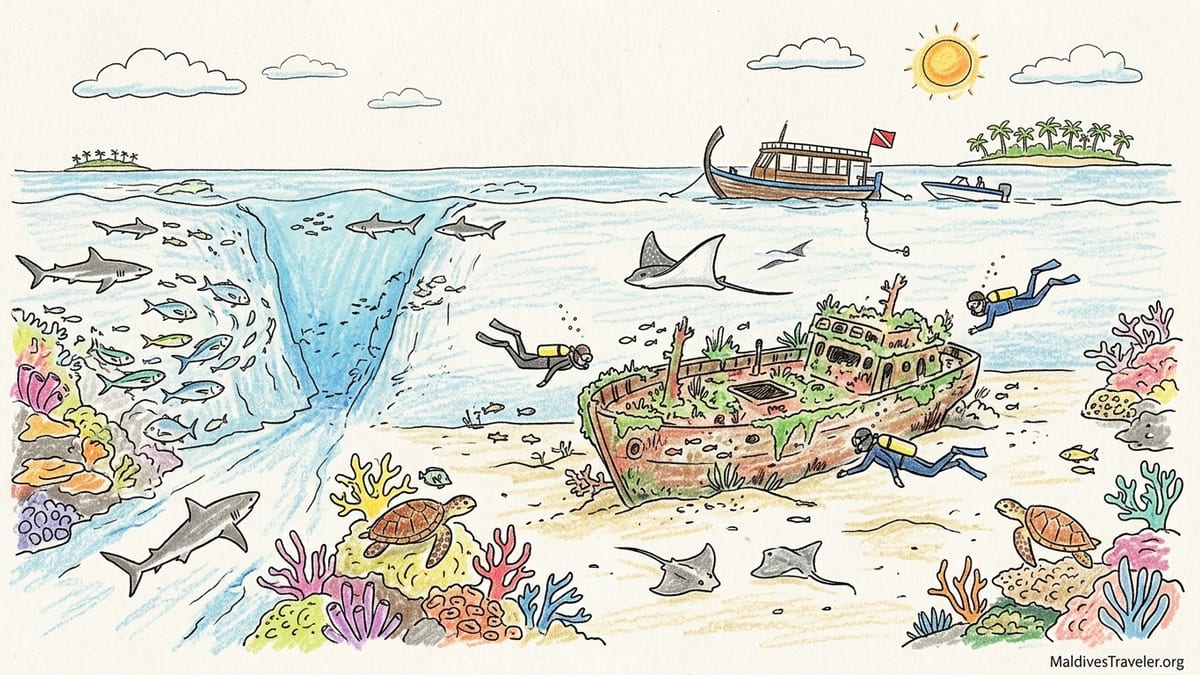
The Haa Alif Dive Landscape: Channels, Reefs and Filadhoo Wreck
Haa Alif, officially Northern Thiladhunmathi Atoll, sits close to the Maldives’ northern tip. PADI highlights that its channels are generally wider and shallower than many of the country’s famous kandu, which softens currents and makes conditions more forgiving for newer divers on many days. You still get that exhilarating Maldivian mix of channel drifts, thilas and outer walls, but often with a little more room and a little less pressure than in busier southern atolls.
One of the signature sites in this region is the Filadhoo Wreck, resting in around the mid-teens of metres. PADI describes it as a shallow, coral-covered wreck where eagle rays may cruise past the hull and macro life hides on the encrusted steel. The accessible depth means Open Water divers and even trainees can experience a wreck environment without pushing into technical territory, while photographers appreciate long bottom times and ambient light.
The atoll’s outer reefs are classic big-fish territory. Local dive maps list around 30 or more marked sites within day-trip distance of JA Manafaru, Hideaway and Vashafaru, with common sightings including hawksbill and green turtles, blacktip and grey reef sharks, stingrays and schooling trevally. Seasonal manta cleaning stations, especially from roughly November to April, add the chance of encounters without the intense crowds found at some central-atoll aggregation points.
What you will not find here is mass tourism underwater. Liveaboard routes are fewer, and resort day boats are spread over a large area. On popular Haa Alif spots, divers often report sharing the site with only one other boat or even having it to themselves. That lower density is a major draw, whether you are fine-tuning buoyancy on your first post-certification dive or hunting for cleaner compositions as an experienced shooter.
JA Manafaru: Polished Private Island with Strong House Reef Access
JA Manafaru sits on its own private island in the far north of Haa Alif, marketed as a high-end hideaway with seaplane transfers and a focus on privacy. For divers, the key asset is a healthy house reef that drops away not far from shore. Recent resort descriptions highlight hawksbill turtles, eagle rays and seasonal manta rays visiting nearby cleaning stations, typically within a half-hour boat ride during the northeast monsoon period.
The on-island PADI dive center, operated by a major regional operator, runs daily boat excursions to outer thilas and channels as well as guided house reef dives. Beginners typically start with lagoon confined sessions and easy reef slopes, where currents are manageable and depths can be kept between 10 and 18 metres. For example, a new Open Water diver might do an afternoon check dive on the house reef, then progress to a gentle outer-reef drift the following morning once skills are dialed in.
More advanced divers benefit from access to deeper outer walls and faster channels on days when currents run stronger. Boats from JA Manafaru regularly visit sharky outer-reef corners where grey reef and blacktip sharks patrol, and where schools of fusiliers, snapper and big-eye trevally swirl around coral heads. Nitrox is commonly offered at similar resorts in this category, and while specific inclusions change with packages, it is reasonable to expect EAN32 availability for those wanting longer bottom times on repetitive dives.
Budget is the main limiting factor. Nightly rates at JA Manafaru commonly start in the mid to high hundreds of US dollars per villa in the shoulder seasons, rising substantially over peak holiday periods, with two-tank boat dives often priced in line with other five-star Maldivian resorts. By the time you add a week of diving, seaplane transfers and meals, a seven-night stay for two divers can easily reach into the low five-figure range in US dollars. In return you get polished service, a quiet house reef at your doorstep and easy access to the northern dive sites without having to think about logistics.
Hideaway Beach Resort & Spa: Double House Reef and Broad Site Menu
Hideaway Beach Resort & Spa occupies Dhonakulhi, a 1.4-kilometre-long island in Haa Alif with a characteristic crescent shape. Factsheets describe a rare double house reef just off the beach and a PADI 5-Star Gold dive center offering trips to around 30 local sites. For divers, this combination of strong in-water infrastructure and a wide choice of dive types is one of the resort’s biggest selling points.
The double house reef means you can drop in from multiple entry and exit points and tailor dives to your experience level. Beginners, including those taking Open Water courses, often start with shallow, sand-bottomed sections on the inside of the reef where surge and current are minimal. From there, instructors can introduce them to the outer reef slope as confidence grows, still within easy swimming distance of shore. Certified but rusty divers can make unguided or lightly guided house reef dives, adjusting depth and profile to comfort.
For more experienced guests, Hideaway’s dive operation runs regular boat dives to channels, thilas and outer walls across Haa Alif. Many of these sites are within 15 to 40 minutes by dhoni, keeping surface intervals relaxed. On a typical two-tank morning, you might start with a channel drift targeting shark and ray encounters, then switch to a shallower reef or the Filadhoo Wreck for a long, easy second dive. Divers report frequent encounters with turtles, reef sharks, schooling jack and sometimes manta rays during the main season. Nitrox is usually available at resorts of this standard, and Hideaway’s marketing leans heavily into catering to repeat and serious divers as well as casual holidaymakers.
Accommodation costs generally sit a notch below or comparable to JA Manafaru, depending on season and villa category. Beach villas can sometimes be found in the low to mid hundreds of US dollars per night in shoulder periods, while larger pool villas and residences climb higher. Dive pricing reflects a premium-resort model: two-tank boat trips can be expected in the mid to high double digits per person in US dollars before gear rental, with multi-day dive packages bringing the per-dive cost down. For non-divers in your party, the resort’s marina, spa and varied restaurants help justify the overall spend.
Vashafaru: Local-Island Atmosphere and Budget-Friendly Diving
Vashafaru is a lived-in local island in Haa Alif with a population of Maldivian residents, a modest cluster of guesthouses and small shops, and public beaches that sit alongside daily island life. Unlike private resort islands, alcohol is not served and dress codes away from designated bikini beaches are conservative. For divers looking to immerse themselves in local culture and stretch their budget, that trade-off can be appealing.
The island hosts PADI dive operators, including Vashafaru Dive and Vashafaru Dive & Water Sports, both described as full-service centers offering courses, equipment rental and boat diving. Another operator, Aquaholic Dive Center, is located a short walk from at least one guesthouse, illustrating how compact and walkable the island is. These centers collectively access much of the same site catalogue as the nearby resorts, including the Filadhoo Wreck and named thilas with reputations for good coral and turtle sightings.
Local-island pricing is the big differentiator. Guesthouse rooms on Vashafaru often fall into the tens rather than hundreds of US dollars per night, especially outside peak holidays, with simple en-suite rooms and breakfast included. A week of two-tank boat diving with equipment at a local PADI center typically costs noticeably less than at a five-star resort, although precise figures vary by season and package. That saving can be significant for long-stay divers or those planning back-to-back atoll hops.
The dive experience itself has a slightly different rhythm. You will likely share boats with a mix of visiting divers and perhaps a few local trainees, and surface intervals may involve tea on the dhoni rather than elaborate resort snacks. On the other hand, you still reach the same channels and reefs, and small-group sizes are common. For independent travelers comfortable arranging domestic flights or speedboat transfers via Hanimaadhoo and navigating local customs, Vashafaru offers one of the most cost-effective gateways into Haa Alif’s underexplored dive scene.
Beginner vs Advanced Diving: Which Base Fits Your Skill Level
For absolute beginners, all three bases can work, but they offer very different learning environments. JA Manafaru and Hideaway both have spacious lagoons and calm inner-reef areas well suited to PADI Discover Scuba Diving sessions and full Open Water courses. Here, you practice mask clearing and buoyancy in warm, clear water just off the beach, with resort-level support and short walks back to your villa between sessions. Groups are usually small, and non-diving companions can lounge by the pool while you complete skills.
On Vashafaru, beginners typically train with a PADI center using local lagoons and sheltered reefs reached by small boat. The water is just as warm and clear, but the setting is more stripped back: simple boats, basic but functional rinse areas and less emphasis on spa robes and cold towels. What you get in exchange is extended time in the water for your budget and the atmosphere of learning alongside resident islanders and long-stay travelers. For many, that adds motivation and a sense of shared adventure.
Advanced divers and those seeking challenging conditions will find more consistent access to deeper channels and stronger currents via JA Manafaru and Hideaway, simply because their operations are geared to meet premium expectations of experienced guests. These resorts can assemble full boats of Advanced Open Water divers for early-morning drifts, time entries around peak current and still be back in time for a long lunch. Nitrox, if offered, pairs well with multi-dive schedules that include repetitive drops in the 25 to 30 metre range.
Vashafaru’s PADI centers also visit advanced sites, including channels where current hooks are standard and negative entries may be used when conditions line up. However, daily schedules may be shaped more by mixed-ability groups and the needs of local students. The advantage is flexibility: on a quiet weekday, you might end up with a boat practically to yourself and the freedom to spend a whole dive exploring one corner of a thila, while the drawback is that specific advanced-only itineraries may require a bit more coordination.
Marine Life Highlights: Sharks, Turtles and Seasonal Mantas
Across all three bases, Haa Alif’s marquee attractions are sharks, turtles and, in season, manta rays. Grey reef and blacktip reef sharks are widely reported along channel edges and outer-reef drop-offs, particularly on early or late dives when traffic is minimal. At some sites, guides position divers on the lip of a channel to watch a continuous procession of sharks, rays and schooling fusiliers riding the current.
Turtles are a near-daily sight. Both JA Manafaru and Hideaway promote regular hawksbill and green turtle encounters right on their house reefs, where individuals graze on sponges and rest on coral ledges. Around Vashafaru, guesthouses and dive operators highlight nearby reefs nicknamed for their turtle density, and boat dives often include at least one unbothered turtle cruising past or ascending to breathe near the surface. For new underwater photographers, these relatively calm, slow-moving animals are ideal early subjects.
Manta rays are more seasonal but a major draw when present. JA Manafaru, for instance, advertises manta cleaning station trips roughly from November to April, with journey times of around half an hour from the resort to known manta points. Hideaway and Vashafaru-based operators tap into similar patterns, heading for exposed thilas and reef corners where plankton concentrates. While Haa Alif does not yet have the same global reputation for mantas as Baa Atoll, the trade-off is fewer boats at each cleaning station and a sense of discovering a still-evolving destination.
Macro life should not be overlooked either. The Filadhoo Wreck, with its coral-encrusted superstructure in relatively shallow water, is a haven for nudibranchs, shrimps and small reef fish. Calm stretches of house reef at JA Manafaru and Hideaway reward slow, methodical hunting for leaf scorpionfish, moray eels and cleaning stations where tiny shrimp and wrasse work over passing clients. Around Vashafaru, guides with a local background often know specific bommies and sand patches that reliably deliver frogfish, ornate ghost pipefish or garden eel colonies.
Nitrox, Logistics and What Your Money Buys
For repetitive diving, especially if you hope to bank three dives per day around the 20 to 30 metre mark, Nitrox can make a noticeable difference. JA Manafaru and Hideaway, both positioning themselves toward serious leisure divers, are good bets for on-site Nitrox blending, although availability and pricing can shift with management changes. In many Maldivian five-star resorts, EAN32 is offered either as a paid add-on per tank or as a package upgrade for certified divers. Courses to obtain Nitrox certification are commonly run in-resort over a half day to a day, making it easy to upskill during a week-long trip.
On Vashafaru, some PADI centers advertise Nitrox and a full menu of recreational courses up to Advanced Open Water and beyond. However, smaller operations may adjust offerings based on demand, so if Nitrox is a priority, confirming in advance by email remains wise. Even on air, the generally moderate depths of many Haa Alif sites, combined with long surface intervals on relaxed local schedules, keep no-decompression diving straightforward for most holiday divers.
When comparing budgets, think in terms of what each destination bundles around your diving. A week at JA Manafaru or Hideaway essentially buys you a self-contained island with multiple restaurants, spas, pools, kids’ clubs and polished service, plus seamless transfers and carefully curated dive days. Daily costs can easily run several times higher than a local-island stay, but the friction is close to zero: you step off the seaplane or domestic flight and everything else is handled.
On Vashafaru, your money goes further in the water but buys simpler comforts on land. Guesthouses are often family-run, with home-style breakfasts and set dinners built around local fish curry, rice and roshi. You will likely walk a few hundred metres to the dive center each morning, ride out on a modest dhoni and rinse gear in basic facilities afterwards. For independent travelers, that simplicity is a feature, not a bug, and the savings may fund extra days of diving or a second atoll in the same trip.
The Takeaway
Choosing between JA Manafaru, Hideaway Beach Resort and Vashafaru is less about which offers “better” diving and more about what kind of trip you want wrapped around those dives. All three share access to the same wide, shallow channels that PADI praises for their gentler currents, the same Filadhoo Wreck sitting in photogenic shallow water, and the same outer reefs where sharks, turtles and seasonal mantas patrol.
If you value privacy, polished service and an elegant setting where every surface interval can be spent by an infinity pool or in a spa, JA Manafaru is compelling. Its strong house reef and easy access to manta cleaning stations in season make it well suited to couples and families who want serious diving tucked inside a high-end resort week.
Hideaway Beach Resort & Spa strikes a slightly more flexible balance. Its double house reef and extensive dive-site menu work for mixed-ability groups, from first-time Discover Scuba participants to Nitrox-certified regulars chasing sharky channels. Non-divers in your party get an almost urban list of restaurants, bars and leisure facilities, which can be decisive on longer stays.
Vashafaru, by contrast, is about immersion in everyday Maldivian life and stretching your dive budget. Here, divemaster briefings might be followed by tea with local staff, and you might spend evenings on the harbour wall watching reef sharks in the shallows rather than at a resort bar. The diving itself reaches the same signature sites, just framed by simpler boats and family-run guesthouses. For experienced travelers comfortable with local customs and logistics, it is one of the most appealing bases in the far north.
FAQ
Q1. Is Haa Alif Atoll suitable for absolute beginner divers?
Yes, Haa Alif can be very beginner friendly. JA Manafaru and Hideaway both offer PADI courses using calm lagoons and gentle house reef slopes, while Vashafaru’s PADI centers provide introductory programs and Open Water training on sheltered local reefs.
Q2. How difficult are the currents compared with central Maldives atolls?
PADI notes that Haa Alif’s channels tend to be wider and shallower than many in the central Maldives, which often means less intense currents. However, conditions vary by tide and moon phase, and some channel dives still demand good buoyancy control and experience.
Q3. Which base is best for wreck diving in Haa Alif?
All three bases access the Filadhoo Wreck, a shallow, coral-covered wreck suitable for Open Water divers. Resorts like JA Manafaru and Hideaway visit it regularly on boat trips, and Vashafaru’s local dive centers also include it in their itineraries.
Q4. Can I see manta rays from JA Manafaru, Hideaway or Vashafaru?
Yes, seasonal manta encounters are possible from all three. JA Manafaru advertises cleaning station trips, particularly between roughly November and April, and Hideaway and Vashafaru-based operators tap into the same seasonal patterns at nearby thilas and reef corners.
Q5. Is Nitrox available in Haa Alif Atoll?
Nitrox is commonly available at premium resorts such as JA Manafaru and Hideaway, often as a paid upgrade or part of dive packages. Some Vashafaru PADI centers also offer Nitrox, but availability can be more variable, so confirming in advance is recommended.
Q6. How do accommodation costs compare between resorts and Vashafaru?
Resorts like JA Manafaru and Hideaway usually charge nightly rates in the mid to high hundreds of US dollars or more, while Vashafaru guesthouses often cost a fraction of that, sometimes in the tens of dollars per night outside peak demand.
Q7. Are there good house reefs at all three locations?
JA Manafaru and Hideaway both market strong house reefs just offshore, with easy access for diving and snorkeling. Vashafaru’s house reef is more variable by entry point, but nearby reefs reached by short boat rides provide excellent coral and marine life for daily diving.
Q8. Which option is better for non-divers in the group?
Non-divers tend to be happier at JA Manafaru or Hideaway, where there are spas, pools, kids’ clubs and multiple dining venues. Vashafaru is quieter and more focused on simple island life, which suits some travelers but not those seeking resort-style entertainment.
Q9. How do I get to Vashafaru compared with the resorts?
Resorts typically package seaplane or domestic flight plus speedboat transfers directly in their rates. Reaching Vashafaru usually involves a domestic flight to Hanimaadhoo followed by a prearranged speedboat, which guesthouses or dive centers can help organize.
Q10. Is Haa Alif less crowded underwater than other parts of the Maldives?
Yes, Haa Alif remains quieter than many well-known southern and central atolls. Fewer resorts and liveaboards operate here, so divers often share sites with only one other boat or even have them entirely to themselves.