


Island hopping in the Maldives looks simple on a map. In reality, the country’s scattered atolls, shallow lagoons and strict transport rules mean that moving from one island to another can be surprisingly complex. The most successful itineraries are built around real transport connections and timetables, not just the apparent distance between dots on a map. This guide explains how to travel between Maldivian islands by public ferry, scheduled speedboat, domestic flight and private transfer, with concrete examples to help you plan routes and budgets that actually work in practice.
Why Transport Shapes Every Maldives Itinerary
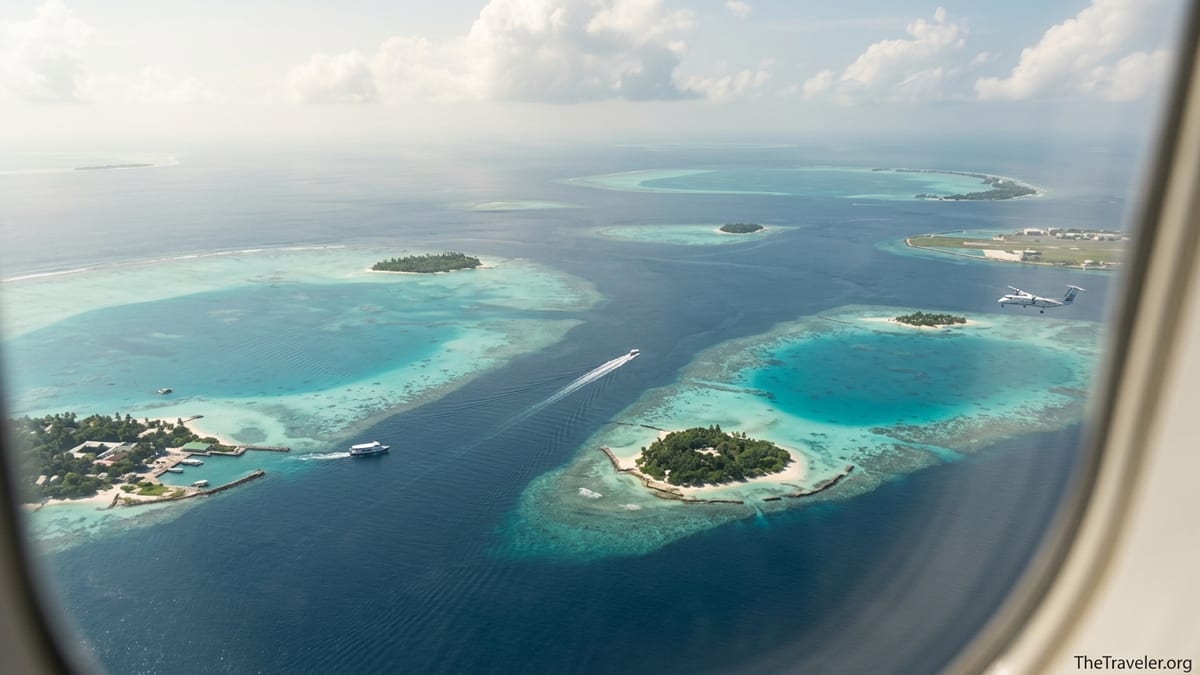
The Maldives stretches over hundreds of kilometers of ocean, with more than a thousand coral islands spread across 26 natural atolls. On a map, two islands can look close, yet be separated by shallow reefs, channels with strong currents, or simply a lack of any scheduled transport. The country’s transport system has grown in layers: traditional slow ferries, new government-backed high speed routes, resort-operated boats, and domestic airlines linking regional airports. Each layer serves different passengers and price points, and they do not always connect smoothly.
For travelers, this means you cannot simply pick a chain of islands and assume you will find an easy hop between them. A classic example is trying to combine Maafushi in South Male Atoll with a local island like Thoddoo in North Ari. On the map they look like neighboring atolls. In reality, most visitors must return to Male or the airport and then connect onwards by another speedboat, because there is no regular direct public route between the two. What appears to be a 30 kilometer journey by sea turns into two separate legs routed through the capital.
Timetables and operating days create further constraints. Public ferries often avoid Fridays, some scheduled speedboats run only a few times per day, and several domestic flight routes are timed around international arrivals. A traveler hoping to fly into Male in the afternoon, visit a budget island for two nights, then move to a remote luxury resort by seaplane the same evening may discover that the last connection left hours earlier. Building your itinerary around actual departure times, not only distance, is therefore essential.
Costs also scale sharply with speed and flexibility. A public ferry ticket between islands in the same region can be as low as a few US dollars, while a return transfer to a private resort by speedboat or seaplane can cost several hundred dollars per person. Travel planning in the Maldives is as much about deciding where you are willing to pay for speed and convenience as it is about choosing beaches and overwater villas.
Understanding the Public Ferry System
The backbone of local transport remains the state-supported ferry network operated by the Maldives Transport and Contracting Company, often branded as Raajje Transport Link or RTL. These boats range from traditional slow ferries to modern high speed catamarans. They link inhabited local islands within atolls and, increasingly, between neighboring atolls. Ticket prices are heavily subsidized, which makes them by far the cheapest way to travel between islands if you have time and can match your plans to fixed schedules.
Recent fare announcements show how affordable this option can be. Within Faafu or Dhaalu atolls, one way RTL tickets start from around 35 Maldivian rufiyaa, roughly the price of a coffee in a resort bar, and return fares are capped at 130 rufiyaa for intra-atoll journeys. For inter-atoll trips between Faafu and Dhaalu, one way tickets start around 130 rufiyaa, with return fares capped at about 300 rufiyaa. In the southern atolls, published prices for high speed ferries linking islands such as Vaadhoo and Fuvahmulah or Hulhumeedhoo and Fuvahmulah are around 16 US dollars per leg, significantly lower than any flight.
On busier routes close to Male, older style ferries still run between the capital and nearby local islands. For example, a traditional MTCC ferry from Male to the island of Guraidhoo in Kaafu Atoll has been reported to cost in the tens of rufiyaa and take over two hours, compared with roughly half an hour on a speedboat. These ferries are extremely budget friendly but slow, and they are more vulnerable to cancellations in rough weather. They also tend to run only once or twice daily, often with no departures on Fridays.
Because RTL services now cover more than a hundred islands across multiple zones, the network can in theory serve as a ladder for multi-stop itineraries: local islands within one atoll, moving step by step to the next atoll. In practice, the challenge is aligning departure days and times. One ferry might leave your island at 7 am while the onward connection in the next atoll sails at noon only on certain days. If the schedules do not line up, you may have an unplanned overnight in a transit island. Travelers who want to use ferries should download the latest RTL schedule, check operating days carefully, and design their island sequence to flow along existing routes rather than trying to force shortcuts.
Scheduled Speedboats: The Workhorse for Popular Local Islands
Scheduled speedboats bridge the gap between slow public ferries and expensive private transfers. These services typically connect Male or the airport directly with specific local islands that see regular tourist traffic, like Maafushi, Thulusdhoo, Rasdhoo or Thoddoo. Boats are usually run by local operators or island guesthouse associations, and they operate several times per day on fixed timetables that are loosely aligned with common international flight arrival windows.
Costs vary by route and operator, but airport to island fares in the central atolls are broadly in the range of 15 to 40 US dollars per person one way for popular islands. One operator advertising transfers to Maafushi, for instance, lists per person one way prices around the mid-teens in US dollars, while travelers sharing recent experiences mention paying closer to 25 dollars each depending on the boat and season. That still makes a return speedboat for two people to Maafushi cheaper than a single seaplane ticket to a far flung resort, with the crossing taking roughly 30 to 35 minutes under normal sea conditions.
For shorter hops between nearby atolls, scheduled speedboats might cost in the tens of dollars per person each way. Routes connecting the airport to Rasdhoo or Ukulhas in Alif Alif Atoll, or to Thulusdhoo in North Male Atoll, often run one or two times per day. The crossing can take between 45 minutes and 90 minutes depending on distance and sea state. Boats are usually modern fiberglass hulls with multiple outboard engines, covered seating and lifejackets, though comfort levels and maintenance standards differ by operator.
The main limitation of scheduled speedboats is timing. They tend to cluster departures in the morning and early afternoon, aimed at international arrivals. If your flight lands late in the evening or after dark, you may find that the last public speedboat to your island left hours earlier. Some islands have only one scheduled departure per day from Male. When planning, treat the speedboat timetable as fixed and arrange your flights around it, or be prepared to pay extra for a private boat or spend a night near the airport.
Domestic Flights and Seaplanes: Covering Long Distances
For longer distances, especially to the far north and deep south, domestic flights and seaplanes become essential. The national carrier Maldivian operates an extensive network of inter-island services from its hub at Velana International Airport, serving around 17 to 19 domestic airports. Other domestic airlines such as Manta Air and Villa Air FlyMe operate on key tourist routes, for example linking Male with Dhaalu Atoll, Baa Atoll, Raa Atoll and Maamigili in South Ari.
On land-based routes, airlines typically use turboprop aircraft such as ATR 72s, with flying times ranging from about 30 minutes to just over 90 minutes depending on distance. A hop from Male to Baa Atoll’s Dharavandhoo usually takes around half an hour, while flights to Gan in the southern Addu Atoll can approach an hour and a half. Fares fluctuate with season, demand and how early you book, but travelers often see one way domestic tickets falling somewhere between around 100 and 250 US dollars per person, sometimes bundled with resort packages that also include onward boat transfers.
Seaplanes are a separate category, typically used for high end resort transfers. Operators like Trans Maldivian Airways and Manta Air’s seaplane division shuttle guests from a dedicated terminal near the main airport to resort platforms scattered across the central atolls. Because these flights are usually booked through resorts as part of a transfer package, travelers rarely see a published schedule. Typical return seaplane transfers today often cost in the low to mid hundreds of US dollars per person, with many reports of round trip prices around 380 dollars or higher for individual resorts, and some ultra luxury properties charging significantly more.
A key planning issue is that domestic airlines and seaplane operators build their timetables around changing international arrivals and resort demand. That means departure times can shift, and exact schedules might not be confirmed until close to travel. If you are combining a local island that relies on scheduled speedboats with a resort that requires a domestic flight or seaplane, it can be difficult to line up same-day connections without an overnight in Male. In many cases, travelers intentionally split their stays, starting on a local island reachable by daytime speedboat, then returning to the capital for one night before flying out the next morning to a remote resort.
Private Speedboats and Resort Transfers: Paying for Flexibility
Private speedboat charters provide the greatest flexibility for island-to-island travel, and they are common for resort transfers close to Male and between nearby local islands. These boats can depart on your schedule, pick you up directly from a resort jetty or local harbor, and take you straight to your next destination without going back to the capital. The trade-off is cost: private boats are usually priced per trip rather than per passenger, so they become more economical for families or groups than for couples.
Real world quotes illustrate how quickly prices climb. Private speedboats able to carry around ten people between the airport and local islands like Maafushi are often advertised in the range of 250 to 300 US dollars one way. Boats chartered for cross-atoll journeys or for day trips to distant sandbanks can easily cost several hundred dollars more, especially when fuel prices are high. One recent traveler reported a quote of 2400 US dollars return for a private speedboat to reach a remote floating restaurant, with additional waiting charges of around 600 dollars per half hour while the boat waited offshore.
Resorts with no public transport options set their own mandatory transfer rates, which can surprise first-time visitors. Guests at luxury properties near the capital frequently report round trip speedboat transfers in the hundreds of dollars per person. A stay at a premium international brand resort north of Male, for example, has been associated with return speedboat charges in the range of 250 to 300 US dollars per adult. Some ultra luxury resorts or distant properties combine a domestic flight and speedboat, leading to bundled transfer prices well above the cost of the international ticket used to reach Male.
An important practical point is that many private resorts do not allow guests to arrange alternative transfers on their own. Even if there is a nearby public harbor, management may require all arrivals and departures to use the resort’s contracted boat or seaplane provider. Travelers who try to book an independent speedboat or arrive by public ferry are often told in advance that outside boats cannot dock at the resort jetty. By contrast, on local islands where independent guesthouses and small hotels dominate, you can normally choose between scheduled speedboats, public ferries, and privately hired boats.
Planning Multi-Island Routes: Think Hubs, Not Straight Lines
The most useful way to imagine Maldivian transport is as a hub-and-spoke system centered on Male and Velana International Airport, with a growing secondary network of regional hubs. In practice, this means that moving directly between two islands in different atolls is often impossible without routing back through one of these hubs. For many itineraries, the capital remains the main switching point between ferries, speedboats and flights, even when the islands you want to visit look close together on the map.
Consider a traveler who wants to split a week between a budget guesthouse on Maafushi and a mid-range resort in Baa Atoll that is served by domestic flights. The most realistic itinerary is to start at the airport, take a scheduled speedboat directly to Maafushi, enjoy several nights there, then return to Male and stay overnight. The next morning, they can fly from the airport to Dharavandhoo in Baa Atoll and connect to the resort’s short speedboat transfer. Trying to move directly from Maafushi to Baa on the same day would require lining up multiple private boats, and could easily cost more than the resort stay itself.
Regional hubs are emerging as the RTL ferry network grows. In the south, for example, high speed ferries connect islands like Fuvahmulah and Hulhumeedhoo, creating a spine that locals and well-organized travelers can use for multi-island trips. However, even here, the ferry days and timings govern everything. If the southbound ferry only runs on specific weekdays, building an itinerary that requires a Sunday departure is likely to fail. Checking the days of operation first, then selecting which islands to visit, is the opposite of how many travelers like to plan, but it produces far smoother journeys in the Maldives.
Weather and daylight also affect inter-island moves. Many private boats and seaplane services do not operate after dark, and rough seas during the southwest monsoon can delay crossings or make ferries uncomfortable. It is wise to avoid tight evening connections between a speedboat and an international flight. Instead, allow extra time near the airport at the start and end of your trip, using Male, Hulhumale or a nearby local island as a buffer against delays.
Realistic Costs and How to Keep Them Under Control
Transport is often the hidden line in a Maldives budget. For travelers staying on local islands and moving mainly by public ferry and scheduled speedboat, inter-island transport can remain very affordable. RTL tickets of 35 to 130 rufiyaa within atolls, regional ferries around 16 US dollars per leg in the deep south, and airport to island speedboats costing roughly 15 to 40 dollars per person each way keep total transfers for a week-long trip to a manageable figure, especially for couples or solo travelers.
Once resort transfers and domestic flights are included, costs rise sharply. Current round trip speedboat transfers to mid and high-end resorts near Male frequently sit in the 250 to 400 US dollar per person range. Seaplane transfers to more isolated properties often land between about 380 and 800 dollars per person return, depending on distance and season, while domestic flight plus speedboat packages to far south atolls can reach the high hundreds of dollars. It is not unusual for a couple to spend more than a thousand dollars on transfers alone when combining two different resorts or mixing a local island with a remote luxury stay.
To keep these costs under control, one approach is to cluster your itinerary within one region. Spending a week in central atolls, combining a local island like Maafushi, Rasdhoo or Thoddoo with a nearby resort that uses shared speedboat transfers, allows you to rely on the same type of transport and avoid expensive flights. Another strategy is to choose either a local island trip with ferries and scheduled speedboats or a single resort stay that includes costly seaplane transfers, rather than trying to cram both into a short visit.
Finally, flexibility with dates pays off. Domestic flight and seaplane fares can vary across the week, and scheduled ferries may not run daily, especially on Fridays. Arriving in Male late at night and insisting on reaching a distant island the same evening is one of the surest ways to end up paying for a private boat. By planning to spend your first or last night near the airport, you give yourself more options to catch cheaper shared transfers the following morning.
The Takeaway
Travel between Maldives islands is defined less by geography than by the routes that actually operate. Public ferries and government-backed high speed services make it possible to hop between inhabited islands at very low cost, but their fixed timetables and limited frequency demand careful planning. Scheduled speedboats provide a faster, still affordable link to popular local islands, while domestic flights and seaplanes unlock the far north and south at a price. Private boats and resort transfers buy freedom and door-to-door convenience, yet they can easily exceed the cost of your international airfare.
The most rewarding itineraries respect these realities from the start. Rather than picking islands purely by reputation and then hunting for a way to connect them, begin with the transport map: which islands share the same speedboat, ferry or domestic flight hub, and on which days. Use hubs like Male and emerging regional centers as natural switching points and allow overnight buffers when combining different transport modes. With this mindset, the puzzle pieces of routes, schedules and budgets fall into place, and the scattered dots of the Maldives become a coherent, navigable chain of experiences.
FAQ
Q1. Can I travel directly between any two Maldives islands by boat?
In most cases, no. Many routes require you to route back through Male, the airport or a regional hub because there is no direct public ferry or scheduled speedboat between islands in different atolls.
Q2. How much does a public ferry ticket typically cost?
Within an atoll, RTL ferry tickets often start around a few dozen rufiyaa per person one way, with longer inter-atoll routes priced higher but still usually in the low tens of US dollars.
Q3. Are public ferries reliable enough to plan my whole trip around them?
They are generally reliable, but schedules are limited, and some routes do not run daily or on Fridays. It is safer to allow buffer days and avoid tight same-day international connections when using ferries.
Q4. What is a realistic price for a scheduled speedboat from the airport to a local island?
On popular routes near Male, travelers commonly pay in the range of about 15 to 40 US dollars per person one way, depending on distance, operator and season.
Q5. How expensive are domestic flights within the Maldives?
Domestic flight prices vary, but a broad planning range is roughly 100 to 250 US dollars per person one way, with some routes bundled into resort packages that also include onward boat transfers.
Q6. Why are resort transfers so expensive compared with local transport?
Resort transfers often use private speedboats or chartered seaplanes dedicated to a small number of guests, with costs spread across fewer passengers, and resorts frequently add service margins to these mandatory transfers.
Q7. Can I book my own private speedboat to reach a resort?
Some local islands and budget resorts allow independent boats, but many private resorts require guests to use their own contracted transfer services and will not permit outside speedboats or ferries to dock.
Q8. Is island hopping between several local islands realistic on a short trip?
It can be, if you choose islands along the same ferry or speedboat routes and accept possible overnight stops. For visits under a week, most travelers find two bases in the same region more manageable.
Q9. Do seaplanes and domestic flights operate at night?
Seaplanes operate only in daylight, and many domestic routes are concentrated in daytime hours, so late evening international arrivals often require an overnight stay near the airport before onward travel.
Q10. How should I start planning an itinerary around real connections?
Begin by checking current ferry, speedboat and domestic flight schedules for your preferred region, then choose islands that sit on the same routes, adjusting your dates to match operating days instead of forcing awkward connections.