


The Maldives has a reputation for thousand-dollar villas on private islands, but a parallel, much cheaper Maldives now exists on local islands. Since guesthouses were legalized on inhabited islands, travelers have been able to sleep, eat and swim in the same turquoise lagoons for a fraction of classic resort prices. This guide looks at where the numbers are lowest and what you can realistically expect to spend on guesthouses, food, transfers, excursions and beach time on some of the best-value local islands.
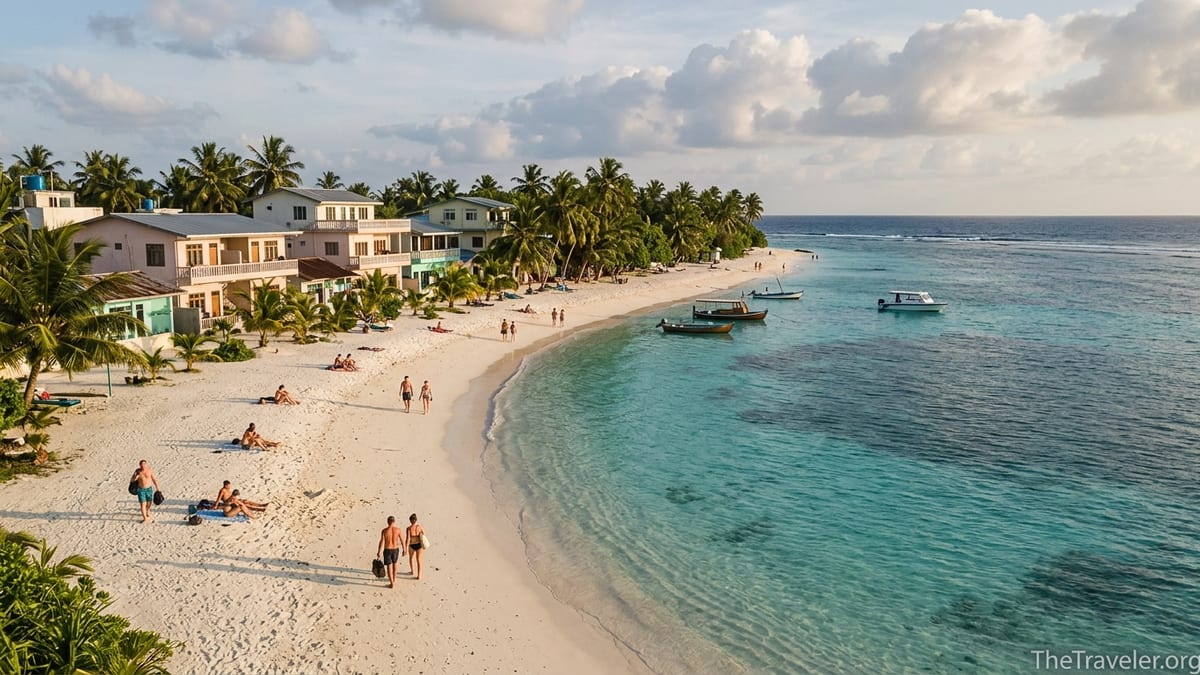
How Local Islands Make the Maldives Affordable
The price gap between private-island resorts and local islands is dramatic. While mid-range resorts often start around several hundred dollars per night, current market examples from Maldives agencies show typical guesthouse rooms on local islands such as Maafushi, Thoddoo and Ukulhas starting around 60 to 160 US dollars per night, depending on season and room type. That usually includes air conditioning, private bathroom and breakfast, with the lower end of the range available in the wet season and for simpler rooms.
Because guesthouses sit inside functioning island communities rather than on standalone resort islands, your daily costs fall as well. On many local islands, simple café meals run about 4 to 10 US dollars for a plate of fried noodles, grilled fish with rice or a curry, instead of the 30 to 60 dollars per meal that are common in resort dining rooms. A realistic daily food budget for a budget-conscious traveler is often 20 to 30 dollars per person if you mix local “short eats” snacks with one or two sit-down meals.
The other big saver is transport. Resort transfers often rely on seaplanes or high-priced private speedboats with round-trip costs in the hundreds of dollars per person. Between Malé and popular local islands, you can often choose a public ferry that costs only a few dollars each way, or a shared speedboat in the 25 to 50 dollar range per person depending on distance. That single choice can unlock islands that look like resort marketing pictures while keeping your overall budget under control.
There are trade-offs. Alcohol is not sold on inhabited local islands, bikinis are only allowed on designated “bikini beaches,” and the vibe is closer to a small coastal town than a sealed-off resort bubble. Yet for travelers who care more about clear water and soft sand than private butlers, the rise of local islands has genuinely turned the Maldives into a feasible mid-budget destination instead of a once-in-a-lifetime splurge.
Maafushi vs Gulhi vs Guraidhoo: Budget Hotspots Near Malé
South Malé Atoll is the easiest place to see how prices shift island by island. Maafushi is the best-known budget island, a small strip of sand about 30 minutes from the capital by speedboat. Because competition between dozens of guesthouses is intense, you can often find rooms from around 65 to 150 dollars per night depending on season, with basic but comfortable doubles at the lower end. Many first-time visitors book Maafushi simply because it is straightforward to reach, has a good bikini beach and offers a wide menu of excursions sold at street-front desks.
A shared speedboat from Malé’s airport area to Maafushi typically costs in the region of 25 to 35 dollars per person one way, with multiple departures daily. There is also a slower public ferry that can drop that fare to just a few dollars if the schedule works for you, though it runs less frequently and can sell out in high season. Once on Maafushi, classic “Maldives” experiences like snorkel trips, sandbank visits and dolphin cruises are advertised from about 25 to 50 dollars per person, and you can eat grilled fish or a local curry at simple cafés for around 8 to 12 dollars.
Nearby Gulhi is even smaller and usually a touch quieter, yet it has one of the better value profiles in the region. Guesthouse rates here can undercut Maafushi slightly, with simple doubles sometimes available from the equivalent of about 60 to 120 dollars per night in low to shoulder season. The transfer structure is similar: shared speedboats in the 25 to 35 dollar range per person and public ferries that cost only a few dollars if your arrival time lines up. For travelers who want a big, beautiful bikini beach but do not need the full menu of Maafushi’s restaurants and tour desks, Gulhi can be a smarter choice.
Guraidhoo, also in the same general area, is another option when Maafushi feels too busy or guesthouses are nudging beyond your budget. It tends to attract a slightly more laid-back crowd and offers decent surfing in season. Room rates broadly mirror lower to mid-range Maafushi pricing, but because demand is a bit softer, you can sometimes find better last-minute deals. In all three islands, your total daily spend can fit under 100 to 130 dollars per person if you share a room, eat mostly local food and choose one modestly priced excursion every couple of days.
Thoddoo, Ukulhas and Rasdhoo: Great-Value Islands for Longer Stays
North Ari Atoll has a cluster of islands that appeal to travelers with a bit more time and a focus on beaches or snorkeling rather than nightlife. Thoddoo, known for its watermelon and papaya farms, is often singled out by budget specialists as one of the best overall value islands. Current examples suggest guesthouse rooms here often fall in the 60 to 135 dollar per night range, which is competitive given the island’s very wide beaches and relatively relaxed atmosphere. Many properties include bicycles for exploring the farmland interior, and the main bikini beach has fine, soft sand that rivals resort islands.
Ukulhas, another small island in the same atoll, also balances price and amenities well. Guesthouse rates are broadly similar to Thoddoo, commonly somewhere between about 70 and 160 dollars per night depending on the standard of the property. The island is known for its strong environmental focus and a long, easily accessible beach. Transfers from Malé are usually by shared speedboat at around 35 to 50 dollars per person one way, though occasional ferries can cut that to a fraction of the price if you are comfortable with a longer journey and a fixed schedule.
Rasdhoo, meanwhile, is the hub for many backpackers who are serious about snorkeling and diving. Its house reef and nearby dive sites make it especially attractive if you want to see sharks and rays on a budget. Guesthouses here are often in a similar price band to Thoddoo and Ukulhas, and the island is well connected by both public ferry and shared speedboats from Malé, usually at prices in the low tens of dollars for the ferry and around the mid-thirties for speedboats. Dive shops regularly advertise fun dives in the 50 to 80 dollar range and open-water courses that are notably cheaper than resort-based equivalents.
On all three islands, daily food and activity costs match broader local-island patterns. Café meals come in at about 5 to 12 dollars, with higher prices for imported Western dishes and lower for Maldivian or South Asian plates. Many travelers keep a basic daily budget of 80 to 120 dollars per person if sharing a room: roughly half to two-thirds allocated to accommodation, a quarter to food and the rest to the occasional excursion, snorkel trip or dive.
Dhigurah, Fulidhoo and Thulusdhoo: Specialist Budget Islands
Some local islands cost slightly more to reach or stay on but still undercut resort prices by a wide margin while offering specialist experiences. Dhigurah in South Ari Atoll is one of the best examples. It is a long, narrow island with a vast stretch of beach and convenient access to seasonal whale shark and manta ray excursions. Guesthouses here range roughly from about 80 to 160 dollars per night. Shared speedboat transfers from Malé are usually more expensive than hops to nearby atolls, often running around 60 to 90 dollars per person one way, but still much cheaper than seaplane transfers to high-end resorts in the same region.
Fulidhoo, in Vaavu Atoll, sits on the radar of travelers looking for a quiet island with excellent value snorkel and dive trips. It has only a small number of guesthouses compared with Maafushi, so availability can be tighter in peak months, but pricing for simple rooms is often comparable, starting from the mid-two-digit to low-three-digit range in dollars per night. Because it is further from Malé than the South Malé Atoll hotspots, speedboats tend to cost a little more, yet public transport options still keep overall costs down for travelers who plan around schedules.
Thulusdhoo in North Malé Atoll is regarded as a surfer’s hub, with famous breaks just offshore and a small but growing guesthouse scene. Room rates are generally similar to mid-range Maafushi options. Surfers may spend more on boat rides to breaks, but non-surfers still benefit from local island pricing for food and basic excursions, with meals often available under 10 dollars if you choose local cafés and snacks. Because Thulusdhoo is relatively close to Malé, shared speedboats are common and public ferries provide the cheapest path for those happy with a longer ride.
These islands show that “cheapest” in the Maldives is relative to your priorities. Dhigurah is not usually the absolute lowest-cost base if you look only at transfers and guesthouse prices, yet it can be the cheapest way to spend multiple days in whale shark territory. A dedicated surfer able to share a room in Thulusdhoo and eat simple meals may end up spending less overall than someone on a supposedly cheaper island who books expensive day trips and imported food every day.
Comparing Realistic Daily Budgets and Hidden Costs
Putting the pieces together, a realistic per-person budget on many well-connected local islands falls into an approximate 80 to 150 dollar per day range if you share a room and travel outside the absolute peak festive weeks. A baseline scenario on an island like Maafushi, Thoddoo or Rasdhoo might look like this: 40 to 80 dollars per person for a shared guesthouse room, around 20 to 30 dollars for food if you eat mostly local dishes, and another 10 to 40 dollars averaged out over several days for shared excursions or ferry rides.
Total trip costs also depend heavily on how you handle airport transfers and domestic movements. A traveler who relies mostly on public ferries that cost a few dollars per leg, accepts longer journey times and plans around fixed departure days can keep internal transport expenses surprisingly low. Someone who prefers the flexibility of shared speedboats at 25 to 90 dollars per person per ride will spend more but still far less than seaplane guests, who regularly pay several hundred dollars per person for return transfers to resort islands.
Hidden costs can creep in if you are not prepared. All tourism services in the Maldives are subject to taxes and service charges that are often added on top of the rates you see in online listings. Guesthouse stays and excursions typically attract a goods and services tax plus a service charge that can together add around 20 percent or more to the headline price, and there is usually a small daily bed tax per person. When comparing islands and accommodations, always check whether prices are quoted inclusive or exclusive of these charges so you are not caught off guard when you check out.
Another cost factor is what you actually want to do. If your ideal trip involves diving every day in Rasdhoo or Dhigurah, your activity budget will climb quickly compared with someone happy to snorkel from the beach and take one or two boat trips. A traveler who combines a week on a local island with a day visit to a nearby resort might spend around 120 to 250 dollars for that single-day pass, including transfers and lunch, which can make sense as a one-off splurge but will transform the budget profile of a very short stay.
Choosing Islands for the Best Budget Beaches
On local islands, not every stretch of sand is equal for budget travelers. Because the Maldives is a Muslim country, bikinis are only allowed on designated beaches, usually signed as bikini beaches, while the rest of the shoreline is for fully covered swimwear. When comparing islands, the size, cleanliness and privacy of the bikini beach play a big role in overall value. Maafushi’s bikini beach is busy but has calm, shallow water and plenty of budget-oriented services just behind it. Gulhi is often praised for having a large, photogenic beach that feels more relaxed yet is only a short walk from guesthouses.
Thoddoo and Ukulhas are known for long, broad beaches with soft sand and good entry for swimming, which helps justify their room rates even when these creep up in peak months. On Dhigurah, the appeal is the sheer length of the island: you can walk for ages along largely undeveloped sand, which is rare in a country where many resort islands are tiny. Rasdhoo’s main beach is smaller but offers very good snorkeling just off shore, which can save you money on boat trips if spotting coral and fish is a priority.
For the tightest budgets, islands with a solid house reef close to shore can be more cost-effective than destinations that require daily boat trips to reach good snorkeling spots. Travelers frequently report that Rasdhoo, Dhigurah and some parts of Thulusdhoo offer good snorkeling within fin-kick distance of the beach, reducing the need for repeated 30 to 50 dollar boat excursions. Islands with good sunsets facing west and little light pollution, such as some corners of Ukulhas and Fulidhoo, also offer free entertainment in the form of evening beach walks and stargazing.
The trade-off is that highly photogenic and well-reviewed bikini beaches can quickly drive up accommodation demand and therefore prices. Thoddoo, for instance, has seen a rapid increase in guesthouse numbers and rate bands as word spreads about its beaches. If your main goal is simply affordable, swimmable water and a clean patch of sand rather than the most Instagrammed spot, you may find better bargains on slightly less famous islands within the same atoll.
Food, Culture and Practical Savings on Local Islands
Eating like a local is one of the easiest ways to keep costs down almost everywhere in the Maldives. On guesthouse islands, most communities have at least a handful of cafés or small restaurants where a plate of fried rice, kottu roshi or grilled reef fish with salad usually costs somewhere in the mid-single to low-double digits in US dollars. Local “short eats” such as stuffed pastries or fritters often cost the equivalent of one or two dollars each, making them ideal for breakfast or an afternoon snack.
If you default to Western-style dishes, imported snacks and espresso drinks at hotel-style cafés, your food costs will climb toward 30 to 40 dollars per day without you noticing. A mixed strategy tends to work best: enjoy local dishes at least once or twice a day, keep an eye on portion sizes and share plates where it makes sense. Many guesthouses include breakfast, which can be as simple as toast and eggs or as substantial as Maldivian mashuni (a tuna and coconut mix) with flatbread, so it is worth checking what is included in your rate when comparing options.
Respecting local culture also keeps your stay smooth. Away from the bikini beach, modest dress is expected, particularly for women. Public displays of affection are kept low-key, and alcohol is not sold on inhabited islands. Some guests factor in the cost of evening boat trips to “floating bars” anchored offshore, where alcohol is legal and drinks are priced closer to resort levels. If your goal is the absolute cheapest possible Maldives trip, skipping alcohol altogether or limiting yourself to soft drinks is a simple way to avoid surprise expenses.
Other practical savings come from thoughtful packing and planning. Bringing your own mask and snorkel, reef-safe sunscreen and a refillable water bottle prevents repeated small purchases that add up quickly on remote islands. Confirming ferry and shared speedboat schedules with your guesthouse before booking flights helps you avoid paying for a private boat or an unplanned night in Malé because your incoming flight missed the last cheap transfer of the day.
The Takeaway
A budget-friendly Maldives trip is less about finding a single “cheapest island” and more about matching your priorities to the right cluster of local islands and making smart choices on transport, food and activities. For first-timers focused on simplicity and low excursion prices, Maafushi and Gulhi near Malé are hard to beat. Travelers seeking quieter beaches and good value over a longer stay often gravitate to Thoddoo, Ukulhas or Rasdhoo. Those willing to spend a bit more on transfers for specific experiences choose Dhigurah for whale sharks, Fulidhoo for tranquil snorkeling or Thulusdhoo for surf.
In all of these places, the basic pattern holds: guesthouses starting in the approximate 60 to 160 dollar per night range instead of resort villas at many times that price, public or shared-boat transfers instead of costly seaplanes, and local cafés serving filling meals for a fraction of resort restaurant bills. If you watch for hidden taxes and charges, plan transfers carefully and embrace the local rhythm of island life, the Maldives shifts from a dream destination that feels financially out of reach to a realistic, even repeatable, trip.
For many travelers, the most rewarding discovery is not just the cost saving but the sense of connection. Staying on a local island means chatting with guesthouse owners, buying snacks where schoolchildren stop after class and hearing the call to prayer drift over the lagoon at sunset. The water is the same turquoise, the sand the same white, but the price of experiencing it drops sharply when you trade a private-island resort for a well-chosen guesthouse and a thoughtful, budget-aware itinerary.
FAQ
Q1. Is the Maldives really affordable if I avoid resorts?
Yes, if you stay on local islands in guesthouses, use public or shared speedboat transfers and eat mostly at local cafés, many travelers manage on roughly 80 to 150 US dollars per person per day, excluding international flights.
Q2. Which island is generally the cheapest for first-time visitors?
For first-time visitors who want low prices and easy logistics, Maafushi and nearby Gulhi are usually among the cheapest because they are close to Malé, have frequent shared speedboats and a large number of competing guesthouses and excursion providers.
Q3. How much does a budget guesthouse cost per night on local islands?
Current examples from Maldivian agencies and booking platforms suggest most guesthouses on popular local islands start around 60 to 160 US dollars per night for a double room, with the lowest rates appearing in the wet season and for simpler properties.
Q4. What will I typically spend on food each day?
If you eat mainly local dishes and short eats, you can often keep food costs to about 20 to 30 US dollars per person per day, rising if you choose imported Western meals or espresso drinks at hotel-style cafés.
Q5. Are public ferries much cheaper than speedboats?
Yes, public ferries between Malé and local islands usually cost only a few US dollars each way, while shared speedboats for the same route commonly charge around 25 to 50 dollars per person, and sometimes more for distant atolls.
Q6. Can I drink alcohol on local islands?
No, alcohol is not sold on inhabited local islands, and bringing your own is not permitted. Some islands have evening boat trips to offshore “floating bars,” but drinks there are priced closer to resort levels, so skipping alcohol is the cheapest option.
Q7. Are bikini beaches really limited to certain areas?
Yes, on local islands bikinis are only allowed on designated bikini beaches, which are usually clearly signed. Elsewhere on the island, especially in village areas, modest dress is expected out of respect for local customs.
Q8. How do excursion prices compare to resorts?
On local islands, common excursions such as sandbank trips, snorkeling safaris and dolphin cruises often start around 25 to 50 US dollars per person, while similar experiences packaged through private resorts can cost several times more.
Q9. Is it cheaper to visit one island or to island-hop?
Staying on a single island usually keeps costs lower because you pay for fewer transfers. Limited island-hopping can still be affordable if you combine public ferries on short routes with occasional shared speedboats and plan around fixed departure days.
Q10. When is the best time to find lower prices in the Maldives?
The wet season months tend to bring lower guesthouse rates and more frequent discounts, although specific prices vary by island and property. Shoulder periods just outside the busiest holiday weeks often offer the best balance of value and decent weather.