


Haa Dhaalu Atoll sits at the far northern edge of the Maldives, and getting there is part of the adventure. Whether you are heading to a barefoot eco‑resort near Hanimaadhoo, staying in Kulhudhuffushi town, or splurging on a once‑in‑a‑lifetime stay at Soneva Secret, careful planning of your domestic flights and transfers will make the difference between a seamless arrival and a stressful overnight in Malé. This guide explains, in concrete and current terms, how to reach Haa Dhaalu, what to expect from Maldivian domestic flights, when a seaplane makes sense, and how to connect safely from your international flight.
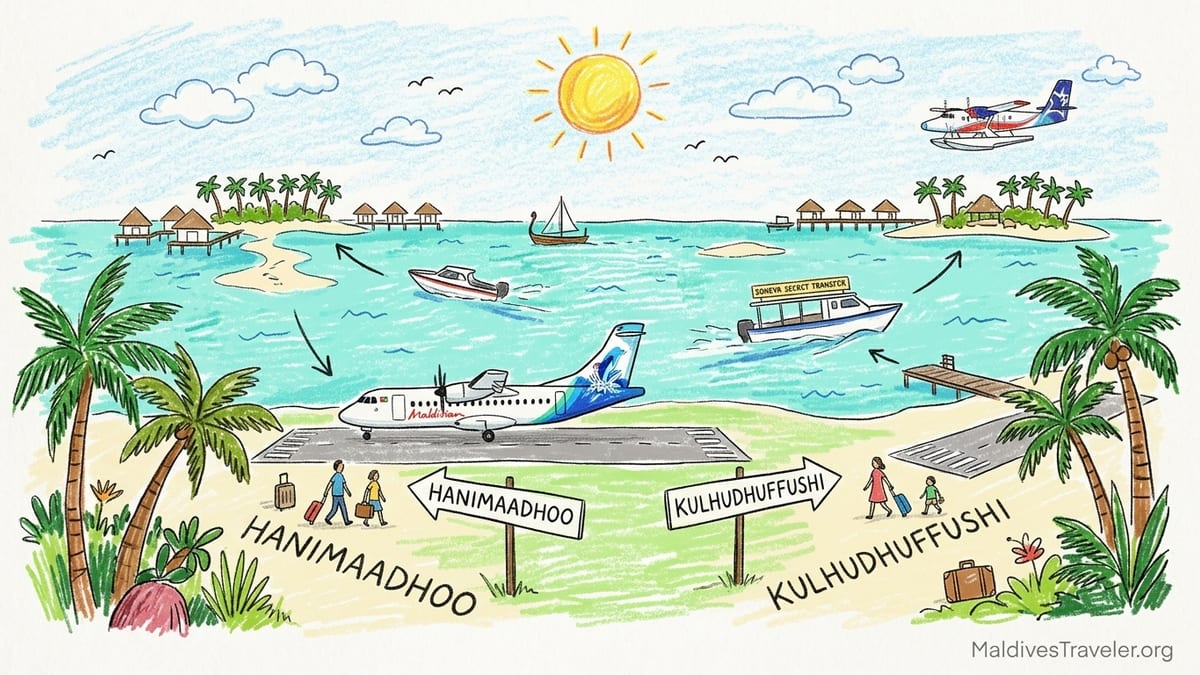
Understanding the Haa Dhaalu network: airports and routes
Haa Dhaalu is served by two main domestic gateways: Hanimaadhoo Airport in the northeast of the atoll and Kulhudhuffushi Airport closer to the atoll’s commercial hub. Both are linked to Malé’s Velana International Airport by Maldivian, the national carrier, using ATR turboprop aircraft on scheduled routes. Hanimaadhoo also has limited international services at times, but for most leisure travelers the standard route remains an international flight into Malé followed by a domestic hop north.
As of late 2026, Maldivian operates regular flights from Malé to both Hanimaadhoo (IATA: HAQ) and Kulhudhuffushi (IATA: HDK). Typical flight times are around 50 to 55 minutes to Hanimaadhoo and about 50 minutes to Kulhudhuffushi, depending on routing and intermediate stops. Schedules change seasonally, so travelers should always confirm exact timings close to departure, but in practice there are usually several daily Malé → Hanimaadhoo services and at least a couple of Malé → Kulhudhuffushi rotations spread across the day.
From these domestic airports, onward transfers are handled by resorts and guesthouses. For example, many Haa Dhaalu resorts use Hanimaadhoo as the domestic gateway, followed by a 15 to 60 minute speedboat ride. Soneva Secret offers an alternative via Kulhudhuffushi, with a roughly one‑hour speedboat journey, or via seaplane direct from Malé. This mix of options is what makes Haa Dhaalu more logistically complex than the quick speedboat‑only transfers in North Malé Atoll, but it also opens up more flexibility for late‑night or weather‑affected arrivals.
For visitors staying on local islands such as Hanimaadhoo itself or Kulhudhuffushi city, the airports are essentially in their backyard. After landing you may only need a short road transfer of 5 to 15 minutes to your guesthouse, arranged either by the property or using local taxis. This is the experience, for instance, at The Barefoot Eco Hotel near Hanimaadhoo, which currently quotes a 45 minute domestic flight followed by a 15 minute road transfer from Hanimaadhoo Airport to the hotel.
Malé to Hanimaadhoo: the classic northern domestic hop
The Malé → Hanimaadhoo route is one of the backbone domestic services in the Maldives. Maldivian’s ATR 72 aircraft make the journey in roughly 50 minutes, often with multiple departures per day, including early morning and late‑evening options. For travelers connecting from Europe or the Middle East, this typically means you can land into Malé in the morning and be swimming off a Haa Dhaalu beach by lunchtime, provided your onward domestic sector lines up.
In practice, many Hanimaadhoo‑area resorts and hotels will reserve and ticket the domestic sector for you as part of a package. A guest booking a week at a local guesthouse or at a property such as The Barefoot will commonly receive a confirmation that includes an indicative domestic itinerary like Malé departure around 10:30, Hanimaadhoo arrival just after 11:15, followed by a 15 minute road or boat transfer. Prices vary widely, but packaged domestic return transfers from Malé to Hanimaadhoo typically fall somewhere in the range of 200 to 350 US dollars per adult, often bundled and not itemized on resort invoices.
Because Hanimaadhoo sits closer to many inhabited islands than Kulhudhuffushi, it serves as the preferred access point for classic “Maldives plus local life” trips. Travelers might split their stay between Hanimaadhoo and a nearby resort island, using short local boat rides once they have arrived on the domestic flight. In these cases, the domestic flight is the only aviation leg you need to worry about after Malé, and timing your arrival to catch one of the midday or early afternoon services can save you the cost and disruption of an overnight in the capital.
When planning, remember that checking in for a domestic flight in Malé is usually more relaxed than for international sectors, but resorts and Maldivian still recommend arriving at the domestic terminal at least one hour before departure. If your inbound long‑haul flight lands at 08:00 and you are ticketed on a 09:30 domestic departure to Hanimaadhoo, this is generally considered a safe connection, provided immigration queues are normal and you do not have separate checked bags that need to be re‑tagged manually.
Malé to Kulhudhuffushi: gateway to Haa Dhaalu’s west and Soneva Secret
Kulhudhuffushi Airport, with IATA code HDK, has become an increasingly important hub for northern Maldives travel. Located about 227 kilometers from Malé, it serves both the regional capital and several high‑end resorts that use it as a springboard for speedboat transfers. Maldivian connects Malé and Kulhudhuffushi with scheduled flights, often including a morning departure around 09:00 to 10:00 and additional services later in the day during busier seasons.
For Haa Dhaalu guests, the key appeal of Kulhudhuffushi is its proximity to a cluster of islands on the western side of the atoll. Soneva Secret, for instance, offers a combination of Malé → Kulhudhuffushi domestic flight, then roughly a one‑hour speedboat to the resort. This route is especially useful for travelers whose international flights arrive into Malé too late for seaplane operations, since domestic flights and boats can operate into the evening and sometimes at night.
On the ground, Kulhudhuffushi Airport is simple and efficient. After landing, you step into a modest terminal, collect your checked bags from a short belt, and meet your resort or guesthouse representative. A typical resort transfer might involve a five‑minute walk or short buggy ride to the harbor and a speedboat departure timed to meet the domestic flight. Guests staying directly in Kulhudhuffushi town often take a brief taxi ride to their hotel, paying the fare in Maldivian rufiyaa or by local payment apps, though many properties are happy to add the ride to your room bill.
Because Kulhudhuffushi serves a mix of local traffic and resort guests, its flights can be busy on Fridays and Sundays when Maldivians travel for work or study. If you are connecting from a long‑haul arrival on these days, try to build in at least two to three hours between landing in Malé and your domestic departure, as check‑in queues can lengthen and last‑minute rebookings onto later flights are not guaranteed.
Combining domestic flights and resort speedboats
Most visitors to Haa Dhaalu will experience some form of domestic flight plus boat transfer. For resorts around Hanimaadhoo, the pattern is a Malé → Hanimaadhoo domestic flight followed by a 15 to 60 minute speedboat. For example, a mid‑range resort south of Hanimaadhoo might schedule a shared speedboat departure around 12:00, timed to meet a morning Malé → Hanimaadhoo arrival. Guests flying in on that domestic sector are greeted, helped with luggage, and escorted directly onto the boat.
Resorts typically bundle this combination into a single “domestic transfer” price. A realistic current example for 2026 would be a resort quoting 350 to 450 US dollars per adult for a round‑trip Malé ↔ Hanimaadhoo flight plus shared speedboat package. Children are often charged 50 to 75 percent of the adult rate, and infants sometimes travel free if they share a seat. These figures vary by property and season, and some ultra‑luxury resorts simply include transfers in their nightly rate, but they illustrate the overall cost bracket.
Soneva Secret’s domestic route via Kulhudhuffushi follows the same structure at a higher level of polish. Guests landing in Malé are met in the arrivals hall, escorted to a private or shared lounge while waiting for the Malé → Kulhudhuffushi flight, and then greeted again at Kulhudhuffushi for a one‑hour speedboat ride across Haa Dhaalu’s lagoons. The entire journey from Malé to the resort takes roughly two and a half hours, and because domestic flights run beyond seaplane operating hours, this option can accommodate arrivals into Malé as late as evening, depending on the day’s schedule.
For travelers staying on local islands, the same principle applies but with a more independent feel. You might book your own Maldivian ticket Malé → Hanimaadhoo, then arrange directly with a local speedboat operator or use the island’s scheduled ferries. A concrete example would be a traveler landing into Malé at 11:00, catching a 14:00 domestic flight to Hanimaadhoo, then transferring by local speedboat at 15:30 to a small guesthouse island, arriving before sunset. The key is to keep some buffer at each stage in case domestic flights run late, which is not uncommon during peak weather disruptions.
Soneva Secret: seaplane elegance versus domestic flexibility
Soneva Secret, one of the Maldives’ most exclusive small resorts, sits in the northern reaches of Haa Dhaalu and offers some of the most diverse transfer options in the country. Guests can fly by seaplane directly from Malé to the resort in about 75 minutes, take a domestic flight to Hanimaadhoo followed by a speedboat ride, or use the Kulhudhuffushi combination with a one‑hour speedboat. There are also options to route via sister resorts such as Soneva Fushi or Soneva Jani, combining multiple properties in a single itinerary.
The seaplane experience is the most iconic. After clearing immigration in Malé, Soneva’s airport hosts escort you to the dedicated lounge at the seaplane terminal, where you wait for boarding. Flights are operated by Manta Air on Soneva’s behalf and typically depart between mid‑morning and mid‑afternoon. The seaplane flies at low altitude over the atoll chain, offering panoramic views of sandbanks and reefs, before landing near the resort’s jetty. This is the route most guests choose when their international flights arrive into Malé before about 15:00, which is the latest comfortable cut‑off to guarantee a same‑day seaplane connection.
However, seaplanes in the Maldives operate only during daylight hours for safety reasons. That means if your long‑haul arrival into Malé is at 16:30 or later, you will generally not be able to reach Soneva Secret by seaplane that day. In these cases Soneva offers alternatives: a domestic flight to Kulhudhuffushi followed by a one‑hour speedboat, a domestic flight to Hanimaadhoo plus speedboat, or arranging an overnight near Malé with a seaplane the following morning. Guests who end up using Manta Air’s shared seaplanes instead of the branded Soneva aircraft may receive a resort credit per person as compensation, which can be used on dining or experiences.
For families with young children or travelers prone to motion sickness, the domestic plus speedboat route can actually feel more comfortable than seaplane. ATR turboprops have pressurized cabins, standard airline seats, and overhead bins, and while the speedboat ride can be bouncy in rough seas, many guests prefer it to the vibration and noise of a floatplane. Soneva’s transfers team will discuss your preferences and your flight times and propose the best routing, so when you are budgeting, allow for premium pricing on these carefully choreographed legs.
Baggage allowances and practical packing tips
On Maldivian domestic flights, checked baggage allowances are typically around 20 kilograms per adult in economy class, with an additional 5 kilograms of hand baggage. Some resort‑ticketed fares or higher booking classes may allow a bit more, but travelers should not assume generous long‑haul style limits on these sectors. Excess baggage is usually charged per kilogram, at rates published by the airline, and is payable at check‑in in Maldivian rufiyaa or widely accepted credit cards.
Seaplanes serving Soneva Secret and other remote resorts generally have stricter limits, often in the range of 20 to 25 kilograms total per person including hand luggage. Bags above that may travel on a later flight or incur extra fees, and in extreme cases very large or hard‑sided suitcases might not fit in the aircraft’s cargo holds. Soneva and other high‑end resorts can arrange luggage storage in Malé for guests who arrive with more belongings than they wish to carry north, with typical locker fees of under 10 US dollars per day for standard suitcases.
The Barefoot’s indicative guidance of a 45 minute domestic flight plus 15 minute road transfer from Hanimaadhoo also hints at the practical side of packing. On these short flights, cabins are compact, overhead bins are small, and soft‑sided duffel bags are often easier to handle than rigid spinner suitcases. For a week‑long Haa Dhaalu stay, many repeat visitors swear by one medium checked bag and one backpack per person, which comfortably sits within most domestic allowances and makes pivoting between domestic flights, seaplanes and small boats less stressful.
If you anticipate bringing scuba gear, camera equipment, or bulky sports items, inform both your resort and your airline well in advance. Some properties can pre‑arrange excess baggage waivers or at least flag your booking so that check‑in staff are prepared. Otherwise, budget realistically for a modest excess charge; for instance, a diver traveling with a full kit might easily exceed the base allowance by 5 to 8 kilograms once wet suits and fins are included.
Connection timings, late arrivals and when to overnight in Malé
The single biggest question for Haa Dhaalu‑bound travelers is whether they can connect directly from their international flight to their domestic or seaplane transfer on the same day. As a rule of thumb, if your international flight lands into Malé before about 13:00, you can usually make a same‑day connection to either Hanimaadhoo or Kulhudhuffushi by domestic flight, and often even catch an afternoon seaplane to Soneva Secret.
For seaplane travel, most resorts recommend that inbound flights land no later than 15:00 to guarantee same‑day transfers. Seaplane operations typically run from around 06:00 or 07:00 until shortly before sunset, and delays from weather or air traffic can compress this window. If your international arrival is scheduled at 14:30, you are on the margin: you may technically be able to clear immigration, collect bags, check in at the seaplane terminal and still board, but many travel advisors would suggest planning an overnight in or around Malé and taking the first seaplane the next morning around 09:00.
Domestic flights and speedboats offer more flexibility, as they are not constrained by daylight in the same way. An evening arrival into Malé at, for example, 19:00 can still potentially connect to a late‑night Malé → Hanimaadhoo or Kulhudhuffushi flight, followed by a short night‑time speedboat to a resort that accepts guests after dark. Some properties, especially those on local islands, are comfortable receiving arrivals at any hour. However, luxury resorts that focus on curated arrival experiences may prefer guests to arrive during daylight and will recommend an overnight stop in Malé if connections feel tight or risky.
There are also practical considerations around immigration and baggage. If your international and domestic flights are on separate tickets and your checked bags are not tagged through to Hanimaadhoo or Kulhudhuffushi, you will need time to clear immigration, collect luggage, walk to the domestic terminal, queue for check‑in, and pass security again. For this reason, many tour operators advise at least three hours between scheduled international arrival and domestic departure in the Maldives, especially in peak periods such as December to March when airport queues are longest.
Real‑world itineraries: how the journey actually looks
To understand how these principles play out in practice, consider a couple flying from London to Malé via a Middle Eastern hub on a winter escape. Their final leg lands in Malé at 09:20. They have pre‑booked a domestic transfer to Hanimaadhoo bundled by their resort. On arrival, a resort host meets them, fast‑tracks them through the domestic check‑in area and escorts them to a lounge. They board a 11:00 Maldivian flight, land in Hanimaadhoo shortly before noon, and are in their resort villa by 13:00 after a 45 minute boat ride. Despite two flights and a boat, the connection feels smooth because each leg has generous buffer.
Now imagine a family from New York whose direct flight lands in Malé at 15:45, heading to Soneva Secret. Because seaplanes will have largely wound down for the day, Soneva has booked them on a domestic flight to Kulhudhuffushi departing around early evening, with a one‑hour speedboat crossing to follow. They arrive at the resort after dark, but still on the same calendar day. On the way home, they leave Soneva Secret after breakfast for a mid‑morning seaplane back to Malé, connecting comfortably to an afternoon long‑haul departure.
A third example is a budget traveler staying in a Kulhudhuffushi guesthouse. Their low‑cost carrier lands in Malé at 22:30, too late for same‑night domestic flights north. They book an inexpensive airport hotel on Hulhumalé, sleep, and catch a 09:00 domestic flight to Kulhudhuffushi the next morning. The overall travel time stretches, but the journey feels less stressful because they are not racing the clock. Importantly, their itinerary was built with this forced overnight in mind, rather than discovering the need to pay for an extra night in Malé after arriving.
In every case, the key is to treat the Maldives transfer network like an additional short‑haul leg of your trip rather than an afterthought. Check domestic flight schedules before locking in your long‑haul tickets, ask your resort to advise on realistic connection times, and be honest with yourself about your appetite for tight transfers. What looks efficient on paper can feel frantic on the ground after a red‑eye flight and two hours in a tropical immigration queue.
FAQ
Q1. How long does it take to travel from Malé to Hanimaadhoo including transfers?
The domestic flight from Malé to Hanimaadhoo is usually around 50 minutes, and most nearby resorts add 15 to 60 minutes by road or speedboat, so a realistic total is 1.5 to 2.5 hours from Malé to your room.
Q2. What is the typical baggage allowance on Maldivian domestic flights?
Most Maldivian economy tickets include about 20 kilograms of checked baggage plus around 5 kilograms of hand luggage per person, with excess charged by the kilogram at the airport.
Q3. Can I connect directly to Haa Dhaalu if my international flight lands in Malé after 15:00?
Same‑day seaplane transfers will likely not be possible after about 15:00, but some domestic flights to Hanimaadhoo or Kulhudhuffushi still operate later; if those do not line up, you will need to overnight in or near Malé.
Q4. Do I book the domestic flight to Hanimaadhoo or Kulhudhuffushi myself or through the resort?
Resorts usually prefer to book domestic and seaplane transfers on your behalf so they can coordinate schedules and meet you at each step, though independent travelers staying in local guesthouses often book directly with Maldivian.
Q5. How does Soneva Secret decide between seaplane and domestic flight plus speedboat?
The resort’s team looks at your international arrival and departure times, daylight hours, weather and your preferences, then proposes either a direct seaplane, a domestic flight to Hanimaadhoo or Kulhudhuffushi plus speedboat, or an overnight in Malé with a morning seaplane.
Q6. Are night‑time speedboat transfers safe and common in Haa Dhaalu?
Night‑time speedboat transfers are widely used for domestic flight connections and are generally well managed by experienced crews, though conditions can be choppier and some luxury resorts prefer daytime arrivals for guest comfort.
Q7. When is it absolutely necessary to plan an overnight stay in Malé?
If your international flight lands in Malé late evening, or if there are no suitable domestic flights left to Hanimaadhoo or Kulhudhuffushi, or if you are uncomfortable with very tight connections, it is wise to schedule an overnight and continue north the next morning.
Q8. How early should I be at the airport for a domestic flight to Haa Dhaalu?
You should aim to be at the domestic terminal at least one hour before departure; if you are connecting from an international arrival on separate tickets, allow two to three hours from landing to domestic take‑off.
Q9. Is the seaplane to Soneva Secret worth the extra cost compared with a domestic flight?
For many guests the direct 75 minute seaplane with sweeping atoll views is a highlight of the trip and justifies the premium, while others prioritize the greater timing flexibility and sometimes lower cost of domestic flights plus speedboats.
Q10. What happens if my international flight is delayed and I miss my domestic or seaplane connection?
If your domestic or seaplane sector was booked through the resort, their transfers team will usually rebook you on the next available service and arrange an interim hotel if needed, though additional charges or a forced overnight may apply depending on availability.