


Hanimaadhoo, in the far north of the Maldives, is quietly becoming a favorite base for divers who care more about manta encounters and healthy reefs than about overwater villas. With its own international airport, an on-island eco resort with an integrated dive center, and a growing scene of local guesthouses that plug into independent dive operators, Hanimaadhoo lets you tailor your stay very precisely around diving. This guide focuses on concrete, real-world package options so you can decide whether a resort-style stay at The Barefoot Eco Hotel or a guesthouse plus local dive center setup is the better value for your next trip.
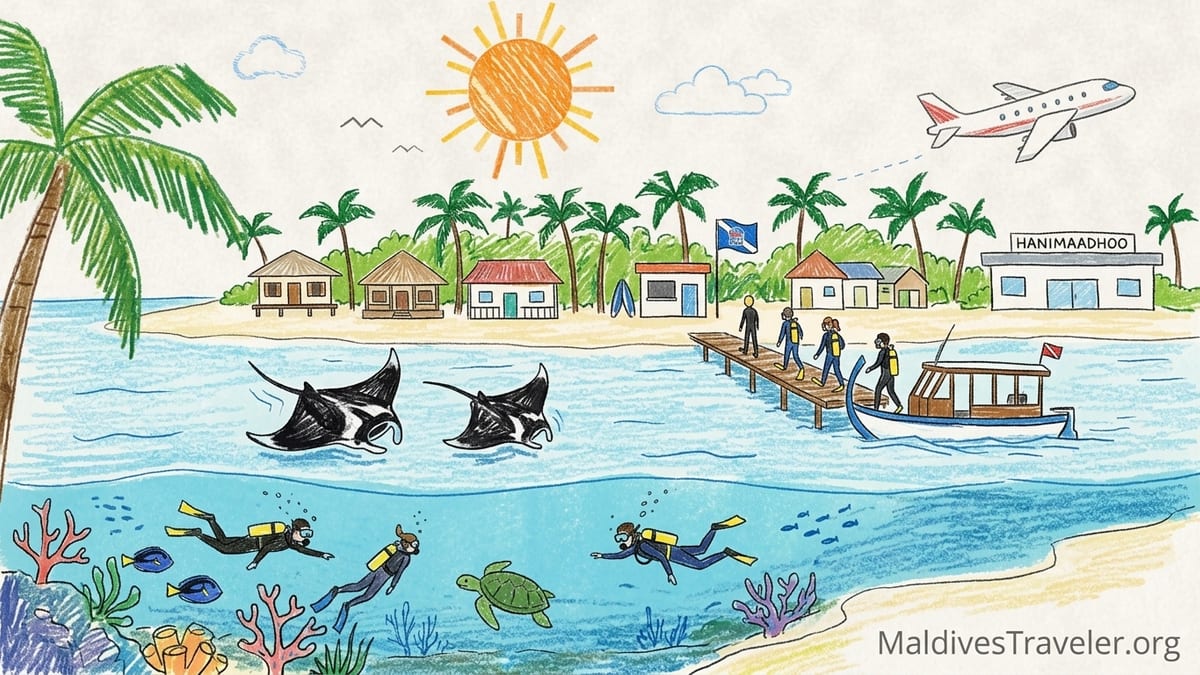
Why Choose Hanimaadhoo for a Dive-Centric Trip
Hanimaadhoo sits in Haa Dhaalu Atoll, one of the northernmost atolls of the Maldives, with its own international airport receiving domestic and limited international flights. For divers, this means you can often connect from Malé in under an hour without expensive seaplane transfers, then be checking in to your accommodation and assembling gear before lunch. The island is large by Maldivian standards, with a lived-in local community and an increasingly polished tourism infrastructure centered around diving and marine life.
The dive sites around Haa Dhaalu are still relatively lightly trafficked compared with better-known atolls further south. Local operators promote a mix of thilas, channels and outer reef slopes that regularly produce encounters with reef sharks, turtles and schooling fish, along with seasonal manta cleaning and feeding sites. A typical review pattern from dedicated divers mentions 20 to 30 dives over a stay of 10 to 14 days and notes that they rarely saw other dive boats on site, which is a selling point if you dislike crowded briefings and underwater traffic.
Hanimaadhoo is also positioned near manta aggregation zones in the wider northern Maldives. Marine research mapping lists “Hanimaadhoo Beyru” and nearby reefs as manta-use areas, which is why many operators build manta-focused monitoring or photo-ID trips into their weekly schedule during the right season. While the certainty of sightings cannot match famous spots like Hanifaru Bay in Baa Atoll or the whale shark zones of South Ari, the appeal here is a lower-key, more exploratory feel that suits repeat Maldives visitors and serious underwater photographers.
On the surface, Hanimaadhoo offers long stretches of natural beach, a small village, and a calm, conservative local island atmosphere. This makes it a practical base for divers traveling with non-diving partners or older family members who want safe swimming, independent walks and simple cafés, rather than a full-scale resort entertainment program.
The Barefoot Eco Hotel: Integrated Diving, Stays and Marine Biology
The Barefoot Eco Hotel sits on the western side of Hanimaadhoo, occupying a long private beachfront section while still sharing the island with local residents. It markets itself as an eco-conscious barefoot-style resort, but for divers the crucial point is that the accommodation, on-site PADI dive center and marine biology team are all part of a single operation. You sleep, brief, kit up and board the dive dhoni from one property, and all billing is consolidated through the hotel.
The Barefoot’s dive center typically offers daily two-tank morning boat dives, plus optional third dives or night dives on demand. Packages sold through European dive travel agents and the hotel’s own partners often bundle, for example, 7 nights half board with a 10- or 12-dive package. These bundles usually price the diving itself in line with mid-range Maldivian resort norms: a 10-dive pack might work out to the equivalent of around 55 to 75 US dollars per dive once you strip out room and board, with gear rental, Nitrox and boat surcharges charged separately. Exact pricing fluctuates by season and promotion, so it is worth requesting a current dive-inclusive quote from the hotel.
For Nitrox users, Barefoot’s center has historically offered Enriched Air at a surcharge per tank or as a weekly Nitrox package. Expect something in the region of a modest add-on per fill or a flat fee for unlimited Nitrox over several days, broadly consistent with Maldivian averages where Nitrox often adds around the cost of a coffee or two per dive. If you plan to do three dives a day for a week, locking in an unlimited Nitrox supplement can be both better value and more comfortable for repetitive profiles.
The eco aspect at The Barefoot goes beyond marketing. The resort hosts an in-house marine biologist who runs presentations, guided snorkeling and occasional manta or turtle monitoring sessions. Some stays or special offers include complimentary marine biology talks and short house-reef snorkels, while more specialized “diving deeper with the marine biologist” activities are sold as add-ons. For a diver, this means you can pair your regular boat dives with one or two more science-focused sessions that explain manta behavior, coral restoration or photo-ID projects using the same team that runs your daily diving.
Guesthouses and Local Dive Centers: Flexible, Often Cheaper Packages
Beyond The Barefoot, Hanimaadhoo now has a cluster of smaller local guesthouses and boutique stays. Names and owners change frequently as the island develops, but typical examples include family-run beachfront houses and compact hotels along the main coastal road. These properties generally have 6 to 20 rooms, offer bed and breakfast or half board, and rely on independent dive operators based on or near the island for sea activities.
A common pattern is to book your room directly with a guesthouse, then either allow them to arrange your dives with a partner such as Hanimaadhoo Dive & Watersports, or contact the dive center yourself to build a tailored dive schedule. Hanimaadhoo Dive & Watersports promotes itself as a flexible operator for everything from single fun dives and discovery scuba to full-day dive excursions and snorkeling trips. Real-world feedback from divers mentions multi-week stays with 25 to 30 dives arranged directly with the center, with the advantage of being able to mix in fishing, sandbank and snorkeling days for non-diving partners as needed.
On pricing, guesthouse-plus-dive-center combinations in the Maldives generally undercut resort packages on a per-dive basis, especially if you are comfortable with simpler rooms and local-style meals. A typical benchmark from recent Maldives-wide diving guides puts guesthouse-region dives in the ballpark of 40 to 70 US dollars per dive for a 10-dive package, versus 70 to 100 dollars in mid-range resorts and more in luxury properties. Nitrox is usually extra, at around the price of a casual restaurant meal per tank or as a modest daily package if available. On Hanimaadhoo specifically, expect guesthouses to quote combined deals like “7 nights with breakfast plus 8 boat dives” that come in noticeably cheaper than resort half-board dive bundles, especially outside peak holiday weeks.
The trade-off is that you need to coordinate a little more. Transfers between your guesthouse and the dive center might involve short pickup drives or bicycle rides. Equipment storage may be split between the center and your room. Billing can come on separate invoices for accommodation and diving. For experienced dive travelers used to local islands in the Maldives, this is familiar territory and the cost savings and extra contact with local operators can be well worth it.
Dive Packages, Number of Dives and What They Actually Include
When comparing offers for Hanimaadhoo, the headline number of dives is only the start. The Barefoot and independent centers will all happily sell you single fun dives, but most visiting divers aim for 8 to 20 dives over a week. Packages tend to be structured in blocks of 6, 8, 10 or 12 dives, with the per-dive rate dropping slightly as you purchase more. Carefully check whether quoted prices include the boat, guide, tanks and weights, or if there are separate “boat trip” or “fuel surcharge” lines that can add up over double-dive days.
A realistic pattern for a 7-night stay focused on diving might be 10 to 12 boat dives, spread across five mornings plus one or two afternoon or night dives. Hardcore divers who plan three dives a day over a longer stay should ask about “unlimited” or “max 3 dives per day” packages that some centers quietly offer to repeat guests. In shoulder seasons or when occupancy is low, you may find that operators are more flexible about running extra dives if you cover minimum numbers or costs for the boat.
Many Hanimaadhoo operators also weave in specialty diving such as night dives on the house reef or fluorescent night dives with UV torches, although these may not be heavily advertised online. If that kind of diving matters to you, mention it clearly in your initial email and ask for an indicative supplement. Similarly, if you are traveling as a group of four or more certified divers, you can sometimes negotiate bespoke packages that combine, for instance, 12 fun dives, one manta-focused day and a complimentary local island excursion in return for committing to a certain number of boat days.
For non-certified companions, consider whether to roll a Discover Scuba Diving experience into your package. In the Maldives, introductory dives generally come in at a premium over a standard fun dive, reflecting the extra instructor time, pool or shallow-water work and paperwork involved. If your partner is on the fence about learning to dive, planning one trial dive early in the trip is a smart way to decide whether to budget for a full course later in your holiday or on a future visit.
Nitrox, Equipment Rental and Dive Courses on Hanimaadhoo
Nitrox is a key consideration in a dive-centric stay, especially if you are over 35 or plan multiple dives per day. On Hanimaadhoo, The Barefoot’s on-site center and the main independent dive shops generally support Enriched Air for certified divers. It is rarely baked into base packages, so budget for a supplement per tank or per day. Across the Maldives, Nitrox fills in guesthouse regions typically add the cost of a simple local restaurant meal to each dive or around that amount per day if unlimited; Hanimaadhoo’s pricing sits broadly in this range. If you are not yet Nitrox certified, many divers choose to complete the PADI Enriched Air course during their stay, combining online theory with one or two supervised Nitrox dives over an afternoon.
Equipment rental policies vary. Resort centers like The Barefoot often price full kit rental per dive or per day, with separate supplements for computers, torches and cameras. Guesthouse-linked dive centers might be more flexible, for example quoting a flat weekly rate for BCD, regulator, mask, fins and wetsuit, plus a reduced “tank and weights only” option if you bring your own core gear. As a rough Maldives-wide benchmark, expect full equipment hire to sit in the equivalent band of 15 to 30 US dollars per dive in guesthouse regions and higher in resorts, with discounts for multi-day rentals. Always check whether a dive computer is included, as many operators increasingly require each diver to have one.
For courses, Hanimaadhoo’s operators typically run the standard PADI ladder from Discover Scuba and Open Water through Advanced and a selection of specialties, including Nitrox, Deep and Night. The Barefoot is well set up for beginners who want the convenience of classroom areas, a sheltered lagoon for confined sessions and predictable scheduling woven around resort mealtimes. Guesthouse-based students may have a slightly more improvised experience, with theory conducted in simple classrooms or even shaded outdoor areas and confined water in the lagoon or house reef shallows. In return they often benefit from smaller class sizes and more flexible start dates.
Course pricing in the Maldives tends to be higher than Southeast Asia hotspots but roughly aligned with other island nations. A PADI Open Water course from a local-island base commonly falls somewhere in the mid-hundreds of US dollars, with Advanced Open Water a little less, and prices nudging higher in resort facilities. Compare what is included: do quoted fees cover learning materials, certification fees, boat dives, full equipment and dive computer, or are any of these charged separately.
Manta Trips, Marine-Biology Excursions and Snorkeling for Non-Divers
For many travelers, the deciding factor in choosing Hanimaadhoo is the chance of manta encounters without the crowds associated with the country’s most famous sites. Local mapping from manta conservation projects identifies several northern Haa Dhaalu reefs, including areas off Hanimaadhoo and nearby islands, as known manta aggregation or cleaning sites. Dive operators build manta-focused trips into their weekly schedule during the more favorable seasons, usually aligned with plankton-rich currents. These trips may be offered as double-dive mornings aiming first at a manta point and then at a scenic reef, or as full-day excursions that combine one or two dives with snorkeling time and a picnic on a sandbank.
At The Barefoot, manta or turtle monitoring may be integrated with the in-house marine biologist program. A typical example could be a morning boat where one dive is led with an emphasis on photographing manta belly patterns for identification, followed by a snorkeling session where non-divers can join under the guidance of the marine team. On guesthouse-based stays, independent operators might emphasize a more general “manta and big-fish” route, but will often be happy to adapt the focus if you ask about contributing to ID databases or learning basic citizen-science techniques.
If you are traveling with a non-diving partner, snorkeling options become just as important as dive logistics. Hanimaadhoo’s house reef access varies by accommodation; some sections of beach offer an easy entry to coral gardens a short swim from shore, while other stretches are more suitable for relaxed swimming and sunset walks. Both The Barefoot and local guesthouses commonly run half-day snorkeling excursions by boat to clearer reef sections, sandbanks and possible manta spots, usually including gear, guide and refreshments. Prices are significantly lower than full dive trips, making it affordable for non-divers to join several outings across a week.
For mixed couples, one effective pattern is to schedule joint boat excursions where you complete one or two dives while your partner snorkels above the same reef or at a nearby shallow site. Operators used to this model will coordinate briefings so that divers and snorkelers understand the plan, signals and pickup procedures. Non-divers get the chance to see turtles, reef sharks and schooling fish, and with a bit of luck mantas, without needing full scuba training, while you still log significant bottom time.
Practical Booking Tips: When to Go, Transfers and What to Ask
Hanimaadhoo is accessible via domestic flights from Malé, and the island’s airport is being upgraded in phases, with projected increases in international connections. From an American or European perspective, you will almost always connect via Malé, then take a short domestic hop north. Flight schedules change seasonally, so check what times your accommodation can coordinate, particularly if you book flights and rooms separately. One of the advantages of The Barefoot is that its reservations team can package domestic flights with your stay. Guesthouse visitors may prefer to use a specialist agent that includes domestic flights and dive packages in one invoice to simplify planning.
In terms of seasonality, northern Maldives diving is viable year round, but conditions and manta probabilities shift with the monsoon pattern. The traditional high season from December to April typically brings calmer seas and better topside weather, which suits first-time visitors and non-divers who value sunshine. Transitional months and the southwest monsoon period can bring more plankton and therefore potentially higher manta activity, balanced against choppier seas and an increased chance of overcast days. If your priority is flat seas and easy entries for newer divers or snorkelers, stay close to the high season. If you are tolerant of some weather variability in exchange for plankton blooms and moodier skies, shoulder months before and after peak can be attractive and often cheaper.
When requesting quotes, ask operators to break down their numbers clearly. For a resort package, request the room rate with board basis, the cost of a 10- or 12-dive package, any boat or fuel surcharges, Nitrox supplements, equipment rental, and domestic flight add-ons. For a guesthouse plus dive center setup, do the same across both entities. This will let you compare offers that might initially seem very different. It is not unusual to find that a simple guesthouse with an independent dive center comes in several hundred dollars cheaper over a week than a resort package once all extras are added, especially if you dive heavily and your non-diving partner is content with local-island simplicity.
Finally, consider the social feel you want. The Barefoot attracts a mix of European couples, small groups and some families, with a quiet eco-resort atmosphere and a fair number of repeat guests who return specifically for the integrated diving and marine biology. Guesthouses skew more toward budget-conscious independent travelers, small dive clubs and long-stay remote workers who intersperse laptop hours with morning dives. Both can work well; the best choice is the one whose rhythm matches your own travel style.
The Takeaway
Hanimaadhoo is not the Maldives of overwater bungalows and Champagne brunches. It is a practical, increasingly polished northern hub where serious divers can build trips around mantas, healthy reefs and flexible, good-value dive packages. The Barefoot Eco Hotel offers a resort-style experience with the advantage of an on-site dive center and marine biologist, ideal if you want everything integrated under one roof and are willing to pay mid-range resort prices for that convenience.
Local guesthouses paired with independent operators such as Hanimaadhoo Dive & Watersports lean into flexibility and value. You will handle a little more logistics, but you gain access to lower room rates, locally owned businesses and often smaller dive groups. Nitrox, equipment rental, and PADI courses are widely available across both types of operation, and manta-focused trips or citizen-science style excursions are easy to add if you ask in advance.
For mixed diver and non-diver couples, the island’s long beaches, casual snorkeling trips and gentle local atmosphere make it an easier sell than some more remote liveaboard-style experiences. Whether you are planning your first northern Maldives dive adventure or returning for deeper exploration, Hanimaadhoo rewards travelers who look beyond headline resort names and examine the actual structure and value of hotel plus dive packages. Choose the setup that best matches your diving intensity, budget and desired level of comfort, and the reefs of Haa Dhaalu will do the rest.
FAQ
Q1. Is Hanimaadhoo a good choice for a first Maldives dive trip?
Yes, if you prioritize diving over luxury trimmings. Conditions are suitable for Open Water level divers, there are established operators on the island, and the airport transfer is relatively straightforward compared with atolls that require seaplanes.
Q2. How many dives should I plan for a 7-night stay on Hanimaadhoo?
Most certified divers aim for 10 to 12 dives over a week, typically two-tank mornings on five days plus one or two extra afternoon or night dives, leaving some time for rest and non-diving excursions.
Q3. Do I really need Nitrox for diving in Haa Dhaalu Atoll?
You can dive safely on air, but Nitrox is recommended if you plan multiple dives per day or are an older diver, as it can provide more no-decompression time and a larger safety buffer when used correctly within your training.
Q4. Are manta ray sightings around Hanimaadhoo guaranteed?
No operator can guarantee mantas. Hanimaadhoo sits near known manta use areas, and dedicated manta trips run in season, but sightings depend on currents, plankton and luck, so treat them as a strong possibility rather than a certainty.
Q5. How do hotel dive packages compare with guesthouse plus dive center deals in price?
Resort packages at places like The Barefoot usually cost more overall but bundle convenience and on-site facilities, while guesthouse plus local dive center combinations often deliver lower per-dive and per-night costs if you are comfortable with simpler rooms and more self-management.
Q6. Can my non-diving partner still enjoy the trip?
Yes. Non-divers can join snorkeling excursions, relax on the beach, take village walks and join some marine biology activities. Many dive boats also welcome snorkelers on selected trips, so you can share time on the water together.
Q7. Is it possible to learn to dive on Hanimaadhoo?
Yes. Operators on the island offer PADI Open Water and Advanced courses, typically combining lagoon or pool sessions with open-water dives. It is wise to confirm course availability and English-speaking instructors in advance.
Q8. What should I ask dive centers before booking?
Request a detailed breakdown of dive package prices, what is included, Nitrox and equipment rental costs, maximum group size, boat schedule, typical dive sites for your dates, and any manta or special trips planned during your stay.
Q9. When is the best time of year to visit Hanimaadhoo for diving?
Diving is possible all year, but December to April usually offers calmer seas and sunnier weather. Transitional months can bring more plankton and potentially more mantas, balanced by a higher chance of wind and clouds.
Q10. How far in advance should I book Hanimaadhoo dive packages?
For high season dates around December to March, book accommodation, domestic flights and dive packages several months ahead. Outside peak weeks you may find more flexibility, but securing dives in advance still helps operators plan boat schedules.