


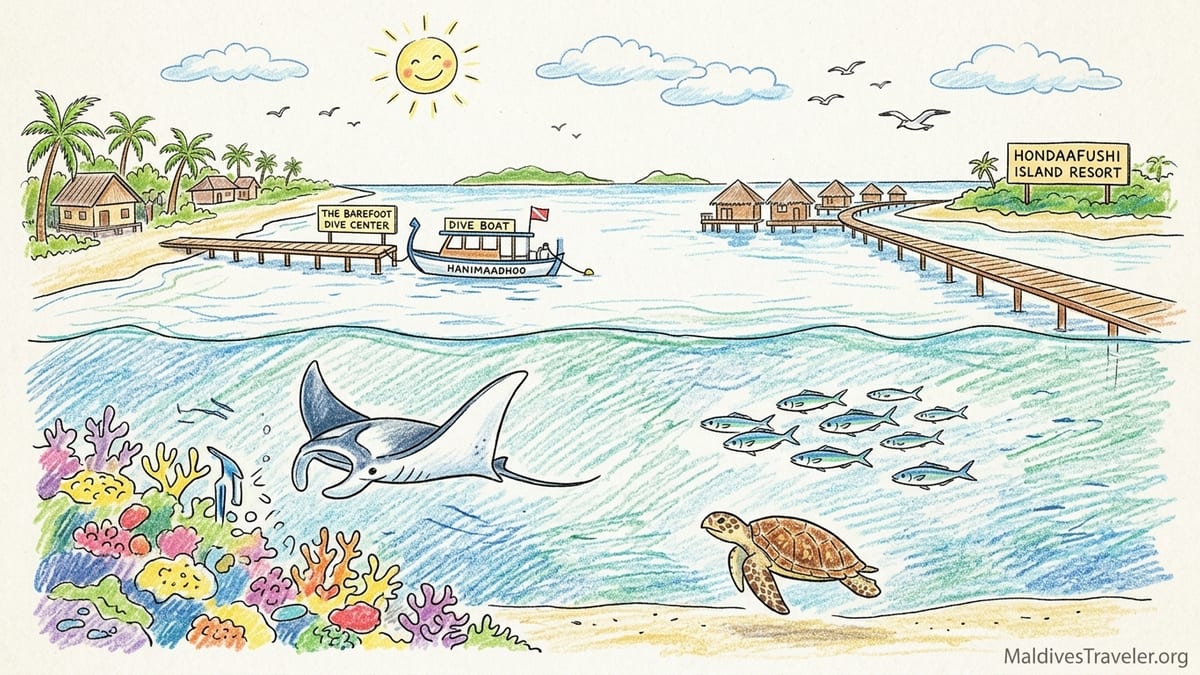
Deep in the far north of the Maldives, Haa Dhaalu Atoll rewards those willing to go a little off the classic tourist circuit. Here, local-island Hanimaadhoo with The Barefoot Eco Hotel, the resort island of Hondaafushi, and the quieter outer-reef dive sites form a compact triangle of options for divers and snorkelers who want healthy coral, frequent turtles and reef sharks, and a more low‑key, authentic atmosphere than the busier central atolls. This guide compares how each location actually feels in the water, from house‑reef entries and boat rides to the chances of drifting past mantas or dropping into a sharky channel on Nitrox.
Why Haa Dhaalu Atoll Belongs on Your Dive Map
Haa Dhaalu, also known as South Thiladhunmathi, sits in the deep north of the Maldives, several domestic flight hours away from the poster‑child atolls of the central region. The upside of that distance is lighter tourism pressure and outer reefs that still feel wild. Around islands such as Hanimaadhoo and Hondaafushi you can expect warm water typically in the 27 to 29 degrees Celsius range, clear visibility that can exceed 20 to 25 meters in the northeast monsoon months, and a mix of sheltered lagoons and high‑energy channels that suit different experience levels.
The atoll has the full Maldives topography in miniature. There are easy sloping house reefs where beginners complete their first giant strides, channels where currents funnel schooling fish and reef sharks, and submerged thilas and giris where soft corals and cleaning stations attract larger visitors. Reefs around several inhabited islands in Haa Dhaalu are known for regular manta sightings and an “every‑dive” cast of hawksbill and green turtles, white‑tip reef sharks and big Napoleon wrasse rather than headline‑grabbing but rare species.
Unlike famous manta hotspots such as Hanifaru Bay in Baa Atoll, Haa Dhaalu still sees fewer boats and day‑trippers. That changes the experience in very practical ways. It is rare to have more than a handful of dive boats on a site, and snorkelers often find themselves sharing a shallow reef with only their own group and the resident turtles. For many divers, that sense of space is as appealing as the marine life itself.
Access is straightforward. From Malé, most travelers fly 45 to 50 minutes to Hanimaadhoo’s domestic airport, then transfer by car or speedboat to their resort. That makes Hanimaadhoo, home of The Barefoot Eco Hotel, a natural base for exploring the eastern side of the atoll, while Hondaafushi sits a boat ride away toward the western rim and its outer‑reef and channel dives.
Hanimaadhoo & The Barefoot: House‑Reef Convenience With Nitrox
Hanimaadhoo is a lived‑in local island rather than a private resort. At its northern end, The Barefoot Eco Hotel occupies a long arc of beach fringed by a turquoise lagoon, with its own fully fledged dive center on site. The resort’s house reef runs close to the shore and the jetty, so many dives here start with a short boat hop or a simple stride off the platform straight over coral‑covered slope.
The Barefoot Diving Center operates as a PADI facility and offers a complete range of programs from Discover Scuba Diving for first‑timers to Advanced Open Water and Nitrox specialties. Rental gear is modern and well maintained, and crucially for returning divers the center offers complimentary Nitrox to certified Nitrox divers. That is a tangible advantage on two‑ or three‑tank days, when typical multi‑level reef dives might stay in the 18 to 28 meter range with relatively long bottom times.
In the water, Hanimaadhoo’s immediate sites provide forgiving conditions. The Barefoot house reef is often used for check dives and courses because the entry is simple and the current usually mild, yet you still see reef staples like stingrays on sandy patches, schools of fusiliers, and patrolling white‑tip reef sharks. More advanced divers can head a little farther out to sites such as Hanimaadhoo Corner, where the reef hooks around toward open water and current can draw in larger numbers of fish and sharks.
For snorkelers, Hanimaadhoo’s appeal is the ability to walk from the room, wade out over sand, and reach living coral within a few fin kicks. Organized boat snorkel trips with the dive center target nearby reefs and cleaning stations where turtles, batfish and, in the right season, reef mantas may appear in snorkelable depths. Because Hanimaadhoo is a local island, it also suits travelers who like combining underwater time with a sense of Maldivian village life rather than spending the entire stay on a self‑contained resort.
Hondaafushi: Classic Resort Island With Its Own Dive Center
Hondaafushi Island Resort, set on its own private island in the northern part of Haa Dhaalu, offers a more traditional Maldives resort experience. Guests stay in beachfront or garden villas facing a wide lagoon, and the resort runs its own in‑house dive center and snorkeling program. That means you can sign up for dives and reef excursions at the same reception where you book spa treatments or sunset fishing, which is particularly convenient if you are traveling with non‑divers.
The snorkeling and introductory diving here focus first on the calm lagoon and house reef. The shallow water in front of the main beach makes a natural classroom for first breaths underwater, with sand patches and coral heads sheltering damselfish, parrotfish, and occasional baby reef sharks cruising the shallows. From the jetty on the west side of the island, divers can access the drop‑off of the house reef, which typically offers easy conditions and depths that allow Open Water divers to explore comfortably.
More experienced divers use Hondaafushi as a jumping‑off point for the atoll’s “outer” portfolio. Resort information and guest reports highlight several nearby sites on the unspoiled outer rim, including channel mouths where the atoll opens to the Indian Ocean. Boat rides are short by Maldives standards, often between 15 and 30 minutes on a dhoni. Underwater, you can expect towering reef walls lined with hard coral, pelagic fish gliding along the edge, and the usual local cast of white‑tip and grey reef sharks, eagle rays and bumphead parrotfish.
Hondaafushi’s own snorkeling program typically includes half‑day boat excursions to reefs chosen for clarity and turtle encounters, as well as night snorkeling or guided house‑reef tours for those who prefer to stay closer to the island. Families often appreciate being able to put children into a guided snorkel straight from the resort, while certified divers head out on deeper trips at the same time.
Outer Reefs & Channels: Quieter, Wilder Haa Dhaalu
Beyond Hanimaadhoo and Hondaafushi, the true wild card of Haa Dhaalu is its outer‑reef and channel diving. The atoll rim acts as a barrier against ocean swell and current, creating steep drop‑offs, caves and ledges where marine life gathers. Several outer‑reef zones lie within reasonable boat distance of both Hanimaadhoo and Hondaafushi, and are regularly included in their weekly dive schedules.
These sites tend to feel quieter and more exposed than inner‑lagoon reefs. Visibility in the northeast monsoon season, typically from December to April, can be excellent on the eastern side of the atoll, regularly 20 meters or more. On incoming currents, large schools of fusiliers and jacks hang in midwater, while white‑tip and grey reef sharks patrol the blue just off the wall. On some dives you may glimpse eagle rays or dogtooth tuna cruising by, especially at the shoulders of channels where current accelerates.
Outer‑reef diving here is best suited to confident Open Water divers with some drift‑dive experience and, ideally, Advanced certification. Descents are often negative or semi‑negative in current, and dive profiles might include time at 25 to 30 meters on the channel edge before drifting shallower across the reef top. Nitrox is particularly useful on these profiles because it lets you spend more time where the action is, though local dive guides are used to tailoring routes so that air divers can also enjoy the big‑fish zone without pushing no‑decompression limits.
For snorkelers, some outer‑reef excursions are offered in calm conditions, usually to thilas or shallow reef tops where the coral crest rises to within a few meters of the surface. These trips are more weather‑dependent than lagoon snorkeling excursions and may be canceled if swell or current is too strong. When they do run, the reward can be drift‑snorkeling over drop‑offs with turtles and the occasional passing ray below.
Marine Life Highlights: Mantas, Turtles & Reef Sharks
Haa Dhaalu is not marketed as a “guaranteed whale shark” destination in the way that parts of South Ari are, but for many visitors its everyday marine life is exactly what they came to the Maldives to see. Green and hawksbill turtles are common around Hanimaadhoo’s house reef and the reefs near Hondaafushi, often encountered grazing along coral heads or surfacing beside snorkelers. It is not unusual for a snorkel trip from either island to log half a dozen turtle sightings in a single outing.
Reef sharks are another reliable presence. Juvenile black‑tip reef sharks regularly cruise the shallows at both islands, which can be a thrill for beginners who have only seen sharks on television. On deeper reef and channel dives, white‑tip and grey reef sharks appear singly or in small groups, especially when current is running. They are typically wary of divers and keep a respectful distance, circling along the drop‑off or gliding across the channel mouth.
Manta rays are the big‑ticket sighting that many divers hope for. While Hanifaru Bay in Baa Atoll remains the country’s headline manta hotspot, scientific work and diver reports show that mantas use multiple northern‑atoll cleaning stations and are present around parts of Haa Dhaalu in both monsoon seasons. In practical terms, this means that from roughly late December into April you have reasonable chances of manta encounters on cleaning‑station dives or snorkels on the western side of the atoll, while from May into October they are more likely along eastern outer reefs where plankton builds up.
Other regulars include schooling batfish and jackfish on the corners, big Napoleon wrasse on outer reefs, and colorful anthias and damselfish that blanket coral heads in the shallows. Night dives on the house reefs can bring out hunting lionfish, sleeping parrotfish cocooned in mucus, and the glowing eyes of crustaceans in torchlight. None of this is staged or fed, so sightings vary, but across a week of mixed house‑reef and outer‑reef diving most visitors log a satisfying list of encounters.
House‑Reef vs Boat Diving: What To Expect Day To Day
Choosing between Hanimaadhoo, Hondaafushi and a more outer‑reef focused stay is partly about how you like to dive and snorkel day to day. House‑reef diving at both The Barefoot and Hondaafushi typically means shorter logistics and more flexible timing. You gear up at the dive center, walk to the jetty or a nearby entry point, and are underwater within minutes. This is ideal for check dives, training, and photographers who like relaxed profiles and the option to repeat the same site in different light.
Boat diving, by contrast, is the key to reaching Haa Dhaalu’s standout outer‑reef and channel sites. A typical two‑tank trip from Hanimaadhoo or Hondaafushi starts with a 15 to 40 minute dhoni ride, during which you get a full site briefing, assemble your gear, and chat with guides about currents and what to watch for. These trips often target one deeper channel or outer‑wall dive followed by a shallower reef, which balances action with a longer, more relaxed second dive.
From a cost perspective, house‑reef dives are sometimes a little cheaper and may be sold as unguided buddy pairs for experienced divers, while boat dives carry a supplement to cover fuel and crew. As a rough guide in the Maldives, individual boat dives at resort centers can range from about the low‑ to mid‑double‑digits in US dollars per dive for packages, plus small surcharges for special sites or private guides. Exact prices at Hanimaadhoo or Hondaafushi vary by season and package, so it is worth requesting a current rate sheet when you book.
Snorkelers also feel this difference. On a house‑reef based day, you might do a relaxed morning snorkel off the beach, break for lunch, then join a guided late‑afternoon tour along the drop‑off. On an outer‑reef excursion, you may spend a full morning on the boat visiting two separate reefs or a known turtle hotspot, with surface intervals floating in the lagoon. Both experiences have their charm, and many visitors structure a week to include a mix of house‑reef time and farther‑afield boat trips.
Beginners, Certified Divers & Nitrox: Matching Site to Skill
Beginners are particularly well served in Haa Dhaalu because both Hanimaadhoo and Hondaafushi offer protected shallow water and modern dive‑center infrastructure. At The Barefoot, for instance, introductory Discover Scuba Diving sessions typically begin in the resort’s calm lagoon or on the shallow section of the house reef, with maximum depths around 6 to 10 meters and a strong focus on comfort and basic skills. Similar programs at Hondaafushi start from sandy entries in the lagoon before progressing to the nearby reef drop‑off.
Once certified, Open Water divers have many options on inner reefs and gentler outer‑reef sections where currents are manageable. Dive centers in the Maldives are careful to match profiles to experience, and it is common practice to check logs, discuss comfort levels, and choose appropriate sites. On a typical week‑long stay at either island, newly certified divers can log a mix of 18‑ to 20‑meter dives on colorful reefs, maybe step up to 25 meters under guide supervision, and finish the trip with enough experience to consider an Advanced Open Water course.
Nitrox adds another layer of choice. The Barefoot’s offer of complimentary Nitrox for certified divers is a genuine value, especially for those planning multiple days of two‑ or three‑tank boat trips on deeper reefs. A common pattern is to run the first dive of the day on Nitrox in the 24 to 28 meter range at an outer‑reef or channel edge, then use Nitrox again for a shallower second dive to stretch bottom time and reduce nitrogen loading. At many other Maldivian resorts, Nitrox carries a daily or per‑tank surcharge, so having it included encourages safe, conservative dive planning.
Hondaafushi’s dive operation also provides Nitrox where available and supports a full spread of PADI courses, though specific pricing and inclusion policies shift with seasons and packages. Wherever you stay, it is wise for Nitrox divers to bring their certification cards and to expect a short on‑site check or refresher on analyzing and logging mixes before the first dive. For those not yet certified, both islands are suitable places to take a Nitrox course, since you can immediately apply the new knowledge to real‑world channel and outer‑reef dives.
Snorkeling Experiences: From Beach Entries to Outer‑Reef Excursions
Not every visitor to Haa Dhaalu intends to strap on a tank, and both Hanimaadhoo and Hondaafushi cater well to snorkel‑first travelers. On Hanimaadhoo, the long beachfront of The Barefoot means you can step into shallow water at multiple points and swim out over sand to patches of coral and eventually the house‑reef crest. Conditions are usually calm enough for confident swimmers to explore unguided, though joining a guided tour is advisable for first‑timers or non‑swimmers who need a life jacket and closer supervision.
Hondaafushi’s wide lagoon plays a similar role, especially for families. Children and cautious adults can start right in front of their villas, then graduate to snorkeling from the jetty down the edge of the house reef. The resort’s snorkeling program tends to offer scheduled morning or afternoon trips to nearby reefs, and may also run special “turtle safari” or “night snorkel” outings when conditions allow. Equipment rental on both islands is straightforward, but frequent snorkelers may prefer to bring their own well‑fitting mask and snorkel to avoid irritation.
Outer‑reef snorkeling excursions from both islands are weather‑dependent but very rewarding when they go ahead. A typical half‑day trip might include a first stop on a shallow thila with bommies rising to within a few meters of the surface, followed by a second site on a reef closer to the channel where turtles and schooling fish gather. On these trips, guides often brief guests on gentle drift techniques, such as keeping to the reef shoulder, staying horizontal at the surface, and allowing the dhoni to follow for easy pick‑up.
For guests combining snorkeling with occasional diving, Haa Dhaalu works well. A couple might, for example, book a 5‑ or 10‑dive package at The Barefoot while also joining two or three dedicated snorkel trips and filling off‑days with independent house‑reef swims. That mix of structured and spontaneous time in the water is one of the region’s understated strengths.
The Takeaway
Hanimaadhoo, Hondaafushi and the outer reefs of Haa Dhaalu Atoll together offer a north‑Maldives alternative for travelers who care as much about everyday reef life as they do about ticking off marquee species. Hanimaadhoo with The Barefoot Eco Hotel suits divers and snorkelers who want house‑reef convenience, complimentary Nitrox, and the atmosphere of a local island with a strong eco and community focus. Hondaafushi Island Resort caters more to those who prefer a self‑contained resort, simple access to a calm lagoon, and the ease of arranging both dives and surface excursions through one front desk.
The outer reefs and channels, reachable from both bases, are where Haa Dhaalu shows its wilder side. Here, certified divers can drift along steep walls with sharks in the blue and mantas overhead in the right season, while snorkelers occasionally join the action on shallow‑reef tops. Visibility, current and sightings vary day by day, as they do across the Maldives, but over a week most visitors leave with a logbook full of turtles, sharks, rays and healthy coral, and the feeling that they have explored a corner of the country that still flies a little under the radar.
For many, that combination of serious but accessible diving, relaxed snorkeling and a quieter, more authentic setting is exactly what a Maldivian escape should be. Whether you are planning your first mask‑and‑snorkel holiday or your fiftieth dive trip, Haa Dhaalu’s mix of Hanimaadhoo, Hondaafushi and the outer reefs deserves a close look before you book.
FAQ
Q1. When is the best time of year to dive and snorkel in Haa Dhaalu Atoll?
The northeast monsoon period from roughly December to April usually brings the calmest seas and clearest visibility, often 20 meters or more on many reefs, which is ideal for both divers and snorkelers. The rest of the year can still offer excellent diving, with a bit more plankton in the water and slightly reduced visibility but sometimes higher chances of manta encounters on certain outer reefs.
Q2. How does The Barefoot on Hanimaadhoo compare with Hondaafushi for beginners?
Both islands are good for beginners thanks to their sheltered lagoons and professional dive centers. The Barefoot’s house reef and calm beach entries make it very easy to run Discover Scuba Diving and Open Water courses, while Hondaafushi offers similarly gentle lagoon sessions followed by short boat rides to nearby reefs. Your choice comes down to whether you prefer a local‑island setting with an eco focus or a classic private‑island resort.
Q3. Is Nitrox really useful for diving in Haa Dhaalu, and where is it available?
Nitrox is particularly useful on Haa Dhaalu’s deeper outer‑reef and channel dives because it can extend no‑decompression time at popular depths around 24 to 30 meters. The Barefoot’s dive center offers complimentary Nitrox to certified divers, which makes it easy to use on most dives. Hondaafushi’s dive operation also supports Nitrox where available, though policies and pricing may differ, so it is wise to confirm details when booking.
Q4. Will I see mantas and sharks if I base myself in Haa Dhaalu?
No operator can guarantee wildlife, but Haa Dhaalu’s reefs are known for regular encounters with white‑tip and grey reef sharks, as well as frequent turtle sightings. Manta rays are seen seasonally at local cleaning stations and along outer reefs, with chances generally better when plankton is present in the water. Over the course of a week that mixes house‑reef and outer‑reef dives, most certified divers will log multiple shark sightings and stand a fair chance of at least one manta encounter.
Q5. How do house‑reef dives differ from boat dives in this part of the Maldives?
House‑reef dives at Hanimaadhoo and Hondaafushi involve shorter logistics, simple entries from jetty or beach, and typically milder currents, which is perfect for training, photography and relaxed profiles. Boat dives, by contrast, take you to more exposed outer‑reef and channel sites with stronger currents, bigger fish life and often deeper profiles. Many divers choose a mix, using house‑reef dives as warm‑ups or afternoon second dives after a more adventurous morning boat trip.
Q6. Are the outer‑reef and channel sites suitable for new Open Water divers?
Some outer‑reef and channel dives in Haa Dhaalu are appropriate for confident new Open Water divers when currents are mild, but many of the best sites are better enjoyed with some experience and, ideally, Advanced certification. Dive guides typically assess experience and choose profiles accordingly, so new divers can start with gentler sloping reefs and gradually progress to more challenging channels as their comfort grows.
Q7. What kind of visibility and water temperatures should I expect?
Water temperatures in Haa Dhaalu are generally warm year‑round, hovering around 27 to 29 degrees Celsius, so most divers are comfortable in a 3 mm wetsuit or even a shorty. Visibility in peak season often ranges from 20 to 25 meters or more on outer reefs, especially on the atoll’s eastern side in the northeast monsoon. During the wetter months, visibility can drop somewhat due to plankton, but that same plankton supports a rich food chain and can attract mantas and other filter feeders.
Q8. Is snorkeling from the beach worthwhile, or do I need boat trips?
Snorkeling from the beach at both Hanimaadhoo and Hondaafushi is very worthwhile, with living coral and fish life accessible from shallow entries a short swim from shore. Beach snorkeling is great for quick sessions and for building confidence, especially with children. Boat trips expand your range to outer reefs, turtle hotspots and occasional manta cleaning stations, so most guests enjoy a combination of both during a week‑long stay.
Q9. How do prices for diving in Haa Dhaalu compare with more famous atolls?
Dive prices in Haa Dhaalu are broadly similar to those at other Maldivian resort‑based centers, with per‑dive costs typically in the low‑ to mid‑double‑digits in US dollars when bought as part of a multi‑dive package. Where you may see value is in inclusions such as complimentary Nitrox at The Barefoot or package deals that bundle accommodation and diving. As always, checking current rate sheets and any seasonal offers directly with the resort or agent is essential.
Q10. Which base should I choose if I want a quieter, more authentic experience?
If you value a sense of local life, easy interaction with Maldivian culture and an eco‑driven resort philosophy, Hanimaadhoo with The Barefoot Eco Hotel is likely the better fit. If you prefer a classic resort island where everything from meals to activities happens within a dedicated property and you can step directly from your villa onto a private beach, Hondaafushi may suit you better. In both cases, the surrounding outer reefs and channels of Haa Dhaalu remain quiet compared with the busier central atolls, so either choice offers a relatively tranquil base for diving and snorkeling.