


For travelers eyeing the quieter northern Maldives, Haa Dhaalu Atoll is an appealing mix of local-island life, uncrowded reefs and a handful of relaxed resorts. Getting the timing right matters, especially here in the far north where the northeast monsoon tends to bring drier skies and clearer water than the rest of the country. This guide walks through the seasons in Haa Dhaalu Atoll so you can match your dates to the kind of holiday you want, from glassy-flat seas and long-visibility channel dives to plankton-rich manta encounters and softer low-season prices.
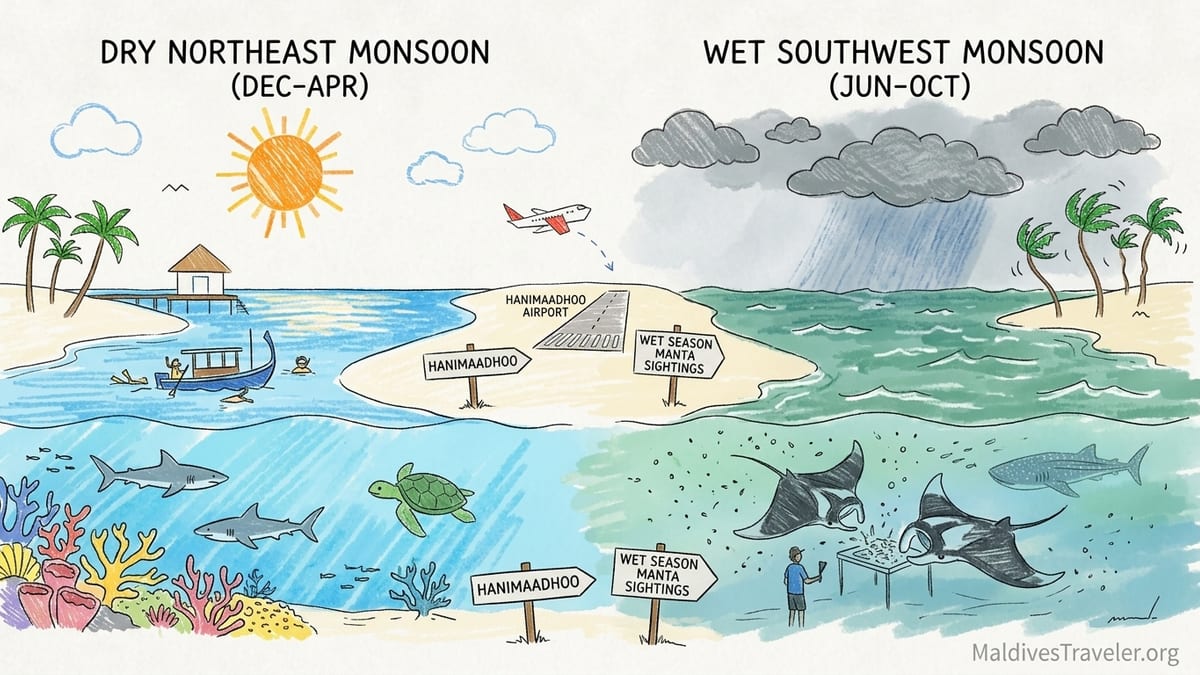
Understanding Haa Dhaalu’s Seasons and Monsoons
Haa Dhaalu Atoll sits in the northern Maldives, with Hanimaadhoo as its main gateway island and airport. Like the rest of the country, it follows a tropical monsoon rhythm, but local observations and guidance from Hanimaadhoo highlight that the northeast monsoon period is often drier here than in the central and southern atolls, with particularly good underwater visibility. Air temperatures stay warm and fairly stable all year, usually in the high 20s to low 30s Celsius, so what really changes by season is rainfall, wind, sea state and what you are likely to see underwater.
The Maldives has two broad monsoon patterns. The northeast monsoon, often called Iruvai, is the “dry” season and typically dominates from about December to April, although older climate summaries for Hanimaadhoo highlight January to March as the core dry window. The southwest monsoon, Hulhangu, runs roughly May to October, bringing more unsettled weather, cloud and rainfall, especially in the central and southern atolls. In Haa Dhaalu, the shift between these patterns is felt, but many travelers are surprised how often days still start and end with sunshine even in the wetter months.
For divers and snorkelers, the monsoon direction matters because it dictates how currents flow through the atoll channels and where plankton gathers. During the northeast monsoon, currents generally run from east to west, which tends to bring the clearest water to the eastern outer reefs and channels, while concentrating more plankton and filter-feeders toward western sides. During the southwest monsoon, that dynamic flips, favoring clearer water in the west but also increasing the overall plankton load in many areas. Manta rays and whale sharks follow this food, so their “high season” in a given area is often different from the peak visibility season.
Keeping these broad patterns in mind will help you weigh trade-offs. If you are planning a once-in-a-lifetime trip focused on photography and long-range visibility, you will likely prioritize the northeast monsoon window. If your dream is drifting along with mantas in slightly milkier water, the wetter months can be worth the occasional squall and choppier seas.
Dry Northeast Monsoon: December to April
The months from December to April line up with the classic dry season in the Maldives, and northern atolls like Haa Dhaalu often see some of the best conditions in the country at this time. Hanimaadhoo’s long-term climate data shows relatively lower rainfall and more sunshine in these months compared with the rest of the year, with many days offering blue skies, light winds and calm seas. On the beach, that translates to dependable sunbathing weather, soft evening breezes and minimal chance that your week-long stay is washed out by a stalled front.
Underwater, the northeast monsoon plays to Haa Dhaalu’s strengths. Dive operators on Hanimaadhoo and nearby islands describe this period as the clearest of the year, with visibility often stretching well beyond 25 to 30 meters on the better days. On the eastern side of the atoll, channel and outer-reef dives can feel almost crystalline, ideal for wide-angle photography, shark spotting and relaxed current dives. Local guidance specific to Hanimaadhoo notes that this drier northeast monsoon is when house reefs and nearshore profiles tend to look their best for both divers and snorkelers, with strong light penetration and brilliant reef colors.
For marine life, the dry season is not a guarantee of mantas on every dive, but it is a strong all-round window. Reef sharks, turtles and schooling fish patrol channel mouths and thilas, and it is common to see eagle rays sweeping along drop-offs. At sites closer to current-swept corners, grey reef and white-tip sharks are more likely. Manta encounters at cleaning stations can occur in this period, especially at specific sites that local guides keep in their rotation, but they are often less tightly “scheduled” than the well-publicized aggregations in central atolls. In practice, a week of diving in January or February in Haa Dhaalu might deliver one or two manta dives mixed into a roster of high-visibility reef and channel sites.
For pricing, this is peak tourist season across the Maldives, and rates in Haa Dhaalu generally follow the same pattern, though often from a lower base than high-profile atolls nearer Malé. At a locally focused eco resort on Hanimaadhoo, for instance, recent listings show early-September rates starting around 140 to 190 US dollars per night for two adults in a standard room, including taxes and fees. Those same rooms can climb notably from late December through March, both because of global holiday demand and the drier, calmer conditions. Liveaboards that pass through the northern atolls also tend to charge their higher seasonal rates in this window.
Shoulder Months: November and May
November and May act as transition months between the two monsoon regimes. Weather in Haa Dhaalu during these periods can be changeable, with sunnier spells punctuated by short-lived showers or thunderstorms, particularly in the afternoons. For many travelers, especially those who prefer a balance between price and conditions, these shoulder months offer compelling value. You are more likely to encounter the occasional grey day than in January or February, but full weeks of heavy rain are uncommon in the north.
Underwater, visibility in November and May can still be very good, though somewhat more variable than mid-season. You might wake up to 30-meter clear water one morning and then dive in slightly hazier 15 to 20-meter conditions the next after a night of wind and rain. Dive centers often use these months to adjust their daily site selection more dynamically, switching between eastern and western sides of the atoll to find the best combination of visibility and current direction. Snorkelers based on islands like Hanimaadhoo may notice more fine particles in the water column on some days, but house reefs remain attractive with adequate light and generally comfortable sea states.
For manta and other pelagic encounters, these months can be a pleasant wild card. As currents begin to shift at the end or the beginning of the dry season, plankton concentrations can spike in certain channels and bays, drawing in filters-feeders for a few weeks at a time. Guides in northern atolls often keep a close eye on where baitfish are schooling and where surface slicks form, and they may add impromptu manta or mobula dives to their schedules when conditions line up. Travelers who are flexible and willing to prioritize diving on short notice can benefit from these ephemeral windows.
On the pricing side, November (outside holiday weeks) and early May can be more affordable than the heart of the high season. A modest local-guesthouse stay on a Haa Dhaalu island might fall below 100 to 120 US dollars per night for a clean, en-suite double room, while four-star island resorts in the atoll typically undercut famous names in central atolls by a noticeable margin. International flights into Hanimaadhoo via Malé can also be a touch cheaper just before and after the busiest months, making these shoulders attractive for cost-conscious divers.
Southwest Monsoon: June to October
The southwest monsoon brings the Maldives’ wetter, windier season, and in Haa Dhaalu that means more passing showers, livelier seas and a generally more changeable sky from about June through October. Air temperatures remain warm, and many days offer a mix of sun and short downpours, but visitors need to be comfortable with the idea that a few mornings may be windy and overcast. For beach-focused travelers who dream of uninterrupted sunbathing, this is not the safest bet, but for divers and snorkelers there are real advantages.
As the southwest monsoon pumps more nutrient-rich water past the atolls, plankton levels in the water column rise. While this can reduce horizontal visibility compared with the dry season, it also fuels the food web that larger animals depend on. Dive operators across the Maldives often describe June to November as prime manta and, in some regions, whale shark season, particularly on current-exposed western sides of atolls. In northern atolls like Haa Dhaalu, local reports and long-term manta research indicate that mantas are more commonly seen at specific monsoon-facing sites during the northeast season, but there are still plenty of opportunities for encounters in the southwest months, especially where currents concentrate food in channels.
Practically, divers visiting Haa Dhaalu from June to October should expect more variable visibility, perhaps in the 10 to 20-meter range on some days, with surges of clearer water when wind drops. House-reef snorkeling can still be very rewarding, particularly for macro life, turtles and reef fish, but photographers seeking those classic blue-background scenes will want to keep expectations realistic. Boat rides between islands and outer reefs may also be bumpier, and operators sometimes shift to more sheltered inner-atoll sites on particularly rough days, which can slightly limit the range of available dive profiles.
The upside for many travelers is price. Resort and guesthouse rates in Haa Dhaalu generally fall through the southwest monsoon, and it is common to find packages that bundle accommodation with multi-day dive packages at a discount. A four-star island resort that might charge comfortably into the upper-mid-range bracket in January can become surprisingly attainable in July, especially for stays of a week or more. Local guesthouses on inhabited islands may include simple full-board meal plans and two-tank boat dives for daily totals that compete with or undercut daily room-only rates in central atolls.
Visibility, Currents and Where to Dive
Because currents in the Maldives are driven by monsoon winds and regional ocean flows, visibility in Haa Dhaalu is not uniform across the atoll. During the dry northeast monsoon, clearer oceanic water tends to sweep in from the east, so eastern outer reefs and entrances to channels often deliver the longest-range visibility. Dive briefings in this period might emphasize spectacular channel “in” dives on the eastern rim, timing entry for slack or incoming current so groups can ride gentle flows past overhangs, soft corals and schooling fusiliers under a clear, bright surface.
On the western side of Haa Dhaalu during the same period, you may find slightly hazier conditions but richer plankton levels, which can attract manta rays and other filter-feeding species at cleaning stations and sheltered bays. This is why some of the most reliable manta sites in the Maldives sit on the down-current side of atolls. A day might start with a high-visibility channel dive on the east, followed by an afternoon excursion to a known cleaning station in the west where guides watch for circling mantas above coral bommies, even though the water looks greener.
In the southwest monsoon, these patterns roughly reverse. Western entrances often clear out, making them better bets for long-range shark and pelagic spotting, while some eastern lagoons and channels become more plankton-rich. Experienced operators in Haa Dhaalu continually adjust their itineraries based on actual daily conditions rather than abstract seasonal charts, so it is helpful to book with a dive center that runs two or three boats and can split groups by experience level and goal. During a one-week stay in September, for example, you might spend two days diving relatively sheltered inner-atoll thilas with 15-meter visibility, then switch to a series of livelier outer-reef dives when the wind drops and currents align.
For snorkelers, house reefs remain the backbone of most experiences in Haa Dhaalu. Many local-island guesthouses and smaller resorts maintain simple entry ladders, marked channels through the shallow coral and daily guidance on ideal times to snorkel based on tide and current. In the northeast monsoon, this can mean almost aquarium-like conditions on calm evenings, while in the southwest season you may time sessions for mid-morning lulls in wind to enjoy the best combination of light and manageable surface chop.
Manta Encounters and Seasonal Expectations
Manta rays are a headline attraction across the Maldives, but their movements are strongly shaped by monsoon-driven plankton patterns and local topography. Research into manta distribution across the archipelago shows that northern atolls, including the broader region around Haa Dhaalu, can display a distinct seasonal pattern: mantas are more frequently reported at certain sites during the northeast monsoon, when visibility is also at its best, and become less common or deeper during the southwest season. That does not mean you will not see mantas in the wetter months, only that encounter reliability can shift with currents and food availability.
In practical terms, divers visiting Haa Dhaalu between roughly December and April may combine the best of both worlds: good to excellent visibility and a fair chance of manta encounters at particular cleaning stations. Dive operators on Hanimaadhoo and nearby resort islands typically schedule manta-focused trips only when recent sightings justify them, often returning to a favored submerged block or reef terrace where mantas circle to be cleaned. A typical outing might involve dropping in along the edge of a channel, settling at a respectful distance from the cleaning coral and waiting quietly as one or more mantas sweep overhead in the clear blue water.
During the southwest monsoon, manta behavior can become more dispersed in Haa Dhaalu, with animals sometimes favoring different depths or sites compared with the dry season. In some years, when plankton concentrations peak strongly along specific western channels, operators may enjoy short bursts of excellent manta activity, especially toward late August or September. In leaner years, mantas might be seen only occasionally on deep reef shoulders while divers focus more on sharks, jacks and macro subjects. Travelers who treat manta sightings as a bonus rather than a guarantee are more likely to come away satisfied.
If your absolute priority is maximizing the chance of witnessing a major manta aggregation, you may consider pairing a Haa Dhaalu stay with time in a central atoll known for seasonal feeding events, timing your trip for when overall Maldives manta activity peaks. However, if you prefer quieter sites, higher odds of unhurried encounters and less boat traffic, Haa Dhaalu during the northeast monsoon can be especially rewarding, even if the numbers of mantas at any one site are smaller.
Resort Pricing, Crowd Levels and Practical Planning
Compared with the high-density resort clusters around Malé, Haa Dhaalu still feels relatively low-key. There are only a handful of full-scale private-island resorts alongside local-island guesthouses, so even in peak season, beaches and dive boats rarely feel crowded. The trade-off is a slightly longer journey: most travelers fly into Malé, then connect onward by domestic flight to Hanimaadhoo, or occasionally by seaplane to a resort island when schedules allow. Seasonal demand can influence both legs of this journey, which is worth factoring into timing and budget.
In terms of pricing, peak tourist months from late December through March generally bring the highest nightly rates. A four-star eco-oriented resort on Hanimaadhoo that might start around the mid-100 US dollar range for a September night for two can rise significantly around Christmas, New Year and school holiday periods. Another island resort in Haa Dhaalu positioned as a classic barefoot-luxury escape may routinely sit in the upper mid-range bracket in high season, with entry-level beach villas priced to reflect the limited inventory and better weather. These are broad patterns rather than fixed numbers, so it is wise to check several dates and accommodation types before locking in flights.
Outside the core dry-season months, particularly from June to early October, Haa Dhaalu offers more scope for value. Many resorts quietly roll out stay-longer deals, complimentary domestic transfers for week-long bookings or bundled dive packages that effectively reduce per-day costs. Local guesthouses may offer full-board stays with basic but hearty Maldivian and international meals, plus discounted snorkel or dive excursions, making a multi-week stay in the atoll surprisingly attainable compared with short, intensive trips elsewhere.
From a crowd perspective, the northeast monsoon is busier across the country, but Haa Dhaalu’s limited beds mean boats rarely feel overloaded. Even so, if you are set on specific room types such as beachfront family units or overwater villas, it pays to book several months ahead for January and February stays. In the wetter months, more last-minute flexibility is possible, and you may be able to choose between different islands based on which dive center’s weekly schedule or training options appeal most.
The Takeaway
Haa Dhaalu Atoll rewards travelers who think seasonally. The drier northeast monsoon from about December to April usually brings the most reliable beach weather, the calmest seas and the longest underwater visibility, especially around Hanimaadhoo and the atoll’s eastern channels. It is the premium window for photographers, new divers and anyone who values clear-blue vistas above all else, though it also carries higher accommodation prices and airfares.
The shoulder months of November and May bridge the gap between monsoons, often offering a mix of sunshine and showers, good but changeable visibility and more moderate pricing. Divers and snorkelers who are willing to accept a bit of weather uncertainty can be rewarded with quieter sites and some of the most interesting currents of the year, as plankton and baitfish shift with the changing winds.
From June to October, the southwest monsoon brings more unsettled skies and softer rates, but also fuels the plankton blooms that support manta rays and other megafauna. Visibility may drop on some days, and boat rides can feel rougher, yet those who prioritize encounters over postcard-perfect conditions often find this trade-off worthwhile. Across all seasons, local guidance from Hanimaadhoo underscores the advantage of the northeast monsoon for visibility, while reminding visitors that wildlife encounters are never guaranteed and vary by site and month.
Ultimately, the “best” time to visit Haa Dhaalu depends on your priorities. If you want long, dry days and clear, calm seas, aim for the heart of the northeast monsoon. If you are chasing mantas and happy to accept moodier skies and milkier water, the wetter months can be where the magic happens. Either way, planning with the atoll’s seasonal rhythms in mind will help you make the most of this quieter corner of the Maldives.
FAQ
Q1. When is the absolute best month to visit Haa Dhaalu Atoll for weather?
For the most reliably dry, sunny conditions, many travelers target January or February, when the northeast monsoon is well established and seas around Haa Dhaalu are typically calm.
Q2. Which months offer the clearest diving visibility in Haa Dhaalu?
Visibility is often best from about December to April, with local guidance from Hanimaadhoo highlighting particularly clear water during the core northeast monsoon months of January to March.
Q3. Is Haa Dhaalu good for manta rays, or should I focus on other atolls?
Haa Dhaalu does see mantas, especially at specific sites influenced by the monsoon, but encounters are less predictable than in some central atolls. It is best to treat mantas as a likely bonus rather than the sole reason to visit.
Q4. Are resort prices much higher in the dry season?
Yes, rates generally peak from late December through March. A room category that might start in the mid-100 US dollar range in September can cost noticeably more during Christmas, New Year and school holidays.
Q5. Is it worth visiting Haa Dhaalu during the southwest monsoon?
It can be very rewarding if you are flexible. You may encounter more rain and choppy seas, but you will often find better prices, quieter islands and rich marine life supported by higher plankton levels.
Q6. How many days should I spend in Haa Dhaalu if I want to dive a lot?
A stay of 7 to 10 nights works well for divers, giving time to experience both inner-atoll thilas and outer-reef channels, with some weather contingency in case a few days are too rough for longer boat rides.
Q7. Is snorkeling from the beach good year-round?
Snorkeling is possible year-round, but conditions are most consistently calm and clear in the northeast monsoon. In the wetter months, you may need to time outings around wind and tide to avoid surface chop.
Q8. Do I need to book far in advance for high season?
For January to March, especially if you want specific room types or family units, booking several months ahead is wise. In the low and shoulder seasons, there is usually more last-minute flexibility.
Q9. Are there strong currents that beginners should worry about?
Some channel and outer-reef dives can have strong currents, particularly when currents peak in the monsoon. Beginners usually start on more sheltered house reefs and inner thilas, guided by local instructors who choose sites to match experience.
Q10. How does Haa Dhaalu compare with central atolls for crowds?
Haa Dhaalu is generally much quieter than the busy atolls near Malé. There are fewer resorts and liveaboards, so even in peak season, dive sites and beaches typically feel less crowded.