


Haa Dhaalu Atoll in the far north of the Maldives feels like a different country from the glossy resort ring around Male. Flights now connect directly into Hanimaadhoo and Kulhudhuffushi, local guesthouses are quietly multiplying, and boat captains are increasingly happy to run sandbank picnics and dolphin trips for independent travelers. Yet the atoll remains low-key and a little raw around the edges, which means choosing the right base matters far more here than in the central atolls. This guide compares Hanimaadhoo, Kulhudhuffushi, Nolhivaranfaru, the resort island of Hondaafushi and the remote Makunudhoo area, so you can match your island to your travel style rather than trying to “do it all” in one place.
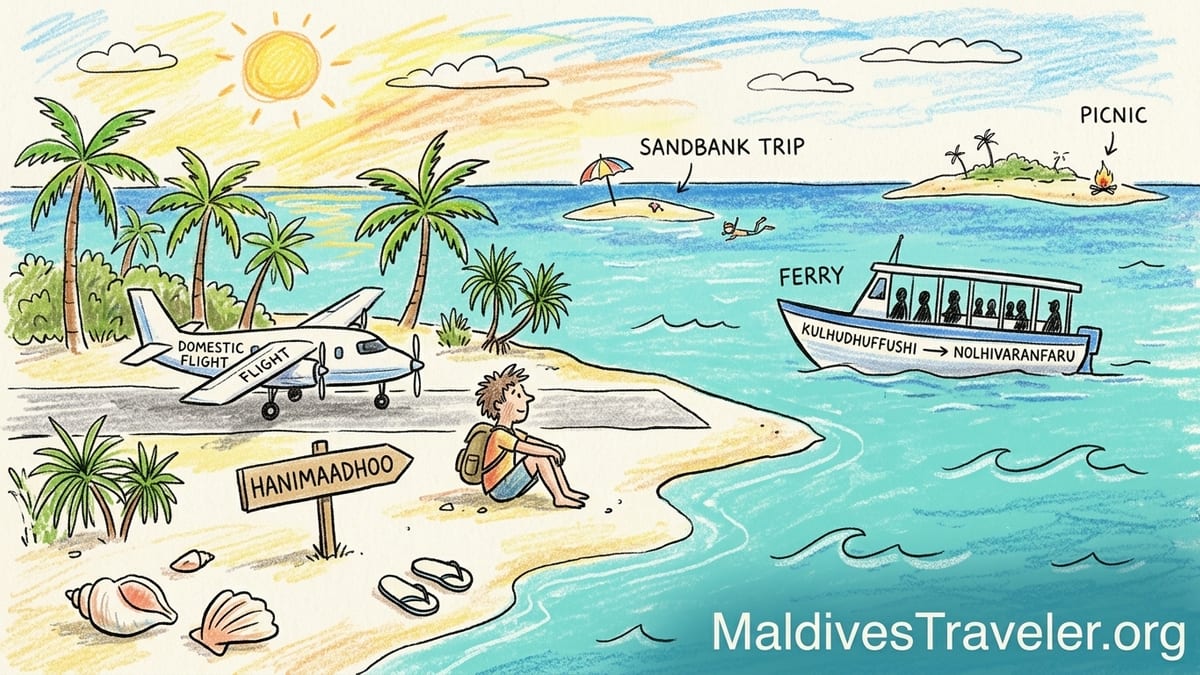
How Haa Dhaalu Atoll Works for Independent Travelers
Haa Dhaalu sits in the deep north of the Maldives, more than 280 kilometers from Male. For most visitors, it functions as a small network of distinct hubs rather than a single, easy-to-hop atoll. Hanimaadhoo and Kulhudhuffushi both have domestic airports with multiple daily flights from Male, and Hanimaadhoo also receives periodic regional flights from India and Sri Lanka. From these two gateways, you move onward by scheduled MTCC ferries or chartered speedboats to quieter islands such as Nolhivaranfaru or Makunudhoo.
Unlike the resort-dominated central atolls, Haa Dhaalu still leans toward local-island tourism. Hanimaadhoo now has a small hotel scene, including The Barefoot Eco Hotel on the northern shore, several independent guesthouses and a PADI dive center offering boat trips to outer reefs and manta cleaning stations. Kulhudhuffushi feels more like a regional capital, with banks, a hospital and cafes lining the harbor. Nearby Nolhivaranfaru has only a handful of guesthouses, while Makunudhoo sits on its own mini atoll on the western fringe and feels almost off the grid.
In practical terms, this means that sandbank and dolphin excursions, uninhabited-island barbecues and multi-dive packages are all possible, but your access and pricing will depend heavily on where you stay. On larger islands such as Hanimaadhoo, competition between operators can keep a half-day snorkeling trip around 40 to 60 US dollars per person if you join a shared boat, slightly more for small private charters. On Nolhivaranfaru or Makunudhoo, you are more likely to arrange custom outings through your guesthouse and pay per boat rather than per seat.
Think of Haa Dhaalu as a toolbox. Each island contributes something different: Hanimaadhoo brings infrastructure and reefs, Kulhudhuffushi brings urban life and services, Nolhivaranfaru brings quiet and community, Hondaafushi brings private-resort beaches when it is operating, and Makunudhoo brings isolation. The art is in combining one or two of these rather than expecting a single island to tick every box.
Hanimaadhoo: Best All-Rounder for Beaches, Reefs and Logistics
If you want the northern Maldives in one island, Hanimaadhoo is still the most versatile base. The runway of Hanimaadhoo International Airport runs along the southern edge of the island, which means you can be on the beach within minutes of landing. Domestic flights from Male take around 45 minutes, and tour operators for nearby resorts like Hideaway Beach routinely route their guests through Hanimaadhoo, a sign of how central it has become in the regional network.
Beaches here are long, walkable and, by Maldivian standards, lightly developed. The main tourist stretch near The Barefoot Eco Hotel fronts a calm lagoon with house-reef snorkeling a few fin-kicks from shore, and smaller bikini beaches are signposted near independent guesthouses on the western side. Away from the designated swim areas, you are often alone with the sand and pandanus trees, especially in the early morning when locals are cycling to work and the reef is at its clearest.
Hanimaadhoo is also the strongest hub in Haa Dhaalu for organized water activities. A dedicated PADI center on the island runs daily boat dives to channel walls and thilas in the outer atoll, including spots where mantas and, in the right season, whale sharks have been recorded. A two-dive boat trip typically costs in the region of 120 to 180 US dollars including equipment, with discounts for multi-day packages. For non-divers, most guesthouses can arrange half-day snorkeling safaris to nearby reefs, sunset dolphin cruises and sandbank picnics that combine swimming in waist-deep turquoise water with simple grilled fish lunches under a sunshade.
Beyond the water, Hanimaadhoo’s size and services make it easy to stay longer. There is a health center, small supermarkets, a fuel station, several local cafes and even a climate observatory, so you are never far from cash machines or a pharmacy. For a week-long trip that mixes beach time, a couple of dive days and perhaps a day-trip to another island, Hanimaadhoo works well as a single base. For most travelers, it is the best first stop in Haa Dhaalu, especially after a long-haul flight into Male.
Kulhudhuffushi: Everyday North-Maldives Life and Regional Services
Kulhudhuffushi, often shortened to Kulhudhuhfushi or Kulhudhuffushi City, feels very different from Hanimaadhoo. It is the administrative and commercial center of Haa Dhaalu, with its own domestic airport, a busy harbor and the bulk of the atoll’s public services. Ferries from more remote islands, including Makunudhoo, typically funnel through here several times a week, and the island’s streets are lined with hardware shops, phone stores, bakeries and small restaurants rather than palm-fringed boutique hotels.
For travelers, that urban character is precisely the appeal. If you are curious about daily life in the far north, Kulhudhuffushi delivers it in concentrated form. You can sit at a harborfront cafe drinking black tea and eating mashuni flatbread alongside port workers, watch schoolchildren stream out of class in the afternoon, or wander residential lanes where boats are being repaired in sandy front yards. Modest guesthouses operate on the island, drawing a mix of domestic business travelers and a smaller number of foreign visitors who prefer local color over lagoon views.
Beaches are not Kulhudhuffushi’s strongest suit. The island has small swimming areas and reclaimed shoreline, but you do not come here purely for sunbathing. Instead, think of Kulhudhuffushi as your practical hub: somewhere to buy a local SIM card, withdraw cash from a bank ATM, or see a doctor at the regional hospital before heading out to a quieter island. Prices in local eateries can be significantly lower than resort buffets or even tourist-focused cafes on other islands, with generous plates of fried rice or noodles often under 5 to 8 US dollars.
In terms of excursions, Kulhudhuffushi sits within speedboat reach of several uninhabited islands and sandbanks dotted across the central part of the atoll. Some guesthouses cooperate with Hanimaadhoo-based operators to run dolphin cruises that depart Kulhudhuffushi’s harbor in the late afternoon, giving you a front-row seat to spinner dolphins surfing the bow waves as the sun drops behind the boats. If you build your trip around longer stays on quieter islands, it is worth factoring in one or two nights in Kulhudhuffushi at the beginning or end of your itinerary to take advantage of the services and straightforward flight connections.
Nolhivaranfaru: Quiet Guesthouse Travel and Community Feel
Nolhivaranfaru is an inhabited island in the eastern part of Haa Dhaalu, geographically part of the wider Thiladhummathi region. On the map it looks unremarkable compared with more famous resort islands, but that is its selling point. There are only a handful of licensed guesthouses here, including small properties like Fanhaa Guest House and Nolhi Escape, and international tour operators rarely feature the island in their standard packages. As a result, you are likely to share the bikini beach with just a few other visitors, even in the dry season.
Reaching Nolhivaranfaru usually involves a domestic flight into Hanimaadhoo or Kulhudhuffushi followed by a transfer by local ferry or chartered speedboat, arranged through your guesthouse. The journey adds time, but it subtly changes the mood of your trip. Once you arrive, everything runs on island time. You wake to the call to prayer, hear roosters competing with mynas in the coconut palms, and see local families heading to the harbor for evening strolls. Guesthouses are typically small, with around five to ten rooms, and staff are often from the island itself.
The quieter pace does not mean you have to forego classic Maldivian experiences. Guesthouse owners will usually know a handful of trusted boat captains who can take you to nearby sandbanks or uninhabited islands for a few hours of swimming and snorkeling. Instead of browsing a tour desk, you will discuss options over breakfast: perhaps a half-day reef trip for around 40 to 70 US dollars per person if enough guests sign up, or a private boat priced by the hour. A common pattern is to spend the morning on a sand spit that emerges at low tide, then grill fish on a neighboring uninhabited island before drifting back as the light softens.
For divers, Nolhivaranfaru is less of a standalone hub than Hanimaadhoo, but it can still work if you coordinate with dive centers elsewhere in the atoll. Some operators based on Hanimaadhoo or at nearby high-end resorts occasionally pick up guests from Nolhivaranfaru by arrangement when they are diving sites in that sector of the atoll, although this is not guaranteed. In most cases, snorkeling, line fishing and dolphin watching will be your main water activities, and the reward is the chance to do them with very few boats around.
Hondaafushi: Private-Resort Style Beaches When Operating
Hondaafushi Island in Haa Dhaalu has historically been developed as a standalone resort, separated from neighboring local islands by its own lagoon and sandbanks. When the resort is operating, it offers the classic Maldivian formula of over-water and beach villas, an all-inclusive meal plan and a roster of excursions: house-reef snorkeling, boat dives, dolphin cruises and full-day sandbank picnics complete with sun umbrellas and barbecue lunches. Access is typically via domestic flight to Hanimaadhoo followed by a short speedboat ride organized directly by the resort.
Because resort openings and closures in the Maldives can fluctuate, Hondaafushi is best treated as an option to check at the planning stage rather than a guaranteed choice. Historically, industry reports have noted periods where Hondaafushi had no firm reopening date for a given year, so you should always verify its current operational status directly with the property or through a reputable agent before locking in flights. If it is closed or under renovation in the season you plan to travel, consider alternative resort islands in neighboring atolls and use Hanimaadhoo as your local-island base instead.
When Hondaafushi is welcoming guests, the main advantage over local islands is convenience. Everything, from your airport transfer to your dolphin cruise, is bundled through one reservations team. A typical half-day trip to a nearby uninhabited island might be priced higher than similar outings booked via guesthouses, but it will include staff, equipment and catering. Many travelers choose a split stay, with four or five nights on Hondaafushi for the private-resort setting and a further three or four nights on Hanimaadhoo or Nolhivaranfaru to experience village life and reduce overall costs.
Keep in mind that resort islands like Hondaafushi are self-contained. You will not be able to wander into a local town for evening tea or hop on a public ferry from the resort jetty. If you crave complete quiet, curated beaches and a structured activity schedule, Hondaafushi fits the bill in the years it operates. If you want spontaneity and local food stalls, you are better off basing yourself on Hanimaadhoo or Nolhivaranfaru and visiting resort islands, where permitted, as paid day guests.
Makunudhoo and Dhipparufushi: Edge-of-the-Map Isolation
At the extreme western edge of Haa Dhaalu lies Makunudhoo, the only inhabited island of its own small sub-atoll, sometimes referred to as Māmakunudhoo or Malcolm Atoll. Reaching it is a journey in itself. According to recent ferry timetables, Makunudhoo is connected by MTCC services that run several times a week to Kulhudhuffushi, often taking many hours and departing early in the morning. Sea conditions can be rough, and schedules are more vulnerable to weather disruption here than in the sheltered central atolls.
For the right traveler, that isolation is a feature, not a bug. Makunudhoo feels like a frontier island, closer to the open Indian Ocean than to the resort chains of Baa Atoll. Accommodation is limited to very small guesthouses, and there are no large hotels or branded dive centers. You visit to disappear into a fishing community and spend long days exploring beaches that see almost no outside visitors. The lagoon is wilder and deeper in color, and beyond the reef the seafloor drops away quickly, making it a compelling region for experienced divers and big-animal enthusiasts who can arrange charters.
Uninhabited islands in this western mini atoll, including low-lying sand cays such as Dhipparufushi, are reachable only by private boat. There is no shared excursion desk or daily schedule of dolphin cruises. Instead, you work with your guesthouse host or a local boat owner to plan a day around the tides and the wind. A realistic day out might see you motoring an hour or more across blue water, landing on a sandbar that barely rises above the sea, snorkeling in clear shallows, then fishing on the drop-off at sunset on the way back. Costs are typically quoted per boat and can be comparable to, or higher than, organized excursions near Hanimaadhoo because of the fuel involved.
Makunudhoo and its neighboring sand islands suit self-sufficient travelers comfortable with unpredictability. There may be days when strong winds make outer-reef snorkeling unsafe or ferries do not sail. There is no nightlife beyond the harborfront where fishermen mend nets, and you will likely eat most meals in your guesthouse or at the same couple of local cafes. In exchange, you get an atoll edge that still feels like an expedition, even in a country better known for polished over-water villas.
Choosing Your Base: Matching Islands to Traveler Types
Instead of asking which island is “best,” it is more helpful to ask what kind of trip you want and how comfortable you are with remote logistics. If you are new to the Maldives or traveling with children, Hanimaadhoo is usually the safest choice. You get an airport on the same island, walkable beaches, a choice of guesthouses and hotel-style properties, and straightforward access to diving, snorkeling and sandbank trips, all without relying on distant ferries. A family of four might split a week between relaxed days on the house reef and two or three organized outings, keeping the budget controlled by eating at local cafes rather than hotel restaurants.
If you are curious about the social fabric of the north, plan at least a night or two in Kulhudhuffushi. Use it as your administrative stop: sort cash and SIM cards, buy any forgotten items and wander the harbor to see how goods flow through the region. Photography enthusiasts will appreciate the contrast between Kulhudhuffushi’s working waterfront and the empty beaches of Hanimaadhoo or Nolhivaranfaru, and food-minded travelers can sample Maldivian short eats in simple cafes that cater mainly to locals.
For couples or solo travelers seeking quiet without pushing into full isolation, Nolhivaranfaru offers a middle ground. With only a few guesthouses and a very local feel, it rewards slow travel: reading in the shade between swims, chatting to your hosts about fishing seasons, and joining occasional group excursions to reefs or sandbanks. You will likely spend a bit more time arranging things in person rather than clicking “book now,” but the upside is flexibility. It is not unusual for a guesthouse to improvise a dolphin-watching run if several guests ask at dinner.
Only a subset of visitors should consider Hondaafushi or Makunudhoo as primary bases. Hondaafushi works when you want a plug-and-play private-resort interlude and are willing to verify operational status, while Makunudhoo is for travelers who enjoy long ferries, sparse infrastructure and the feeling of being at the edge of the chart. In many itineraries, these two are best woven into a broader route: for example, two nights in Kulhudhuffushi, four in Hanimaadhoo, then three in Makunudhoo, giving you a gradient from services to solitude.
Planning Sandbanks, Reefs, Dolphins and Uninhabited Islands
Across Haa Dhaalu, the classic Maldivian experiences remain consistent: sandbank picnics, reef snorkeling or diving, dolphin cruises and visits to uninhabited islands where your boat is the only one on the horizon. What changes by island is how easy they are to arrange and how predictable the schedules are. On Hanimaadhoo, a typical week might see a published rotation of outings from larger guesthouses and dive centers: manta-focused dives on Monday, full-day snorkeling on Wednesday, sunset fishing and dolphin cruise on Friday. You can usually join a group trip as a solo traveler and pay on a per-person basis.
On Nolhivaranfaru or Makunudhoo, think more in terms of bespoke outings. If there are not enough guests to share costs, the boat may only go if you are willing to charter it privately. This can still be good value if you split the price among friends, but it makes advance budgeting trickier. Tides also matter. The classic postcard sandbank experience, with a long curving spit of exposed sand, only appears for a few hours around low tide, and on days with higher sea levels the bank may be submerged. Plan some flexibility so you can slot a sandbank trip into a day with cooperative conditions rather than a fixed date.
Dolphin cruises are a highlight throughout the atoll, especially in channels where spinner dolphins travel at dawn and dusk. Boat captains on Hanimaadhoo and Kulhudhuffushi know the regular routes, and success rates are generally high, although never guaranteed. A typical outing lasts two hours and may combine dolphin spotting with a short swim stop. For reef excursions, clarity is often best in the dry season from roughly December to April, but it is still possible to snorkel in the rainy months, particularly on the protected sides of the islands. When arranging any sea trip, ask about life jackets, communication equipment and whether your operator cancels in unsafe conditions.
Uninhabited-island visits in Haa Dhaalu have a different flavor than in the crowded atolls near Male. You are more likely to be alone on a tiny vegetated isle, hearing only the surf and the hiss of the grill, than sharing the space with multiple excursion boats. Simple facilities mean you should bring everything you need: drinking water, shade, reef-safe sunscreen and a dry bag for cameras. Work closely with your guesthouse to understand local customs, including appropriate dress when passing inhabited islands and rules on leaving no trace.
The Takeaway
Haa Dhaalu Atoll rewards travelers who treat it as a small constellation of contrasting islands rather than a single homogeneous destination. Hanimaadhoo is your all-rounder, blending beaches, reefs and practical infrastructure. Kulhudhuffushi is the working heart, where ferries dock and daily life in the north plays out in front of you. Nolhivaranfaru is the quiet village stay, ideal for low-key days and intimate excursions. Hondaafushi, when open, offers a sealed private-resort world, while Makunudhoo and its neighboring sand islets promise edge-of-the-map solitude for those willing to endure long boat rides.
If you match your base island to your priorities, you can keep logistics smooth and still access the experiences that make the Maldives iconic: drifting over bright coral, watching dolphins arc in the wake of your boat, standing barefoot on a sandbank with water on every side. In Haa Dhaalu, those moments come with fewer crowds and a more local accent. With a little planning and realistic expectations around ferries and weather, the far north can feel like the Maldives before mass tourism, without giving up the comforts most travelers now expect.
FAQ
Q1. How do I get to Haa Dhaalu Atoll from Male?
Most travelers fly from Male to either Hanimaadhoo or Kulhudhuffushi on a 45 to 60 minute domestic flight, then transfer by short taxi or boat to their chosen island. Some regional flights from India and Sri Lanka also land directly at Hanimaadhoo on selected days.
Q2. Which island in Haa Dhaalu is best for a first-time visitor?
Hanimaadhoo is usually the best starting point thanks to its on-island airport, good beaches, established guesthouses and hotel-style options, plus easy access to diving, snorkeling and sandbank trips.
Q3. Can I visit multiple islands in Haa Dhaalu on one trip?
Yes, but you need to plan carefully around ferry and speedboat schedules. A realistic route for a 10 to 12 day trip might combine Hanimaadhoo, Kulhudhuffushi and either Nolhivaranfaru or Makunudhoo, using domestic flights at the beginning and end.
Q4. Is Hondaafushi currently open as a resort island?
Resort operations on Hondaafushi have varied in recent years, so you should always confirm its current status directly with the property or a trusted agent before booking flights or building your itinerary around it.
Q5. Where is the best place in Haa Dhaalu for diving?
Hanimaadhoo has the most consistent dive infrastructure, including a PADI center running regular boat dives to outer-reef thilas and channels. Serious divers sometimes base on Hanimaadhoo and arrange additional dives by boat in other parts of the atoll.
Q6. Are sandbank and uninhabited-island trips available from all islands?
They are commonly arranged from Hanimaadhoo and Kulhudhuffushi and can usually be organized from Nolhivaranfaru and Makunudhoo via local boat owners. Availability depends on weather, tides and whether enough guests share the cost.
Q7. What should I budget for excursions in Haa Dhaalu?
As a rough guide, shared half-day snorkeling or dolphin trips often run around 40 to 60 US dollars per person from larger islands, while private boat charters to remote sandbanks or uninhabited islands can cost more, especially around Makunudhoo where distances are longer.
Q8. Is Haa Dhaalu suitable for families with children?
Yes, particularly Hanimaadhoo, which has easy logistics, gentle lagoon beaches and more services. Families should choose guesthouses or hotels with clear information on safety equipment and child-friendly activities.
Q9. What is the best time of year to visit Haa Dhaalu?
The drier, calmer months from roughly December to April usually offer better visibility for snorkeling and diving and smoother sea conditions. Travel in other months is still possible but may involve more rain and occasional boat disruptions.
Q10. Can I drink alcohol on these islands?
On inhabited local islands such as Hanimaadhoo, Kulhudhuffushi and Nolhivaranfaru, alcohol is generally not available due to Maldivian law. If Hondaafushi is operating as a resort, it may serve alcohol to guests under resort licensing rules.