


Haa Dhaalu Atoll in the far north of the Maldives remains largely off the mainstream tourism radar, yet it now offers almost every type of Maldivian stay: city hotels, barefoot local-island guesthouses, classic resort seclusion and one of the country’s most exclusive private-island escapes. The challenge for travelers is not finding somewhere to sleep, but choosing the right style of holiday before they ever start comparing room photos and breakfast menus. This guide breaks down the main options island by island to help you decide where in Haa Dhaalu to base yourself.
How Haa Dhaalu Atoll Works: Local Islands, City Hub and Resorts
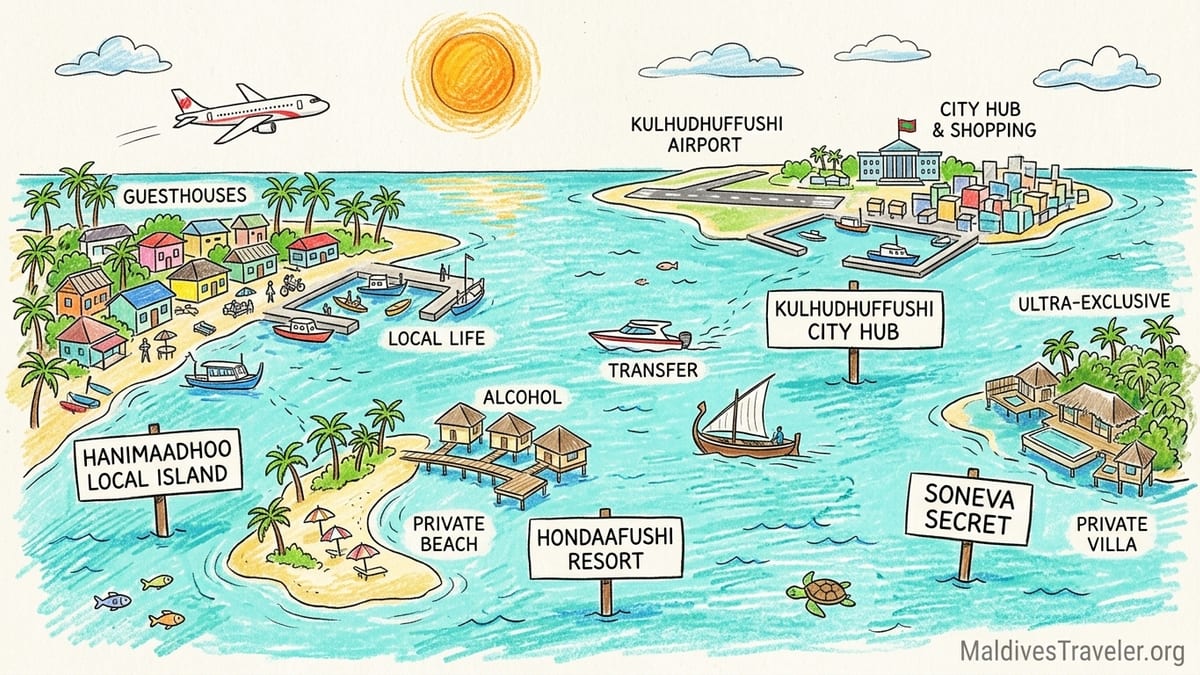
Haa Dhaalu sits in the northern Maldives and feels very different to the famous resort atolls around Malé. It has two airports: Hanimaadhoo, an international and domestic hub, and Kulhudhuffushi, a domestic city airport. Most visitors arrive at Malé and connect north by domestic flight in about 45 to 60 minutes, then transfer again by speedboat to their island or resort. The atoll’s geography means you can mix and match: spend a few nights on a local island like Hanimaadhoo or Nolhivaranfaru, then move to a private island such as Hondaafushi or Soneva Secret.
Unlike the central atolls where almost every island is a resort, Haa Dhaalu still has only a handful of private islands open to international visitors and a small but growing local-guesthouse scene. Hanimaadhoo offers the widest choice of hotels and guesthouses right by the airport. Nolhivaranfaru is a quieter, more traditional island with a handful of guesthouses. Kulhudhuffushi functions as the atoll’s city, with basic hotels, government services and stores. Hondaafushi is a conventional resort island with familiar meal plans and beach villas, while Dhipparufushi hosts Soneva Secret, a 14-villa ultra-luxury hideaway.
Before you book anything, it helps to decide what type of Maldives you want. Do you want alcohol, total beach seclusion and all-inclusive meals, or are you curious about local life, happy with simple comfort and willing to follow local culture rules? The answer to that question is usually what sends people to either a resort like Hondaafushi or Soneva Secret, or to a local island base such as Hanimaadhoo or Nolhivaranfaru.
Hanimaadhoo: Easiest Access and Most Developed Local-Island Choice
Hanimaadhoo is the atoll’s main gateway, home to Hanimaadhoo International Airport and several established local-island hotels and guesthouses. Flights from Malé are frequent, and there are also periodic international services operated seasonally from regional hubs. For travelers who dislike long boat rides, this is the most convenient base: you land, collect your bags and are often at your guesthouse within 10 to 15 minutes by car or a short transfer arranged by your host.
The island has a string of beachside properties ranging from simple guesthouses like Fanhaa Guest House and Himeyn Beach Retreat to more polished options that market themselves as boutique hotels. Nightly rates typically start around the lower three-figure range in US dollars for a comfortable double room including breakfast, often well below what you would pay at a resort island. Many stays include bicycles, kayaks and snorkel gear, which keeps activity costs down, and guesthouse teams can arrange half-day snorkeling trips, sandbank picnics or dolphin cruises at per-person prices that are modest by Maldivian resort standards.
Because Hanimaadhoo is a local island, alcohol is not served in village cafes or guesthouse dining rooms. Some operators partner with offshore “floating bars” moored outside the island’s reef, reachable by short boat trip, where alcohol can be purchased and consumed. If having a glass of wine with dinner on the beach is essential every night, a full resort island might suit you better. Dress expectations are also different: bikinis and swimwear are usually restricted to designated tourist beaches, while modest clothing is required when you walk through the village or visit shops and mosques.
Diving and excursions are a major reason to choose Hanimaadhoo. Small dive centers work with local boats to access nearby reefs and channels, and you can arrange everything from introductory dives to multi-day packages. It is a practical base for exploring multiple sites around the northern atolls because you are already at the airport and can transfer quickly to liveaboards or onward flights. If you like the idea of a flexible, budget-conscious holiday where you can add activities as you go and still get a broad beach and reasonable privacy on designated tourist stretches, Hanimaadhoo is usually the best starting point.
Nolhivaranfaru: Small-Scale Guesthouses and Quieter Island Life
Nolhivaranfaru, west of Hanimaadhoo, feels more low-key and intimate. The island supports only a handful of guesthouses, such as Nolhi Escape, Medhufaru Guest House and newer properties like Ocean Voice Beach Guesthouse. Rooms here are typically simple but air-conditioned, with en-suite bathrooms and home-style meals. Prices are similar to or slightly below Hanimaadhoo, sometimes dipping into the high two-figure range per night for basic stays outside peak holiday dates.
The main appeal of Nolhivaranfaru is its atmosphere. With fewer visitors, beaches can feel pleasantly empty, especially outside local school holiday periods. You will likely recognize the same faces at breakfast and on the beach each day, and owners often live on-site or nearby. It is the sort of place where staff will remember your coffee order after the first morning and spontaneously invite you to watch a boduberu drumming practice or a local football match in the evening.
As a local island, Nolhivaranfaru follows Maldivian law on alcohol and dress. There is no alcohol served on the island, and swimwear is again limited to agreed tourist or bikini-beach stretches. In practice, this often means one side of the island is quietly set aside for guests, where you can sunbathe and swim in normal beachwear, while the village side is reserved for everyday life. If you are happy to respect those boundaries, the reward is a peaceful, authentic setting and lower overall costs.
Diving and excursions from Nolhivaranfaru are usually arranged through your guesthouse rather than through large dive shops. A typical day might involve a morning snorkel trip to a nearby reef where you have a high chance of spotting turtles and reef sharks, followed by a sandbank picnic and sunset fishing. Transfers are slightly more involved than Hanimaadhoo: you will generally fly into Hanimaadhoo or Kulhudhuffushi and take a scheduled or chartered speedboat, which guesthouses can arrange in advance. If you like the idea of a quiet community island with just enough tourism to support basic services, Nolhivaranfaru is a strong candidate.
Kulhudhuffushi: City Convenience, Shopping and Transit Hub
Kulhudhuffushi is the capital and economic center of Haa Dhaalu Atoll, a genuine Maldivian city rather than a beach resort. It has its own domestic airport, opened in 2019, regular ferries and speedboats, a large harbor, hospital, banks and government offices. Stays here tend to be in small city hotels, serviced apartments and guesthouses scattered through residential streets, including options like Haajy Guesthouse, Bahee Residence and other simple lodgings listed on local tourism sites and booking platforms.
Travelers usually choose Kulhudhuffushi for practical reasons. It is the logical overnight stop if you are arriving late on a domestic flight and connecting the next day to a resort or local island, or if you are visiting friends, family or doing business in the north. Room rates are typically friendly, comparable to local-island guesthouses, and you gain access to city-level amenities: supermarkets where you can stock up on snacks and sunscreen at local prices, hardware and electronics stores, and a wider variety of cafes and restaurants serving Maldivian, Indian and simple Western-style dishes.
The trade-off is that you are not coming here primarily for barefoot beach life. While there are shoreline areas and small swimming spots, beach privacy is limited, and urban noise from motorbikes, harbor traffic and construction is part of the experience. Alcohol is not available in town, and dress is conservative throughout, since there are no designated tourist or bikini beaches. For many visitors this is a one- or two-night base rather than a full holiday, though some slow travelers enjoy staying longer to experience daily life in a northern Maldivian city.
Diving and excursions can be arranged from Kulhudhuffushi but are less central to the city’s identity. You may find small operators offering fishing charters or reef trips that leave from the harbor. However, if diving is a priority, it is usually more efficient to base yourself on Hanimaadhoo or a resort. Think of Kulhudhuffushi as the northern Maldives’ transport and services hub: very useful in a multi-stop itinerary but rarely the star attraction in its own right.
Hondaafushi Island Resort: Classic Private-Island Experience
Hondaafushi Island Resort sits on its own island in Haa Dhaalu and offers what many people picture when they imagine a Maldivian holiday: soft white sand beaches, overwater or beachfront villas, and a self-contained resort environment. Guests typically reach Hondaafushi via a domestic flight to Hanimaadhoo followed by a speedboat transfer arranged by the resort. Exact timings and prices vary, but you should expect to pay a significant per-person transfer fee on top of your room rate, similar to other Maldivian resorts.
Unlike local islands, private resorts like Hondaafushi can legally serve alcohol. That means sunset cocktails by the pool, wine-pairing dinners and drinks in the bar are straightforward parts of the experience. Dress codes are relaxed within the resort, and you can wear swimwear at the pool, on the beach and between your villa and common areas without worrying about village customs. For many honeymooners and couples celebrating a special occasion, this freedom is one of the main reasons to choose a resort.
Hondaafushi offers the usual Maldivian mix of meal plans: breakfast only, half-board, full-board and in some seasons all-inclusive. An all-inclusive package might bundle three meals a day with select drinks and non-motorized water sports, while still charging extra for premium alcohol, diving and motorized activities like jet skis. While exact prices fluctuate, nightly rates for beachfront villas generally start in the mid-range of Maldivian resort pricing and rise for overwater categories and peak dates such as December and January. Once you are on the island, almost all spending happens in resort currency, so Hondaafushi suits travelers who like having costs predictable and contained.
Diving here is typically run by an in-house dive center, with two-tank morning dives, night dives and courses available. Being in a less-developed tourism atoll can mean quieter dive sites, with a good chance of seeing sharks, rays and healthy coral compared to more trafficked central atolls. Beach privacy is excellent on most of the shoreline, especially if you choose a villa with direct beach access and natural vegetation between you and your neighbors. If you prioritize alcohol availability, smooth resort service and a straightforward transfer from the domestic airport, Hondaafushi is the conventional Haa Dhaalu resort choice.
Dhipparufushi & Soneva Secret: Ultra-Exclusive Barefoot Luxury
Dhipparufushi, at the remote western edge of Haa Dhaalu, is home to Soneva Secret, one of the most exclusive resorts in the Maldives. With only around 14 villas spread across beach, overwater and unique “castaway” concepts, it feels more like a private hideaway than a standard resort. The island sits in a broad lagoon with deep blue drop-offs and few other developments in sight, which is a large part of its appeal for high-end travelers seeking privacy.
Reaching Soneva Secret typically involves a combination of domestic flight or seaplane and then private boat, arranged by the resort. Transfers are choreographed to feel seamless, with staff meeting you at each stage. This inevitably adds to the cost, and total package prices are in a completely different league from local-island guesthouses or even mid-range resorts. Published nightly rates often run into the high four or five figures in US dollars for the larger villas, sometimes more for peak festive seasons, and packages are usually tailored individually.
As a private resort, Soneva Secret serves alcohol freely in its bars and dining venues, with extensive cellars and tasting experiences. The culinary program focuses on creative, sustainable fine dining, including multi-course tasting menus and bespoke meals served in unusual settings such as treetop platforms or sandbanks. The resort’s “barefoot luxury” philosophy means guests are encouraged to go shoeless, and villas come with dedicated butlers who manage everything from unpacking to arranging private cinema screenings under the stars.
Beach and lagoon privacy here are on another level compared with almost anywhere else in Haa Dhaalu. With so few villas, it is common to walk along sections of beach or kayak across the lagoon without seeing anyone. Diving and snorkeling are a major highlight, with house-reef access and curated trips to nearby sites that are rarely shared with other boats. Soneva Secret is the right choice if budget is very flexible, you want full resort comforts including alcohol and gourmet dining, and you value discretion and space above all else.
Alcohol Rules, Beach Privacy, Diving and Budget Compared
Understanding the differences between local islands and resort islands is crucial for choosing where to stay in Haa Dhaalu. On local islands like Hanimaadhoo, Nolhivaranfaru and Kulhudhuffushi, national law prohibits serving alcohol in cafes, shops and guesthouses on land. Any access to alcohol usually comes via offshore boats or separate facilities operating under different licenses, if at all. In practice this means that if having drinks is central to your holiday, you will be happier at Hondaafushi or Soneva Secret, where bars, wine lists and all-inclusive beverage packages are integrated into the stay.
Beach privacy also varies significantly. Local islands must share their shoreline between residents and visitors, with only certain zones designated as bikini beaches. In Hanimaadhoo and Nolhivaranfaru you can still find quiet stretches of sand, especially early in the morning or on weekdays, but you will also see local families using the beach and boats moving in and out of the harbor. In Kulhudhuffushi, urban waterfront and harbor structures further limit that sense of seclusion. By contrast, Hondaafushi and Soneva Secret control access to their beaches entirely, with villas often fronting semi-private strips of sand. At Soneva Secret in particular, low villa density and thoughtful landscaping mean many guests rarely encounter others outside shared facilities.
Diving and excursions are available across all five locations but in different forms. On Hanimaadhoo and Nolhivaranfaru, diving is typically arranged with small local centers or directly through guesthouses, which keeps prices competitive and allows for flexible, custom trips. You might pay an approximate per-dive rate that is noticeably lower than at many central-atoll resorts. Hondaafushi and Soneva Secret operate full-service dive centers with multilingual instructors, rental gear and structured packages, often at higher prices to reflect the level of service and smaller group sizes. For absolute beginners, resort-based centers can feel reassuringly organized, while experienced divers may enjoy the more exploratory feel of local-island operations.
Overall budget is where the divide becomes clearest. A week on a local island such as Hanimaadhoo or Nolhivaranfaru, staying in a mid-range guesthouse, eating at local cafes and joining a few paid excursions can cost a fraction of what the same period would cost in a resort. You will also spend less on transfers and day-to-day extras. A mid-priced resort stay at Hondaafushi significantly increases your base cost but delivers full alcohol access, polished service and deeper beach privacy. Soneva Secret sits in its own financial category entirely, aimed at travelers for whom ultra-luxury and exclusivity matter more than price. Deciding where you sit on this spectrum should come before choosing specific properties.
How to Choose the Right Haa Dhaalu Base for Your Trip
If your priority is easy travel and a gentle introduction to local-island life, Hanimaadhoo is usually the best match. You gain the atoll’s main airport on your doorstep, a usable tourist beach, a range of reasonably priced guesthouses and straightforward access to excursions. It works well for couples, solo travelers and small groups who want to keep costs under control without sacrificing comfort. You can also treat it as the “hub” of a longer northern-Maldives journey, pairing a few days here with visits to islands in neighboring atolls.
Travelers craving quiet, personal contact with hosts and a slower rhythm may find Nolhivaranfaru more appealing. The smaller number of properties means the island rarely feels busy, and you are more likely to be the only foreigner on a given street. It is ideal for repeat Maldives visitors who have already done resorts and want something more rooted in daily life, or for long-stay digital nomads who value low costs and calm surroundings over nightlife and elaborate facilities.
Kulhudhuffushi comes into its own for stopovers, business trips and logistics-heavy itineraries. If you are planning to explore several northern atolls by ferry or domestic flight, having a night or two here to organize SIM cards, cash withdrawals and supplies can be very practical. It is seldom the main holiday destination, but as a transit and shopping base it is hard to beat in the region.
For many first-time Maldives visitors, however, a resort remains the dream. Hondaafushi offers the classic all-in-one package: transfers arranged from Malé, a picture-postcard island, meal plans, bars and a curated menu of activities from spa treatments to diving and watersports. It suits honeymooners, families and anyone who prefers paying more upfront in exchange for simple, predictable costs once they arrive. Soneva Secret goes a step further into hyper-luxury. It is the right choice if privacy, service and culinary experiences are as important to you as the lagoon itself, and if your budget can comfortably support five-figure trip totals.
The Takeaway
Haa Dhaalu Atoll now offers a full spectrum of Maldivian stays, from city hotels and modest guesthouses to high-end resorts. The most important decision is not whether a specific room has the right view, but whether the entire setting matches what you want from your trip. Local islands like Hanimaadhoo and Nolhivaranfaru keep costs down and bring you closer to everyday Maldivian life, but ask you to adapt to local culture and forgo easy access to alcohol. Kulhudhuffushi delivers urban convenience and transport links at the expense of beaches and seclusion.
Resort islands such as Hondaafushi and Soneva Secret simplify everything: transfers, meals, activities and dress codes. They also dramatically increase your budget, from mid-range resort pricing at Hondaafushi to ultra-luxury at Soneva Secret. In return you gain private beaches, full-service dive centers, curated dining and a level of comfort that many travelers dream of when they picture the Maldives.
When planning, start with a simple question: are you coming to Haa Dhaalu primarily for culture and value, or for seclusion and indulgence? If it is culture and value, look to Hanimaadhoo and Nolhivaranfaru, with perhaps a night in Kulhudhuffushi for logistics. If it is seclusion and indulgence, focus your research on Hondaafushi or Soneva Secret, and treat local islands as optional add-ons instead of your main base. Once you are clear on that, picking an individual property within your chosen island becomes much easier.
FAQ
Q1. Can I drink alcohol on Hanimaadhoo or Nolhivaranfaru?
On both islands, alcohol is not served in guesthouses, cafes or shops because they are local communities. Some operators may offer trips to offshore facilities where alcohol is available, but if having drinks every day is essential, a resort island like Hondaafushi or Soneva Secret is a better fit.
Q2. Which island in Haa Dhaalu is easiest to reach after flying into Malé?
Hanimaadhoo is generally the easiest because it has frequent domestic flights and acts as a regional hub. From there, guesthouses are just a short road transfer away, and resorts such as Hondaafushi can arrange onward speedboats. Kulhudhuffushi also has its own domestic airport but usually involves an extra boat or car ride to reach beaches or outlying islands.
Q3. Is Kulhudhuffushi a good place for a classic beach holiday?
Kulhudhuffushi is primarily a working city and administrative capital rather than a resort destination. While you can access the water and enjoy walks along the shoreline, beach privacy and postcard-style scenery are limited compared with Hanimaadhoo, Nolhivaranfaru or the resort islands. Most leisure travelers use it as a transit or shopping stop, not as their main beach base.
Q4. How expensive is Soneva Secret compared with a local guesthouse?
The difference is very large. A night in a local guesthouse on Hanimaadhoo or Nolhivaranfaru might cost roughly what you would pay for a single meal or activity at Soneva Secret. Nightly villa rates there commonly reach into the high four or five figures in US dollars during popular seasons, reflecting the ultra-low villa count, high service levels and remote location.
Q5. Do I need to worry about dress codes on local islands?
Yes, local islands observe Maldivian cultural norms. Swimwear is usually allowed only on designated tourist or bikini beaches, and you should wear modest clothing that covers shoulders and knees when walking through villages or visiting shops and public areas. On resort islands like Hondaafushi and Soneva Secret, dress codes are much more relaxed, and swimwear is acceptable in most outdoor spaces.
Q6. Which base is best if I want to dive as much as possible?
If you are an experienced diver seeking variety and good value, Hanimaadhoo or Nolhivaranfaru with their local dive operators can be very appealing, and you can easily arrange multiple dives over a week. If you are a beginner or want structured courses and high-end facilities, Hondaafushi and Soneva Secret offer full-service dive centers, though at higher prices. All four options provide access to healthy northern atoll reefs.
Q7. Are transfers within Haa Dhaalu complicated?
Transfers need a bit of planning but are manageable. Most visitors fly from Malé to Hanimaadhoo or Kulhudhuffushi on a domestic flight, then continue by resort boat or local speedboat to their final island. Guesthouses and resorts usually coordinate schedules for you, but you should allow extra time for connections, especially if your international flight arrives late in the day.
Q8. Is Hondaafushi suitable for families with children?
Hondaafushi follows the typical Maldivian resort model, which generally suits families well. Expect shallow sections of lagoon, organized activities, meal plans that make children’s dining easier and the convenience of having everything on one island. It is quieter and more nature-focused than many large family resorts closer to Malé, so it tends to suit families looking for a calm environment rather than extensive water parks or nightlife.
Q9. Can I combine a local-island stay with a resort stay in one trip?
Yes, combining is one of the best ways to experience Haa Dhaalu. Many travelers spend a few nights on Hanimaadhoo or Nolhivaranfaru for local culture and value, then transfer to Hondaafushi or Soneva Secret for a shorter period of full resort luxury. Coordinating domestic flights and boat transfers through both your guesthouse and resort in advance helps keep the logistics smooth.
Q10. When is the best time to visit Haa Dhaalu Atoll?
The atoll follows the same general weather patterns as the rest of the Maldives, with drier, sunnier conditions typically from around December to April and more unsettled, wetter weather more likely from May to November. Prices often rise in the drier months, especially over festive periods, so travelers on tighter budgets may prefer shoulder seasons, accepting the chance of some rain in exchange for better value.