


Deep in the northern Maldives, Haa Dhaalu Atoll offers a quieter, more authentic side of the country compared with the high-profile luxury names in the central atolls. For travelers who want this region but do not need Soneva-level extravagance, the real decision often comes down to two very different ways to stay: Hanimaadhoo, an inhabited island anchored by The Barefoot Eco Hotel and a handful of guesthouses, or Hondaafushi Island Resort, a classic private-island escape. Both are reached via Hanimaadhoo Airport, but they deliver strikingly different experiences in terms of beach privacy, alcohol, food, community interaction, diving and overall cost. This guide breaks down those differences with concrete examples so you can choose the Haa Dhaalu base that fits your style and budget.
Getting There: Transfers and First Impressions
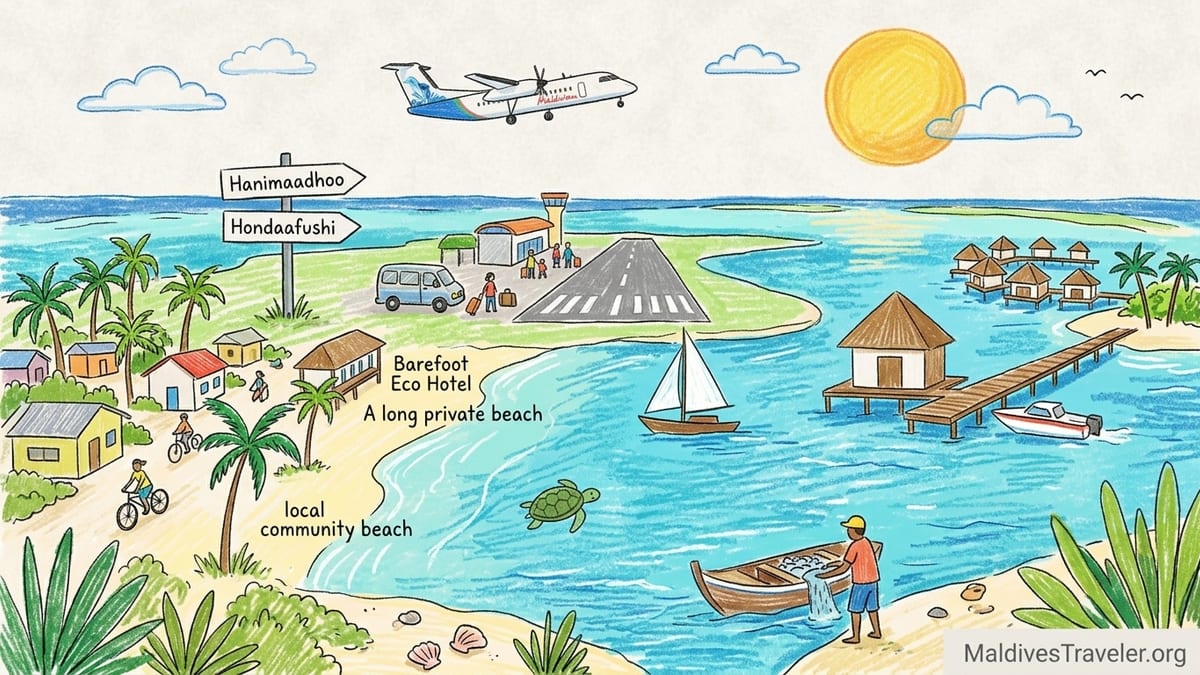
Whether you end up on Hanimaadhoo or Hondaafushi, your journey almost always begins with a domestic flight from Male to Hanimaadhoo Airport. As of 2026, this hop takes around 45 to 55 minutes on carriers such as Maldivian, usually in 50- to 60-seat turboprop aircraft. From many long-haul arrivals that land in the afternoon, you can connect the same day, walking a few minutes from the international terminal in Male to the domestic side and continuing north without needing a seaplane.
If you stay on Hanimaadhoo itself at The Barefoot Eco Hotel or a local guesthouse, the transfer is simple. The Barefoot typically arranges a minivan pickup at Hanimaadhoo Airport, and the drive to the hotel takes roughly 10 to 15 minutes along a quiet island road. After the sometimes chaotic feel of Male, it is disarmingly low-key: think small village streets, coconut palms and the occasional scooter rather than speedboat pontoons and resort staff lines.
Hondaafushi Island Resort, by contrast, adds a short boat leg to the same domestic flight. After landing in Hanimaadhoo, resort staff usually meet guests, gather luggage and transfer them to a speedboat for the final 10-minute ride across the lagoon. It is a classic Maldivian arrival: sea breeze, turquoise water and the sight of a low-slung island ringed by white sand. If you enjoy that sense of “crossing a threshold” to an entirely separate bubble, Hondaafushi delivers it in a way Hanimaadhoo, as an inhabited island, cannot.
In practice, transfer logistics and travel time are similar for both options, but the feel on arrival is very different. Hanimaadhoo feels like you have dropped into a real Maldivian community that happens to host a beach hotel, while Hondaafushi immediately signals a dedicated leisure environment where everything is organized around the resort.
Hanimaadhoo: Local-Island Life with a Private-Beach Bubble
Hanimaadhoo is a sizable local island with several thousand residents, a school, a mosque and even a climate observatory. The Barefoot Eco Hotel sits on a quieter stretch of coast, framed by a private half-mile sandy beach and mature forest. In practical terms, this creates a hybrid experience: on the sand and within the hotel grounds, you could easily assume you are on a small resort island, yet a five- to ten-minute walk or bike ride takes you past village houses, local cafes and harbor life.
The Barefoot’s beach is genuinely generous in scale. Beachfront and beachside rooms open to soft sand shaded by palms and sea almonds, with loungers spaced far apart. You will see other guests walking or cycling along the shoreline, but you are unlikely to encounter crowds of locals in bathing attire because the resort maintains its own designated beach area, separate from the village’s community beaches, where dress is more conservative. For travelers who want both cultural exposure and the comfort of a Western-style swimwear beach, this arrangement is a strong advantage.
The island context shows up in small daily details. For example, you might cycle from your room to the harbor in the late afternoon and find fishermen unloading their catch, or stop at a corner shop to pick up snacks priced for locals rather than resort guests. Children play football in open sandy lots as the call to prayer sounds from the mosque. If you have visited only private islands in the Maldives before, this can dramatically change your perception of the country from an abstract turquoise backdrop to a real place where people live.
At the same time, Hanimaadhoo lacks some of the postcard-perfect isolation of a tiny private island. You may see buildings in the distance, and the feel on the back roads is more village than resort. Travelers who dream of seeing nothing but sea and shoreline for a week may find Hondaafushi’s more controlled environment closer to their ideal.
Hondaafushi: Classic Private-Island Resort Energy
Hondaafushi Island Resort is built on its own island in Haa Dhaalu Atoll, hidden within a ring of reef and framed by over five kilometers of beach. There are no local houses, no harbor town and no mosque next door. Once you step off the speedboat, you are in a fully curated resort space where every building, pathway and bar is dedicated to guests.
Rooms at Hondaafushi typically follow the Maldivian resort template: detached or semi-detached beach bungalows and, in some configurations, water villas strung out over the lagoon. Interiors lean toward comfortable, mid-range Maldivian style: tiled or wooden floors, thatched roofs, air conditioning, outdoor or semi-outdoor bathrooms and shaded verandas leading directly to the sand. You will not find the hyper-designed, Instagram-honed architecture of the ultra-luxury brands, but you will wake to the sound of the surf only a few meters away.
The atmosphere is generally more “holiday village” than “eco retreat.” Expect a central pool, a main bar, buffet restaurant and possibly themed evenings such as barbecue nights or live music, depending on the season and occupancy. Families appreciate the straightforward layout and the ability to let children roam safely along the sand without worrying about traffic or suddenly wandering into a village area.
Perhaps the biggest conceptual difference with Hanimaadhoo is that Hondaafushi gives you the classic Maldives mental image: sand, sea and resort infrastructure only. You will meet Maldivians mainly as staff rather than neighbors, and your interactions with the broader atoll are mostly through organized excursions. For many honeymooners and first-time visitors, that stripped-down simplicity is precisely the appeal.
Beach Privacy, Alcohol and Dress: What Everyday Life Looks Like
On beach privacy, both options are strong, but in slightly different ways. The Barefoot Eco Hotel has a long, curved stretch of sand where rooms are set back behind a shallow line of vegetation, so you can step from your veranda to the beach without feeling overlooked. Because the hotel is the only sizable tourism operation along this side of the island, you rarely share the area with non-guests, and there are corners of the beach where you can walk for ten minutes and encounter only a few people. However, you remain on a local island, so certain lines are drawn clearly: no topless sunbathing, no nude swimming and a request to wear cover-ups when walking through areas visible from the village.
Hondaafushi, as a private resort, can offer more flexibility on beach attire and design spaces with nearly complete visual seclusion. Many bungalows open to little coves or arcs of sand that feel essentially private, especially on parts of the island where vegetation has been left dense between units. You can usually walk the entire circumference of the island on sand, passing other guests but very few staff buildings, which are tucked away inland. For couples prioritizing a honeymoon-like sense of seclusion, this may edge out Hanimaadhoo.
Alcohol is a critical distinction. On Hanimaadhoo, Maldivian law prohibits serving alcohol on the island itself because it is inhabited. The Barefoot handles this by operating a “boat bar” moored offshore, where guests can take a short shuttle and enjoy wine, beer and cocktails in the evening. In practice, this means you can have a gin and tonic at sunset, but not a glass of wine at lunch on the beach or a cocktail in your room minibar. Travelers who enjoy a casual beer after an afternoon snorkel or who prefer having a bottle of wine during dinner on land may find this inconvenient.
Hondaafushi, by contrast, follows the typical resort model with full bar service on the island. Alcohol is sold at the main bar and usually at restaurants, and all-inclusive packages often bundle local beer, house wine and standard spirits. For many guests, this is part of the relaxed holiday routine: ordering a drink by the pool, having sundowners on the beach and not thinking about separate boat transfers or legal logistics. If easy access to alcohol is important to your experience, Hondaafushi is the more straightforward choice.
Food, Room Styles and Overall Comfort
The Barefoot Eco Hotel positions itself as a mid-range, eco-conscious property with a focus on fresh, often locally sourced food. Expect a mix of Maldivian dishes such as fish curry and chapati, alongside international staples like grilled chicken, pasta and salads. Buffets are common, but there may also be set menus or themed evenings depending on occupancy. One concrete advantage of being on a local island is that you can step outside the hotel and sample simple local eateries, trying snacks like hedhikaa (savory bites such as tuna-filled pastries) for a fraction of resort prices. A plate of local short eats and tea in a village café might cost roughly what you would pay for a single dessert at a resort.
Rooms at The Barefoot come in several categories, often labeled seaside, beach side, beach front and ocean view. Beachfront units sit close to the sand with direct access, while upstairs ocean view rooms trade immediate beach access for wide sea vistas from a balcony. Interiors are simple but well-kept: think white walls, natural wood furniture, ceiling fans in addition to air conditioning and practical tile floors, with decor that foregrounds natural textures rather than glossy design pieces.
Hondaafushi’s food offering leans into the classic resort buffet model. Breakfast usually includes an international spread of eggs, pastries, fruit and Maldivian touches like mashuni (tuna and coconut salad) with flatbread. Lunch and dinner rotate between grilled meats, curries, salads and Western comfort dishes. Because you are on a self-contained island, there is essentially no alternative dining beyond what the resort provides, so food variety over a 7- or 10-night stay depends heavily on the creativity of the kitchen and whether the resort offers à la carte or specialty dining in addition to the main buffet.
In terms of comfort level, both properties sit in the solid mid-range rather than the ultra-luxury bracket. You will have air conditioning, hot showers and comfortable beds, but not a private butler or plunge pool. The key difference is aesthetic: The Barefoot feels like an eco-lodge woven into a forest on a local island, while Hondaafushi feels like a self-contained beach resort with the familiar rhythms of pool, bar and restaurant.
Diving, Snorkeling and Excursions Around Haa Dhaalu
Both Hanimaadhoo and Hondaafushi are well placed for exploring the relatively quiet dive sites of Haa Dhaalu, where boat traffic is far lighter than in the central atolls. The Barefoot runs a full dive center with PADI and often SSI courses, offering everything from introductory dives to advanced training. Guests can join daily boat dives to thilas and channels in the surrounding area, looking for reef sharks, turtles and schooling fish. A notable perk is the resident marine biologist program, which adds evening talks on reef ecology and often leads guided snorkeling excursions with commentary on local species.
For snorkeling, The Barefoot benefits from Hanimaadhoo’s house reef and its long lagoon. You can usually enter the water directly from the beach and swim over seagrass areas frequented by turtles, then out toward the edge of the reef where coral bommies host clouds of fish. The hotel also offers boat trips to nearby uninhabited sandbanks and reefs, which can feel remarkably untouched given the lack of neighboring resorts in the deep north.
Hondaafushi operates its own dive center, with house-reef access from the jetty and boat dives to sites around the atoll. Being on a private island means entry points can be optimized for guests, and you can often arrange night dives or special trips more easily because everything is managed in-house. Reports from divers highlight healthy coral in certain spots, modest but enjoyable pelagic action and the satisfaction of having dive boats depart right from the resort jetty without needing additional transfers.
Excursions differ subtly between the two. From Hanimaadhoo, you can join village walks, bike tours, fishing trips with local crews and visits to neighboring inhabited islands, which give a grounded sense of daily life. From Hondaafushi, excursions skew toward uninhabited sandbanks, snorkeling safaris, dolphin cruises and sunset fishing. If your goal is meaningful contact with Maldivian communities, Hanimaadhoo has the clear edge. If you mainly want time in the water and on empty sand spits, either base works, with Hondaafushi slightly more focused on the resort-style experiences.
Couples, Families and Costs: Who Each Option Suits Best
For couples, the choice often comes down to how much you value cultural immersion versus a pure escape bubble. A pair of travelers in their 30s might choose The Barefoot on Hanimaadhoo precisely because they can alternate days: one day diving and reading on the semi-private beach, the next riding bikes through the village and stopping for coffee at a local café. Evenings can be quiet, with stargazing on the beach or a boat-bar sunset drink rather than a loud entertainment program.
Honeymooners who picture long, lazy days drifting between their villa, the sea and the resort bar, without needing to think about dress codes outside the property or separate arrangements for alcohol, may feel better matched with Hondaafushi. Many packages are marketed specifically to couples, bundling extras such as a private beach dinner or spa credits. A tangible example: a mid-season, one-week stay for two on an all-inclusive basis at Hondaafushi might be priced so that you rarely need to sign a bill, whereas on Hanimaadhoo you might book half board at The Barefoot and then mix hotel lunches with very inexpensive snacks in the village.
Families face a similar trade-off. The Barefoot welcomes children, with family-friendly activities like snorkeling, cycling and movie nights, and some room categories can accommodate extra beds. Parents who want their kids to experience a real island community often appreciate being able to walk through the village, visit local shops and talk about how life differs from home. On the flip side, you will want to be mindful of local norms, dressing modestly off the beach and keeping noise down near the mosque during prayer times.
Hondaafushi’s fully private setting simplifies things for families who prefer not to think about these nuances while on holiday. Children can run along the beach without the same concern about wandering into village areas, and resort-run kids’ activities, if available, keep them engaged while parents relax. The trade-off is that every ice cream, juice and excursion is priced at resort levels, which can add up over a long stay.
On overall cost, both options tend to sit well below elite brands like Soneva. The Barefoot, as of recent seasons, often lists nightly rates for standard rooms that undercut many private islands in the central atolls, especially if you travel outside peak holiday weeks. Hondaafushi, while usually a bit higher than a local-island stay once you factor in all-inclusive plans, can still represent good value for guests who know they will make full use of included meals, drinks and activities. A rough rule of thumb: if you are a light drinker and like the idea of buying some meals or snacks in the village, Hanimaadhoo will usually work out cheaper. If you want the “pay once and relax” simplicity of all-inclusive with alcohol, Hondaafushi may be more straightforward even if the sticker price looks higher.
The Takeaway
Choosing between Hanimaadhoo and Hondaafushi is less about which is objectively “better” and more about what kind of Maldives you want to experience. Both share the same general region of Haa Dhaalu, the same domestic flight into Hanimaadhoo and access to many of the same reefs and sandbanks. Yet on the ground, your days will feel very different.
Hanimaadhoo, anchored by The Barefoot Eco Hotel and a small ecosystem of guesthouses, is ideal if you want a softer, more authentic encounter with Maldivian life without giving up the comforts of a private beach and organized diving. The absence of alcohol on land and the need to use a boat bar is a clear limitation for some, but for others it is a minor logistical detail in exchange for village walks, local cafés and the chance to see how the atoll actually lives.
Hondaafushi Island Resort, on its private island, is the right fit if you imagine your holiday as a contained bubble of sun, sea, sand and resort services. Full bar access, straightforward all-inclusive packages, family-friendly beaches and classic beach villas make it an easy recommendation for honeymooners and families who prioritize convenience and seclusion over cultural immersion.
If you picture yourself chatting with island shopkeepers, hearing the call to prayer drift over the trees and cycling through a Maldivian village in the late afternoon, choose Hanimaadhoo. If your dream is waking up in a bungalow where the only sounds are waves and the clink of ice in a sunset cocktail at the resort bar, Hondaafushi is likely your Haa Dhaalu match.
FAQ
Q1. Is Hanimaadhoo or Hondaafushi easier to reach from Male?
Both use the same domestic flight to Hanimaadhoo, which takes around 45 to 55 minutes. Hanimaadhoo stays add a 10–15 minute road transfer, while Hondaafushi adds a roughly 10-minute speedboat ride.
Q2. Can I drink alcohol on Hanimaadhoo?
Alcohol cannot be served on the inhabited island itself. The Barefoot Eco Hotel offers an offshore “boat bar” where guests can have drinks in the evening, but you will not find alcohol in village cafés or on the hotel’s land-based premises.
Q3. Does Hondaafushi offer all-inclusive packages with alcohol?
Yes, Hondaafushi generally follows the Maldivian resort model with bar service on the island and all-inclusive options that include local beer, wine and standard spirits, subject to the exact package you book.
Q4. Which is better for cultural immersion, Hanimaadhoo or Hondaafushi?
Hanimaadhoo wins clearly on cultural immersion. You can walk through the village, visit local shops, watch daily life at the harbor and interact with residents in a way that is not possible on a private island like Hondaafushi.
Q5. How do beach privacy and dress codes compare?
Both offer good beach privacy, but Hanimaadhoo remains a local island, so modest dress is expected away from the resort beach and topless sunbathing is not allowed. Hondaafushi, being a private resort, has more relaxed, purely holiday-oriented norms on attire within the island.
Q6. Which option is generally more affordable?
Staying on Hanimaadhoo at The Barefoot or a guesthouse usually works out cheaper, especially for light drinkers or those happy to eat some meals in local cafés. Hondaafushi’s all-inclusive deals can still be good value for guests who plan to make extensive use of included food and drinks.
Q7. Are diving and snorkeling better from Hanimaadhoo or Hondaafushi?
Both offer strong diving and snorkeling in a relatively uncrowded atoll. The Barefoot leverages Hanimaadhoo’s house reef and marine biologist program, while Hondaafushi offers easy house-reef access from its jetty and dedicated dive boats. Quality is more about specific sites and conditions than the island you choose.
Q8. Which is more suitable for families with young children?
Families who want cultural exposure and do not mind local norms may prefer Hanimaadhoo, where kids can see real island life. Those who value a fully controlled, traffic-free environment with simple resort routines often find Hondaafushi easier with young children.
Q9. How do the room styles differ between the two?
The Barefoot offers eco-lodge-style rooms such as seaside, beach front and ocean view, often integrated into lush vegetation on a local island coastline. Hondaafushi features classic Maldivian resort bungalows and, in some configurations, water villas on a private island, with interiors that are comfortable and beach-focused rather than ultra-luxury.
Q10. If I want a quieter, less commercial Maldives, which should I choose?
Both feel quieter than major resort hubs, but in different ways. Hanimaadhoo feels genuinely lived-in yet low-key, with a single main hotel and village life. Hondaafushi feels like a peaceful, self-contained resort with long beaches and limited boat traffic. Pick Hanimaadhoo for authenticity and Hondaafushi for pure seclusion.