


Planning a trip to the Maldives often starts with scrolling through overwater villas, but the smartest first choice is not the resort. It is the atoll. Each Maldivian atoll comes with its own transfer logistics, marine life highlights, level of seclusion and overall travel style. Deciding whether you are a North Malé, Ari, Baa, Lhaviyani or Dhaalu type of traveler will narrow hundreds of resorts down to a manageable shortlist and make your time and money work harder once you land at Malé’s Velana International Airport.
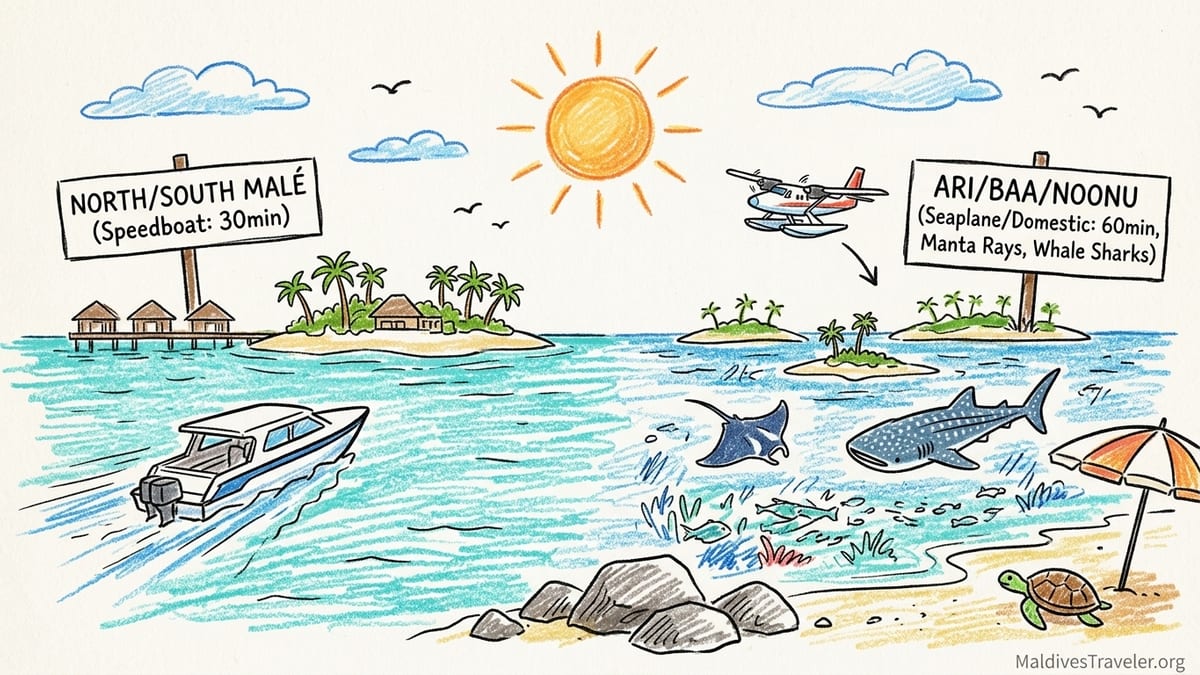
How Maldives Atolls Shape Your Trip
The Maldives stretches over 800 kilometers of Indian Ocean, divided into atolls that each feel like their own mini destination. From a visitor perspective, the most important difference between atolls is how you get there and what you hope to do once you arrive. Closer atolls around Malé suit short breaks and nervous flyers who prefer boats over small planes. More distant atolls require seaplanes or domestic flights, but reward you with emptier horizons and darker night skies.
Transfers set the tone for your stay. Resorts in North and South Malé Atolls typically use shared speedboats, often reaching the island in 10 to 45 minutes after you clear immigration. Further-flung atolls such as Ari, Baa, Lhaviyani, Raa, Noonu, Dhaalu and Gaafu usually involve seaplane transfers or a domestic flight plus speedboat. A seaplane hop can easily add 30 to 60 minutes of air time and a few hundred dollars per person to the bill, but it turns the journey into a scenic experience in its own right, with patchwork reefs and sandbanks visible below.
Beyond logistics, each atoll also has a distinct tourism profile. Baa is known for manta rays around Hanifaru Bay. Ari is famous for year-round whale shark encounters. North Malé has some of the highest resort density and easiest access, while Noonu, Dhaalu and Gaafu attract travelers explicitly seeking more space and fewer neighbors. Understanding these patterns helps you pick the atoll that matches your priorities before you fall in love with a specific resort marketing video.
All Maldivian resort islands can work for both couples and families in principle, but not all are equal. Some properties, especially in busier atolls, lean strongly toward honeymooners with quiet pool decks and fine-dining restaurants as the main draw. Others, particularly on larger islands in Lhaviyani or Dhaalu, add kids’ clubs, splash parks and multi-bedroom villas that make life easier for parents. Once you know which atoll best fits your style, you can then look for resorts within that atoll that match your budget and expectations.
North & South Malé Atolls: Fast-Track Island Escapes
North and South Malé Atolls are the capital region, and their greatest selling point is speed. Many resorts here can be reached by speedboat directly from Velana International Airport in under an hour, with no need to wait for seaplane schedules. Kurumba Maldives, one of the classic North Malé properties, is often cited as the closest resort to the airport at about a 10 minute boat ride, which makes it a popular choice for long weekend breaks or overnight stopovers. Baros Maldives and Kuda Villingili, both in North Malé, typically require around 25 to 30 minutes by speedboat, short enough that you might be sipping a welcome drink less than an hour after your plane lands.
This quick access comes with trade-offs. North Malé has one of the highest resort densities in the country, plus several local islands and surf spots. On some islands you may see boat traffic on the horizon or even neighboring resorts in the distance. For many travelers that is a fair price to pay for convenience and lower transfer costs. A family of four paying for a short shared speedboat ride will usually spend noticeably less on transfers than they would on four seaplane seats to a remote atoll, freeing up budget for better room categories or activities.
House-reef quality in the Malé atolls varies from island to island. Some resorts, such as Meeru Island or smaller boutique properties, have easy reef access directly from the beach, while others rely more on boat trips to nearby snorkeling sites. Divers will find plenty of sites, especially channels with reef sharks, but if your main goal is big-animals such as whale sharks or high-density manta gatherings, you are better off focusing on Ari or Baa. On the other hand, surfers often prefer North Malé because several famous reef breaks sit within speedboat distance of resort islands.
North and South Malé work well for almost every traveler profile, but particularly for short stays, nervous flyers, multi-generational groups and guests who want choice. You can find ultra-luxury adults-leaning boltholes like Baros that feel peaceful even in a busy atoll, alongside very family-oriented resorts with kids’ clubs and varied dining. Because the region is compact, it is also a good base for travelers who plan to split their trip, for example doing three nights on a quick-access Malé atoll resort before heading by seaplane to a more remote island for the remainder of their holiday.
Ari Atoll: Whale Sharks, Diving and Classic Overwater Villas
Ari Atoll, split administratively into North and South Ari, is one of the best-known resort regions in the Maldives. From a marine perspective, its main claim to fame is the relatively reliable presence of whale sharks, especially along the outer reef of South Ari. Resorts like Lily Beach, LUX South Ari Atoll and several liveaboard operators base themselves here because it is one of the few places on the planet where you have a decent chance of snorkeling or diving with whale sharks at any time of year, even though sightings are never guaranteed.
Getting to Ari usually means taking a seaplane from Malé, with flight times often around 25 to 35 minutes depending on the specific island. This immediately changes the feel of the trip. You swap the bustle of the capital region for wider lagoons and fewer neighboring islands. From above, Ari looks like a scatter of turquoise rings and pale sandbars, and the seaplane flight becomes part of the holiday narrative. For travelers wary of seaplanes, a handful of Ari resorts can also be reached via domestic flight plus speedboat, but most visitors accept the seaplane as the simplest option.
Resort density in Ari is high by Maldivian standards, but because reefs and channels are spread over a larger area, the experience still feels more open than the immediate Malé region. Many islands here have good house reefs suitable for everyday snorkeling, and dive centers typically offer a mix of gentle thilas for beginners and more challenging channel dives where strong currents bring in gray reef sharks, eagle rays and schools of jacks. If diving and snorkeling are major priorities, Ari belongs near the top of your shortlist.
Ari suits both couples and families, but the overall mood is often described as “classic postcard Maldives” with long jetties of overwater villas extending into clear lagoons. Honeymooners appreciate the combination of romantic settings and soft adventure such as whale shark excursions, while families benefit from the fact that many larger Ari resorts include kids’ clubs, multiple restaurants and spacious beach villas. Typical guests here are willing to pay extra for the seaplane because the region delivers so consistently on the promise of underwater encounters and dramatic sandbank backdrops.
Baa Atoll: Manta Rays, Biosphere Reserve and Seasonal Safaris
Baa Atoll is globally recognized for its manta rays and forms part of a UNESCO Biosphere Reserve. On its eastern side lies Hanifaru Bay, a small, funnel-shaped lagoon that has become famous as one of the world’s most reliable seasonal aggregation sites for reef manta rays and, at times, whale sharks. During the southwest monsoon, roughly from May to November and particularly around mid-year, currents funnel plankton into the bay, occasionally drawing dozens of mantas into a single, swirling feeding “train.” Access is tightly controlled to protect the site, and in peak season visitors usually join guided snorkeling trips rather than scuba dives, because diving is restricted during the busiest months.
Most visitors reach Baa by seaplane from Malé, usually in around 30 to 40 minutes, or by a domestic flight to airports such as Dharavandhoo followed by a short speedboat ride. This keeps Baa comfortably removed from the main traffic of the capital region but still easier to reach than the far-southern atolls. The atoll offers a mix of ultra-luxury private islands and mid-range options, and its resort market benefits directly from proximity to Hanifaru Bay. Properties including Soneva Fushi, Anantara Kihavah, Finolhu and various locally-owned guesthouses on inhabited islands market dedicated manta-safari packages built around the June to November season.
Beyond Hanifaru, Baa has strong house-reef potential and varied diving, including coral pinnacles that turn into cleaning stations where mantas queue up one by one for the attention of cleaner fish. Even outside peak season, you can expect colorful coral gardens, turtles and reef sharks as everyday sightings. Because Baa is a biosphere reserve, there is a visible conservation presence, from research teams based in the atoll to educational talks for guests. Travelers who care about marine science or want their tourism spending to support protected areas often gravitate here.
In terms of travel style, Baa tends to skew slightly more upscale and more nature-focused than some busier atolls. Many islands offer refined villas and strong spa and dining programs aimed at honeymooners and special-occasion trips, but you will also find family-friendly resorts with kids’ clubs and marine biology centers that run activities for children. If your dream Maldivian holiday features snorkeling with manta rays, joining citizen science projects or simply knowing you are inside a protected marine landscape, Baa is the logical atoll to prioritize.
Lhaviyani, Raa & Noonu: Spacious Lagoons and Quieter Horizons
Lhaviyani, Raa and Noonu sit north of the capital region and hit a middle ground between easy access and genuine remoteness. Transfers here are almost always by seaplane, typically 35 to 45 minutes from Malé depending on the exact island and routing on the day. Once you land, however, you quickly notice the change in atmosphere. Resort density is lower than in North Malé or Ari, views are wider and the sense of being out on the open ocean is stronger, especially at properties built on larger natural islands or double-island configurations.
Lhaviyani is known among divers for its rich channel diving and frequent turtle and shark sightings, while still offering good options for beginners. Resorts here often sit within broad lagoons where you can snorkel directly from the beach. Raa and Noonu, slightly further north, lean even more into the “escape” narrative, with some high-end private islands and integrated developments that feel almost like self-contained mini archipelagos. Many of these resorts are physically larger than the tiny coral islets common closer to Malé, which makes it easier to include long bicycle paths, multiple beaches facing different directions and separate adults-only and family zones.
House reefs in these atolls can be excellent, but they vary by island. Some resorts are perched on the edge of drop-offs that allow you to swim from a shallow lagoon to deeper blue water within a few fin kicks. Others prioritize expansive sandy shallows for paddleboarding and sandbank picnics rather than steep reefs. If you are a keen snorkeler or diver, it pays to check how far the reef edge is from the shore at your chosen resort, because that detail can make a big difference to daily routines.
Families often appreciate Lhaviyani, Raa and Noonu because the larger land area and quieter environment allow for generous kids’ clubs, sports facilities and multi-bedroom villas without feeling cramped. At the same time, honeymooners enjoy the relative seclusion and the sense of being “far away” even if they are still within a single seaplane hop of Malé. Typical guests here are willing to accept the cost and slight unpredictability of seaplane schedules in exchange for broad white-sand beaches, good house reefs and the luxury of seeing few if any other islands on the horizon.
Dhaalu & Gaafu: Deep Seclusion and Longer Journeys
Dhaalu and Gaafu Atolls lie much further from Malé and appeal to travelers who value seclusion enough to invest extra time in getting there. Reaching Dhaalu usually involves either a direct seaplane flight of roughly 45 to 60 minutes or a domestic flight on carriers such as Manta Air to an atoll airport like Kudahuvadhoo, followed by a short speedboat ride to the resort. For example, resort guides for properties like Niyama Private Islands and RIU Atoll describe options that combine a domestic flight segment with a speedboat transfer, or a longer but more straightforward direct seaplane route. The atoll has more than 50 islands but only a small fraction host resorts, which keeps overall visitor numbers relatively low for the size of the area.
Gaafu, which is geographically split into Gaafu Alifu and Gaafu Dhaalu, lies even further south. Most guests reach these atolls by taking a domestic flight from Malé to regional airports such as Kooddoo or Kaadedhdhoo, and then continue by resort speedboat. Flight times alone can approach an hour, with the boat leg adding another 15 to 30 minutes. This can mean that, door to door, it takes a large part of a day to reach your island, especially if you arrive on a long-haul flight in the afternoon and need to wait for the next domestic connection. In return, you get some of the emptiest sea views in the country and a feeling of being closer to the equator, with slightly different weather patterns and marine life nuances.
These southern atolls are particularly attractive to repeat visitors who have already done the classic Malé or Ari experience and now want darker skies for stargazing, longer uninterrupted sandbanks and fewer passing boats. Resorts in Dhaalu and Gaafu often sit on sizable islands or double islands and can support a wide range of activities, from surfing specific seasonal breaks to extensive spa and wellness programs. House-reef quality again depends on the exact island, but the distance from heavy boat traffic can be a plus for both coral health and the sense of tranquility when snorkeling.
Families and honeymooners who choose Dhaalu or Gaafu generally fall into two categories. Some are time-rich travelers on longer trips of ten nights or more, who can afford to lose a half day to transfers at each end without feeling rushed. Others are special-occasion visitors who value privacy above all else and see the extra travel as part of the adventure. Transfer costs here tend to be among the highest in the country because of the longer distances, so it often makes sense to compare total trip budgets rather than just nightly room rates when deciding between a southern atoll and a closer alternative.
Matching Atolls to Travel Styles and Practicalities
When you strip back the marketing language, the decision between atolls comes down to a few core questions. First, how comfortable are you with seaplanes and domestic flights, and how much of your arrival day are you willing to spend in transit after you land in Malé. If you are traveling with young children, nervous flyers or on a tight schedule, North and South Malé Atolls are hard to beat for simplicity, with direct speedboats that run at all hours. For trips of five nights or less, the time you save by avoiding seaplane layovers can be significant.
Second, what are your non-negotiable experiences. If you want the highest probability of seeing manta rays in big numbers, Baa Atoll during the May to November manta season is the obvious choice. For whale sharks, Ari Atoll should be at the top of the list, especially if you are willing to join organized snorkeling or diving excursions along the outer reef. If your dream is a resort where you can step off your villa deck into a strong house reef every day, several islands in Ari, Baa, Lhaviyani, Raa and Noonu have an edge, but it is important to look at individual resort reef maps within those atolls.
Third, how much do you value seclusion relative to cost. Atolls like Lhaviyani, Raa, Noonu, Dhaalu and Gaafu tend to have lower resort density and wider views, but you pay for that with higher transfer prices and, occasionally, more weather-related disruptions. A family that chooses a moderately priced resort in North Malé might pay less overall than they would for a cheaper nightly rate further south once transfer costs are included. Couples on a honeymoon budget might decide that paying extra for a remote atoll makes sense if it means quieter beaches and more privacy around their villa.
Finally, consider who is traveling. Multigenerational groups and families with small children often appreciate larger islands in Lhaviyani or Dhaalu where kids’ clubs, shallow lagoons and varied dining keep everyone happy without daily boat trips. Honeymooners might prefer boutique resorts in North Malé that feel intimate despite the proximity to the airport, or high-end private islands in Baa and Noonu where everything from the spa to the wine cellar is designed for indulgence. Thinking in terms of atolls before you search for individual resorts keeps you focused on what matters most for your particular trip rather than getting distracted by generic images of overwater villas.
FAQ
Q1. Which Maldives atoll is best if I want to minimize travel time from the airport?
North and South Malé Atolls are best for minimizing travel time, since most resorts there are reached by speedboat in 10 to 45 minutes from Velana International Airport.
Q2. If I want to see whale sharks, which atoll should I choose?
Ari Atoll, especially South Ari, is the top choice for relatively reliable whale shark encounters, with many resorts and dive operators offering year-round excursions.
Q3. When is the best time to visit Baa Atoll for manta rays at Hanifaru Bay?
The key manta season in Baa Atoll typically runs from about May to November, with the strongest aggregations often occurring in the middle of that period.
Q4. Are seaplane transfers worth the extra cost compared to speedboats?
They can be, especially if you value remoteness and scenery. Seaplanes open up access to atolls such as Ari, Baa, Lhaviyani, Raa and Noonu that feel more distant from Malé.
Q5. Which atolls are best for a quieter, more remote resort experience?
Lhaviyani, Raa, Noonu, Dhaalu and Gaafu generally offer lower resort density and wider horizons, which many travelers experience as more remote and tranquil.
Q6. Is the Maldives suitable for families with young children or only for honeymooners?
Many resort islands in atolls like North Malé, Lhaviyani and Dhaalu have kids’ clubs, shallow lagoons and family villas, making them very suitable for families.
Q7. How should I factor transfer costs into my atoll choice?
Consider the total trip budget, not just nightly rates. Speedboat-access atolls like Malé often mean lower transfer costs, while distant atolls with seaplanes or domestic flights can add several hundred dollars per person.
Q8. Do all resorts have good house reefs for snorkeling?
No, house-reef quality varies by island. Some resorts sit directly on strong reefs, while others emphasize sandy lagoons and rely on boat trips for the best snorkeling.
Q9. Can I split my stay between two different atolls?
Yes, many travelers spend a few nights in a quick-access Malé atoll resort and then transfer by seaplane or domestic flight to a more remote atoll for the remainder of the trip.
Q10. If I am nervous about small planes, where should I book?
Choose a resort in North or South Malé Atoll that offers direct speedboat transfers from the airport, so you can avoid seaplanes and domestic flights entirely.