


Arriving in the Maldives is only the first step. The real journey begins when you leave Velana International Airport in Malé and head out across the atolls by speedboat, public ferry, seaplane or domestic flight. In the central Maldives, where many of the country’s most popular resorts and local islands sit scattered across Baa, Rasdhoo, Ari, Vaavu and Meemu atolls, understanding these transfer options can save you hours of travel time, missed connections and unnecessary expense. This guide explains, in practical terms, how each type of transfer works, when it makes sense, and which central atolls are easiest to reach.
Understanding the Central Maldives & Key Arrival Hubs
Almost every international visitor to the Maldives arrives at Velana International Airport on Hulhulé Island, just off the capital Malé. From here, you connect onward to your resort or local island using one of four main transfer types: shared or private speedboat, public ferry, seaplane, or a domestic flight combined with a short boat ride. For the purposes of transfers, the “central” Maldives usually refers to the atolls within a few hundred kilometres of Malé, especially North Malé (Kaafu), South Malé (Kaafu), Ari (Alif Alif and Alif Dhaalu), Baa, Lhaviyani, Rasdhoo, Vaavu and Meemu. These atolls sit in a sweet spot: far enough to feel remote, but close enough that transfers remain relatively straightforward.
The geography dictates your choices. Resorts within roughly 80 kilometres of Malé, such as those in North and South Malé Atoll and parts of Vaavu, are most often reached by speedboat in under 90 minutes. Further out, especially in Baa Atoll or the outer parts of Ari, many higher-end resorts rely on seaplanes that hop directly to the resort’s own jetty. Where distances increase or seaplane networks thin out, domestic airports like Dharavandhoo in Baa or Maamigili in South Ari act as mini hubs, with local speedboats fanning out to surrounding islands.
For travellers staying on local islands rather than private resorts, the picture shifts slightly. Budget travellers heading to central atolls like Rasdhoo, Thoddoo, Ukulhas or Fulidhoo may use a mix of scheduled speedboats operated by local companies and slower public ferries operated or subsidised by Maldives Transport and Contracting Company. These do not typically serve resorts but can be an economical way to reach inhabited islands with guesthouses. As a result, two visitors landing on the same flight may end up taking very different routes to islands that are geographically quite close.
The most important planning principle is that nearly everything funnels through Malé and Velana. Even when you connect via a domestic airport within the atolls, you nearly always change from your international aircraft to a domestic plane or seaplane on Hulhulé. That means your arrival and departure times into and out of Malé are critical in determining which transfer modes you can realistically use on the same day.
Speedboats: Fastest Option for Nearby Central Atolls
For central atolls within around 80 kilometres of Malé, speedboat transfers are the workhorse option. Resorts in North and South Malé Atoll, such as Meeru Island Resort or resorts in the South Malé lagoon, routinely run shared speedboats from a small pier just opposite the international terminal. A resort boat to Meeru, for example, typically takes about 55 minutes from the airport and runs several times a day, with the cost bundled into your resort bill and usually starting from a few hundred US dollars per person for the round trip depending on season and contract.
In Vaavu Atoll, which includes popular local islands such as Fulidhoo and Thinadhoo, scheduled speedboats are more common than public ferries for tourists. Local operators run multiple daily departures from Malé’s harbour to these islands, with one-way prices often in the range of tens rather than hundreds of dollars per person. Travel time is usually around 60 to 90 minutes, depending on sea conditions and the number of stops. This makes Vaavu one of the easiest central atolls to reach if you are willing to ride in a speedboat rather than fly.
Scheduled or chartered speedboats also connect Malé to Rasdhoo, Ukulhas and Thoddoo at the northeastern fringe of Ari Atoll. These journeys are longer, commonly taking 90 minutes or more, and may be rough in windy conditions. Travellers prone to seasickness sometimes prefer to pay more for a seaplane or a domestic flight if available, but many budget and mid-range visitors accept the trade-off. The upside is flexibility: several independent operators run these routes, and you can often book seats online in advance or through your guesthouse, with morning and afternoon departures designed to meet common international flight banks.
When planning a speedboat transfer, factor in the practicalities. You normally exit customs, meet either a resort representative or your pre-booked operator in the arrivals hall, and are walked to the nearby jetty. Luggage is stacked on deck or in a small hold and remains accessible only once you arrive. Most boats wait until all booked passengers are present, so delays to flights can ripple through departure times. In rough seas, these rides can be bumpy, and operators sometimes delay or cancel crossings for safety. If you are connecting onward the same evening, allow generous margins, and consider scheduling your international departure for later in the day.
Public Ferries & Scheduled Speedboats for Budget Island Hopping
Public ferries are the slowest but cheapest way to move between central atolls. Operated or coordinated by national and regional authorities, they primarily serve locals but are open to tourists. Example routes from Malé to popular local islands include ferries to Maafushi in South Malé or to some islands in Ari Atoll, though frequencies have fluctuated in recent years and many travellers have shifted to using scheduled speedboats instead. A public ferry ticket can cost only a few dollars per person, but journey times stretch into several hours and services may not run daily.
In practice, most short-stay visitors to central atolls choose scheduled speedboats rather than ferries. Travellers heading to Maafushi often debate whether to save money with the public ferry or pay extra for a speedboat. The ferry involves working around limited departure days and a journey that may take close to two hours or more with intermediate stops. By contrast, speedboats run many times per day from Malé to Maafushi, with typical prices starting from roughly the cost of a simple restaurant meal in a Western capital each way, and transit times often around 30 minutes. For couples on a week-long trip, the marginal savings of the ferry often do not justify the loss of flexibility.
Where public ferries really come into their own is for slow travellers who want to hop between inhabited islands across central atolls. Backpackers sometimes use ferries from Malé to Rasdhoo, then onward to Ukulhas or Thoddoo on separate days, enjoying the gradual progression through the archipelago. Timetables are subject to change, and information can be fragmented, so most travellers depend on their guesthouse to confirm current schedules shortly before travel. It is wise to build buffer days into the itinerary if you are relying heavily on ferries, especially during the southwest monsoon when seas can be rough.
Luggage on ferries and scheduled speedboats is usually handled informally. There are no strict checked baggage allowances akin to airlines; instead, you pay per seat, and large suitcases are stacked wherever space permits. That said, some tourist-focused operators now specify limits, such as one 20 kilogram suitcase plus hand baggage per person, in their booking conditions. Oversized surfboards or dive gear may require an extra fee or separate charter. Always let your accommodation know if you are travelling with unusual items so they can help you choose the right service.
Seaplanes: Scenic Hops Across the Central Atolls
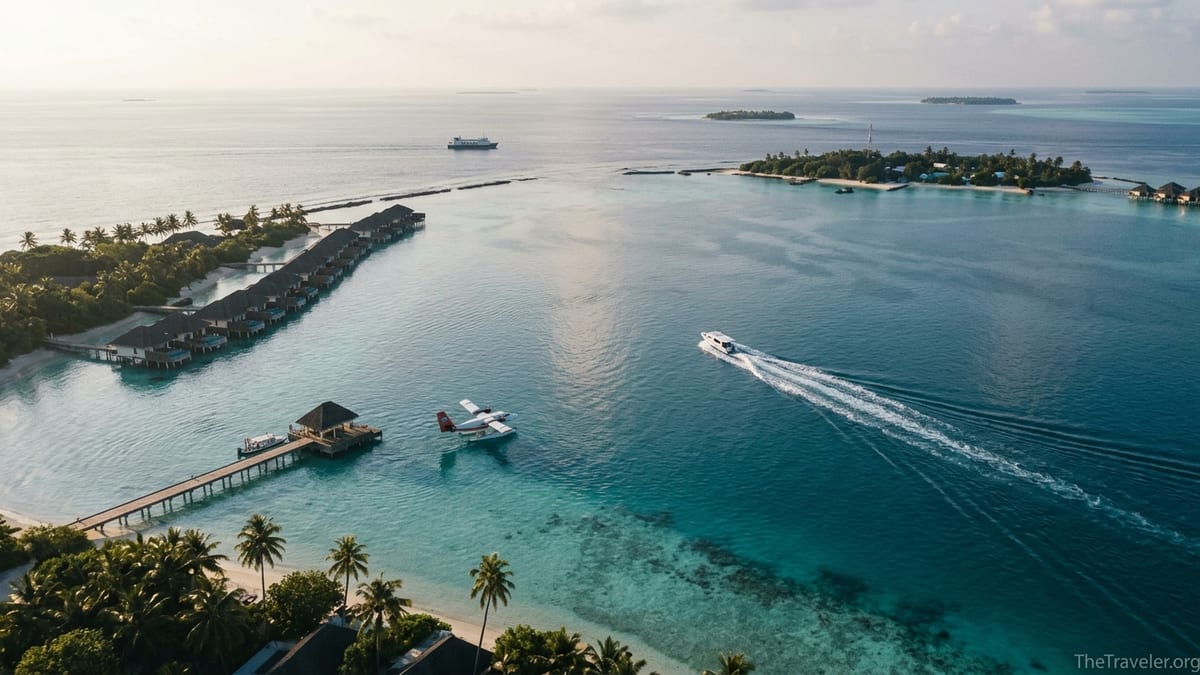
For many visitors, seaplanes are the quintessential Maldives transfer: small twin‑otter aircraft fitted with floats that land directly at resort jetties. In the central Maldives, seaplanes are widely used by higher-end resorts in Baa, Lhaviyani, Noonu, Raa and the outer reaches of Ari Atoll. Trans Maldivian Airways and Manta Air are the main operators, running dozens of daily flights from the dedicated seaplane terminal near Velana International Airport to more than 80 resort islands across the country. Travellers do not usually book these flights directly; instead, the resort blocks seats and simply adds the round‑trip transfer cost to your stay.
Transfer pricing by seaplane in the central atolls commonly runs into several hundred US dollars per adult for a return journey, sometimes more at ultra‑luxury properties. Children pay reduced rates, and some resorts periodically offer promotions where seaplane transfers are discounted or included in package deals. For example, a resort in Baa Atoll may quote a return seaplane transfer of approximately the price of a regional business‑class flight per person, with flight times of 30 to 40 minutes plus waiting time. While expensive, seaplanes can significantly shorten travel days for islands that would otherwise require long sea crossings.
Timing is the main constraint. Seaplanes operate in daylight only, which in the Maldives means roughly between early morning and late afternoon depending on the season. If your international flight lands late in the afternoon or after dark, you will not be able to board a seaplane the same day and will need to overnight in Malé or Hulhumalé and fly the following morning. Similarly, on departure, most resorts require you to leave early enough to allow at least three hours at the international terminal before your onward flight, and seaplane schedules may be adjusted the day before based on demand and weather.
Luggage rules on seaplanes are stricter than on speedboats. Typical allowances are around 20 kilograms of checked baggage plus 5 kilograms of hand luggage per person, including hand‑bags and camera gear. Excess baggage is accepted subject to space and charged per kilogram, which can add up quickly for travellers with dive equipment or multiple suitcases. Seaplane cabins are compact, overhead bins are minimal or nonexistent, and large rigid carry‑ons are often tagged and placed in the rear of the aircraft. If you are combining a seaplane resort stay with a liveaboard or a domestic flight to the far south, plan your packing so bulky gear can be left in storage in Malé if necessary.
Domestic Flights: Key Links for Outer Central Atolls
Domestic flights use standard turboprop aircraft operating from paved runways on inhabited islands. In the central region, key domestic airports include Dharavandhoo in Baa Atoll, Maamigili at the southern edge of Ari Atoll, and Dhaalu Airport a little further south. The national carrier Maldivian and other domestic airlines operate regular services from Velana International to these airports, often timed to match international arrival and departure waves. Once you land, resorts and guesthouses arrange short speedboat rides of 10 to 30 minutes to reach their islands.
For example, a traveller heading to a guesthouse on Dharavandhoo in Baa Atoll may fly a 20 to 25 minute domestic sector from Malé, then stroll from the small terminal to the harbour where the property’s dhoni or speedboat is waiting. Similarly, some resorts in southern Ari Atoll rely on Maamigili Airport as their gateway, whisking guests across the channel by boat after the short flight. These domestic sectors can be more forgiving than seaplanes for arrival times because many flights operate into the evening, although schedules still thin out overnight.
Costs for domestic flights in the central Maldives sit somewhere between scheduled speedboats and seaplanes. Return fares for tourists often land in the low to mid hundreds of US dollars per person when arranged through a resort or guesthouse, including the onward boat leg. For independent travellers, it is sometimes possible to book domestic flights directly on airline websites, but coordinating boat pickups still requires liaising with your accommodation. As with seaplanes, luggage allowances usually hover around 20 kilograms checked plus 5 to 7 kilograms hand baggage, with paid excess available.
Domestic flights are also a useful strategy when you want to connect remote parts of the central region without enduring very long boat rides. A traveller prone to motion sickness but booked at a resort far down Meemu Atoll, for instance, may ask the resort if they can connect via the nearest domestic airport instead of an exposed multi‑hour speedboat transfer. This can add a connection and some cost, but offers a smoother, more predictable journey in rough weather. It is worth asking your resort or guesthouse what alternatives exist, especially if you are travelling outside the calmest months.
Practicalities: Luggage, Arrival Timing & Transfer Coordination
Across all modes, successful transfers in the central Maldives come down to three variables: how much luggage you carry, what time your international flights land and depart, and how well your resort or guesthouse coordinates the links. Unlike in some countries where you can improvise with taxis at the last minute, Maldivian transfers, particularly seaplanes and domestic flights, normally need to be confirmed in advance, and last‑minute changes can be difficult or expensive.
On the luggage front, speedboats and ferries are generally the most flexible. They seldom weigh bags unless capacity is critical, and families with large suitcases, strollers and beach gear often prefer these modes for that reason. Seaplanes and domestic flights, by contrast, enforce allowances more rigorously. If you exceed the standard 20 kilogram checked limit, you will typically pay an excess fee per kilogram, and very heavy items might be pushed to a later flight if the aircraft is close to weight limits. Photographers, divers and surfers should budget for this and consider travelling with soft‑sided bags that can be more easily stowed.
Arrival timing is particularly critical for seaplane resorts in Baa, Lhaviyani or outer Ari Atoll. Properties often recommend that inbound international flights arrive into Malé no later than early afternoon to guarantee same‑day seaplane transfer. Late‑night arrivals almost always require a transit hotel. Conversely, if your onward transfer is a speedboat to North or South Malé, or a domestic flight to a central airport, same‑day connections are more realistic even for evening flights, provided services still operate at that hour. It is sensible to leave at least three hours between your scheduled seaplane or domestic arrival back into Malé and your international departure to allow for weather‑related delays.
Coordination is usually handled for you when you book a resort. Once your flights are confirmed, you send the details to the property, and they arrange the appropriate transfer via seaplane, domestic flight or resort speedboat. On arrival, a representative meets you outside customs, escorts you either to the nearby jetty or to a lounge while you await your seaplane or domestic departure, and tracks any delays. With guesthouses on local islands, coordination can be looser; you may be told the name of a scheduled speedboat company and advised to check in at a particular jetty. In these cases, keeping your phone data active or using airport Wi‑Fi to message your host on arrival can smooth any last‑minute changes.
Which Central Atolls Are Easiest to Reach?
In terms of pure simplicity, North and South Malé Atoll are the easiest central regions to reach. Almost every resort and local island here uses either a speedboat from the airport or a short hop by taxi and local ferry from Malé’s main harbour. Travel times to popular islands such as Maafushi, Gulhi or Himmafushi are often under an hour by speedboat, with multiple departures per day. This makes these islands particularly attractive for short stays, late‑night arrivals or travellers who want to avoid the complexity and cost of flying again after landing in the Maldives.
Next in line for ease of access are Vaavu Atoll and the northeastern fringe of Ari Atoll, including Rasdhoo and nearby local islands. These are still reachable purely by speedboat from Malé in 60 to 90 minutes, though seas can be choppy and there are fewer departures compared with the immediate Malé area. Many travellers accept slightly longer transfers here in exchange for quieter reefs and a less developed feel. For those open to flying, much of Ari Atoll becomes straightforward via domestic flights through Maamigili or, for some resorts, via seaplane directly to the island’s jetty.
Baa, Lhaviyani and Noonu Atolls, while technically still central in the national geography, are more dependent on seaplanes and domestic flights. If your budget and schedule comfortably accommodate a seaplane, these atolls offer some of the country’s most celebrated resort lagoons and marine protected areas, with transfer times by air usually between 30 and 45 minutes. For travellers on tighter budgets, the reliance on seaplanes can be a deterrent, pushing them back toward the Malé area or to islands served by scheduled speedboats instead.
When comparing options, think in terms of total door‑to‑door time rather than pure distance. A resort 25 minutes by speedboat from Velana may be faster and cheaper to reach than a technically closer island that requires an indirect seaplane route and a wait at the terminal. Similarly, two islands in the same atoll might require very different transfer setups depending on whether one has a nearby domestic airport and the other does not. Asking your accommodation for realistic transfer timing and cost ranges at the planning stage will help you choose an atoll that matches your priorities.
The Takeaway
Transfers in the central Maldives are an integral part of the experience rather than a mere logistical hurdle. Speedboats and scheduled local services make Malé’s neighbouring atolls, Vaavu and parts of Ari reasonably straightforward and budget‑friendly to reach, at the cost of some exposure to choppy seas. Seaplanes add breathtaking aerial views to central atolls such as Baa and Lhaviyani, but their daylight‑only operation and higher prices demand careful timing and budgeting. Domestic flights bridge the gap, opening up smaller regional airports and allowing smoother connections to more remote corners of the central region.
By understanding how these modes work in practice, you can match the transfer to your own tolerance for cost, time and motion. Families with lots of luggage may prioritise direct speedboats to nearby atolls. Honeymooners might see a seaplane splurge to Baa or outer Ari as a once‑in‑a‑lifetime treat worth the premium. Backpackers could accept long ferry rides for the sake of savings and island‑hopping freedom. Whatever your style, build generous buffers into arrival and departure days, share your flight details early with your accommodation, and keep your expectations flexible if weather or scheduling tweaks arise.
Ultimately, the central Maldives reward the effort. Whether you skim low over coral reefs in a twin‑otter, watch the wake peel away behind a speedboat at sunset, or sit on a public ferry’s open deck alongside local commuters, your transfer will likely be your first real glimpse of the country beyond the airport. Planning it well ensures that this first chapter of your trip sets exactly the tone you want for the days to come.
FAQ
Q1. Can I choose my transfer type, or am I limited to what the resort offers?
In most cases you are limited to the transfer method your resort or guesthouse is set up to use, especially if that involves a seaplane or domestic flight. Local islands with multiple operators sometimes give you more flexibility to pick between scheduled speedboats and public ferries, but private resorts usually insist you use their contracted transfer for safety, coordination and licensing reasons.
Q2. How early should my international flight arrive to catch a same day seaplane?
For central atolls like Baa or Lhaviyani, aim for your international flight to land in Malé by early afternoon to have a comfortable margin for same day seaplane transfer. Arrivals in the very late afternoon or evening generally require an overnight stay in Malé or Hulhumalé, since seaplanes operate only during daylight hours and schedules are finalised a day in advance.
Q3. What happens if my flight is delayed and I miss my seaplane or domestic connection?
If your resort or guesthouse has arranged the transfer and holds your up to date flight details, they will usually work with the seaplane or domestic airline to place you on the next available service. In the case of lengthy delays or missed daylight windows, you may be accommodated overnight in Malé or Hulhumalé and transferred the following day. Travel insurance that covers missed connections is strongly recommended.
Q4. Are public ferries a realistic option for a one week resort holiday?
Public ferries are slow and run on limited schedules, so they are rarely used to reach private resorts and are only sometimes practical for short stays on local islands. For a one week trip where you want to maximise time on the beach and minimise uncertainty, paying extra for a scheduled speedboat or a resort arranged transfer is usually the more realistic choice.
Q5. How strict are luggage limits on seaplanes and domestic flights?
Luggage limits on seaplanes and domestic flights are typically around 20 kilograms of checked baggage plus a small hand bag per person, and they are enforced more strictly than on speedboats. Excess baggage is generally accepted but charged per kilogram and may be placed on a later flight if the aircraft is close to its weight limit, so plan ahead if you are travelling with dive gear, surfboards or heavy camera equipment.
Q6. Can I book seaplane or domestic transfers directly instead of through my resort?
For seaplanes serving resorts, seats are almost always controlled by the properties, so individual direct booking is unusual. Domestic flights between Velana and regional airports can sometimes be booked on airline websites, but you will still need your resort or guesthouse to organise onward boat transfers and to ensure timings align. In practice, letting the property handle the full chain is usually the simplest approach.
Q7. Which central atolls are best if I want to avoid flying after I land in Malé?
If you prefer to avoid seaplanes and domestic flights, focus on North and South Malé Atoll, Vaavu Atoll and the closer islands of northeastern Ari reachable by speedboat. These regions are well served by resort and scheduled speedboats, keeping your transfers on the water only and eliminating the need to check in again for another flight after your international arrival.
Q8. Is seasickness a big concern on speedboat transfers?
Seasickness can be an issue on choppy days, especially on longer runs of 60 to 90 minutes to islands in Vaavu or Ari Atoll. If you are prone to motion sickness, choose morning departures when seas may be calmer, sit toward the rear of the boat where motion is slightly reduced, and consider using medication or wristbands. Where available, asking your resort about a domestic flight alternative can also help you avoid the roughest rides.
Q9. How far in advance should I plan and confirm my transfers?
Once you have confirmed your international flights and accommodation, you should send your arrival and departure details to your resort or guesthouse as soon as possible, ideally weeks or months ahead. This allows them to block seats on seaplanes or domestic flights and to place you on shared speedboats. For budget travellers relying on public ferries, timetables can change, so reconfirming schedules a few days before travel is equally important.
Q10. Can I easily move between resorts or islands in different central atolls during one trip?
Moving between atolls is possible but often more complicated and expensive than visitors expect, because most transfer networks are set up to run to and from Malé rather than directly between resorts. You may need to return to Malé by seaplane or speedboat and then connect onward, or charter a private boat. If you are keen to combine multiple islands, it is usually simplest to pair resorts or guesthouses within the same atoll or along the same scheduled speedboat route.