


The heart of the Maldives is a maze of coral atolls, sandbars and reef-fringed islands stretching south from the international airport near Malé. For most travelers, the real decision is not whether to visit the Maldives, but which atoll to choose as a base. North Malé, South Malé, Ari, Vaavu and Meemu all offer white-sand beaches, turquoise lagoons and overwater villas, yet they deliver very different experiences in terms of marine life, surfing, budget, atmosphere and transfer logistics.
How the Central Atolls Compare: Quick Overview
When you land at Velana International Airport outside Malé, you are already in Kaafu Atoll, which is split into North Malé and South Malé. These two atolls are the most accessible, with dozens of resorts and local islands reached by shared speedboat in 15 to 60 minutes. They suit travelers who want to minimize travel time and cost while still enjoying classic Maldives scenery, with some islands focused on surfing, others on family facilities or party atmospheres.
Continue west and you reach Ari Atoll, one of the most famous names in Maldivian tourism. Ari is larger and sits further from the capital, so most resorts are reached by seaplane in about 25 to 35 minutes. In return for the extra step and higher transfer cost, you get some of the richest marine life in the country, including year-round whale shark encounters in South Ari and excellent house reefs around several resort and local islands.
To the southeast are the quieter Vaavu and Meemu atolls. Vaavu is small and sparsely populated, known among divers for channel drifts with schooling sharks and for a legendary nurse shark night snorkel at Alimatha jetty. Meemu is even more low key, with just a handful of resorts and local islands scattered among deep lagoons and surfable reef passes. Both atolls feel off the main tourist circuit but can still be reached within 60 to 90 minutes by speedboat or about 40 to 45 minutes by seaplane, depending on where you stay.
For a one- or two-week holiday, most visitors pick a single atoll and then choose either a resort or a local island guesthouse within it. The sections below walk through what each central atoll does best, along with concrete examples of resorts and islands that match different priorities such as beaches, snorkeling, surfing, couples escapes, family trips and ease of access.
North Malé Atoll: Classic Maldives and Convenient Transfers
North Malé Atoll is the original tourist hub of the Maldives and still one of the most popular choices for first-time visitors who want postcard beaches without complicated logistics. From the airport, shared speedboats serve multiple resort and local islands, with journey times typically between 15 and 50 minutes. This keeps transfer prices comparatively low and avoids the weather-related delays that can affect seaplane schedules, which is valuable on shorter trips of four to six nights.
For resort stays, Bandos Maldives and Meeru Island are long-standing favorites for families and couples who want plenty of facilities without ultra-luxury prices. Both offer wide sandy beaches, multiple restaurants, kids’ clubs and good beginner-friendly snorkeling from the shore. For adults-focused stays, Centara Ras Fushi and several small private-island resorts in the atoll emphasize overwater villas, pool bars and sunset-facing decks but tend to have more compact beaches.
North Malé is also one of the main surf zones in the country. Local islands such as Thulusdhoo and Himmafushi have guesthouses from around 60 to 150 US dollars per night for a double room, attracting surfers who come for well-known breaks like Cokes, Chickens and Jailbreaks. These islands offer bikini beaches demarcated for tourists, basic cafés and small dive centers. They are good value compared with resort islands, though alcohol is not served on local islands and infrastructure is simpler.
Marine life around North Malé is diverse, but currents and human impact mean coral gardens closest to Malé are less pristine than those of more remote atolls. That said, resorts like Dhawa Ihuru, where the island is encircled by a narrow but lively house reef, still deliver vibrant snorkeling with reef sharks, turtles and schooling fish just a few fin kicks from the beach. For travelers who want an easy, no-fuss escape with a mix of beaches, watersports, moderate snorkeling and nightlife options, North Malé is usually the most convenient choice.
South Malé Atoll: Short-Haul Escapes, Surf Breaks and Family Resorts
South Malé Atoll begins just across a deep channel from the airport and shares the same advantage of speedboat-only transfers. Depending on the island, you can check in at your resort 15 to 45 minutes after leaving the terminal, which makes South Malé particularly attractive for families with young children and for long-weekend breaks from Europe or the Middle East.
This atoll offers a wide spread of resort styles. On the more upscale side, properties like Anantara Dhigu, Naladhu and OZEN LIFE MAADHOO focus on polished villas, strong food and beverage programs and full-service spas. A typical shared speedboat transfer for these mid- to high-end islands often runs in the range of 150 to 250 US dollars per adult return, added to your room rate. At the more affordable end, Fihalhohi and Embudu Village deliver simple rooms and a more traditional island feel, while still offering house reefs that can be reached from the beach with a short swim.
For surfing, South Malé has several reef passes that pick up clean swells from May to October. Holiday Inn Resort Kandooma, for example, markets itself to surfers with a right-hand break peeling just off the island, while nearby local island Guraidhoo has guesthouses that run boat shuttles to various spots in the area. Conditions are typically best for intermediate riders who are comfortable on reefs, and most visitors book surf guiding packages that include boat transfers and in-water support.
A number of local islands in South Malé, such as Maafushi and Guraidhoo, have seen rapid growth in guesthouses and small hotels, with room rates starting around 50 to 80 US dollars per night for basic double rooms. Maafushi, in particular, has become a budget hub, with dozens of small accommodations, simple cafés and daily excursions sold to nearby sandbanks and reefs. It offers excellent value and easy access, though travelers who prefer quiet beaches may find it busy compared with more remote local islands in Vaavu or Meemu.
Ari Atoll: Marine Life Capital and Whale Shark Encounters
Ari Atoll sits to the west of Malé and is often split into North Ari and South Ari for tourism planning. It is one of the top regions in the Maldives for serious snorkeling and diving, with a long list of thilas and channels that draw manta rays, reef sharks, turtles and schooling fish. South Ari in particular has a protected area along its outer reef where whale sharks can be seen year-round, though sightings are never guaranteed.
Reaching Ari usually involves a seaplane transfer that takes roughly 25 to 35 minutes from Malé, depending on the island’s location. Seaplane return transfers can easily add 350 to 600 US dollars or more per adult to the trip cost, so it is important to factor this into your budget. In return, you trade crowded shipping lanes and aircraft noise for sweeping lagoon views and a feeling of remoteness as the atoll spreads out below you.
South Ari is home to several resorts famous among underwater enthusiasts. LUX South Ari Atoll, Vilamendhoo Island Resort, Mirihi and Lily Beach are commonly cited for their access to the whale shark zone and strong house reefs. Many of these properties run dedicated whale shark excursions by speedboat to the Maamigili area, with on-board marine biologists explaining identification techniques and conservation rules. Guests sometimes spend a full day cruising the outer reef, entering the water multiple times when a shark is spotted near the surface.
Local islands in Ari, such as Ukulhas, Rasdhoo and Dhigurah, also attract independent travelers looking for good house-reef snorkeling and occasional manta or shark encounters at lower nightly rates. On Dhigurah, for example, several guesthouses organize shared whale shark trips, with prices often below those charged by comparable resort excursions. Rooms in well-reviewed guesthouses may start around 60 to 120 US dollars per double, though seaplane or domestic flight plus speedboat transfers still need to be added on top.
Vaavu Atoll: Quiet Channels, Night Sharks and Local-Island Charm
Vaavu Atoll, also known administratively as Felidhu Atoll, lies southeast of Malé and remains one of the least populated atolls in the Maldives. It has only a small number of inhabited islands and a short list of resort properties, which means boat traffic is light and many dive sites see few other groups. For divers and snorkelers willing to travel a little farther, Vaavu offers some of the most dramatic channel dives in the central Maldives.
Two of the best-known dive sites here are Fotteyo Kandu and Miyaru Kandu, where incoming currents can bring grey reef sharks, eagle rays and schooling jacks sweeping along the walls. These are typically intermediate to advanced sites due to depth and current, but even snorkelers can enjoy the region by joining sandbank trips and gentle lagoon snorkels sold by guesthouses on local islands like Fulidhoo. Many trips are run in small groups, and prices are generally lower than in high-profile resort atolls.
One of the signature experiences in Vaavu is the nurse shark night snorkel around Alimatha jetty. From certain resorts and local islands, boats head out after dark to an area where large numbers of nurse sharks and other fish gather in the lights near the pier. Guests float on the surface while dozens of sharks circle below, an adrenaline-filled but well-managed experience when operators follow safety briefings and keep guests from touching the animals. It is an unforgettable evening for confident swimmers who are comfortable in open water at night.
Accommodation options in Vaavu include a couple of all-inclusive resorts like Alimatha itself, plus a growing cluster of guesthouses on Fulidhoo and other inhabited islands. Guesthouse rooms might range from 50 to 100 US dollars per night, with optional meal packages. Transfers are usually by scheduled speedboat from Malé, taking around 60 to 90 minutes depending on sea conditions and the number of stops. This atoll best suits divers, repeat Maldives visitors and travelers seeking a low-key, community-driven stay rather than polished resort infrastructure.
Meemu Atoll: Under-the-Radar Resorts, Secluded Lagoons and Surf
Meemu Atoll sits just south of Vaavu and remains relatively under the radar compared with North Malé, South Malé or Ari. Tourism here is centered on a small number of resorts, notably Medhufushi Island Resort and Cinnamon Hakuraa Huraa, plus several local islands with emerging guesthouse scenes. Because the atoll is farther from Malé, many resorts are served by seaplane in around 40 to 45 minutes, though some itineraries also combine a domestic flight with a short speedboat ride.
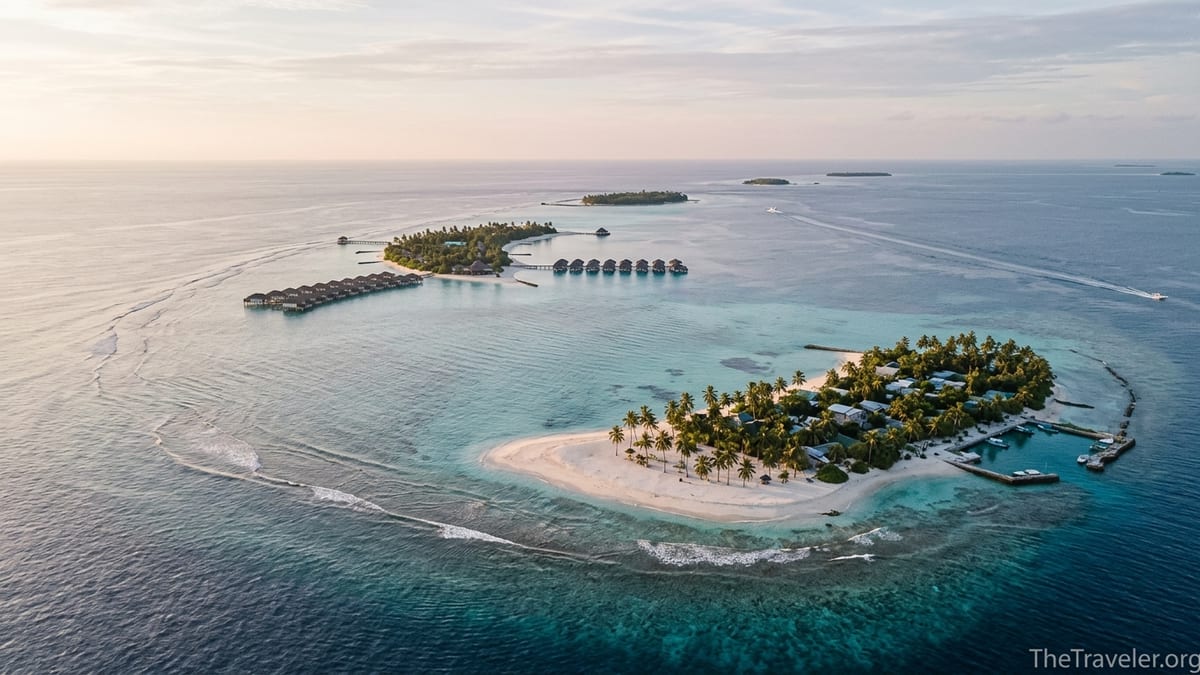
The classic Meemu image is a slender sandbar tapering into a calm lagoon, with a ring of overwater villas set on the deeper turquoises beyond. On islands like Hakuraa Huraa, shallow sand flats extend far from shore at low tide, creating long wading areas and warm shallows ideal for relaxed paddling and beginner snorkeling. House reefs tend to be a little farther from the beach than in parts of Ari or Vaavu, so many guests opt for boat trips to outer reefs and channels where currents bring more pelagic life.
Although Meemu does not yet have the name recognition of Ari, it features uncrowded surfable passes and channels that appeal to experienced surfers seeking quieter peaks. Some resorts and guesthouses have started to offer dedicated surf packages during the April to October season, which can bundle accommodation, boat transfers to the breaks and guiding. Outside the surf season, Meemu is a classic choice for couples and honeymooners who want a sense of isolation without committing to ultra-remote southern atolls that require longer domestic flights.
Prices here vary widely. Mid-range full-board resort stays can sometimes be found at lower nightly rates than comparable properties in Ari or North Malé, especially outside peak months of December to March. Guesthouses on local islands may start from around 50 to 90 US dollars per double, plus transfer fees. Because tourism is still developing, service can feel more personal but infrastructure less standardized, so Meemu is best suited to travelers comfortable with a slightly softer, more informal style of island life.
Choosing Between Resorts and Local Islands
One of the most important decisions when planning a trip to the central Maldives is whether to stay on a dedicated resort island or on a local island in a guesthouse or small hotel. Resorts occupy entire islands leased specifically for tourism. They can serve alcohol, offer private beaches where swimwear norms are relaxed, and typically bundle meals, excursions and spa treatments into streamlined packages. In North and South Malé, some resorts also integrate kids’ clubs, multiple pools and activities such as cooking classes and sunset cruises, making them practical for families and groups.
Local islands, by contrast, are inhabited by Maldivian communities and follow local laws and customs. Alcohol is not served, and guests are expected to dress modestly in village streets, though designated bikini beaches allow normal swimwear. Staying on a local island such as Thulusdhoo in North Malé, Maafushi in South Malé, Fulidhoo in Vaavu or Dhigurah in Ari can cut nightly accommodation costs dramatically compared with resort villas. A simple but clean guesthouse room with breakfast might cost less than the taxes and service charges alone on a luxury overwater suite.
For snorkeling and diving, both resorts and local islands can offer excellent access, but the style is different. Resorts often have house reefs encircling the island, so you can step off the beach and be above coral within a few minutes, while on some local islands the best reefs may require a short boat ride. On the other hand, guesthouses often work with small, owner-operated dive centers that tailor trips day by day to guests’ interests and the conditions, which can be appealing if you want longer dives, flexible schedules or specialist trips such as shark channels in Vaavu and Meemu.
Travelers focused on romance and privacy generally gravitate toward resort islands in Ari, Meemu or the quieter corners of South Malé, where overwater villas are spaced well apart and staff can arrange private sandbank picnics or candlelit beach dinners. Families with younger children often prioritize easy speedboat access and shallow lagoons, making North or South Malé resorts with kids’ clubs and medical facilities a safer and simpler choice. Budget-conscious divers and surfers tend to get the best value on local islands in North Malé, South Malé and Vaavu, where daily boat dives or surf shuttles can be booked on a pay-as-you-go basis.
Accessibility, Transfers and Practical Planning
Central Maldives itineraries are defined by transfers. If you want to avoid seaplanes entirely, focus on North Malé, South Malé and parts of Vaavu, where shared speedboats connect the airport with both resorts and local islands in under 90 minutes. As a rough guide, return speedboat transfers on scheduled services might range from 50 to 200 US dollars per person depending on distance and whether the operator is a resort or local transport company. Private speedboats are considerably more expensive and mostly used by groups or high-end resorts.
Seaplanes are the gateway to many islands in Ari and Meemu. They offer a memorable experience, with views across lagoons and reefs, but they run only in daylight and are more vulnerable to delays in poor weather. If your international flight arrives late in the afternoon or departs early in the morning, you may need to book an overnight stay near the airport before or after your seaplane sector. When comparing resorts, always check whether the transfer is by seaplane, domestic flight plus speedboat, or speedboat only, and factor both timing and cost into your decision.
It is also worth thinking about inter-atoll travel. While maps make it look easy to hop between, for example, a North Malé surf island and a South Ari whale shark resort, in practice almost all transfers route back through Malé or the main domestic airport hubs. Hiring private boats between atolls is logistically complex and often more expensive than simply routing via the capital. If you want a multi-stop holiday, you will usually get smoother logistics by combining islands within the same atoll or by working with a specialist Maldives travel agency that coordinates transfers across properties.
Finally, consider seasonality. The northeast monsoon from roughly December to April generally brings drier, calmer weather and higher prices. From May to October, the southwest monsoon brings more wind and occasional showers but also better surf and productive currents for diving in channels, especially in atolls like Vaavu and Meemu. Whale sharks in South Ari can be seen year-round, but mantas and visibility may fluctuate with plankton levels and currents. When planning, accept a degree of uncertainty and choose an atoll that offers enough non-marine activities to keep you happy if conditions are not ideal every day.
The Takeaway
For a first or even second trip, the central Maldives offer a spectrum of experiences, from quick speedboat-accessible weekend breaks to more remote marine life adventures. North Malé suits travelers who want minimal transfer time, a broad choice of resorts and guesthouses, and easy access to surfing and entertainment. South Malé offers similar convenience with more family-oriented resorts and popular budget local islands like Maafushi, plus several surf breaks within reach.
If your priority is underwater life, Ari Atoll remains the top pick, combining strong house reefs at both resorts and local islands with reliable access to the South Ari whale shark zone. Divers and snorkelers who prefer quieter sites and channel action gravitate to Vaavu, where guesthouses on islands like Fulidhoo provide affordable access to sharky channels and the famous nurse shark night snorkel. Meemu, with its limited number of resorts and local islands, is best for travelers seeking seclusion, uncrowded surf and calm lagoons, accepting slightly more complex or costly transfers in return.
The choice between resort islands and local islands will define not just your budget but your entire experience of the Maldives. Resorts deliver privacy, alcohol service, and polished facilities, while local islands offer community interaction, lower nightly costs and smaller-scale operations. Whichever combination you choose among North Malé, South Malé, Ari, Vaavu and Meemu, planning ahead for transfers, seasonality and your own comfort level with remoteness will help you match the Maldives you imagine with the Maldives you actually visit.
FAQ
Q1: Which central Maldives atoll is best for a first-time visitor?
For most first-time visitors, North Malé or South Malé work best because they are reachable by speedboat in under an hour, offer a wide choice of resorts and local islands, and keep transfer costs down compared with seaplanes.
Q2: Where should I stay if I want to see whale sharks?
The most reliable area for whale shark encounters in the central Maldives is South Ari Atoll. Resorts such as LUX South Ari Atoll and Vilamendhoo, and local islands like Dhigurah, run regular boat trips to the protected whale shark zone along the atoll’s outer reef.
Q3: Which atolls are best for surfing near Malé?
North Malé and South Malé are the main surf hubs in the central region, with well-known reef breaks near local islands like Thulusdhoo, Himmafushi and Guraidhoo, and surf-focused resorts such as Holiday Inn Resort Kandooma catering to intermediate and advanced surfers.
Q4: Are local islands much cheaper than resort islands?
Yes, local islands are typically significantly cheaper. You might find clean guesthouse rooms from about 50 to 120 US dollars per night, whereas resort villas often start several times higher. However, you give up alcohol service, some privacy and many of the extra facilities found at resort islands.
Q5: Which atoll has the best snorkeling house reefs?
Ari Atoll is widely regarded as one of the best for strong house reefs, with islands like Mirihi, Vilamendhoo and several North Ari resorts offering drop-offs close to shore. Parts of Vaavu and North Malé also have excellent reefs, but quality can vary by island.
Q6: How do transfers usually work between Malé and the islands?
For North Malé, South Malé and parts of Vaavu, shared speedboats run set schedules from the airport or capital. Ari and Meemu are mostly served by seaplane or by domestic flight plus speedboat. Transfers are usually arranged by your resort or guesthouse and paid in addition to room rates.
Q7: Is Vaavu Atoll suitable for non-divers?
Vaavu is best known for diving, but non-divers still enjoy it for quiet beaches, sandbanks and the famous nurse shark night snorkel near Alimatha jetty. It suits travelers who are comfortable on boats and happy with a low-key atmosphere rather than resort-style entertainment.
Q8: Which central atoll is most romantic for couples or honeymoons?
Many couples choose resorts in South Ari or Meemu for a more secluded feel, overwater villas and strong marine life. Quieter resorts in South Malé, especially those on private islands with large lagoons, also work very well for honeymoons.
Q9: Is it realistic to visit more than one atoll in a week?
It is possible but can be inefficient, because most transfers between atolls route back via Malé or domestic hubs. For a one-week trip, it is usually simpler to combine two islands within the same atoll or focus on a single base to avoid lost time and extra transfer costs.
Q10: When is the best time of year to visit the central Maldives?
Generally, December to April offers drier weather and calmer seas, with higher prices. May to October brings more wind and occasional showers but better surf and productive currents for diving, especially in channel-focused atolls like Vaavu and Meemu.