


The northern Maldives is where many of the country’s most talked-about luxury islands sit, but two atolls in particular dominate traveler shortlists: Baa Atoll and Noonu Atoll. Both promise overwater villas, turquoise lagoons and castaway sandbanks, yet the experience on the ground can be very different. This internal comparison looks at marine life, resort style, house reefs, transfers, privacy, family facilities, costs and how to match each atoll to the right type of traveler.
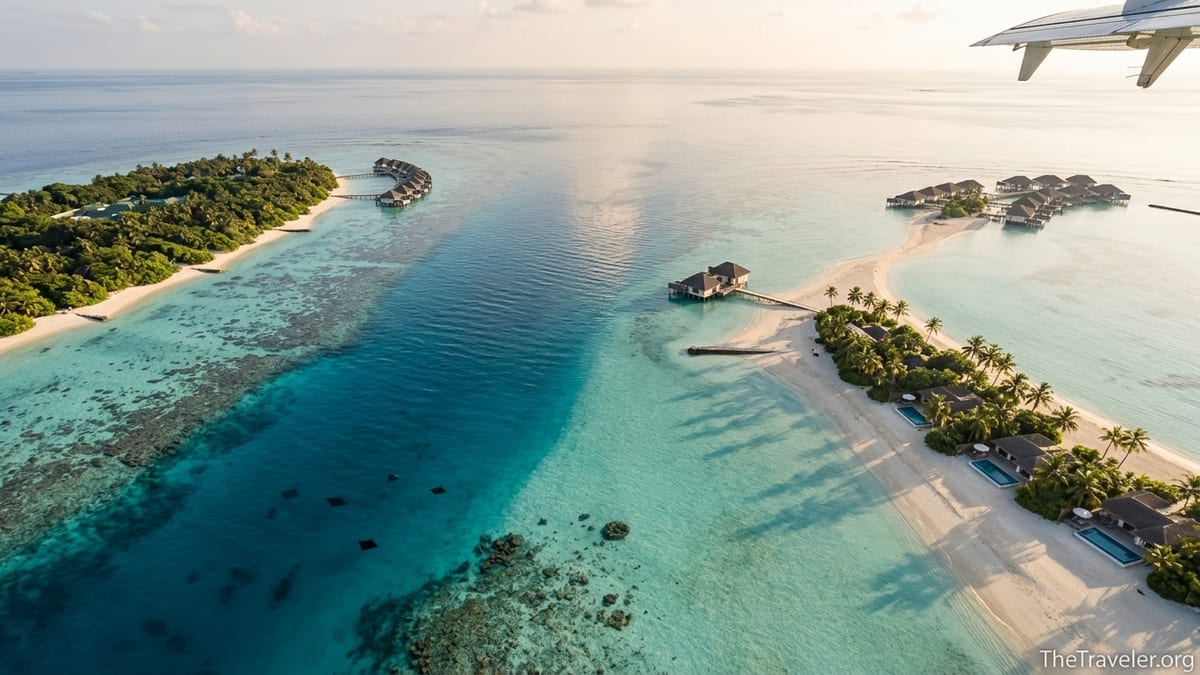
Orientation: Where Baa and Noonu Sit in the Maldives
Baa Atoll lies northwest of Malé in the central-western chain of the Maldives. It is a UNESCO Biosphere Reserve recognized for its dense coral reefs, manta ray aggregations and relatively long-established resort scene. Travelers typically reach Baa via a 30 to 40 minute seaplane hop from Velana International Airport, or in some cases a short domestic flight followed by a speedboat if they arrive after seaplanes stop operating at sunset. In practical terms, it feels well connected yet still clearly away from the capital’s busy traffic lanes.
Noonu Atoll sits further north, roughly 170 kilometers from Malé. It is less developed, with fewer resorts spread over a larger area, which immediately translates into a quieter, more remote feel. Reaching Noonu commonly involves a 35 to 45 minute seaplane transfer that flies over largely untouched lagoons. Some properties also offer a domestic flight plus speedboat for late-night arrivals, but travelers should still expect to overnight in Malé if landing very late, because seaplane services are limited to daylight hours.
In terms of travel time, both atolls are similar once you are in the air, but Baa’s central location means a slightly wider choice of domestic flight routes and local guesthouse options. Noonu’s more northerly position is part of its appeal: you see and hear fewer neighboring islands and boat traffic, something privacy-seeking guests consistently value.
When planning an itinerary that combines multiple properties, Baa is easier to pair with other central atolls such as Lhaviyani or Raa. Noonu usually works best as a single-island stay because inter-atoll seaplane hops can add cost, and resort-to-resort boat transfers are less common at this distance from Malé.
Marine Life & House Reefs: Where the Underwater Action Is
Baa Atoll is globally known for Hanifaru Bay, a protected inlet where, in season, dozens of reef manta rays and the occasional whale shark gather to feed in plankton-rich water. Between roughly May and November, resorts such as Four Seasons Landaa Giraavaru, Dusit Thani Maldives, Anantara Kihavah Maldives Villas and Soneva Fushi run regular excursions, and some even operate informal “manta alerts” so guests can join at short notice when conditions line up. Inside Hanifaru itself only snorkeling is allowed, numbers are capped and stays are time-limited, but the experience of being surrounded by mantas is often what draws travelers to Baa in the first place.
Beyond Hanifaru, Baa’s reef system includes numerous thilas and channels with hard and soft corals, reef sharks, turtles and schooling fish. Several resorts, including Anantara Kihavah and Milaidhoo, are repeatedly praised by divers and snorkelers for strong house reefs that start a few fin kicks from the beach, allowing guests to see turtles, eagle rays and reef sharks on daily casual swims. For travelers who want to maximize marine encounters without spending a lot of time on dive boats, Baa’s combination of accessible house reefs and nearby signature sites is a major advantage.
Noonu Atoll, by contrast, is not anchored to a single world-famous site, but that is part of its appeal. With far fewer resorts and limited local development, the lagoons and outer reefs remain relatively quiet. Resorts such as Sun Siyam Iru Fushi, Noku Maldives, Siyam World and Velaa Private Island advertise thriving house reefs with turtles, reef sharks and rays seen directly from the shore or villa steps. Divers often highlight the sense of space on Noonu dive sites: fewer boats, more untouched coral slopes and regular sightings of pelagics passing through outer channels.
For pure, headline-grabbing wildlife, Baa’s manta and occasional whale shark shows are hard to beat, particularly for first-time visitors keen to tick off iconic encounters. For everyday snorkeling off your villa, the gap narrows. Many Baa and Noonu resorts both deliver excellent house-reef experiences, but Baa carries a slight edge for scientific monitoring, on-site marine biologists and structured conservation programs, while Noonu wins if your ideal reef session involves very few other people in the water with you.
Resort Style & Luxury Level: Established Icons vs New-Era Hideaways
Baa Atoll’s resort scene is older and more varied. It ranges from classic barefoot luxury to high-end but family-friendly resorts and a handful of more accessibly priced four-star options. On the ultra-luxury end, Soneva Fushi is a benchmark for eco-luxury, with large villas, serious sustainability credentials and experiences like outdoor cinemas and observatories. Anantara Kihavah is known for its underwater restaurant and polished service. Four Seasons Landaa Giraavaru blends high-touch hospitality with a strong marine biology focus. These properties typically start from around 1,800 to 2,500 US dollars per night for entry-level villas in high season, before taxes and transfers, and more in peak holiday weeks.
Alongside the flagships, Baa hosts smaller, design-led islands such as Milaidhoo, which targets couples with compact but very private villas and calm, intimate atmospheres, as well as mid-range resorts like Reethi Beach that appeal to divers and repeat Maldives visitors who prioritize reef access over high-gloss interiors. Overall, Baa offers a spectrum: you can find barefoot-chic castaway islands, family-focused brands with kids clubs, and boutique-style properties, often within one seaplane radius.
Noonu Atoll, on the other hand, has positioned itself as a quieter stage for some of the Maldives’ most exclusive names. Velaa Private Island is one of the country’s most expensive and private properties, with only 47 villas and residences, a golf academy and a service model tailored to guests who prefer to stay completely under the radar. Joali Maldives, although technically just outside Noonu in Raa, often gets compared alongside Noonu resorts for its art-immersive design and ultra-luxury positioning. Within Noonu proper, Sun Siyam Iru Fushi offers a more broadly accessible five-star experience with around 15 restaurants and bars, a large spa and a wide activity program.
Compared side by side, Baa’s resorts trend more towards established brands with deep repeat-guest bases and a strong emphasis on marine-led experiences. Noonu, with fewer players, often feels more curated: a mix of extremely high-end private-island offerings like Velaa and larger full-service resorts aimed at families and groups seeking nonstop activity but still wanting the feeling of being far from the crowd.
Getting There: Transfers, Time and Hidden Costs
For most travelers, the journey to Baa or Noonu begins in Malé. Seaplane transfers from Velana International Airport typically fall in the range of about 450 to 800 US dollars per adult for a roundtrip ticket, depending on resort and season. Children’s fares are usually discounted. Because Baa is closer, some resorts can keep transfer costs at the lower end of this band, and a few use nearby domestic airports, which may slightly reduce seaplane exposure for those nervous about small aircraft.
Noonu’s greater distance means transfer pricing is often at the higher end, especially for very exclusive resorts that charter or heavily brand their own seaplane services. Some properties in Noonu offer a domestic flight plus speedboat option that can help late-night arrivals, though this can still add time and complexity. Travelers arriving into Malé after mid-afternoon should plan on an overnight stay in or near the capital regardless of atoll, as seaplane schedules are limited to daylight for safety reasons.
When budgeting, it is important to note that transfer fees are typically not included in headline room rates and are subject to local taxes and service charges. For a family of four, roundtrip seaplane costs can easily reach the low to mid four-figure range. Because Baa has slightly more competition and closer distances, it can sometimes offer marginally better value on transfers, but the difference is not always dramatic. In many cases the specific resort, not the atoll, dictates your final transfer bill.
Where the two atolls diverge more clearly is in onward logistics. If you are combining a resort stay with a local-island guesthouse, Baa’s more central location and domestic flight access to islands like Dharavandhoo gives you more options. Noonu is less developed for independent travel, which suits guests looking for a self-contained, “fly in and stay put” resort model, but is less convenient if you want to explore beyond your island.
Couples vs Families: Matching Atolls to Different Travelers
Both Baa and Noonu cater well to couples, honeymooners and families, but in subtly different ways. In Baa, islands like Milaidhoo and The Nautilus lean heavily into romance and seclusion, with smaller guest counts, private pools and service tuned to adults. Many villas are spaced to minimize overlooking neighbors, and restaurants skew toward quiet, fine-dining atmospheres. At the same time, properties such as Soneva Fushi and Anantara Kihavah blend romance with strong family programming, including kids clubs, teen hangouts and astronomy or marine-biology themed activities suitable for all ages.
Noonu’s family offer is perhaps even more pronounced at several large resorts. Siyam World, for example, is designed almost as a self-contained playground, with slides from some overwater villas into the sea, extensive water parks, multiple pools and all-inclusive dining structures that appeal to multi-generational groups. Sun Siyam Iru Fushi and Noku Maldives also invest significantly in kids clubs, shallow lagoons and multi-bedroom villas, which make them attractive to families willing to pay seaplane prices but seeking good per-person value once on island.
For couples placing a premium on intimacy, Baa offers a higher concentration of small, adults-oriented or at least strongly couples-focused properties. Even at larger resorts, the presence of serious spa programs, quiet sandbanks and low-rise, sandy-footpath design preserves a romantic feel. Noonu, while absolutely capable of hosting honeymoons and anniversaries, tends to split between ultra-exclusive islands that price out many travelers and bigger, high-energy resorts aimed at families and groups. Couples should therefore be specific about the type of environment they want and choose accordingly.
Solo travelers and small groups of friends often gravitate toward Baa if diving and marine life are the main goal, simply because the density of high-quality sites and marine centers is greater. Noonu can be a strong choice for groups who want a mix of watersports, nightlife-style entertainment and the option to stay mostly within the resort bubble without the sense of being in a crowded region.
Privacy, Atmosphere and Sense of Place
On the surface, both atolls tick the postcard boxes: white sand, turquoise water, overwater villas. The differences emerge in atmosphere and how “remote” each place feels. Baa’s longer development history means there are more islands in operation, and on clear days you may see neighboring resort silhouettes or local islands on the horizon. Boat traffic to and from Hanifaru and other dive sites can create a modest sense of movement. Many guests appreciate this as a feeling of being in a living seascape rather than a wholly isolated bubble.
Noonu’s lower resort density creates a stronger impression of seclusion. On many islands, views are dominated by empty horizon or uninhabited sandbanks. At high-end properties like Velaa Private Island, villa orientation, private pools and tailored service routines all reinforce a sense that guests are shielded from others’ presence as much as possible. Even at larger, busier resorts, the sheer amount of space and the distance between islands means you are less likely to see nearby developments or frequent passing boats.
Culturally, both atolls share the same Maldivian heritage, but Baa’s UNESCO Biosphere Reserve status has encouraged tighter integration with research organizations, conservation NGOs and local communities. Guests may find more structured opportunities to visit inhabited islands, learn about reef restoration or attend talks by on-site marine biologists. In Noonu, resorts also support conservation and community projects, but the narrative tends to be framed more around pristine remoteness and “untouched” nature than around a specific biosphere designation.
For travelers who feel more relaxed when they can see that other islands and services are not far away, Baa’s semi-busy seascape will be reassuring. For those whose ideal vacation is about feeling like one of only a handful of people for miles around, Noonu generally delivers that mood more consistently.
Costs, Value and When Each Atoll Makes Financial Sense
Neither Baa nor Noonu is a budget destination by global standards, but there are meaningful differences in how far your money goes. In Baa, the presence of both ultra-luxury and more modest four-star resorts creates a wider price range. It is possible, in some seasons, to find packages at simpler Baa properties that come in around the mid-hundreds of dollars per night, especially for beach villas on half board. Mid to high-end resorts often run early-booking discounts, stay-longer offers and occasional shoulder-season promotions that can materially reduce nightly costs without sacrificing reef quality.
Noonu’s inventory is weighted more towards five-star and ultra-luxury properties, particularly once you factor in the per-night cost of ultra-private islands and expansive villa categories. Some resorts, especially those with all-inclusive or premium-inclusive plans, can represent good value for families and groups who will maximize the inclusions, but entry-level pricing is rarely low. Transfer costs, as noted, tend to sit at or above Baa levels because of the extra distance and premium branding of some seaplane services.
Seasonality affects both atolls similarly. The May to November period, which overlaps with Baa’s manta season, can feature attractive shoulder season pricing but also brings a higher chance of short rain showers and choppier seas. December to April generally commands higher rates, especially over holiday periods, when flagship resorts in both atolls sell out far in advance. Travelers willing to accept some weather variability in exchange for better rates often find late May, June and September particularly good value windows in Baa; in Noonu, value tends to depend more on individual resort campaigns than on a uniform “cheaper” season.
For guests flying long-haul and treating the trip as a once-in-a-decade splurge, the key financial question is often whether to allocate more budget to the room or to experiences. Baa’s variety means you can choose a mid-priced room and invest heavily in diving, private sandbank dinners and repeated manta excursions. In Noonu, the spend often skews towards the villa itself and the overall privacy and design, with more of the activities centered on what is included within the resort environment.
Which Atoll Suits Which Traveler?
When choosing between Baa and Noonu, it helps to start with your non-negotiables. If swimming with manta rays during their aggregation season is a dream, Baa is the clear pick. The atoll’s Biosphere Reserve status, concentration of marine research programs and easy access to Hanifaru Bay make it uniquely suited to wildlife-focused trips where the reef, not the resort, is the main character. Divers, underwater photographers and repeat Maldives travelers who prioritize house reefs over villa aesthetics often lean strongly towards Baa.
If, on the other hand, your priority is extreme privacy, low visual clutter on the horizon and the feeling of being far from the tourist trail, Noonu steps into the lead. The atoll’s limited number of resorts, long sightlines and remote position give it an edge for ultra-luxury, high-privacy stays and for families or groups who want a huge range of included facilities within a single, self-contained island. Guests who enjoy long, quiet walks on largely empty beaches and lagoons without frequent boat traffic usually report that Noonu feels more like the private Maldives of their imagination.
Travelers focused on cost-efficiency within the luxury bracket may find Baa slightly easier to work with, given its broader spread of resort categories and promotions, as well as marginally lower average transfer costs. Those booking top-tier private islands or penthouse-style overwater residences will find that the price difference between Baa and Noonu narrows; at this level, the choice becomes more about design, service style and personal taste than about the atoll itself.
For many, the decision comes down to how they want to remember the trip. If the story you want to tell is about drifting among a cloud of manta rays, snorkeling thriving house reefs and learning from marine biologists in a protected reserve, Baa Atoll is the better fit. If you picture yourself in a sprawling villa in a far-flung atoll, with minimal neighboring islands, high levels of service privacy and an emphasis on quiet, everyday lagoon life, Noonu Atoll will likely be the atoll that best matches your expectations.
The Takeaway
Baa and Noonu Atolls both showcase the northern Maldives at its most compelling, but they do so in different ways. Baa pairs headline marine encounters and a mature resort ecosystem with a biosphere-reserve narrative and relatively convenient transfers. Noonu trades famous names like Hanifaru Bay for a deeper sense of remoteness, ultra-private high-end properties and expansive, less-trafficked seascapes.
For wildlife-first travelers, divers, snorkelers and couples who want a strong sense of place grounded in conservation, Baa usually comes out ahead. For privacy seekers, design connoisseurs and families who want large, facility-rich islands with minimal neighboring development, Noonu often feels more aligned with their vision of the Maldives. Pricing and logistics matter, but in practice most travelers are happiest when they pick the atoll whose core strengths mirror their own priorities.
Whichever atoll you choose, success in the northern Maldives comes down to matching expectations with reality. Clarify whether your must-haves are manta rays and thriving house reefs, or horizon-to-horizon emptiness and ultra-private villas. From there, Baa and Noonu each offer their own version of paradise; the better atoll is simply the one that reflects the Maldives you have been imagining.
FAQ
Q1. Is Baa or Noonu better for seeing manta rays and whale sharks?
Baa Atoll is generally better if manta rays are a priority, especially between roughly May and November when Hanifaru Bay sees peak aggregations. Whale sharks do appear but far less predictably, so travelers should treat any whale shark encounter in either atoll as a bonus rather than a guarantee.
Q2. Which atoll offers the best house reef snorkeling right from the beach?
Both atolls have excellent house reefs, but Baa has a higher concentration of resorts known specifically for strong, easily accessible reefs and structured marine programs. Noonu’s house reefs can be superb as well, with the added benefit of fewer boats and divers around, which enhances the feeling of solitude in the water.
Q3. Are transfers to Baa cheaper or easier than to Noonu?
Transfers to Baa can be marginally cheaper on average due to the shorter distance from Malé, and there are more domestic flight options linking to nearby islands. However, for most travelers both atolls require similar seaplane logistics, and final costs are more influenced by the specific resort’s seaplane contract than by the atoll alone.
Q4. Which atoll is better for a honeymoon?
Both work very well. Baa suits couples who want a strong marine focus, intimate resorts and the chance to combine romance with experiences like manta snorkeling and sandbank picnics. Noonu is ideal for honeymooners who prioritize seclusion, large private villas and very quiet surroundings with minimal neighboring islands in view.
Q5. Is Noonu really more private than Baa?
In practice, yes. Noonu has fewer resorts spread over a wide area, so you tend to see less boat traffic and fewer nearby islands on the horizon. Baa is still tranquil by global standards, but its longer development history means more visible signs of other islands and activity, especially near key marine sites.
Q6. Which atoll is better value for money?
Baa usually offers a wider range of price points, from mid-range dive-focused resorts to ultra-luxury properties, so it can be easier to find options that balance reef quality with cost. Noonu leans more towards high-end and ultra-luxury, and while inclusive plans can offer good per-person value, entry prices are rarely low.
Q7. Are both atolls suitable for families with children?
Yes. Baa has several resorts that combine strong kids clubs with great snorkeling, while Noonu features some of the Maldives’ biggest, most activity-driven family resorts, complete with water parks, slides and multiple dining options. Families should focus on individual resort facilities rather than the atoll name when choosing.
Q8. How far in advance should I book Baa or Noonu in peak season?
For December to April, and especially for the Christmas and New Year period, it is sensible to book at least six to nine months in advance for both atolls. Signature villas, private residences and the most sought-after overwater categories can sell out even earlier at headline resorts.
Q9. Can I easily combine stays in Baa and Noonu on one trip?
It is possible but not always straightforward or cost-effective. Inter-atoll transfers often involve returning to Malé for another seaplane or domestic flight. Given the distances, many travelers find it more relaxing and economical to focus on one atoll per trip unless they have ample time and budget for complex transfers.
Q10. If it is my first time in the Maldives, which atoll should I pick?
If your dream is centered on iconic underwater encounters and learning about a UNESCO-listed marine environment, Baa is usually the best first choice. If your vision is more about an ultra-private, visually empty horizon and spending time in a standout villa with comprehensive on-island facilities, Noonu is likely to feel closer to the Maldives you have imagined.