


From the air, Noonu Atoll looks like a painter dropped a palette of blues into the Indian Ocean. From the waterline at Kuredhivaru, one of the most talked-about snorkeling bases in the atoll, it feels even more vivid. Over several days of snorkeling directly off the island’s beaches and from the dive-center jetty, I kept detailed notes on how the house reef actually performs for keen snorkelers. This is a practical report from the water, not a brochure translation: how far you really swim, how deep it feels under your fins, what coral is alive, and which fish, turtles, rays and sharks you are realistically likely to see.
Setting the Scene: Noonu Atoll and Kuredhivaru’s Location
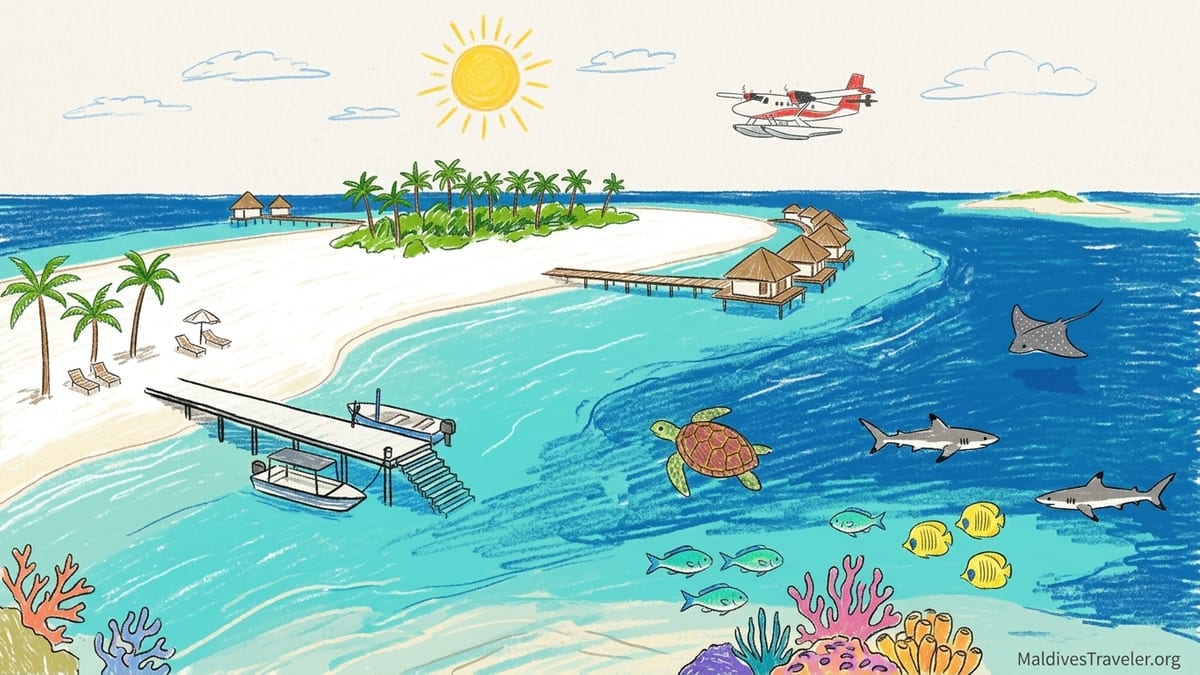
Noonu Atoll sits in the northern half of the Maldives, a little over 180 kilometers from Malé. It is a relatively sparsely developed atoll, which is part of the appeal. Compared with resort-heavy atolls nearer the capital, Noonu still feels quiet once you are on the water. The seaplane flight in is often described as part of the experience, and on the approach to Kuredhivaru you can already see the dark ring of reef encircling the island, with the PADI dive center perched at the edge. That aerial view turns out to be a fair preview of what the house reef delivers once you get your mask on.
The island at Kuredhivaru is long and slightly curved, with overwater villas extending from one side and a dive center and watersports base on another. Snorkeling access is deliberately centered around the dive-center jetty and a designated platform on the reef edge, which are used for both guided dives and do-it-yourself snorkeling sessions. Staff encourage guests to treat the reef as something to be entered at specific points, partly for safety and partly to protect the coral. Over several days I used both the structured entry at the dive-center jetty and more casual entries from the beach near the sports center to get a sense of the different approaches.
Noonu Atoll as a whole is known among dive operators for healthy outer reefs and channels with reef sharks and seasonal manta sightings. That reputation raises expectations, and it is important to be clear that a resort house reef rarely matches a top outer atoll site. Even so, the reef fringing Kuredhivaru has been consistently praised in recent independent summaries of guest reviews as one of the stronger snorkeling options in Noonu, with particular mentions of accessible drop-offs and regular encounters with turtles and blacktip reef sharks. My time in the water largely agrees with that picture, though with caveats about coral recovery and currents.
Beach Entries and Swim Distance to the Reef Edge
On paper, the resort encourages snorkelers to head for two main entry points on the house reef: the dive-center jetty, which can be used all day, and one of the overwater-villa jetties, which is recommended only around high tide. In practice, snorkelers also slip in from sandy gaps along the main beach near the watersports center, especially when the sea looks calm and inviting. I tested all three options during a mid-year visit when sea conditions were fairly typical for the southwest monsoon, with light chop on the windward side and calmer water in the lee of the island.
The easiest entry for less confident swimmers proved to be the dive-center jetty. Here, a short set of steps drops you straight into water that is roughly chest to neck deep on an average-height adult at mid-tide. From the jetty, the reef flat extends perhaps 30 to 40 meters before it begins to slope more steeply, and another 20 meters beyond that you are at the lip of the main drop-off. So from the ladder to the edge of the reef, you are looking at an unhurried surface swim of about 50 to 60 meters. Stronger swimmers cruising steadily can cover it in a few minutes; tentative snorkelers who pause to adjust gear may take closer to ten.
Beach entry near the watersports center is more gradual. Here you can wade out through fine, white sand until the water reaches your waist, usually after 15 to 20 meters, and then start floating over scattered coral bommies in one to two meters of water. The main reef structure lies further out, roughly 70 to 100 meters offshore in this section. That longer swim is pleasant on a glassy morning, but it can feel exposed when afternoon winds pick up. Several families I spoke with preferred the beach entry for the ability to stand in the shallows and adjust masks and children’s vests before committing to the swim, but then turned back once the depth and slight surge increased near the drop-off.
The overwater-villa jetty entry, usable around high tide, offers the shortest horizontal distance to the reef edge, since the villas are built almost directly above the deeper coral slope. From villa steps or the nearby ladder, the reef wall starts less than 20 meters away. The trade-off is that the water here is already three to four meters deep at the steps, so non-swimmers will not be able to stand at all. For confident snorkelers comfortable with depth and without children in tow, this is arguably the most efficient way to reach the interesting part of the reef quickly, especially early in the morning before boat activity begins for the day.
Depth, Currents and Overall Comfort in the Water
One of the first things snorkelers notice at Kuredhivaru is how quickly the depth changes once you pass the inner coral gardens and move toward the drop-off. Inside the reef flat, near the beach, the water is often waist to chest deep at mid-tide and no more than two meters deep at low tide. You can see sand ripples on the bottom, patches of seagrass and the bases of coral heads with remarkable clarity when visibility is good. As you glide toward the outer side, that depth increases to three or four meters along the slope and then drops away beyond the ledge, where the blue becomes noticeably darker and the bottom disappears from casual view.
At the main drop-off, estimates from both the dive team and depth-gauge-equipped divers put the depth beyond the ledge at over 20 meters within a short distance, which explains why the resort’s dive center is built practically on top of the reef. From the surface, you do not need precise numbers to feel the change. Fish behavior shifts, with larger schools peeling away into the blue, and the sense of hovering above a wall rather than over a shallow garden becomes pronounced. For confident swimmers this adds a sense of drama that many house reefs lack. For less experienced snorkelers, the abrupt transition can feel intimidating, and a buoyancy aid is a good idea.
Currents around the island vary by tide and seasonal monsoon pattern, but during my stay the most consistent flow was parallel to the reef edge near the dive center, gently pulling from one side of the island to the other. On most sessions this current was manageable, useful even, for a drift-style snorkel where you enter from the jetty and let yourself be carried along the wall before exiting further down and walking back on shore. The dive team briefings consistently warned against pushing out across the channel beyond the reef, where current can increase sharply, particularly at mid-tide when water exchanges between lagoon and open ocean are strongest.
In three days of snorkeling two to three times per day, I experienced one session where wind-driven chop and a stronger current combined to make the swim back to the jetty tiring. That was in the late afternoon on the windward side, when whitecaps were visible beyond the reef. For that reason, families and less confident swimmers are better off planning their longest reef swims either in the early morning, when the sea is often calmest, or on the more sheltered leeward side of the island where resort staff sometimes set out a safety float or keep a lifeguard in sight of the main swimming zone.
Coral Condition and Water Visibility
Like much of the Maldives, Noonu Atoll has not escaped coral bleaching events in recent years, and it would be inaccurate to describe Kuredhivaru’s house reef as uniformly pristine. At snorkel depth along the reef flat you will see bleached and broken coral mixed with living colonies, especially in the shallower few meters closest to the sand. Hard corals, including table and branching forms, are patchy but clearly in a phase of regrowth in several sections. Soft corals and sponges add more color and texture once you move down the slope where water temperatures and exposure appear to have been kinder.
From the dive-center jetty along the right-hand side of the reef, I found some of the healthiest coral within 50 to 80 meters of the platform at three to five meters deep. Here, mounded hard coral heads form a mini landscape, and smaller fish species shelter among the crevices. On one memorable morning with glassy sea conditions, I could see the outline of these structures from the surface as clearly as if I were looking into a swimming pool, even though the depth below me was several meters. That clarity made it easy to float above the busiest patches without the temptation to kick downward and risk touching anything.
Water visibility during my visit was generally excellent, in the range of 20 to 25 meters horizontally on calm days, dropping closer to 10 to 15 meters when wind-driven chop stirred up fine sand from the shallows. The best combination of light and clarity tended to be mid-morning, roughly between 9 and 11 a.m., when the sun was high enough to pierce the water but pre-lunch boat traffic had not yet peaked. Late afternoon sessions could be beautiful when rays of low-angle sunlight slanted across the reef, but particles in the water also caught that light and sharpened the sense of haze.
Overall, if your mental image of a Maldivian reef is borrowed from untouched outposts that escaped bleaching, you will notice areas of stress here. If instead you are expecting a recovering reef with pockets of genuine beauty, Kuredhivaru’s house reef delivers. Its strength lies less in a carpet of unbroken coral and more in the combination of reasonable coral cover, varied topography and the presence of larger marine life that visits or patrols the reef wall.
Fish, Turtles, Rays and Sharks Actually Encountered
Across roughly a dozen snorkel sessions over several days, I kept a simple log of notable sightings. Everyday residents were present in force. Sergeant majors, butterflyfish, surgeonfish and parrotfish were constant companions, especially in the upper three meters of water along the slope. Blue-green chromis clustered over branching corals like clouds of confetti, and small wrasses flashed iridescent colors as they zigzagged in and out of rock crevices. None of this will surprise anyone who has snorkeled in the Maldives before, but the density of small reef fish here was above average compared with some heavily trafficked house reefs nearer Malé.
Larger, more charismatic species did appear regularly. Blacktip reef sharks were the most visible predators, with juveniles cruising ankle-deep water just off the beach and adults patrolling the drop-off. During one mid-morning drift, I counted five distinct blacktips between one and one and a half meters long within a 20-minute window, all keeping a casual but consistent distance of two to three meters from me. These sharks are wary rather than aggressive, and resort staff sensibly brief guests not to chase or corner them. A few nighttime walkers reported seeing the same species ghosting through the shallows under jetty lights.
Turtles were present but less predictable. Across my three snorkeling days, I encountered hawksbill turtles on three occasions. The first was over the slope near a patch of healthy hard coral, where a mid-sized individual surfaced twice within 10 meters of me before resuming feeding. The second and third sightings were gliding along the wall, silhouetted against the blue, both at depths of roughly five to eight meters. Divers and long-stay guests I spoke with claimed that turtles are seen on “most days” if you spend enough time on the reef, particularly in quieter corners away from the main jetty, but shorter-stay visitors should treat them as a bonus rather than a guarantee.
Rays were less of a house-reef staple and more associated with boat trips to sandbanks and channels, but I did see a single eagle ray pass along the outer edge of the reef during an early-morning snorkel. It appeared briefly below and ahead, moving purposefully along the wall before disappearing into deeper water. Nurse sharks, which are regularly reported at some Noonu properties such as Robinson Noonu, did not feature in my house-reef sessions at Kuredhivaru, though dive-center staff mentioned that they are encountered more often on dedicated boat dives to specific thilas and channels in the atoll.
How the House Reef Shapes Your Stay
Because the reef is accessible directly from the island and via the dive-center jetty, it naturally becomes a daily rhythm-builder for guests who are comfortable in the water. Several repeat visitors I met described falling into a pattern of early-morning snorkel before breakfast, a mid-day rest and then either a second house-reef session or an afternoon boat trip, depending on weather and energy levels. The fact that snorkel gear is typically provided as part of the stay, with no separate rental fee if you bring it back daily, lowers the threshold for casual, short swims.
For families, the house reef offers an accessible step up from pool-only days without committing to a long excursion. The inner sandy areas in front of the main beach allow children to practice with masks and fins while parents supervise from waist-deep water. From there, confident swimmers can venture out to the first coral heads and then, in stages, toward the deeper reef, always with the option to turn back before reaching the drop-off. Because the dive-center team runs regular reef-safety briefings and sometimes posts a staff member to keep an eye on busy sections during peak times, there is a structure in place that makes many guests more comfortable about entering open water.
The presence of a functioning PADI dive center directly over the reef also shapes how you experience it. Guided house-reef snorkels are on the activities board most days, often scheduled in the late morning or mid-afternoon, and these are useful for first-time or nervous snorkelers. A guide will lead a small group from the jetty along a portion of the wall, point out notable species and then assist everyone in exiting safely. Night snorkeling on the house reef is also typically offered, transforming familiar daytime territory into a very different seascape of hunting lionfish, sleeping parrotfish and occasionally cruising sharks in the beam of dive torches.
During my stay, boat traffic around the house reef was noticeable but not disruptive. Dive boats and excursion dhonis largely kept outside the main snorkel area, using separate channels. At times, though, you could hear distant engine hum while floating quietly above the coral. Some snorkelers appreciate the reassuring sense of infrastructure nearby; others may prefer the illusion of total isolation found at more remote, dive-centric islands where the house reef is the primary attraction and daily boat runs are fewer.
House Reef vs Boat Snorkeling: Is the Reef Alone Worth the Trip?
The key question for many travelers is whether Kuredhivaru’s house reef is strong enough to justify choosing this resort primarily as a snorkeling base, or whether you would be better off at a different island where boat snorkeling dominates. Based on my time in the water and conversations with both staff and experienced guests, the answer is that the house reef here is very good by general Maldivian resort standards, particularly within Noonu Atoll, but it does not entirely replace the value of boat excursions if you are an avid snorkeler chasing variety.
On the plus side, the combination of easy access, dramatic drop-off, decent coral recovery and frequent shark and occasional turtle sightings gives the reef genuine character. You can spend several days exploring different stretches without boredom, especially if you vary your entry point and the time of day. Compared with resorts whose reefs are either too far from shore for relaxed swims or too shallow and sand-smothered to support much life, Kuredhivaru offers a satisfying middle ground that rewards daily, unguided snorkeling.
Where boat snorkeling comes into its own is in exposing you to the wider Noonu seascape. Outer-reef and channel sites within a 15 to 40 minute boat radius add wall dives with stronger currents, cleaning stations where bigger pelagics aggregate and, in season, the chance of manta rays. These trips usually cost extra, often in the range that experienced travelers report as roughly 70 to 120 US dollars per person for a half-day snorkeling excursion including gear and guide, depending on the specific site and group size. While the resort positions the house reef as a core attraction, even enthusiastic snorkelers who love it tend to book at least one or two of these outings during a week-long stay.
If you are the sort of traveler who wants a house reef on par with the very top-rated Maldivian snorkeling islands, where you might easily spend the entire holiday circling the island with fins and never tire of it, you may find Kuredhivaru sits just a notch below that rarefied tier. Its reef is strong enough to be a major reason to book, especially if you are also interested in the resort’s villa hardware and service, but perhaps not the sole deciding factor if snorkeling is your absolute top priority. If, however, you value a balance of good reef access, full-service resort comforts and the option to upgrade your underwater experience with boat trips, Kuredhivaru and its corner of Noonu Atoll make a persuasive case.
Practical Tips for Snorkeling Kuredhivaru’s House Reef
Several practical lessons emerged over repeated sessions on the reef. The first is timing. Early-morning snorkels between 7 and 9 a.m. consistently offered the calmest water, softest light and some of the most interesting wildlife behavior, including reef sharks patrolling the shallows and turtles rising to breathe in quieter stretches. Midday brought intense light that penetrated deeper and lit up coral structures, but also stronger glare at the surface and more boat activity along the horizon.
The second is route choice. From the dive-center jetty, heading right along the reef wall often produced slightly better coral and fish density than going left, though conditions change and staff sometimes reverse that recommendation based on wind and current. If you are planning a drift snorkel, check the current direction from the jetty steps before you commit. You want to move with the flow, not against it, and know in advance where you intend to exit back onto the island.
Gear matters as well. While the resort typically supplies masks, snorkels and fins at no extra charge for in-house guests, serious snorkelers may prefer to bring their own well-fitted masks and, if used to them, short open-heel fins with booties. A thin rash guard or swim shirt helps protect against both sun and the occasional brush with stinging plankton in the water column. Reef-safe sunscreen is encouraged by the resort, and applying it well before entering the water reduces slicks on the surface that can interfere with visibility, especially in calm lagoons where oils can linger.
Finally, factor in your own swimming confidence honestly when deciding whether to rely entirely on the house reef for underwater entertainment. If you are comfortable in open water without the ability to stand, the reef’s depth changes and drop-off will feel like exciting features. If not, prioritize the shallower inner gardens, consider a buoyancy vest and perhaps start with a guided house-reef snorkel to build familiarity with the environment. The goal is to turn the house reef into a pleasant daily ritual, not an ordeal.
The Takeaway
Snorkeling at Kuredhivaru in Noonu Atoll delivers a house-reef experience that feels rooted in the real Maldives of 2026: a reef that has endured stress, is visibly recovering in sections and still hosts a lively cast of marine characters. From the first step off the dive-center jetty to the moment you float above the drop-off watching blacktip sharks trace the edge of the blue, it offers enough drama and accessibility to anchor an ocean-focused holiday.
Beach entries are straightforward, the swim to the reef edge is manageable for anyone with moderate fitness, and the combination of two main access points allows you to adapt your route to wind and tide. Depth increases quickly enough to add a sense of hovering above a wall rather than merely drifting over a flat, and currents are usually gentle enough to make drift-style snorkels pleasant, provided you heed dive-center guidance about avoiding channels and stronger flows.
Coral condition is mixed but hopeful, with pockets of healthy structure and color in three to five meters of water where sunlight and cooler circulation combine in the reef’s favor. Everyday fish life is abundant, and while headline species such as turtles and rays are not guaranteed, they are present often enough to make each session feel like a genuine encounter with a working reef ecosystem rather than a staged aquarium. The proximity of the PADI dive center, literally built over the reef, underpins these experiences with accessible briefings, guided snorkels and night sessions for those who want to take the next step.
Is the house reef alone reason enough to choose this resort in Noonu Atoll? For many snorkel-led travelers, the answer will be yes, particularly when combined with the island’s comfortable villas and seaplane-accessible location. For purists who measure every reef against the very best in the country, it may land just shy of legendary status, but still firmly in the category of “worth waking up early for every day.” Add a couple of boat excursions to outer reefs and channels, and Kuredhivaru becomes not just a place with a house reef, but a solid base camp for exploring one of the Maldives’ quieter and more rewarding atolls from the water.
FAQ
Q1. How far is the swim from the beach to the reef edge at Kuredhivaru?
The main reef edge typically lies about 70 to 100 meters offshore from the central beach and around 50 to 60 meters from the dive-center jetty ladder, which most confident swimmers can cover in a few relaxed minutes.
Q2. Do I need to be an experienced swimmer to snorkel the house reef?
You do not need to be an athlete, but you should be comfortable swimming in water where you cannot stand. Less confident swimmers can stay over the shallower inner gardens, use buoyancy vests and join guided house-reef snorkels led by the dive center.
Q3. What kinds of sharks are usually seen on the house reef?
The most commonly encountered species are blacktip reef sharks, both juveniles in the shallows and adults along the drop-off. They generally keep a respectful distance and are not considered dangerous if left unprovoked.
Q4. How healthy is the coral compared with other parts of the Maldives?
The coral shows a mix of bleaching damage and encouraging regrowth. You will see stressed and broken sections, but also areas of healthy hard and soft coral in three to five meters of water. It is not the most pristine reef in the country, yet it remains one of the stronger house reefs in Noonu Atoll.
Q5. When is the best time of day to snorkel the house reef?
Early mornings and mid-mornings usually offer the calmest water and clearest visibility, with softer light and fewer boats. Late afternoons can be beautiful but may have a little more surface chop and suspended particles.
Q6. Are turtles and rays guaranteed sightings on the house reef?
No wildlife is guaranteed, but hawksbill turtles are seen regularly by guests who snorkel daily, and eagle rays occasionally pass along the drop-off. For higher chances of rays or mantas, dedicated boat trips to known sites in the atoll are recommended.
Q7. Does the resort provide snorkel gear, or should I bring my own?
The resort typically offers masks, snorkels and fins for in-house guests, often without extra charge for basic use. Passionate snorkelers may still prefer to bring their own well-fitted masks for comfort and to reduce the risk of leaks or fogging.
Q8. Are guided snorkeling tours on the house reef available?
Yes, the on-site PADI dive center usually runs guided house-reef snorkels and night snorkeling sessions, which are especially helpful for beginners or those who want a marine expert to point out species and manage safety.
Q9. How does the house reef compare to boat-snorkeling sites nearby?
The house reef is strong enough to keep keen snorkelers happy day after day, but boat trips to outer reefs and channels offer more dramatic topography, stronger currents and a higher chance of larger pelagic species. Many guests choose to do both.
Q10. Is Kuredhivaru a good choice if snorkeling is my main reason for visiting Noonu Atoll?
If you want a reliable house reef you can access daily, with regular shark encounters and ongoing coral recovery, Kuredhivaru is a solid choice. If you are chasing only the very top-tier reefs in the Maldives, you may want to pair it with a resort or itinerary known purely for exceptional snorkeling.