


The marketing around Noonu Atoll in the Maldives can sound almost mythical, full of sweeping promises about shark-filled channels and easy drifts for every level of diver. On my recent trip I set out to test those claims under real-world conditions. Over a week of boat diving with a local PADI center, I logged a mix of reefs, thilas and channel edges in Noonu, taking careful notes of what I actually saw, how the currents felt, and what that means in practice for beginners, intermediate divers and anyone planning a once-in-a-lifetime Maldives holiday.
Dive Base, Certification Level and How I Planned the Week
For this Noonu Atoll trip I based myself on an island with a resident PADI 5 Star dive center that operates twin-dhoni day boats and nitrox. The center follows standard Maldivian practice: a detailed briefing with a sketch of the site, a negative or controlled descent depending on current, and surface support throughout. All dives were guided in small groups, usually four to six guests per divemaster, which helped keep the drift dives organized once the current picked up.
I dived with an Advanced Open Water certification and roughly 200 logged dives, plus the PADI Drift Diver and Nitrox specialties. The dive center required at least Advanced or an equivalent experience level for the more exposed channel dives in Noonu, especially when the current was forecast as medium to strong. Open Water divers were limited to more sheltered reefs, lagoons and easy outer slopes, which meant that not every diver on the island could join every excursion.
Across the week I averaged two boat dives a day, occasionally three when conditions allowed. Depths stayed within recreational limits: most reefs topped out around 5 to 10 meters, with working depths between 18 and 28 meters on the more serious sites. Maximum depths, recorded on my computer, ranged from 22 meters on the shallowest reef dives to about 30 meters on one of the deeper corners when the action was lower on the wall. Nitrox 32 was available at a surcharge, and almost everyone on the boat used it for added cushion on repetitive dives.
Equipment-wise I brought my own mask, computer, SMB and regulator, and rented a BCD and 3 mm shorty from the center. Rental gear was in solid condition, with standard aluminum 12-liter tanks using both DIN and yoke fittings via inserts. The boat crew set up tanks and handled the swaps, but guests were expected to check their own valves, weights and computers before each backward roll or giant stride off the dhoni.
First Impressions: House Reef and Easy Outer Slopes
We started the week with two check dives on an easy outer reef and the island’s house reef. These sites sat in the lee of the atoll, chosen specifically to avoid the livelier currents on the channels until everyone’s weighting and buoyancy were dialed in. The boat ride was short, about ten to fifteen minutes each way, which made it a low-stress introduction to Noonu’s conditions.
On these calmer sites, depths hovered around 14 to 20 meters along a gently sloping reef that dropped into blue water. Current was light enough that we could fin slowly into it without strain. Visibility was respectable at roughly 18 to 22 meters, a touch milky from recent wind but more than enough to see the structure of the reef and approaching fish. Water temperature held around the high 20s Celsius, so a 3 mm suit was comfortable for 50 to 60 minute runs.
Marine life on these initial dives was classic Maldives rather than headline-grabbing. I noted healthy schools of fusiliers and blue triggerfish, swarms of anthias along the crest and plenty of surgeonfish. Closer inspections of the reef revealed moray eels tucked into crevices, cleaner wrasse stations and a few well-camouflaged scorpionfish. We saw a couple of small white tip reef sharks cruise by at a distance and one green turtle grazing unbothered on a coral head. There were no rays or big pelagic encounters on these first dives, but the coral cover in patches was encouraging, with tables and branching corals intermixed with rubble from older storm damage.
The main takeaway from those early immersions was that Noonu can indeed be gentle and forgiving in the right spots. Air consumption was relaxed, the ascent and safety stop were conducted on a mooring line, and less experienced divers on the boat, including those with under 30 dives, came up smiling and unshaken.
Raafushi Corner: The First Taste of Real Current
The character of the diving shifted when we moved to Raafushi Corner on the eastern side of Noonu Atoll, a site that lies where a tongue of reef meets an atoll channel. Our briefing emphasized that this would likely be our first medium-strength current of the week and that if it ran incoming, we would use reef hooks near the corner to watch whatever drifted by. The boat time from our island was about 30 to 35 minutes, enough to kit up, check gear and review hand signals for current changes.
We rolled in close to the reef, dropped to about 20 meters and immediately felt the flow, a steady push that required deliberate fin strokes to maintain position while we traversed toward the corner. This was not a ripping, equipment-rattling current, but it was strong enough that a diver with marginal buoyancy or fitness would notice the effort. Our guide kept the group tucked close to the wall where the current eased slightly, using bommies as eddies for brief rests.
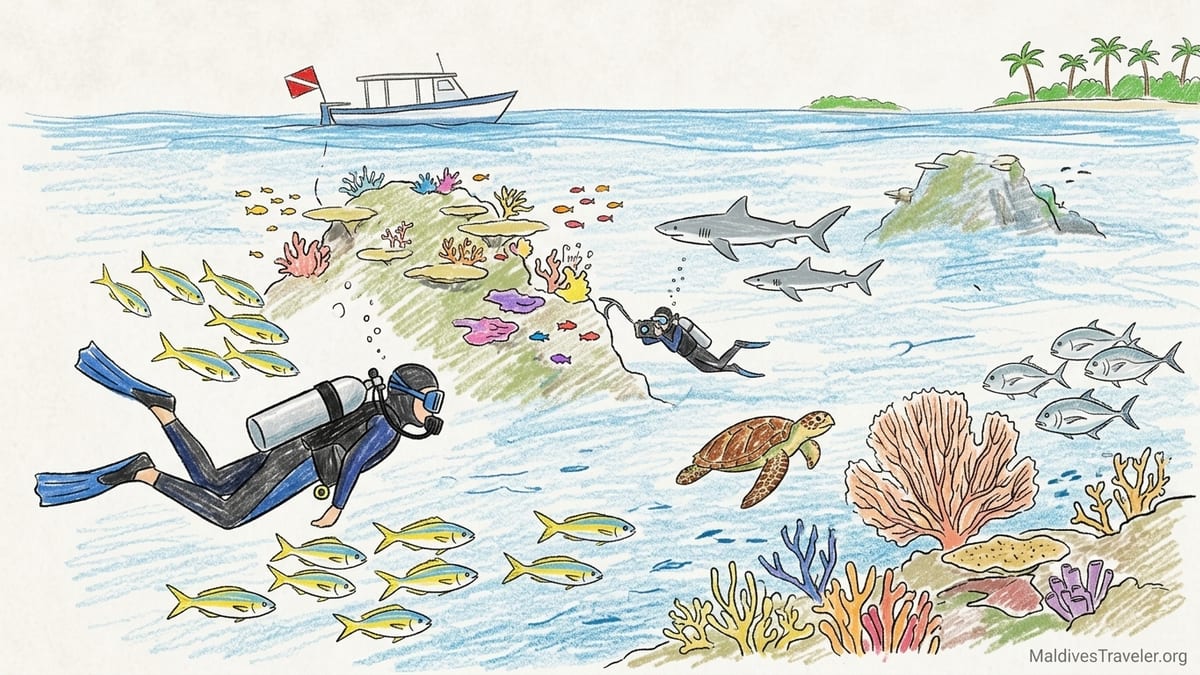
At the corner we settled around 24 to 26 meters and clipped in with reef hooks, inflating BCDs slightly to rise off the coral and hang in the blue. In front of us the water was alive: a dense curtain of blue and yellow fusiliers, a pack of large trevally patrolling the outskirts, and a handful of batfish hovering just above the slope. During roughly 15 minutes hooked in we saw several grey reef sharks at mid-water distance, moving confidently across the current line. They never came as close as the marketing photos often imply but they were unmistakable, solid and relaxed in their home territory.
Other notable sightings on this dive included a single spotted eagle ray passing below us, a Napoleon wrasse working over the reef for food, and a hawksbill turtle that made an unhurried transit along the slope, indifferent to our presence. The current eased slightly as the tide shifted, and we unhooked to drift shallower along the top of the reef at 12 to 15 meters, finally ascending in the blue with a delayed SMB. By the time we surfaced, most divers reported the current as “moderate but manageable,” with only one guest needing help to stay close during the drift.
Thilas and Cleaning Stations: Structured Dives in the Blue
Mid-week we dedicated a day to thilas, the submerged pinnacles that are a hallmark of Maldivian diving. In Noonu, the most talked-about thilas double as cleaning stations for reef sharks and other pelagics, but what you see depends heavily on current strength, time of day and luck. The shop deliberately scheduled these dives for early morning, aiming to arrive around slack turning to mild incoming tide in the hope of shark traffic without unmanageable flow.
Our first thila dive started with a negative descent in open blue. We rolled in on the divemaster’s signal, vented our BCDs and dropped quickly to about 18 meters where the top of the pinnacle came into view. Current was mild at depth, but the surface layer had enough movement that anyone delaying their descent would have risked being pushed off the mark, which is why the briefing insisted on fast, coordinated entries and no lengthy mask-clearing on the surface.
Once established on the thila, we circled clockwise between 20 and 27 meters, staying out of any sand channels where the flow was stronger. This was one of the more fish-dense dives of the trip. Schools of snapper and sweetlips clustered around overhangs, while clouds of anthias formed bright orange halos above table corals. We spotted several more grey reef sharks cruising the perimeter of the cleaning station, but again they remained at a respectful distance. A couple of large barracuda hovered in the blue, holding steady in the faint current. We did not see manta rays or large numbers of eagle rays here, which underscored the point that even known cleaning stations do not guarantee marquee encounters on any given day.
Our second thila that day was shallower, topping at roughly 12 meters with a base around 24 meters. Visibility opened to about 25 meters and the current slackened noticeably. This created ideal conditions for longer bottom times and wide-angle views. Highlights were two green turtles, both approachable at close range, and a small group of white tip reef sharks napping on the sand. Macro hunters in the group focused on nudibranchs and cleaner shrimps tucked into the reef, which were easy to appreciate now that we were not fighting the flow.
Channel Edges and Drift Skills: How Challenging Did It Really Feel?
The core question for most divers considering Noonu is how tough the channels and drifts actually feel in the water, compared with the way PADI and resort brochures frame them as suitable for all levels but especially appealing to intermediates. Over the week I experienced a range from almost lake-like calm to what I would classify as solid intermediate-level drift, but nothing that rose to truly punishing or unsafe when handled by a competent guide and prepared divers.
On the livelier days, currents at channel edges were strong enough that swimming directly into them for any length of time would have been futile. Instead, we followed the contours of the reef, using the guide’s knowledge of eddies and overhangs to make progress with minimal effort. There were moments, particularly at 23 to 28 meters near corners, when controlling buoyancy felt more demanding. Any lapse in trim or finning could send a diver drifting higher into faster water or sliding off the reef into blue, so situational awareness and comfort with quick micro-adjustments were essential.
At no point did we encounter true washing-machine conditions or violent down-currents, but there were short sections where the water funneled and accelerated, briefly tugging us sideways or upward. Less experienced divers on the boat who were used to calm quarry or sheltered tropical reef diving commented afterward that these channels felt like a meaningful step up. They were glad to have a line to hold during safety stops and appreciated the pre-dive explanation of how to deploy SMBs if separated.
In terms of suitability, I would not recommend Noonu’s channel and outer corner dives as a first experience with current for brand new Open Water divers who have never drifted before. However, for divers in the 30 to 100 dive range who have done at least a few drifts elsewhere and who are comfortable descending and ascending without a fixed line, Noonu offers a very manageable platform to grow those skills, as long as they stay within the limits of conservative, guided dives.
Visibility, Surface Conditions and Boat Logistics
Across the week, underwater visibility in Noonu ranged from about 15 meters on the haziest day to around 25 meters at its best. On average I would place it around 18 to 20 meters, enough to see other groups on the reef and any larger animals approaching from the blue, but not the ultra-crystal conditions that some Maldives postcards might suggest. Reduced visibility tended to coincide with slightly choppier surface conditions, which the dive center monitored when choosing sites.
Surface intervals played out on the dhoni or mother boat, with tea, coffee and snacks between dives. Boat times varied from ten minutes to local reefs, through half an hour to channel corners like Raafushi, up to roughly 45 minutes for the farthest thilas. For planning days, this meant that two-tank morning trips would usually get us back to the island by early afternoon, leaving time for rest or a sunset house-reef dive. Seas ranged from near-flat to modest wind chop, but there were no days lost to weather during the week.
Entry methods were standard giant strides from the dhoni’s rear deck or side, with crew positioning the boat upcurrent of the drop point so that the group drifted down to the planned starting depth and structure. Pickups were efficient, usually within a few minutes of SMB deployment. Oxygen kits, spare masks and extra weights were kept on board, and the staff insisted on seeing each diver’s computer and certification card on the first day, which contributed to a sense of orderly operations rather than ad-hoc improvisation.
Gear rinsing and storage took place back at the dive center, which provided freshwater tanks and dedicated drying racks. Nitrox analyzers and log sheets were available at the counter. Certified nitrox divers were asked to test and sign for each tank, a small but reassuring procedural detail for those used to international best practice.
Marine Life: What I Actually Saw Versus the Brochures
PADI’s overview describes Noonu as particularly attractive for intermediate divers because of stronger drift dives, with grey reef sharks, eagle rays, barracuda and turtles among possible sightings. That assessment matches the potential of the atoll, but it is important to emphasize that these animals are possibilities rather than guarantees, and my own logbook from this trip reflects that variability.
Across roughly a dozen dives in Noonu I saw grey reef sharks on several occasions, but never in large schooling numbers. Most encounters involved one to four individuals cruising at a distance along channel mouths or around thilas. They were present, but often at the edge of comfortable photography range unless you were prepared with a long lens. At no point did we have a wall-of-sharks experience, and on a few dives in promising locations we saw none at all.
Spotted eagle rays made two brief but memorable appearances: once below us while we were hooked in at Raafushi Corner, and once gliding along the reef at about 18 meters on a different site. In both cases they were solitary animals, not the sweeping trains that sometimes feature in dive magazine spreads. Barracuda showed up intermittently, again as small groups of medium-sized fish hanging in the blue rather than dense tornadoes.
By contrast, turtles were reliably common. I logged hawksbills on most days, occasionally two or three individuals per dive, often close enough for detailed observation as they fed or slept on ledges. Green turtles were slightly less frequent but still appeared several times, especially on the shallower thila and outer reef slopes. Reef fish life was consistently rich, with jacks, trevally, snappers and surgeonfish a daily feature. We did not see mantas or whale sharks on this trip, and there were days with no shark sightings at all, which is important context for anyone traveling solely for big-animal encounters.
Who Noonu Atoll Really Suits, Based on This Trip
Based on these genuine dives, Noonu Atoll feels best suited to divers who sit between early intermediate and experienced recreational in both skill and expectations. If you already have good buoyancy control, are comfortable with negative entries, and understand how to manage yourself in moderate current while staying with a group, you will likely find Noonu engaging and rewarding. The mix of reefs, thilas and channel corners offers enough variety that you can enjoy both relaxing fish-rich drifts and more focused, hook-in shark watching.
For brand new divers with only a handful of logged dives and no prior experience in current, Noonu can still work, but only if you and your operator agree on suitably sheltered sites and perhaps a focus on the house reef or inner atoll. Those dives were gentle, scenic and well within the grasp of careful beginners during my week. In that sense, PADI’s statement that the atoll offers options for all levels is accurate, provided guests and guides are honest about limits and do not pressure novices into the more demanding channels too early.
Travelers chasing guaranteed high-adrenaline shark channels or daily manta action may find Noonu more understated than some southern Maldivian atolls or very famous central sites. The marine life I actually saw was varied and at times impressive, but not extreme. The strength of Noonu lies in its balance: real drift diving that asks something of your skills without being punishing, combined with enough calm reefs that you can ease off when you want a slower day.
On balance, I would recommend Noonu as a solid choice for divers who want to deepen their drift experience, enjoy healthy reef fish life, and accept that sharks and rays are welcome bonuses rather than entitlements. Approached with that mindset, and booked through a reputable PADI center that tailors sites to experience levels, Noonu delivers a grounded, satisfying week in the water.
The Takeaway
After a week of diving reefs, thilas and channel edges in Noonu Atoll, my logbook reads like a realistic portrait rather than a highlight reel. I recorded manageable but sometimes demanding currents, visibility that was good without being perfect, and a cast of marine life headlined by consistent turtles, frequent reef fish and intermittent grey reef sharks, eagle rays and barracuda. I did not see mantas or whale sharks, and there were no dives where the water seemed to boil with big animals, which is important perspective for anyone drawn in by hyperbolic advertising.
The currents felt exactly as PADI’s general guidance suggests: interesting and engaging for intermediate divers, occasionally stretching but not overwhelming. On more placid days, beginners handled the sheltered reefs with ease, and the atoll certainly has pockets that work as training grounds. It is the exposed corners and channels, however, that justify the journey for divers looking to practice hook-in techniques, SMB deployment in moving water and group drifts along structured reef.
If you arrive in Noonu with an honest assessment of your skills, choose a center that enforces sensible limits, and keep your expectations aligned with what the ocean actually chooses to show you on a given day, the atoll offers a very real, very human version of Maldivian diving. It is neither the most extreme destination in the country nor the most beginner-focused, but sits in that valuable middle ground where divers can grow, experiment with current and return to the boat feeling challenged in the right ways.
FAQ
Q1. Is Noonu Atoll suitable for absolute beginner divers?
For complete beginners with very few dives, Noonu can work if you stick to house reefs and sheltered inner sites, but the more exposed channels and corners are better left until you have at least some drift experience.
Q2. What certification level do you really need for channel dives in Noonu?
In practice most centers expect Advanced Open Water or equivalent experience, comfort to around 25 to 30 meters, and prior exposure to mild or moderate current before taking you to the livelier channel edges.
Q3. How strong were the currents you experienced in Noonu?
Certain corners and channel mouths had what I would call solid intermediate-level current, strong enough to require reef hooks and careful buoyancy, but not the extreme, washing-machine flows found in some far-southern atolls.
Q4. Did you see as many sharks and rays as the brochures promise?
I saw grey reef sharks on several dives and a few eagle rays and barracuda, but rarely in large numbers, so they felt like special sightings rather than guaranteed features of every dive.
Q5. What was the typical visibility on your Noonu dives?
During my week visibility usually sat around 18 to 20 meters, sometimes stretching to about 25 meters on clearer days and dropping closer to 15 meters when wind and swell picked up.
Q6. How long were the boat rides to the main dive sites?
From the island where I stayed, local reefs were roughly 10 to 15 minutes away, channel corners about 30 to 35 minutes, and the more distant thilas up to around 45 minutes by dhoni.
Q7. Is special equipment required for diving in Noonu Atoll?
You can use standard warm-water gear, but a surface marker buoy, reel or spool, and, for some sites, a reef hook are very useful given the prevalence of drift conditions.
Q8. Would you recommend Noonu for photographers?
Yes for wide-angle reef scenes, turtles and general fish life, but big-animal photographers seeking guaranteed shark or manta shots might prefer combining Noonu with atolls that have more predictable pelagic aggregations.
Q9. How physically demanding did the dives feel overall?
Most dives felt moderate, with some sections of real effort in current, so a basic level of fitness and comfort swimming against light flow at times made the experience far more enjoyable.
Q10. Is it necessary to use nitrox when diving Noonu?
Nitrox is not strictly required but is helpful for adding a safety margin on repetitive dives in the 18 to 28 meter range, which is where much of the best reef and channel action takes place.