


I spent ten days in Noonu Atoll splitting my time between Siyam World and Velaa Private Island, and I made it my mission to spend as many waking hours as possible in the water. What follows is not a theoretical roundup of activities, but a report on the experiences I actually completed and would happily repeat: from house reef snorkeling and deeper scuba dives to dolphin cruises, sandbank picnics, paddleboarding and hands-on coral restoration with a marine biologist. I include how I booked each activity, what it cost at the time of travel, boat times, guide quality, the sea conditions and, crucially, what marine life I genuinely saw.
Snorkeling Noonu’s House Reefs
Across my stay I logged six separate house reef snorkels: four at Siyam World Maldives and two at Velaa Private Island. I booked them either directly through the dive and water sports centers or, in the case of casual unguided sessions, simply by signing out equipment at the beach hut. At Siyam World, a basic guided house-reef snorkel was listed at just under 50 US dollars per person plus service charge and tax, while rental of mask, snorkel and fins for unguided use was included in my premium all inclusive package, which matches how the resort currently bundles non motorised water sports and snorkel gear for many plans.
Boat time for the Siyam World guided snorkels was minimal because the focus was the drop off near the resort, reached via a short walk along the jetty and an easy ladder entry at high tide. Each session lasted about 60 minutes in the water. Conditions in early afternoon were calm with light current running along the reef edge, which made it comfortable for less experienced swimmers. The guides were Maldivian and Sri Lankan, clearly PADI trained, and started each session with a short briefing on currents, hand signals and how to avoid fin-kicking the coral.
On those Siyam World house reef sessions I saw clouds of blue and yellow fusiliers, several species of butterflyfish and angelfish, a few modest but healthy stands of branching coral and table coral, along with scattered patches of bleaching and rubble that reflected the atoll wide history of heat stress. I also encountered two hawksbill turtles that were used to snorkelers, a resting white tip reef shark in about eight metres of water and, further along the reef, a spotted eagle ray gliding at the edge of visibility. The house reef here is not the most dramatic in Noonu Atoll, something even resort comparison sites note, but the marine life was still varied enough that I repeated the snorkel on consecutive days.
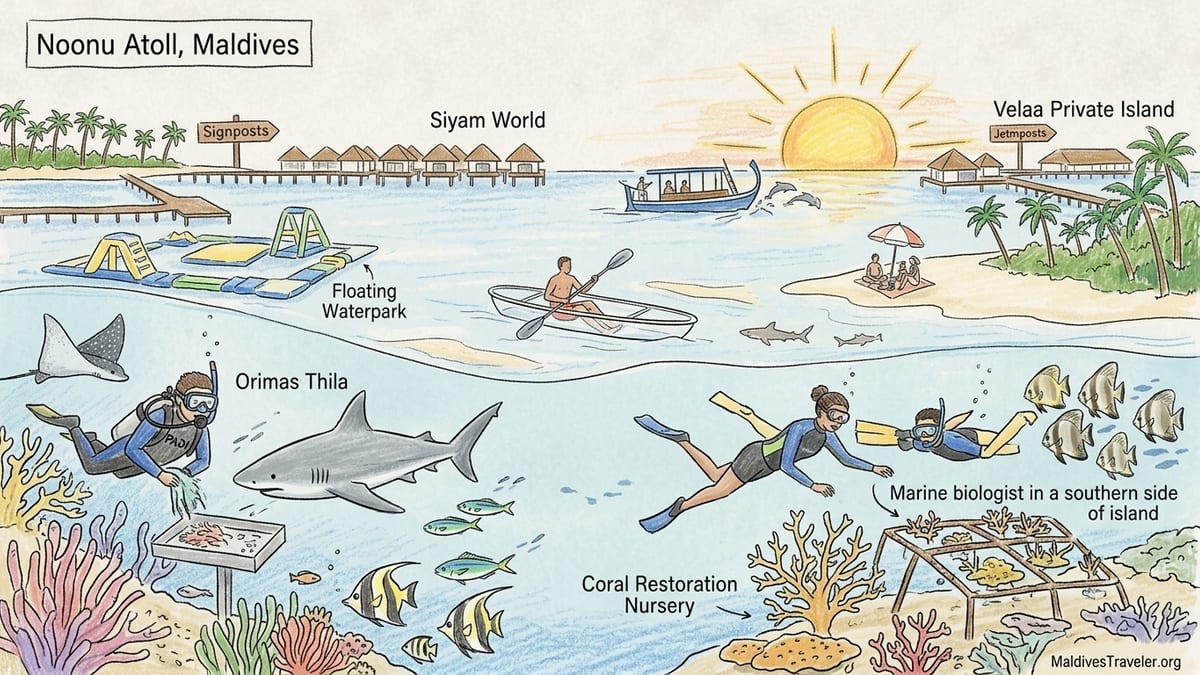
At Velaa Private Island the experience felt more intimate and conservation focused. I joined a guided “marine biologist snorkel” booked via the resort app the day before. The rate on my bill came to a little over 130 US dollars per person for around 75 minutes in the water, including short instruction on coral identification. Access again was from the main jetty, no boat required, but we finned along the southern side of the island where Velaa’s reef restoration programme has been running since 2014. The marine biologist pointed out frames of nursery grown corals that the resort has transplanted in the surrounding reef, part of what Velaa describes as one of the largest coral restoration projects in the Maldives. In this section of reef I saw more structural complexity than at Siyam World: thick bommies, overhangs and a higher density of reef fish, including a swirling school of bigeye trevally and several inquisitive batfish that shadowed us for ten minutes.
Scuba Diving Remote Reefs of Noonu Atoll
I completed four boat dives in Noonu Atoll, three with Siyam World’s partner dive center and one with the PADI center at Velaa. At Siyam World I visited a channel dive site known locally as Orimas Thila, recognised in diving guides as a shark point for grey and white tip reef sharks in this part of the Maldives, and another softer coral covered pinnacle that locals referred to as “Christmas Tree Rock,” echoing the better known Vavathi Kurohli Thila that divers praise for its soft coral life. Each two tank trip was booked in person at the dive center the afternoon before and confirmed once minimum numbers were reached.
Dive pricing in Noonu sits at the higher end of the Maldivian average. My invoice from Siyam World showed a rate a little over 100 US dollars per single boat dive including tank and weights, with 10 to 15 percent discounts when joining a two dive excursion. Equipment rental added around 30 dollars per day for BCD, regulator and wetsuit. Boat rides to the dive sites ranged from 20 to 35 minutes by traditional dhoni. The dive dhoni had shaded seating, a basic marine toilet and a ready box of ginger candy for guests prone to motion sickness when the northeast monsoon wind picked up.
Conditions on my November dives were classic Maldivian: visibility between 20 and 25 metres, water temperature around 28 degrees Celsius and moderate current at the channel mouth. At Orimas Thila we descended along the mooring line to around 24 metres and immediately spotted grey reef sharks circling at a cleaning station. Over the course of the 45 minute dive I counted more than a dozen grey reef sharks, two white tip reef sharks resting under a ledge, several bluefin trevallies hunting fusiliers and a pair of napoleon wrasse. The soft corals were not as explosively colourful as pre bleaching footage I have seen, but gorgonian sea fans and whip corals still decorated the drop off.
The dive at Velaa was structured quite differently. Velaa’s PADI dive center combines regular recreational diving with conservation and coral restoration experiences led by their resident marine team, something highlighted in their own dive and sustainability materials. I booked a single afternoon dive focused on visiting the coral nurseries, again through the island’s experience team, and paid just under 200 US dollars including a private guide surcharge because there were no other certified divers at that depth level that day. The dive site was only a few minutes by speedboat from the island but felt surprisingly untouched, with very little other boat traffic.
On that coral nursery dive we remained shallower, around 14 to 16 metres, which meant bottom time of almost an hour. We hovered beside lines of coral fragments growing on frames, and my guide explained how the team has transplanted thousands of nursery grown corals around the island in response to bleaching years. Fish life here was rich and unbothered by our presence: anthias pulsing over the coral, a green turtle grazing calmly on algae, and a small squadron of eagle rays that passed just at the limit of clear observation. That combination of solid reef diving and a close look at active conservation work made it a dive I would prioritise again, especially for intermediate divers.
Dolphin Cruises and Sunset on the Indian Ocean
Over my stay I joined two dolphin cruises, one from Siyam World and one from Sun Siyam Iru Fushi, another resort in Noonu that offers regular “Lucky Dolphin Sunset Cruise” outings as part of its excursion programme. At Siyam World, the dolphin trip was not included in my package, so I booked and paid at the water sports desk. The listed price at the time was a little under 80 US dollars per adult for approximately two hours on the water, with soft drinks included. The small excursion dhoni departed around 4:45 pm, timed so that the return would coincide with sunset over the open ocean.
The sky that afternoon was partly cloudy with light chop, and the crew gave seasickness advice to a couple of guests who were new to boats. We motored for about 25 minutes toward deeper channels between Noonu’s islands before slowing to scan the horizon. It took another ten minutes before the first spinner dolphins appeared, jumping in small groups off the bow. Over the course of an hour we saw several pods, perhaps thirty to forty dolphins in total, including juveniles that rode the pressure wave near the hull. The guide explained in simple terms the difference between spinners and bottlenose dolphins and was careful not to chase the animals aggressively; instead, he kept a consistent slow course that allowed them to choose how close to come.
The Iru Fushi dolphin cruise was broadly similar in format but slightly longer, advertised at 2.5 hours on the resort’s printed excursion fact sheet. I booked via reception in the morning, as the resort notes that places on scheduled excursions must be checked and confirmed in advance. The price on my folio was close to 85 US dollars per adult. That evening the weather was glassy calm, and as we cruised along the outer edge of the atoll we encountered a particularly large pod of spinner dolphins, potentially more than fifty individuals spread out across the surface. Without the roll of the previous outing, passengers moved more easily around the dhoni for photos, and the crew served fruit skewers while pointing out distant storm cells flashing on the horizon.
On both cruises there was no guarantee of sightings, something the guides clearly stated. I was fortunate that both trips delivered classic Maldivian dolphin displays, and in calm seas I would repeat either in a heartbeat, especially for families who want a low effort way to be out on the water at golden hour.
Sandbank Picnics and Private Boat Time
My favourite surface level experience in Noonu Atoll was a half day private sandbank trip arranged from Siyam World. I booked it two days ahead through the excursion desk because departure times and sandbank availability depend heavily on tides and weather. The quoted rate was just under 450 US dollars for up to four guests on a private basis including boat, crew, snorkel gear, beach umbrella and a light picnic of wraps, fruit and soft drinks. There are cheaper shared sandbank excursions in the Maldives, but the ability to have the strip of sand to my small group alone for several hours made this splurge feel justified.
We left Siyam World by speedboat at 9:30 am under high, hazy sunshine. The ride took about 35 minutes across open lagoon to a sandbank at the edge of Noonu, a luminous crescent of white sand surrounded by shallow turquoise water. The crew first walked the perimeter to check current and depth, then set up a beach umbrella and a few beanbags in the centre. They remained discreetly on the speedboat moored a short distance away unless we called them over, which gave the time there a pleasantly castaway feel rather than a crowded day trip atmosphere.
Marine life here was accessible even to non swimmers. Wading ankle deep off the sandbank I spotted juvenile black tip reef sharks patrolling the shallows and small rays resting under thin layers of sand. With fins and mask, I drifted a little further to where the sand slope met scattered coral bommies in two to three metres of water and watched clouds of chromis, parrotfish and surgeonfish moving across the patch reef. The water was exceptionally clear, with visibility easily beyond 20 metres horizontally, and only a light breeze ruffling the surface.
On a separate day at Velaa, I opted for a shorter private boat excursion that combined reef snorkeling and a visit to an uninhabited island for coffee rather than a full picnic. This was arranged through the experience team and price wise came in at roughly 700 US dollars for the boat for two hours, a figure very much in line with Velaa’s position as an ultra luxury property in Noonu Atoll. The speedboat was larger and more comfortable than the excursion boats at midrange resorts, with padded seating, a shaded cabin and high quality snorkel gear already set up. Marine life on that outing included a school of batfish near the mooring line, several triggerfish on the sandy bottom and another graceful eagle ray, and although the uninhabited island stop was brief, it provided a sense of the atoll’s isolation beyond resort boundaries.
Kayaking, Paddleboarding and Siyam World’s Floating Waterpark
While diving and long boat trips define the drama of Noonu Atoll, I found that some of the most repeatable moments were the simple ones: sliding a kayak off the beach at 7:00 am or paddling a stand up board across the lagoon as the sun set behind the palms. At Siyam World, non motorised water sports are a core part of the resort’s identity, and the official water sports price list shows that kayaks and stand up paddleboards are included for a set amount of complimentary time for in house guests. During my visit, I could sign out a transparent kayak or regular sea kayak for up to an hour at no charge, provided I wore a flotation vest and stayed within marked buoy lines.
The first morning I took a glass bottom kayak straight from the main beach and paddled along the shoreline for about 45 minutes. The lagoon here is shallow and sandy with patches of sea grass, so while the coral scenery is limited close in, the transparent hull made it easy to spot juvenile reef fish and the occasional stingray resting on the sand. Conditions were mirror calm and there was nearly no wind, which allowed the kayak to glide without much effort. Staff at the water sports centre were efficient rather than effusive, but clearly safety oriented, checking my vest fit and reminding me about boat channels.
Paddleboarding in the late afternoon was slightly more challenging because of side winds, but that added a sense of play. I paddled from the beach out toward the start of Siyam World’s large floating waterpark, a signature feature that extends into the lagoon with inflatable slides, climbing walls and balance beams. Access to the waterpark during my stay was included in the all inclusive plan for set sessions, and I joined a one hour slot that turned out to be much more of a workout than I expected. Clambering over the inflatable obstacles, plunging into the lagoon and racing children along the balance beams felt like a tropical version of an adventure course. The lifeguards stationed at the corners were attentive, frequently whistling gentle reminders about safe jumping and helping younger kids back onto the platforms.
From a marine life perspective these lagoon based activities are light compared with outer reef snorkels or dives, but they offer a low stress way to spend time in Noonu’s warm water between more ambitious excursions. If I returned, I would again start most days with a kayak or board session before breakfast, not for wildlife but for the sense of calm that comes from being nearly alone on the lagoon’s surface.
Hands-On Marine Conservation at Velaa Private Island
Among all the experiences I tried in Noonu Atoll, the one that most changed how I think about Maldivian reefs was Velaa Private Island’s marine conservation programme. Velaa’s official sustainability information explains that the resort runs one of the country’s largest coral restoration projects, with a dedicated marine team that has transplanted thousands of nursery grown corals around the island to help recovery after significant bleaching events. I joined two distinct conservation focused activities: a guided educational snorkel described earlier, and a “coral adoption and planting” session that took place partly on land and partly in the water.
Booking was via the resort’s marine biology centre a day in advance. The coral adoption experience on my bill was priced a little above 300 US dollars for two participants, including a short classroom style talk, a snorkel session to view existing frames and the chance to help attach small coral fragments to a new frame that would then be placed in the nursery. The resort also offers options to adopt larger frames at higher prices, which some guests choose as a way to mark honeymoons or anniversaries. The marine team takes underwater photos of each frame several times a year and emails updates to guests, a system that aligns with reviews describing biannual progress reports.
The session began with a 30 minute briefing led by the resident marine biologist inside a small lab space filled with coral samples and identification charts. We discussed how rising sea temperatures have affected Noonu’s reefs, what species have shown resilience and how coral gardening can increase local structural complexity even if it is not a cure for climate change. Then we moved to a shaded work area where we used simple tools and marine safe cement to attach finger sized coral fragments to metal rods in a frame. Wearing gloves and following the biologist’s careful instructions, we completed a full frame in about 20 minutes.
The in water component was a guided snorkel along the nursery line close to shore. Conditions were mild that morning, with only a slight surface ripple and excellent clarity. Floating above rows of frames populated with fast growing branching corals, I saw numerous reef fish using the new structure as shelter: damselfish darting among the branches, small groupers resting in the shade and surgeonfish grazing algae from the metal. While turtle or shark sightings are possible in this area, on that particular morning the highlights were more subtle: watching polyps extend feeding tentacles from a recovering colony and noticing the gradation of growth from newly planted fragments to mature heads that will soon be transplanted to the reef.
This was not an adrenaline filled excursion, but it was the experience I would most insist on repeating and recommending, especially for travellers who want to understand what it takes to maintain the beauty they see on postcards. It delivered concrete, hands on insight into reef conservation rather than a brief slideshow, and connected me emotionally to a very specific patch of Noonu Atoll.
Fishing on the Edge of the Atoll
I joined one evening bottom fishing trip from Siyam World, a type of excursion that many Maldivian resorts offer as a relaxed introduction to local fishing practices. Booking was again through the excursion desk, and the shared outing cost a little under 70 US dollars per adult including basic tackle and soft drinks. We departed the jetty at around 5:30 pm on a traditional dhoni, reaching the fishing spot in about 20 minutes. The crew used simple hand lines, baited with fish pieces, and instructed guests on how to feel for bites and haul in the line without tangling those of others.
The weather that evening was overcast with a mild swell, enough to rock the boat gently but not uncomfortably. Over approximately two hours we collectively caught several smallish reef fish, mainly snappers and groupers in the one to two kilogram range. I personally landed two modest snappers which the crew bled and stored on ice with the option to have them cooked for dinner. One family on board took up the resort’s offer to grill their catch as part of a beach barbecue the following night, at a supplementary cost discussed individually with the restaurant team.
This was a social rather than wildlife heavy trip, but it provided a calm way to be out at sea and see the outline of Noonu’s islands from a different angle as the light faded. Those hoping for big game fishing should look at the dedicated trolling charters many resorts offer, using faster boats and heavier gear aimed at tuna or wahoo, at prices that can easily exceed 800 US dollars for a half day private trip. For me, the simple bottom fishing evening, with the sound of hand lines spooling and the occasional cheer when someone brought up a larger fish, was exactly the low key introduction I wanted.
The Takeaway
When I look back on my time in Noonu Atoll, the pattern that emerges is not one of a single standout activity but a layered set of experiences that build on one another. House reef snorkels at both Siyam World and Velaa provided the daily rhythm, revealing how much life thrives within a few fin kicks of the beach. Boat dives on deeper thilas added scale and drama, especially at shark cleaning stations where grey reef sharks circled in clear blue water. Dolphin cruises and sandbank picnics offered that archetypal Maldivian sense of horizon and space, while early morning kayak and paddleboard sessions grounded me in the lagoon’s quiet.
If I were returning to Noonu Atoll with a week to spend, I would prioritise three categories. First, at least two guided snorkels or shallow dives with a marine biologist at a resort with an active conservation programme, such as Velaa’s coral restoration sessions, because they deepen understanding as much as they delight the eyes. Second, one or two serious boat dives to signature sites like Orimas Thila for sharks and outer reef pinnacles for soft coral, booked on days with manageable currents and good visibility. Third, a private half day sandbank or uninhabited island trip timed for calm weather, which provides both excellent shallow snorkeling and the unforgettable feeling of standing alone on a strip of sand in the Indian Ocean.
The activity market in Noonu Atoll is unusually rich for its relatively small cluster of resorts. Siyam World alone layers house reef snorkeling, a full water sports centre, excursions, a sprawling floating waterpark and spa and sports facilities, while Velaa sets a benchmark for combining high end PADI diving with in depth coral restoration and marine biology. The key, I found, is not to do everything, but to select a mix of experiences that balance exertion and ease, surface and depth, fun and education. Done that way, Noonu Atoll is not just a place you tick off once, but one you start planning to return to as soon as your seaplane lifts off.
FAQ
Q1. Do I need to be a strong swimmer to enjoy Noonu Atoll’s activities?
Many activities I repeated, such as dolphin cruises, sandbank visits and glass bottom kayaking, are suitable for confident waders and light swimmers, but for house reef snorkeling you should be comfortable floating in deep water with a life vest and listening carefully to guides’ safety briefings.
Q2. How much should I budget for snorkeling and diving in Noonu Atoll?
On my trip, guided house reef snorkels ranged from around 50 to 130 US dollars per person depending on the resort and level of marine biologist involvement, while single boat dives with equipment typically landed between 130 and 160 dollars per dive after gear rental and taxes.
Q3. When is the best time of year for visibility and calm seas?
I dived in November and enjoyed 20 to 25 metres of underwater visibility with moderate currents and mostly calm surface conditions, and many dive operators in Noonu consider the period from roughly January to April to be especially reliable for clear water and stable weather.
Q4. Are dolphin sightings guaranteed on cruises?
No operator in Noonu Atoll can ethically guarantee dolphins, but on my two sunset cruises from Siyam World and Iru Fushi I did see pods of spinner dolphins on each outing, with the guides making clear that sightings depend on sea conditions and animal behaviour.
Q5. Is coral restoration participation suitable for children?
The coral adoption and planting session I joined at Velaa worked well for older children and teenagers because it combined a simple hands on component on land with a shallow guided snorkel, but very young children or non swimmers may be more comfortable joining only the briefing or watching from the boat.
Q6. What marine life did I actually see while snorkeling the house reefs?
Across house reef snorkels at Siyam World and Velaa I personally saw hawksbill turtles, black tip and white tip reef sharks, schooling fusiliers, batfish, parrotfish, surgeonfish and, on one lucky pass, a spotted eagle ray along the drop off.
Q7. Are the floating waterpark and lagoon activities safe?
At Siyam World’s floating waterpark and during kayak and paddleboard sessions, staff consistently required life vests, maintained lifeguard presence and enforced simple rules on where to paddle, which made the activities feel well managed as long as guests followed instructions.
Q8. Can I have my fishing catch cooked at the resort?
On the evening bottom fishing trip I joined from Siyam World, the crew stored edible fish on ice and offered to have them prepared for dinner or a later barbecue, with any extra cooking or private dining charges discussed directly with the restaurant team.
Q9. How far are the main dive sites from the resorts?
Most of the Noonu Atoll dive sites I visited, including sharky thilas and coral pinnacles, were between 20 and 35 minutes by dhoni from the resort jetty, while some coral nursery and house reef dives at Velaa required only a few minutes by speedboat or even a short swim from shore.
Q10. Is Noonu Atoll a good choice for first time visitors to the Maldives?
Based on my experience, Noonu Atoll works very well for first timers because resorts like Siyam World offer an unusually wide menu of activities while Velaa and others provide high calibre diving and conservation, so you can sample everything from relaxed dolphin cruises to serious reef exploration within a single trip.