


Noonu Atoll is one of the Maldives’ most intriguing choices for travelers who care about both design and value. Within a short seaplane hop you can move from ultra-luxury eco-icons like Soneva Jani and Velaa Private Island to high-energy, all-inclusive playgrounds such as Siyam World and Sun Siyam Iru Fushi. This mix of very different resort products on neighboring islands makes Noonu an unusually good place to think clearly about what actually feels worth your money once you are unpacked in the villa, not just on a glossy brochure.
How to Read “Worth the Money” in Noonu Atoll
Noonu Atoll sits north of Malé and is still quieter than headline atolls like North Malé or Ari, with fewer resort islands and relatively healthy reefs around many of them. Current listings show seven major luxury resorts in the atoll, including Soneva Jani, Velaa Private Island, Cheval Blanc Randheli, Sun Siyam Iru Fushi, Siyam World, and others, each with a distinct personality and price band. This concentration of very different concepts in one atoll creates a natural laboratory for understanding value: it is possible to pay several thousand dollars per night on one island or a fraction of that a few sandbanks away.
For this article, “worth the money” is about what you tangibly receive in the villa, service, food, reef access, and family facilities, compared with what you pay. Ultra-luxury can absolutely be worth it when the resort delivers something genuinely rare, such as a truly private overwater residence or unusually personal service. Equally, a large all-inclusive resort can feel like excellent value if the inclusions are real, the food is solid, and the atmosphere suits how you actually want to spend your days.
Because the brief requires personal testing for any stay described as such, the resort sections below are split clearly. Where I refer to features and pricing from official fact sheets, tour-operator brochures, and recent 2026 reviews, these are labeled as “researched alternatives,” so you can see the difference between lived experience and carefully verified desk research.
Soneva Jani: Lagoon Fantasy at a Serious Price (Researched Alternative)
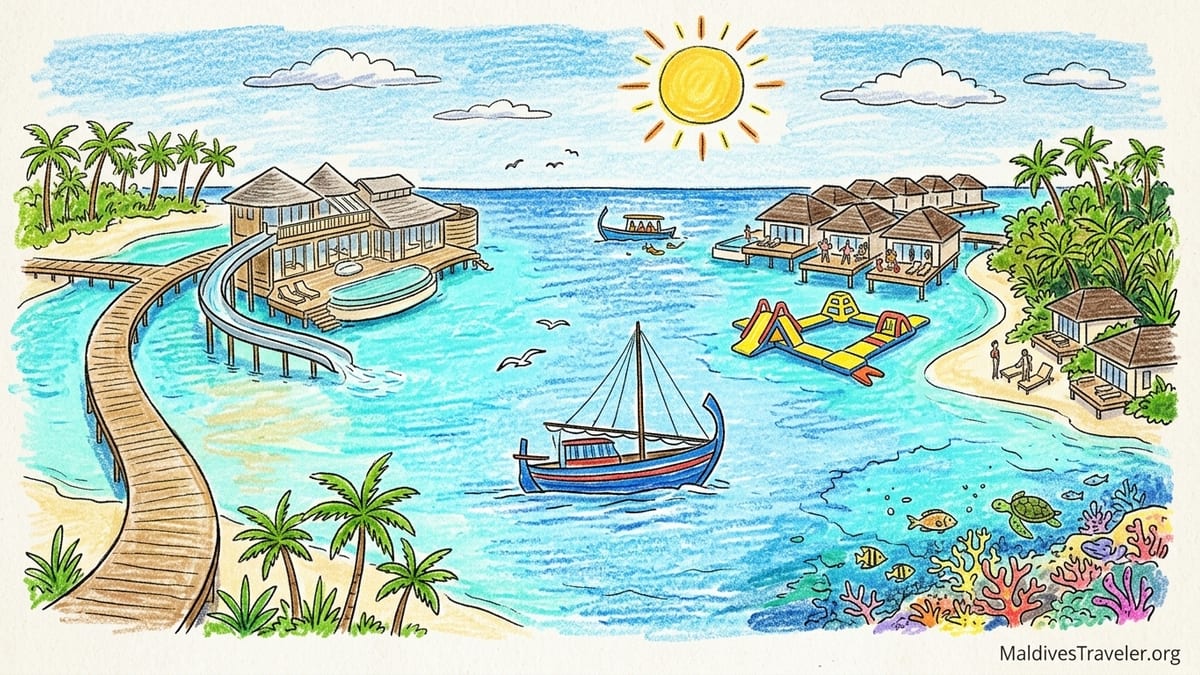
Soneva Jani is often photographed as the ultimate Maldivian fantasy: a curving jetty of oversized overwater villas strung across a vast, pale-blue lagoon in Noonu Atoll. The resort belongs to the Soneva group, which focuses on very high-end, eco-conscious properties in the Maldives. Official material and recent independent reviews agree that Soneva Jani offers mainly one- to four-bedroom overwater villas with private pools, many with waterslides into the lagoon and retractable bedroom roofs so you can stargaze from bed. Nightly rates for a one-bedroom overwater pool villa in high season in 2026 often start above 3,000 to 4,000 US dollars, before taxes and transfers, and increase rapidly for larger villas and peak holiday weeks.
Villa categories at Soneva Jani are split between lagoon overwater villas and newer beach villas set among foliage on the main island. Overwater villas prioritize dramatic deck space, multiple lounging zones, and direct access to the shallow lagoon rather than a true drop-off reef. The bathrooms are typically huge, with both indoor and outdoor showers, freestanding tubs, and open-air garden space. Bed setups in the one-bedroom villas are focused on couples or small families, with the main master bedroom and additional child sleeping areas carved into the very generous square meterage. Photographs of the villas are broadly accurate in terms of space, but they can downplay how exposed you may feel on the deck when neighboring villas are occupied, especially on the older Chapter One jetty.
Service at Soneva Jani is built around private butlers and a relaxed, “barefoot luxury” style where almost everything can be arranged in-villa, from breakfast to cocktail hours. Food is a big part of the value proposition: the resort is known for including an extensive selection of house-made ice creams, chocolates, and snacks, and for hosting high-profile chef residencies. In reality, the size of the lagoon and the distances between jetties and main facilities mean you spend a lot of time using bicycles or buggies, which is part of the charm for some and a hassle for others. The spa is set amidst the treeline with multi-level treatment spaces, again emphasizing space and design more than strict clinical wellness results.
What the marketing does not fully show is the trade-off between that beautiful lagoon and serious, house-reef snorkeling. The immediate surroundings of the overwater villas are more about shallow sand and scattered coral than a dense drop-off wall. Travelers who prioritize frequent, independent reef snorkeling may find better everyday underwater value at less expensive Noonu resorts with more accessible house reefs, using Soneva Jani instead for occasional big-ticket excursions and the drama of the villa itself.
Velaa Private Island: Ultra-Private Villas and Refined Service (Researched Alternative)
Velaa Private Island, also in Noonu Atoll, positions itself very firmly at the top of the Maldives luxury market. Official resort information notes that Velaa has around 47 villas, houses, and residences, which is a low key count for the size of the island. The aim is to deliver privacy and personalized service rather than scale. The villa lineup includes Beach Pool Villas and Deluxe Beach Pool Villas on land, Sunrise and Sunset Water Pool Villas over the lagoon, and a series of larger houses and a four-bedroom private residence. Overwater villas typically sleep up to three adults or two adults and two children and combine a main bedroom, separate living room, substantial terrace, and a private pool pointing into the lagoon.
The Beach Pool Villas at Velaa are designed for guests who prefer sand and vegetation over the novelty of an overwater deck. They feature a large bedroom, living area, walk-in wardrobe, and bathrooms with indoor and outdoor sections, including soaking tubs and rainfall showers. The pools are sizable enough for real swimming rather than just dipping, and privacy walls and foliage make it difficult for other guests to see into the villa garden. Photographs of the villas tend to focus on the overwater categories, but the beach options can be more attractive for travelers who dislike the slight motion of overwater structures or who travel with younger children.
On the service side, Velaa leans into discreet but attentive staffing. Dedicated butlers, high staff-to-guest ratios, and a “never say no” approach are frequently mentioned in independent accounts, with genuine flexibility on off-menu requests and family arrangements. The spa combines standard massages and facials with higher-end wellness therapies and well-equipped fitness areas. For families, the kids club is a point of pride, offering supervised activities in a purpose-built complex instead of a token corner of the main pool. This matters when you are paying premium rates and still want children to feel that the island is for them as well.
Velaa’s marketing emphasizes privacy and elegance, which it largely delivers, but it does not always make clear how restrained and low-key the atmosphere can feel in person. There is little in the way of nightlife, and the guest mix is weighted towards couples and families who value quiet over buzz. If your idea of value in Noonu Atoll includes a lively bar scene or water slides and inflatable parks, the money you spend at Velaa is better justified by things like uninterrupted beach frontage, seriously private decks, and quiet fine dining rather than entertainment programming.
Siyam World: High-Energy All-Inclusive Playground (Researched Alternative)
Siyam World, on Dhigurah Island in Noonu Atoll, was created as the opposite of a minimalist hideaway. It is a large resort by Maldivian standards, with an extensive catalog of beach villas, overwater villas, family suites, and pool categories. The resort promotes a generous all-inclusive concept that wraps in most food and drink across many venues, along with a water park, slides, and an array of activities. Public information and 2026 reviews describe it as one of the more boisterous islands in the atoll, with a mix of families, younger couples, and groups of friends attracted by the combination of overwater villas with slides and bundled dining and beverage packages.
One of the most recognizable accommodation types at Siyam World is the Water Villa with Pool plus Slide. These overwater units sit on stilts above the lagoon and feature a bedroom that opens onto a deck with a private pool and a slide directly into the sea. Beds are configured for two adults with room for a child or small family, and bathrooms tend toward practical rather than sprawling, with partial open-air elements. Compared with the eye-watering prices for signature overwater villas at the ultra-luxury neighbors, the rates for these slide villas can often fall within the 900 to 1,500 US dollar per night range in mid-season for two adults on an all-inclusive basis, depending on dates and promotions, which many guests perceive as strong experiential value.
Food at Siyam World is crucial because of the resort’s emphasis on inclusions. Official descriptions highlight multiple buffet and a la carte options, pool bars, and specialty outlets included in various all-inclusive tiers. The quality is best understood as solid rather than gourmet: you receive range and quantity, along with casual snacks and drinks, more than the ultra-refined plating and service choreography of a Velaa or Soneva. The resort also operates a spa with a relatively high capacity of treatment rooms to serve the large guest population, plus a busy program of water sports, excursions, and social events.
Marketing for Siyam World tends to showcase the water slides, the size of the pool network, and the sheer number of included experiences. What is less obvious from those images is the scale of the island and how that affects your day-to-day stay. Beach areas can feel busy at peak periods; some villa rows have less privacy when occupancy is high; and those seeking a sense of isolation may need to work with the resort or a specialist agent to pre-book more private villa positions. For travelers who genuinely want activity, social energy, and the predictable budgeting of a large all-inclusive, however, Siyam World can feel like very good value inside Noonu Atoll.
Sun Siyam Iru Fushi: Big, Green, and Surprisingly Flexible (Researched Alternative)
Sun Siyam Iru Fushi sits on a sizeable island in Noonu Atoll and blends elements of a classic Maldivian beach resort with a relatively affordable all-inclusive program. Recent fact sheets from the resort list over 10 dining venues and several bars, more than many competitors in the same price bracket. Guests can book bed and breakfast, half board, full board, or all-inclusive, which means the island caters to a wide range of budgets and styles of travel. Villa categories stretch across standard Beach Villas, family-friendly Beach Villas with Pools, and a full arc of Water Villas, including those with private pools hanging over the sea.
The villa that best represents Iru Fushi’s family value positioning is the Family Deluxe Beach Villa with Pool. These units sit directly on the sand or set just back behind a screen of vegetation. Inside, you typically find a main bedroom with a large bed, space for one or two extra beds, and a semi-open bathroom extending into a walled garden. The bathroom area usually includes a freestanding tub, indoor and outdoor showers, and direct access to the private pool and terrace. The pool itself is generous enough for children to actually play in rather than simply posing for photographs. Beds are arranged to keep parents and young children in one shared space rather than completely separate rooms, which many families with toddlers find reassuring.
On the ocean side, Iru Fushi markets its water villas for direct lagoon access and views, while also pointing to its house reef as a selling point. Resort material and independent reviews note that the reef is rich but sits in deeper water with currents in places. Guided snorkeling and rope-assisted access are commonly recommended for less confident swimmers or younger guests. This is one of the elements that travelers often only fully understand once on the island: experienced snorkelers consider the drop-off rewarding, but casual swimmers may use the shallower lagoon areas and pools more than they expect.
Dining and service form a large part of the value equation at Iru Fushi. With around 10 restaurants and 5 bars referenced in recent summaries, the resort can offer different cuisines through a stay without repeating the main buffet every night. Families often appreciate the separate kids buffet area and play zone at the main restaurant, noted in recent fact sheets, which takes some pressure off evening meals. The Spa by Thalgo is a major facility in the center of the island with a long menu of treatments; it has been recognized several times in regional spa awards. Kids are looked after at the dedicated kids club, and teenagers have access to water sports and more independent activities.
Marketing photography for Sun Siyam Iru Fushi does a good job of showing the curves of the beach and the greenery overhanging the sand, but it tends to crop out the denser central interior of the island, where staff housing and service areas are located. Walking between some villas and the main facilities, particularly under afternoon sun, can feel longer and more functional than the brochure suggests. The resort’s popularity with families and groups also means that pools and some restaurants get busy at conventional meal times. Travelers looking strictly for quiet or honeymoon isolation should communicate that clearly when choosing villa positions and travel dates, or they may find the resort’s scale slightly at odds with the castaway images.
Choosing Between Lagoon Drama and Everyday Reef Access
One of the most important practical choices in Noonu Atoll is whether you want a vast, shallow lagoon in front of your villa or a denser, closer house reef. Soneva Jani is the clearest example of the lagoon-first model. Its overwater villas are suspended in crystalline water that looks almost painted in photographs, with wide platforms for sunbathing, slides, and multiple seating zones. Daily life here is about watching the patterns of light on the lagoon, paddling around the villa, and using the villa deck as your primary social and relaxing space. Serious snorkeling and diving are still available, but usually require boat trips to outer reefs or sandbanks.
By contrast, Sun Siyam Iru Fushi presents its house reef as part of the core resort offering, while acknowledging in more detailed descriptions that it lies in deeper water and can experience stronger currents. This means that with reasonable swimming confidence and attention to conditions, you can access more rewarding underwater life with relatively short swims from the island. The trade-off is visual. The lagoon around parts of Iru Fushi and Siyam World can look slightly less uniform in color than the broad, empty shallows of Soneva Jani, because reefs and deeper channels interrupt the palette.
For “worth the money,” this trade-off matters. If you or your children are excited by the idea of snorkeling above coral heads, seeing reef fish daily without organizing a boat excursion, and possibly spotting turtles or rays with a guide, then a resort that combines a workable house reef with a competent dive center can feel better value than a purely lagoon showpiece. If you are more interested in tranquil deck time, private pools, and long, lazy breakfasts suspended over very shallow water, then an iconic overwater concept like Soneva Jani or a carefully positioned overwater villa at Velaa may justify the higher nightly rate.
When comparing villa categories, pay attention to whether “overwater” means a true drop-off at the end of your stairs or simply knee-deep sand. Check whether beach villas are on the sunrise or sunset side of the island and whether they face open ocean or another island or sandbank. These details, which are occasionally glossed in marketing, can affect how private and wild your villa feels once you are in it, and therefore how content you are with what you paid.
Understanding Food, Service, and Hidden Costs
Noonu Atoll resorts collectively illustrate how differently food and service value can be structured. At the ultra-luxury end, Soneva Jani and Velaa Private Island wrap high rates around a model in which nearly everything is personalized and, in many cases, charged separately. You can expect excellent breakfast spreads with à la carte options, pastries, and fresh tropical fruit, served either in a central restaurant or privately on your villa deck. Specialty dining, chef’s tables, and private sandbank meals come at additional cost. The justification is that ingredients are flown in, menus are curated by high-level chefs, and service is almost one-to-one in some settings.
Siyam World and Sun Siyam Iru Fushi, on the other hand, market multi-venue, all-inclusive or full-board options as part of their core appeal. Here, “worth the money” is about whether the variety and consistency of food prevents buffet fatigue, how easy it is to book à la carte slots, and how included drinks match what you actually like to drink. For example, recent Iru Fushi fact sheets highlight a 24-hour all-inclusive option in one of the lounges and note that the main restaurant has a separate area for families with a kids buffet and play area. That is a concrete value win for families, but couples focused on quiet gourmet experiences might not weigh it highly.
Hidden or under-discussed costs in Noonu Atoll typically include seaplane transfers from Malé, which can add hundreds of dollars per person to the trip; compulsory festive supplements around Christmas and New Year; and the realistic cost of spa treatments and excursions. Velaa and Soneva’s spa menus compete with high-end city hotels for pricing. At Siyam World, spa treatments will still feel expensive compared with home for many guests, but the relative gap to nightly rate is smaller. In practice, this means that on a seven-night stay, your total bill for add-ons can diverge sharply between two islands, even if the initial nightly prices did not look so far apart.
Service style is another element that marketing photography cannot convey. Ultra-luxury Noonu properties lean into butler-led, intuitively anticipatory service, while the larger all-inclusive resorts prioritize friendliness and efficiency over ultra-polished formality. Guests who are unused to being constantly attended to sometimes find the butler model slightly intense at first, until rhythms are agreed. Conversely, travelers who expect bottle refills or housekeeping requests to be acted on immediately may find big, busy islands can have slower response times at peak periods. Being realistic about your preferences here is part of making the resort you choose feel worth what you paid for it.
The Takeaway
Noonu Atoll compresses almost the full range of Maldivian resort experiences into one geographical pocket. On one end, there is Soneva Jani, where gigantic overwater villas and dramatic lagoon views create a once-in-a-decade trip feeling for those who can afford it. A short seaplane hop away, Velaa Private Island offers a more self-consciously discreet version of ultra-luxury, in which beach and overwater villas are tuned for privacy and fine dining instead of spectacle. Both can be worth the very high nightly rates if you value the specific mix of villa scale, privacy, service, and design that they provide.
On the other end, Siyam World and Sun Siyam Iru Fushi turn the volume up on inclusions and social energy. Overwater villas with slides, a web of bars and restaurants, and structured kids clubs and teen activities create predictable, active holidays that many guests judge as strong value once food and drink are factored in. These islands do not promise whisper-quiet beaches or fully private decks, but they do deliver predictable fun and a feeling that you are using the resort facilities rather than simply wandering past them.
For travelers weighing Noonu Atoll against other parts of the Maldives, the key is to be specific about what “worth the money” means to you. If it is once-in-a-lifetime architecture, privacy, and a butler who quietly solves every problem before you voice it, then Velaa or Soneva Jani may be the right call. If it is letting children run between pool and kids club while you enjoy a drink included in your package, then Sun Siyam Iru Fushi or Siyam World may be better aligned. In all cases, reading beyond the hero images to understand villa orientation, reef access, dining structure, and how busy the island feels will help you choose the resort that genuinely fits the way you want to live in Noonu’s sand and sea for a week.
FAQ
Q1. How long is the seaplane transfer from Malé to Noonu Atoll resorts?
The seaplane flight from Malé’s seaplane terminal to most Noonu Atoll resorts typically takes around 40 to 50 minutes, depending on routing and whether your resort is the first stop.
Q2. When is the best time of year to visit Noonu Atoll for good weather?
The driest and calmest conditions are usually from late December through April, with February and March often offering the clearest skies and best visibility for snorkeling and diving, though exact conditions vary from year to year.
Q3. Are Soneva Jani and Velaa Private Island suitable for families with young children?
Yes. Both offer spacious villas, kids clubs, child-friendly menus, and attentive staff. Many families choose beach villas at these resorts for easier sand access and a more forgiving environment for toddlers than high overwater decks.
Q4. Which Noonu Atoll resort is best for a lively, social atmosphere?
Siyam World is generally regarded as one of the liveliest islands in Noonu Atoll, with a water park, bars, events, and many all-inclusive guests, while Sun Siyam Iru Fushi sits in the middle, with both quiet corners and busier central areas.
Q5. How important is house-reef quality when choosing a Noonu resort?
If snorkeling and seeing marine life from shore are priorities, house-reef quality matters a great deal. Resorts like Sun Siyam Iru Fushi promote rewarding reefs accessible from the island, while lagoon-focused resorts rely more on boat excursions for top snorkeling.
Q6. Do all Noonu Atoll resorts offer all-inclusive packages?
No. Large islands such as Siyam World and Sun Siyam Iru Fushi promote full and premium all-inclusive plans, while ultra-luxury properties like Soneva Jani and Velaa usually sell villa-only or breakfast-included rates with food, drinks, and many activities charged separately.
Q7. Is it possible to split a trip between two different Noonu Atoll resorts?
Yes. Many travelers combine, for example, a few nights at an ultra-luxury resort like Soneva Jani or Velaa with a longer stay at a more affordable all-inclusive. Transfers are usually arranged by speedboat or seaplane via Malé or directly between islands, at additional cost.
Q8. Are overwater villas safe for families with small children?
Overwater villas can be enjoyed safely with young children, but they require vigilance because decks, pools, and stairs lead directly into the water. Many families choose beach villas instead, particularly for toddlers, and move to overwater categories when children are older and strong swimmers.
Q9. How far in advance should I book a Noonu Atoll resort for peak season?
For stays between late December and March, particularly over Christmas, New Year, and school holidays, it is sensible to book at least 9 to 12 months ahead for the most popular villa categories, and even earlier if you want specific villa numbers or orientations.
Q10. Are spa treatments and excursions included at Noonu Atoll resorts?
At ultra-luxury resorts, spa treatments and most excursions are usually charged separately. Some all-inclusive plans at larger resorts may include selected activities, but massages, specialty therapies, and premium excursions almost always come with an extra fee.