


The brochures show Noonu Atoll as a flawless band of turquoise in the northern Maldives, but the reality on the ground depends very much on when you go. I have visited Noonu twice in recent years: once in the dry northeast monsoon (late January) and once at the height of the southwest monsoon (early July). On paper, both trips promised warm water and year-round diving. In practice, the difference in wind, rain and sea conditions changed everything from seaplane timings and snorkeling visibility to whether my overwater villa felt like good value. This article unpacks those real conditions first, then separates them clearly from researched guidance for the months I have not personally experienced.
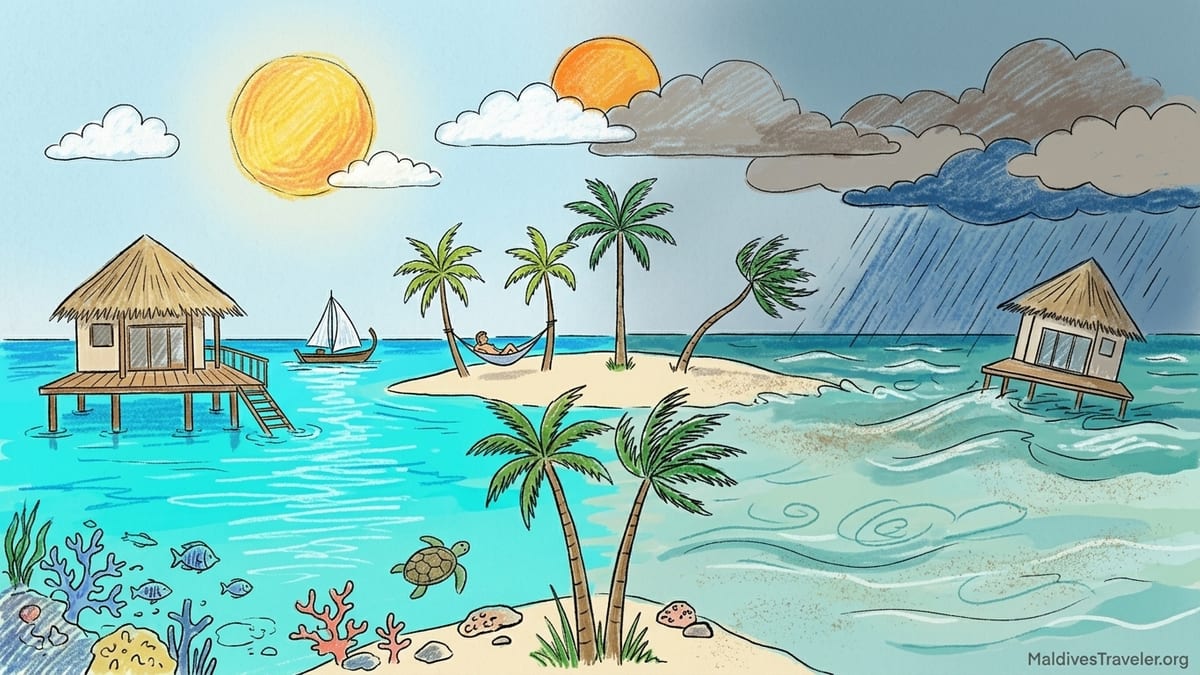
How Seasons Really Feel in Noonu Atoll
Officially, PADI describes Noonu Atoll as diveable all year, with a dry season from November to April and a wet season from May to October. On my two trips, the calendar labels were accurate in broad strokes, but the details were more nuanced than a simple sunny-versus-rainy split. Both visits had blue skies and postcard moments. Both also had periods when wind and cloud genuinely limited what I could do, and that is what matters when you are paying four-figure nightly rates for a private island resort.
On my late January stay, the northeast monsoon was established. Days started clear, with a pale pastel sunrise over glassy water. There were brief showers but they tended to fall overnight or as quick, sharp bursts that blew through within ten to twenty minutes. The sea inside the lagoon was calm enough that stand-up paddleboards sat almost motionless. On most afternoons I could swim straight from my villa stairs and see the reef slope with minimal surface chop.
Early July in Noonu felt like an entirely different destination. Low cloud often sat on the horizon from breakfast onward, with large banks of darker cloud forming by mid-afternoon. Showers were heavier and more prolonged. One day we had three distinct storm cells roll through, each with half an hour of hard rain and gusty wind strong enough to send deck cushions skidding. Lagoon color shifted from clear turquoise to a milky blue-green, especially after overnight squalls when fine sand and silt were stirred up.
Despite the contrast, temperatures on both trips stayed remarkably stable. Air hovered around the high 20s Celsius to low 30s, and sea temperatures felt warm enough to swim comfortably at any hour. The real difference was not heat but what the wind and cloud did to visibility, boat schedules and how much of the resort I could actually use each day.
Dry Season in Noonu: My January Reality
My dry-season visit was a nine-night stay spanning the last week of January. This is generally considered peak season for the Maldives, with the northeast monsoon bringing drier air and calmer seas over the northern atolls. I flew into Velana International Airport and connected onward by seaplane to Maafaru and then directly to the resort. Both flights ran on schedule, and the air felt hazy but stable as we skimmed over flat seas, with only small whitecaps visible.
Rainfall during those nine days was modest. I logged two nights with what I would describe as steady rain, lasting perhaps one to two hours each, and three or four short showers during daylight. Those daytime showers were usually visible as a darker band over the ocean long before they arrived. One afternoon I watched a curtain of rain approach across the lagoon while I was in the infinity pool. By the time I had walked back to the villa and pulled the outdoor cushions under cover, the rain hit, drumming on the wooden deck and roof for fifteen minutes and then stopping abruptly. Within another twenty minutes the sun was out and the deck dry enough to sit on.
Cloud cover was often light and high, more of a veil than a ceiling. Mornings were typically bright with sharp, defined shadows, excellent for photography and those classic overwater hammock shots. By mid-afternoon a softer haze would move in, but sunsets remained open, with the sun dropping behind a clear horizon line most evenings. On only one day did we have a mostly grey afternoon with a flat, colorless sunset and no real golden hour.
Winds through this January stretch were gentle inside the lagoon. The resort’s palm trees barely moved, and the staff kept kayaks lined up nose-to-shore without needing many extra tie-downs. A staff member told me that in January they rarely have to cancel snorkeling trips for wind once guests are already at the island, and that matched my experience. The outer side of the reef had a mild swell, but speedboat runs to nearby sandbanks and dive sites remained smooth enough that no one on our small boat appeared seasick.
Snorkeling, Diving and Water Clarity in the Dry Season
I am primarily a snorkeler and casual diver, so visibility matters more to me than chasing specific pelagic species. In late January, the lagoon around my resort in Noonu Atoll looked almost unnaturally clear. When I leaned over the edge of the overwater deck, I could see coral heads, sand ripples and rays resting on the bottom in water that was three to four meters deep. On a calm morning, I dropped a mask in by accident and could still see it glinting on the sand several meters away.
House-reef snorkeling during this dry-season trip remained consistently good. On most days, I could see my partner clearly at a distance of ten to fifteen meters underwater. Reef fish appeared crisp and colorful rather than muted by suspended sand. I photographed a turtle cruising along the top of the reef, and later, zooming into the image, individual scales and remoras on its shell remained distinct, a sign that there was not much fine particulate clouding the water column.
Dives arranged through the on-island PADI center took us to thilas and outer reef slopes within twenty to thirty minutes by boat. Dive guides estimated horizontal visibility in the range of twenty to twenty-five meters for most dives. While these are subjective numbers, I found them believable. From the mooring line, I could see the full outline of the reef structure well before we descended to depth. There was some current, but not the swirling, unpredictable conditions that can arrive during monsoon transitions. For me as a guest, that translated into easier, more relaxed dives where I could linger at cleaning stations without constantly checking my position.
Not everything was perfect. On one morning dive, a thin layer of plankton-rich water sat at around six to eight meters, creating a faint greenish tint that dulled colors until we dropped below it. Another day, wind shifted slightly and blew in enough surface chop that getting back onto the boat felt more awkward as it pitched. But in comparison with my July experience, dry-season Noonu felt like a reliable bet for anyone who values clear water around a resort that sells itself on lagoon color and house-reef snorkeling.
Wet Season in Noonu: My July Monsoon Experience
My wet-season visit was a shorter six-night break in early July. I chose the same atoll deliberately to understand how much the season would change conditions. This time, I connected through Malé on a domestic flight to Maafaru followed by a speedboat hop to the resort, since seaplane operations can be more constrained by weather during the southwest monsoon.
The difference started at the airport. While waiting in the domestic terminal, departure boards flickered with several “delayed due to weather” notes for other atolls. Our own flight pushed back about forty minutes late because of a line of storms along the route. When we finally approached Noonu, the view from the window was a patchwork of darker water and scattered whitecaps, with squalls clearly visible between islands. On landing, the air felt thicker and more humid than in January, with a dampness that lingered even when it was not actively raining.
Across those six days, I recorded rain of some kind on every day except one. Two days brought heavy, prolonged downpours lasting around two hours each, with visibility reduced to a few hundred meters and the horizon completely erased. The other days saw passing showers, some as light drizzle, others with strong gusts and slanting rain that drove under the roofline and soaked sections of the usually protected deck. Overnight, I often woke to the rattle of showers on the villa roof even when the late evening had been clear.
Cloud cover was the main difference in mood. In July, the sun often appeared as a bright glow behind high cloud rather than a sharp disc. Blue patches would open suddenly and then close again, creating very fast shifts in light. Photography became a matter of seizing brief gaps. Sunsets were often behind thick cloud banks; on three evenings out of six, the sun dropped into a wall of grey well before reaching the horizon, and colors were more muted oranges than the rich pinks and purples I had seen in January.
Lagoon Conditions, Wind and Boat Cancellations in July
Wind in July was noticeably stronger, although it varied hour by hour. Palm fronds rattled and flags snapped rather than hung. Walking along the jetty, I sometimes had to steady my phone to shoot video without visible shake. Inside the lagoon, small whitecaps were common by midday, and the resort temporarily removed some of the lighter kayaks from the beach because they were too easily pushed around.
Lagoon clarity was the biggest surprise. The same stretch of water that had been clear in January now shifted in color and transparency after each spell of wind or rain. On calmer mornings, I could still see down three to four meters from the villa deck, but after a night of squalls the lagoon turned noticeably more opaque. Sand and very fine silt hung in the top meter of water, enough that my own legs looked slightly blurred when I kicked out from the stairs. This did not make swimming unpleasant, but it reduced the “wow” factor of photographs and the sense of floating in gin-clear water.
Boat operations were more heavily affected than I had expected. During our stay, the resort canceled one scheduled sunset dolphin cruise and one outer-reef snorkeling trip due to wind and choppy seas beyond the sheltering reef. On another day, they moved the departure of a dive trip an hour earlier to avoid a forecasted squall line. That adjustment worked, but the ride back still felt bumpy, with occasional spray soaking the front half of the boat. None of this felt unsafe, but guests with a low tolerance for motion would likely have found it uncomfortable.
While we never became fully “weathered in,” staff mentioned that in strong monsoon spells they sometimes hold arriving guests overnight in Malé or Maafaru if seaplanes cannot safely operate to smaller platforms. Given that many Noonu resorts cost several hundred to several thousand dollars per night, losing a night on the island due to weather would materially change the perceived value of a trip. In July, I packed an extra dose of patience for transfer days and treated the domestic hop and speedboat ride as parts of the adventure rather than guaranteed, smooth connections.
How Weather Changed the Value of an Expensive Resort Stay
Both my Noonu stays were at resorts that would generally be classed as upper-tier private island properties, with nightly rates in the high hundreds to low thousands of US dollars depending on villa type and board plan. In January, the weather and the resort’s promise lined up neatly. I used the outdoor deck almost constantly, from sunrise coffee to late-evening stargazing. The complimentary stand-up paddleboards and kayaks were available on nearly every day. The house-reef snorkeling, easily accessed directly from the beach and jetty, became a twice-daily habit. When I did the rough math of cost per waking hour spent outdoors, the premium felt justified.
Rain in January rarely forced us to change plans. Once, a short shower pushed back a private sandbank picnic by half an hour, but the staff simply watched the radar, delayed our boat departure slightly and we still enjoyed clear skies for most of the experience. Sunset cocktails on the jetty bar went ahead all but one evening. From a value perspective, we used almost every advertised facility: pool, sandbank, rooftop observatory, open-air cinema and multiple pier restaurants.
July was more complicated. The room rate for our villa was lower in the published tariff during wet season, and the resort offered an extended-stay promotion, but the weather reduced how much we could actually use the island. Two of our six sunsets were essentially non-events, with the outdoor sunset bar closed early due to strong gusts. One afternoon yoga session on the overwater deck moved indoors because the mat corners kept lifting. We canceled a planned floating breakfast because staff warned that photos would likely look flat under solid cloud and the tray might bob more roughly than expected.
These are minor problems in the grand scheme of a holiday, but at a resort level they chip away at the perceived value of an expensive stay. A private plunge pool that looks out onto whitecapped chop under a grey sky simply feels less indulgent than the same pool under a calm, mirrored lagoon. On the other hand, July brought compensations that suited certain travelers. The resort felt quieter, staff had more time to chat, and indoor experiences like wine tastings, spa treatments and Maldivian cooking classes felt more appropriate when rain pattered outside. For couples happy to swap some outdoor hours for lower rates and a softer, moodier atmosphere, wet season did not feel like a loss. For first-timers chasing postcard conditions, my experience would make me nudge them toward the dry months if budget allows.
First-Hand vs Researched Advice for Other Months
Beyond January and July, my understanding of Noonu’s seasons comes from speaking with resort staff and dive teams and from cross-checking those impressions with published climate information and diving overviews. Maldivian climate data identifies a drier period aligned roughly with the northeast monsoon from around December to April, and a wetter southwest monsoon from roughly May to November, with some year-to-year variation in onset and strength. Within this structure, the northern atolls, including Noonu, often receive slightly less total rainfall than central atolls, but they still experience the same pattern of changing winds and cloud.
In practical terms, resort staff described December, January and February as their most reliable months for long runs of sunny days and calmer lagoons, which is consistent with how my January stay felt. March and April can stay clear but often feel hotter and more humid, with the first hints of more unsettled weather late in the afternoons. Guests visiting in March have reported strong sun and high visibility underwater, along with the need to pay more attention to hydration and sun protection.
May and June were consistently described as more unsettled, with a larger chance of storms that can last several hours or cluster across multiple days. While there can still be beautiful spells, the mix is more variable. The southwest monsoon strengthens through June and July, and during these months boat captains and seaplane pilots have to work around more short-notice schedule changes. August through October often remain influenced by the southwest monsoon, though some years see calmer spells and clearer water as the season transitions back toward the northeast pattern by November.
For divers, most operators I spoke with in Noonu echoed PADI’s broad guidance that the atoll can be dived year-round. In the drier months, visibility around outer reefs and thilas often stretches further, while during the wetter months plankton and nutrients become more abundant in some areas, which can attract manta rays and other filter feeders at specific sites. However, these seasonal animal patterns are not guaranteed on a short stay. If your primary goal is to maximize calm conditions and lagoon clarity around a resort, the broad dry season from about December to April aligns best with both my personal experience and local guidance.
The Takeaway
Across my two Noonu Atoll stays, the calendar pattern of dry and wet season translated into very real differences on the ground. In late January, rain felt like a side note. Lagoon water stayed consistently clear, boat trips ran on schedule, and I could plan days around snorkeling, sandbanks and long hours on the deck without checking the sky too often. The premium high-season price felt offset by how fully I could use the outdoor spaces and water-based experiences that define a Maldivian holiday.
In early July, the atoll kept its essential charm but changed personality. Wind and cloud shaped each day’s rhythm. I checked the forecast every morning before deciding whether to book a sunset cruise or an outer-reef snorkeling trip. Lagoon visibility shifted after each squall, and we accepted that some experiences might be canceled or rescheduled. The reduced room rates and quieter resort helped balance this, but for a once-in-a-lifetime trip where guests expect uninterrupted turquoise, I would hesitate to recommend the heart of the wet season without very clear expectations.
If you are planning your first visit to Noonu and want conditions closest to the postcards, my own experience points toward the months from roughly late December through February, extending into March for those who can tolerate more heat. If you prefer softer light, do not mind cloudier days and want to stretch your budget at a high-end property, early or mid-wet-season months can still work, as long as you treat the weather as part of the story rather than a background detail. Above all, keep in mind that Noonu’s beauty is not fragile. The turquoise lagoon dulls and clears, clouds build and break, but even under monsoon skies the atoll holds a quiet, saturated color that reminds you why you came in the first place.
FAQ
Q1. Is Noonu Atoll really worth visiting in the wet season?
It can be, especially if you value quieter resorts and lower rates. Expect more rain showers, choppier lagoons and occasional boat or seaplane schedule changes, but also softer light, dramatic skies and more availability for spa and indoor experiences.
Q2. How often do boat trips get canceled in Noonu during the monsoon?
On my July trip, two scheduled excursions were canceled across six days due to wind and sea state. Staff said that in stronger spells of southwest monsoon weather, cancellations become more frequent, especially for sunset cruises and outer-reef snorkeling, while essential transfers are given priority.
Q3. Will I still see clear turquoise water in July and August?
You will, but not all the time. During calm spells, the lagoon can look almost as clear as in the dry season. After heavy rain or strong wind, fine sand and silt can cloud the top meter of water for several hours or more, making the color more milky blue-green when viewed from your villa or the jetty.
Q4. When is the best time to visit Noonu Atoll for snorkeling from the resort?
From my own experience, late December through February provided the most consistently clear water and calm lagoon conditions for house-reef snorkeling. During the core wet-season months, snorkeling is still possible but visibility and comfort can change more from day to day.
Q5. How does the season affect diving in Noonu if PADI says it is year-round?
Diving is indeed possible year-round, but the feel of the dives changes. In the drier months, visibility around many reef sites tends to be higher and surface conditions smoother. In wetter months, you may encounter more plankton in the water, slightly reduced visibility and choppier boat rides, though marine life remains rich throughout the year.
Q6. Could weather stop me from reaching my resort in Noonu?
In strong monsoon conditions, seaplane and some domestic flights can be delayed or, less commonly, postponed to the next suitable window. Resorts and airlines prioritize safety, so there is a small but real chance that you could spend an extra night in Malé or near Maafaru if weather does not allow safe onward travel that day.
Q7. Are resort prices in Noonu much lower during the wet season?
Many high-end resorts in Noonu reduce their public rates and run promotions from roughly May to October. The exact discount varies by property and year, but it is common to see lower nightly rates or added-value offers such as complimentary half-board compared with peak dry-season pricing.
Q8. Is January always sunny and dry in Noonu Atoll?
No month in the Maldives is completely rain-free. During my late January stay, I still experienced several showers, including two longer nighttime rains. However, most days were dominated by sun and light cloud, with only brief interruptions from passing showers.
Q9. How should I pack differently for a wet-season stay in Noonu?
For a wet-season trip, it helps to bring a lightweight rain jacket or poncho, quick-drying clothing, a dry bag for boat excursions and sandals that cope well with wet boardwalks. A small waterproof cover for your camera or phone is also useful when brief squalls blow through.
Q10. If this is my once-in-a-lifetime Maldives trip, which months would you personally choose for Noonu?
Based on my own time there, I would aim for late December to February, when lagoon clarity, sunshine and calmer boat conditions align most closely with the classic images that draw many travelers to Noonu in the first place.