


My journey to Noonu Atoll began the same way every trip to the Maldives begins, by stepping off a long-haul flight into the warm air of Velana International Airport and realising that the real logistics still lay ahead. In Noonu, the adventure starts after immigration, when you trade jet bridges and baggage belts for seaplanes, domestic hops to Maafaru and speedboats that finally take you to your villa. What follows is a detailed, on-the-ground style account of that transfer route, then a comparison with the alternatives that link Malé, Maafaru and some of the most talked-about resorts in the Maldives, including Soneva Jani and Velaa Private Island.
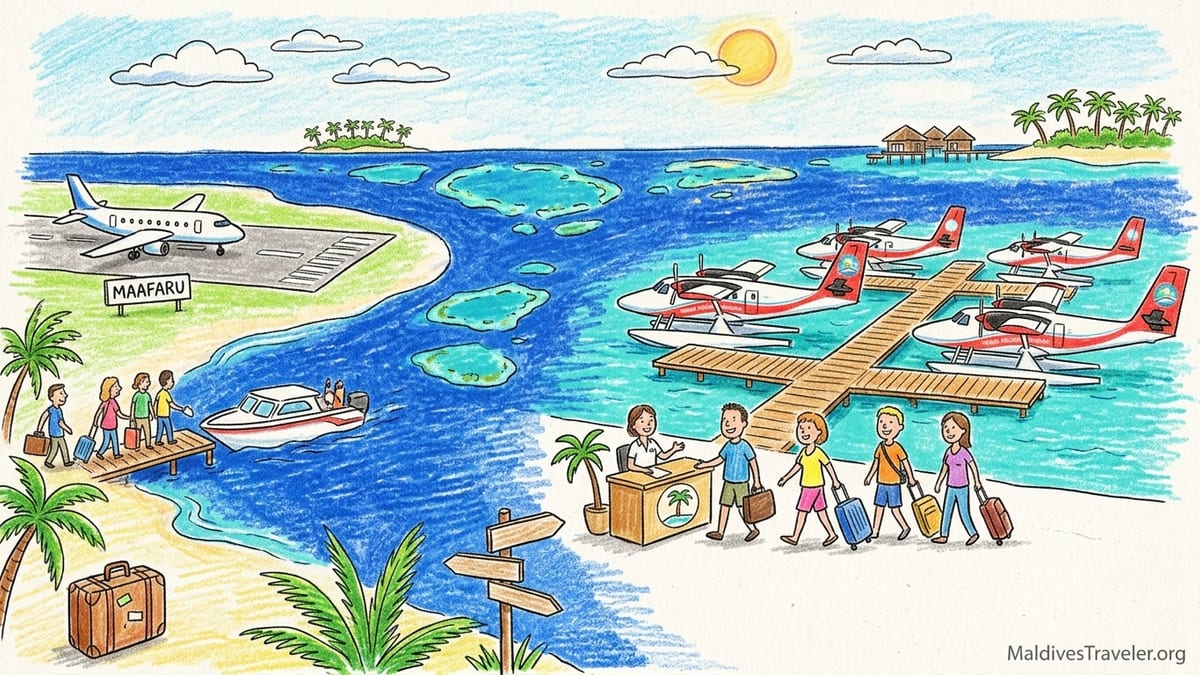
Landing at Velana: First Steps Into the Maldives
The aircraft doors opened onto the jet bridge at Velana International Airport and the wall of humidity that always hits first-time visitors to the Maldives. Signage for immigration and transfer counters is clear, but what many travellers do not realise until they arrive is that every resort transfer, whether by seaplane, domestic flight or speedboat, is organised from here. There is no direct public transport to the private islands. Everything starts with clearing formalities efficiently so that the resort team can take over.
Immigration at Velana is usually straightforward if your paperwork is in order. Most visitors receive a free tourist visa on arrival, and you will need a passport, onward ticket and confirmed accommodation. Queues fluctuate depending on banked arrivals, especially from hubs such as Doha, Dubai and Singapore. On recent midday arrivals it has taken around 20 to 40 minutes from joining the immigration line to reaching the baggage hall, though peak holiday periods can be slower. Once stamped in, you exit directly to the single baggage reclaim where all international flights unload together.
At the carousel, luggage for seaplane and domestic guests is collected in the same way as everyone else. Only after customs do the resort representatives appear in force. They stand behind branded desks or placards along the arrivals hall wall, grouped by atoll or transfer type. This is where the journey to Noonu really begins. Instead of heading towards the exit and public jetty, you look for your resort logo, present your passport or booking confirmation, and hand over your luggage tags so the team can re-check your bags for the onward journey.
The difference compared with many destinations is that from this point almost everything is handled for you. Resort staff arrange the check-in for Trans Maldivian Airways or Manta Air for seaplanes, or for domestic carriers operating to Maafaru. They also coordinate speedboat schedules and, for higher-end properties, escort guests into private lounges while transfers are finalised. For Noonu Atoll, where distances are greater than the near-Malé islands, those logistics matter more than most.
From Arrivals Hall to Lounge: Waiting for the Sky
Once I had met my resort representative, my checked bags disappeared onto a trolley to be weighed for the seaplane sector and, separately, for a potential domestic leg. Seaplane baggage allowances in the Maldives are typically around 20 kilograms of checked luggage plus 5 kilograms of hand luggage per paying passenger, with any excess charged per kilogram and sometimes subject to space availability rather than a guaranteed uplift. These limits come from the small size and strict weight-and-balance rules of the Twin Otter aircraft used for seaplane transfers.
After weighing and tagging the bags, the next step was the transfer to the seaplane terminal. Velana’s dedicated seaplane terminal is on the opposite side of the runway from the main international building and is reached by an air-conditioned shuttle. Resort staff usually accompany you, which removes any guesswork. For many travellers this short bus ride is the first glimpse of the country’s aviation ecosystem, with views of docks full of red-and-white Trans Maldivian seaplanes and blue-and-white Manta Air aircraft floating like oversized toys just offshore.
Because seaplanes in the Maldives operate in daylight hours only, roughly between sunrise and late afternoon, there is often a wait before departure. This is where the airport lounges come in. Many upscale resorts in Noonu, including those serviced by private or semi-private seaplane charters, maintain their own branded lounges, offering showers, snacks, soft drinks and occasionally a light buffet. In my case, after a long overnight flight, being able to shower, change into lighter clothes and have a coffee in a quiet room overlooking the water felt less like a delay and more like a decompression chamber before the final island hop.
Waiting times vary and are usually aligned with the day’s inbound international flights. On a well-timed morning arrival my seaplane boarding was called after about 60 minutes in the lounge, although waits of two hours or longer are not unusual for guests landing later in the day or when weather causes backlogs. Resorts and airlines generally avoid committing to exact seaplane times in advance, instead giving an indicative window, precisely because daily schedules are rebuilt around aircraft availability, daylight and live passenger loads.
Boarding the Seaplane: Flying Low Over Noonu
When the seaplane was ready, a staff member gathered our small group for security screening and a short walk across the floating jetties to the aircraft. The boarding experience is informal by long-haul standards. Most seaplanes in the Maldives seat around 15 passengers in a single cabin, with no assigned seats, hand luggage placed either under the seat or in small overhead shelves, and cockpit doors often left open so you can see pilots flying in sunglasses and, occasionally, sandals.
Once airborne, the scale of the Maldivian archipelago comes into focus. From about 500 to 1,500 meters above sea level, the Indian Ocean turns from deep cobalt to turquoise as sandbanks and reef edges appear beneath the wings. The flight time from Velana to resorts in Noonu Atoll such as Soneva Jani is usually quoted at around 40 minutes by resort and transfer providers, while Velaa Private Island is about 45 minutes away by seaplane from Malé. Flights often stop at one or two other islands en route, turning the hop into an island-hopping milk run in the sky, which can add a few minutes but rarely more than an extra quarter of an hour.
The seaplane experience is not about in-flight service. There is no cabin crew trolley or on-board lavatory. Instead, the reward is the view and the time saved compared with domestic routes that require an extra boat leg. Window seats are prized, and many travellers find the drone of the engines and the constant view of reefs and islands below to be a memorable part of their Maldivian story. For some, however, the tight seating, noise and lack of air conditioning on the ground can be challenging, which is where alternatives like Maafaru’s domestic connections come into play.
On approach to Noonu the aircraft descends over a scatter of sandbanks, circles once or twice to align with the floating platform, then lands directly on the lagoon. At Soneva Jani, for instance, the seaplane touches down close to the resort’s jetty, where staff in golf carts or boats are already waiting. At Velaa Private Island, the seaplane docks at a separate platform near the resort, with staff transferring guests by boat or walkway depending on water conditions and configuration at the time. From wheels-up in Malé to stepping onto the resort jetty, my seaplane sector took just under an hour, which brought the total door-to-resort journey from my international flight’s arrival to roughly three and a half hours.
Choosing Maafaru: Domestic Flight Plus Speedboat
Not every journey to Noonu has to involve a seaplane. Maafaru International Airport, located within Noonu Atoll itself, has become an important secondary gateway. Its 2,200 meter runway can handle private jets and narrow-body aircraft, and domestic airlines use it as a hub to bring guests closer to the northern resorts without relying solely on floatplanes. For travellers who are nervous flyers, prone to motion sickness, or arriving late in the day when seaplanes have stopped, Maafaru plus a speedboat can be an appealing alternative.
Where Soneva Jani is concerned, the resort offers a combination of domestic flight and speedboat transfer. The typical pattern involves a domestic hop from Velana to Maafaru on a wheeled aircraft operated by a local airline, followed by around a 10 to 15 minute speedboat ride to the resort. Flight times on this route are usually in the region of 35 to 45 minutes in the air, though they can be slightly longer depending on routing and intermediate stops. On arrival at Maafaru, guests are met at the small terminal and guided directly to the waiting speedboat at the nearby jetty.
Velaa Private Island showcases a different use of Maafaru. Guests travelling by private jet can land directly at Maafaru and transfer to the resort by yacht or seaplane. Current resort fact sheets describe the onward journey as roughly 35 minutes by luxury yacht or about 7 minutes by seaplane, covering a distance of around 26 kilometers across the atoll. Separate materials aimed at the yachting market mention even shorter boat times on high-speed vessels, while some more recent collateral from tourism offices indicates that in practice the resort now often quotes around 15 minutes by luxury yacht from Maafaru, likely reflecting faster transfer boats or refinements to the route.
From a traveller’s perspective, the domestic route changes the rhythm of arrival. Instead of going straight to the seaplane terminal, guests connecting via Maafaru are escorted from the international arrivals hall to the domestic terminal at Velana. Baggage allowances on domestic flights are often similar to or slightly more generous than seaplanes, though still lower than intercontinental tickets, and excess baggage fees apply. The advantage is that domestic flights are less restricted by daylight hours, and the fixed runway means a slightly smoother ride than many seaplane sectors, which some guests appreciate after a long-haul leg.
Baggage, Costs and Practical Constraints
No matter which route you take into Noonu, baggage and budgets shape the experience. Seaplane operators such as Trans Maldivian Airways and Manta Air usually apply a standard allowance of around 20 kilograms of checked luggage plus 5 kilograms of hand luggage per passenger on scheduled shared flights, though some resorts negotiate slightly higher limits or include extra kilograms for guests staying in larger villas. Excess baggage is charged per kilogram and, crucially, is accepted only on a space-available basis, which means it might be offloaded to a later flight if the aircraft is near its weight limit.
This matters most for guests travelling with camera equipment, dive gear or families with young children who may have extra items. In practice, many repeat visitors pack lighter for the Maldives than for city breaks, focusing on breathable clothing, swimwear and reef-safe sunscreen, precisely to avoid the risk of baggage being held back. Domestic flights to Maafaru can be slightly more forgiving, as wheeled aircraft sometimes allow a bit more checked weight under similar policies, but travellers should still expect total allowances lower than their long-haul ticket and budget for any surcharges.
Costs are another key variable. Shared seaplane transfers to high-end resorts can easily run into several hundred US dollars per person for a return ticket, with top-tier properties sometimes pricing above that band. Private seaplane charters, which some ultra-luxury resorts or groups of travellers opt for to secure dedicated schedules, are considerably more expensive again. Yacht transfers from Maafaru to properties such as Velaa are marketed as exclusive experiences, and pricing reflects that, with full-boat charter charges that make most sense for groups or for those arriving by private jet rather than on a commercial flight.
Speedboat legs from Maafaru to nearby islands, by contrast, add proportionally less to the bill than the flights themselves, but they still come at a premium compared with public ferries on local-island routes. The trade-off is that resort-operated boats align exactly with your arriving aircraft and deliver you directly to the welcome jetty, drink in hand, without waits or ticket queues. For most travellers heading to private islands in Noonu, that convenience and the time savings over local transport are part of what they are paying for when they book an upscale resort.
Door-to-Resort Timing: How Long It Really Takes
Looking back at my own door-to-resort journey into Noonu, the numbers tell a story that many travellers can use to benchmark their plans. From aircraft touchdown at Velana to clearing immigration and customs took approximately 45 minutes on a midday arrival, including a moderate queue at passport control and a ten-minute wait for bags. Meeting the resort representative and walking to the seaplane check-in desk added another 15 minutes, followed by around 20 minutes to weigh and tag luggage and transfer by shuttle bus to the seaplane terminal.
The lounge wait, in my case, was a little over an hour. This was long enough to freshen up, send messages home using the lounge Wi-Fi and have a light snack. When the seaplane was called, boarding, taxiing and takeoff took another 20 minutes. The seaplane itself flew for just under 50 minutes, including a short detour to drop guests at a neighbouring resort first, before landing near my final stop. The short boat hop from the platform to the main jetty added about ten minutes, during which welcome towels appeared and my check-in formalities were already being handled.
In total, then, the journey from the moment the international aircraft doors opened at Velana to stepping into my villa in Noonu was in the region of three and a half to four hours. Travellers using the Maafaru route will find similar overall timers. A realistic outline for that option might involve 45 minutes to an hour for immigration and luggage, 20 to 30 minutes to move to the domestic terminal and complete check-in, a 30 to 45 minute wait before boarding, 35 to 45 minutes in the air to Maafaru, and a final 10 to 35 minute speedboat or yacht transfer depending on resort and vessel.
The important lesson is that even though Noonu Atoll feels remote on the map, it is effectively less than half a day away from touchdown at Malé once the connections are factored in. What determines your total travel time is not only the pure flight duration but how your international arrival lines up with the day’s seaplane roster and domestic schedules, and whether weather or visibility imposes any temporary holds on floatplane operations.
Alternatives Across Noonu: Matching Resort and Route
Noonu Atoll has become a showcase for how different resorts use different transfer combinations. Soneva Jani illustrates a dual strategy. Guests can fly by seaplane from Velana to the resort in around 40 minutes, landing directly at the resort’s own platform and transfer jetty. Alternatively, they can choose a domestic flight from Malé to Maafaru followed by approximately a 10 to 15 minute speedboat ride, which can be particularly practical for those arriving on late-night or very early-morning long-haul services that do not mesh neatly with seaplane daylight windows.
Velaa Private Island demonstrates how an ultra-luxury property can lean heavily into the seaplane narrative while still taking advantage of Maafaru’s runway. Standard access is via a seaplane flight of about 45 minutes from Malé, arranged on a shared or semi-private basis depending on occupancy and guest preference. For travellers arriving by private jet, the resort also coordinates transfers from Maafaru Airport, where the distance to the island is around 26 kilometers. Resort and tourism materials indicate that the onward leg takes about 35 minutes by luxury yacht or, if taking to the air again, roughly 7 minutes by seaplane to bridge the gap between runway and resort.
Other properties in Noonu and neighbouring atolls use similar combinations. Some pair domestic flights with longer speedboat rides from regional airports, trading the spectacle of a floatplane landing for the predictability of wheeled aircraft schedules. Others contract with seaplane operators to offer branded aircraft and upgraded services such as chilled towels, priority boarding or guaranteed window seats. Across all these options, the same backbone remains: an international arrival into Velana, resort staff handling the handover, and a final leg that matches geography, budget and guest comfort levels.
For travellers comparing resorts, it can be useful to work backwards from the type of transfer you prefer. If the idea of a low-level seaplane flight excites you and you do not mind daylight-only operations and strict baggage limits, a pure seaplane-access resort might be the best fit. If you are travelling in a larger group, carrying more luggage or concerned about small aircraft, a property that actively uses Maafaru for domestic arrivals plus a shorter speedboat may better match your priorities, even if the raw door-to-door timing is similar.
The Takeaway
Reaching Noonu Atoll is not simply a practical necessity. It is the prologue to your time in the Maldives, and the choices you make between seaplane, Maafaru domestic flight and speedboat shape that opening chapter. Landing at Velana, clearing immigration, being met by a resort representative and waiting in a lounge overlooking the water all set the tone. The final hop, whether it involves skimming over reefs in a Twin Otter or watching the atoll slide by from the deck of a yacht out of Maafaru, cements the sense of having travelled somewhere remote and distinct.
From a logistics perspective, the key lessons are clear. Allow for several hours from aircraft door to villa, even when transfer times look short on paper. Pack with seaplane baggage limits in mind and be prepared to pay for or prioritise luggage if you are bringing more than the standard allowance. Understand that seaplanes are constrained by daylight and weather, while domestic flights to Maafaru offer slightly more schedule resilience but add an extra terminal and boarding step.
Most importantly, match your transfer choice to the experience you want. Soneva Jani’s combination of a roughly 40 minute seaplane from Malé or a domestic-and-speedboat route via Maafaru delivers flexibility. Velaa’s about 45 minute seaplane or a Maafaru connection that can shrink the final hop to around 7 minutes by seaplane or a leisurely 35 minutes by yacht underscores its position as a playground for travellers who treat the journey as part of the indulgence. In Noonu, how you arrive is as memorable as where you stay, and understanding the options turns a potentially confusing set of connections into a smooth, even enjoyable, passage across sea and sky.
FAQ
Q1. How long does it take to reach Noonu Atoll from Velana International Airport?
In most cases you should plan on three and a half to four hours from landing in Malé to reaching your villa, including immigration, baggage, lounge time and the final seaplane or domestic flight plus speedboat.
Q2. What is the typical seaplane flight time from Malé to Noonu resorts like Soneva Jani and Velaa?
Seaplane transfers from Velana to Soneva Jani are usually around 40 minutes in the air, while flights to Velaa Private Island are generally about 45 minutes, sometimes with a brief stop at another resort.
Q3. How does the Maafaru domestic route work for Soneva Jani?
Guests take a domestic flight from Malé to Maafaru International Airport, which usually takes around 35 to 45 minutes, then transfer to a speedboat for roughly 10 to 15 minutes to reach Soneva Jani.
Q4. What are the onward transfer options from Maafaru to Velaa Private Island?
From Maafaru, Velaa offers transfers by luxury yacht, taking about 35 minutes across the atoll, or by a short seaplane hop of roughly 7 minutes, typically used by guests arriving by private jet or charter.
Q5. What baggage allowance should I expect on Maldivian seaplanes?
Most seaplane operators allocate around 20 kilograms of checked luggage plus 5 kilograms of hand luggage per passenger, with excess charged by weight and accepted only if space and aircraft balance allow.
Q6. Are seaplane transfers in the Maldives available at night?
No, seaplanes operate only during daylight hours for safety reasons, so late-night or very early-morning international arrivals usually connect via domestic flights and speedboats rather than seaplanes.
Q7. Is the domestic flight plus speedboat route via Maafaru cheaper than taking a seaplane?
Pricing varies by resort and season, but domestic-plus-boat options are sometimes similar in cost to seaplanes. At ultra-luxury properties, the difference is often modest compared with overall trip cost, so schedule and comfort tend to matter more.
Q8. I am nervous about small aircraft. Which transfer option is best for me?
If you dislike small seaplanes, choosing a resort that uses Maafaru for domestic flights on larger wheeled aircraft plus a speedboat transfer can feel more familiar and may be more comfortable than a low-altitude floatplane.
Q9. Can I arrange my own speedboat or seaplane instead of using the resort’s transfer?
For private island resorts in Noonu, transfers are usually controlled by the property for security and scheduling reasons, so most guests must use the resort’s own seaplane, domestic-flight arrangement or speedboat and cannot simply book a separate public transfer.
Q10. How far in advance should I share my international flight details with the resort?
It is wise to send your arrival and departure flight information as soon as your tickets are confirmed so the resort can pre-book seaplane or domestic flight slots and align speedboat schedules, reducing waiting times at Velana and Maafaru.