


On paper, Noonu Atoll sounded like the Maldives of my imagination turned up a notch: farther from Malé, bigger lagoons, fewer resorts, and the sort of deep, quiet blue you see on luxury hotel billboards. In reality, staying in the northern Maldives felt both more rugged and more human than I expected. This is my honest account of what surprised me about traveling up to Noonu, what was worth the extra flight, and what I would do differently next time.
Getting to Noonu Atoll: The Long Transfer That Sets the Tone
My Noonu trip started in the most Maldivian way possible: stepping off an overnight flight into the bright, slightly chaotic morning at Velana International Airport in Malé. I had arranged my seaplane transfer through the resort in advance, which is how it almost always works here. For Noonu, most high-end resorts quote about 40 to 45 minutes by seaplane from Malé, and mine was no exception. The real surprise was not the flight time but how the logistics shape your first day. Because seaplanes only operate in daylight and schedules are batched around arriving international flights, I ended up waiting just over two hours in the resort’s dedicated lounge before my boarding time was called.
The lounge itself felt like a preview of the resort: air conditioning turned up high, espresso machines humming, and a small buffet of finger foods and fruit. It was comfortable, but I had underestimated how drained I would feel after a red-eye flight followed by this limbo. Looking back, I wish I had booked my international arrival into Malé before 10:00 a.m. sharp. Guests who land later than about 3:00 p.m. often find that there are no more seaplane slots that day, which can mean an unplanned night near the airport instead of on the island. For a northern atoll like Noonu, that risk felt very real as the afternoon shadows started to stretch across the seaplane terminal apron.
The seaplane itself was a classic twin-otter operated in partnership with Trans Maldivian Airways, with rows of compact seats and minimal baggage space. Earplugs were handed out at the door and I quickly understood why as the engines roared to life. Once we lifted off and the concrete faded, the atoll system unfolded beneath us like a relief map. I had stayed in South Ari and Baa before, but the run north to Noonu gave a different sense of distance. The gap between some atolls widened, with deeper sapphire channels cutting between rings of reef, and the outlines of islands became a little more sparse. That emptier horizon was my first hint that Noonu’s remoteness was not only marketing language.
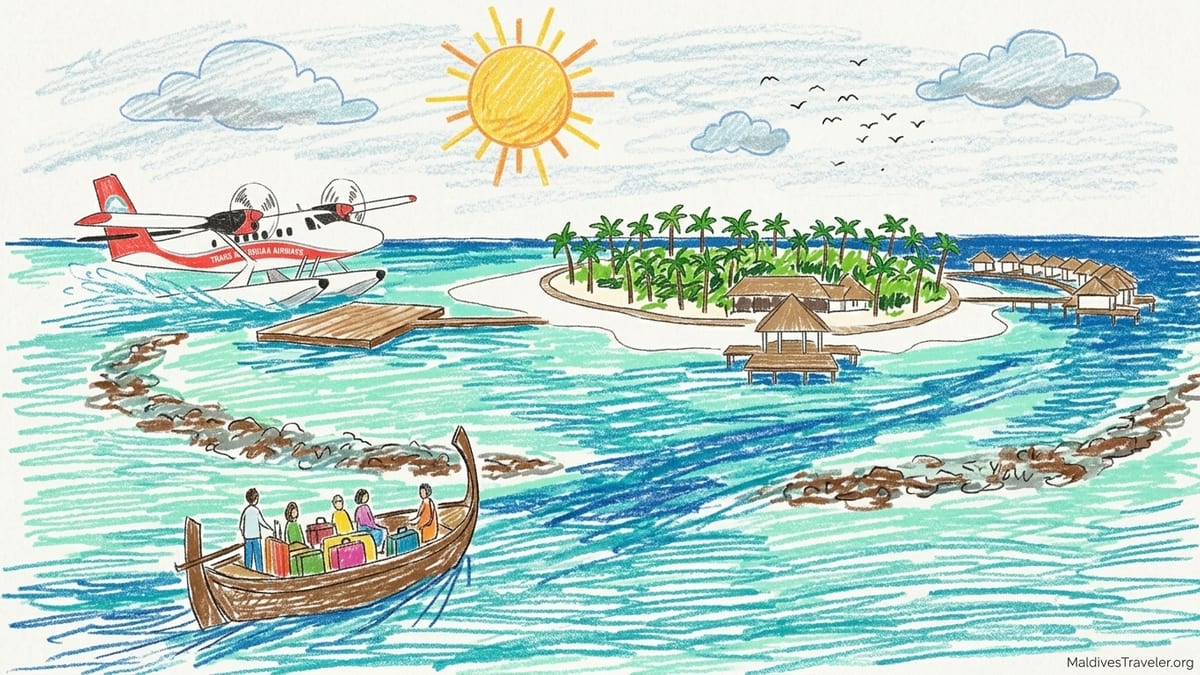
We touched down in a sheet of spray outside a floating platform rather than directly at the island jetty. This mid-lagoon platform transfer caught me off guard. A dhoni, the traditional Maldivian boat, ferried us the final five minutes to the island. Luggage came on a separate boat, and that separation meant I did not see my main bag for almost an hour after my first welcome drink. Next time, I would pack a swimsuit, sunscreen, and a change of clothes in my hand luggage, because once you are on a northern island, going back to fix packing mistakes is simply not an option.
First Impressions of the Island and Lagoon
I stayed at Sun Siyam Iru Fushi, one of the larger and more established resorts in Noonu Atoll, set on a sizable natural island ringed with white sand and a generous lagoon. From the jetty, the water looked more nuanced than the pure neon turquoise that dominates Maldivian postcards. Near the beach it was a pale mint color that deepened quickly into cobalt as it dropped off over the reef edge. Compared with the more crowded lagoons I had seen in Baa Atoll, Noonu’s water felt somehow wider and calmer, with fewer boat wakes and almost no other islands visible at eye level.
The beach itself was not perfectly uniform. On the eastern side of the island, facing the sunrise, the sand formed a continuous curve that made the classic Maldivian walking circuit. On the western side, which took the brunt of the southwest monsoon swell, there were short stretches of sand broken by low sandbag reinforcement and rocky bits that the resort had left partially natural. I had expected pristine, uninterrupted beach everywhere, because that is how Noonu is often photographed. Instead I found a coastline that showed its interaction with wind and current more honestly. The upside was that some corners of the island felt wild, with driftwood and crabs scuttling at the foam line at dawn.
What struck me most, though, was the scale of the lagoon. Looking from the main jetty, the reef edge felt significantly farther away than at my previous stay in South Ari. At high tide, the inner lagoon on the leeward side was deep enough for small motorboats to cross quite close to shore. That meant the house reef was not a few casual fin-kicks from the sand but something you had to actively swim or boat to reach. It was beautiful water for stand-up paddling and kayaking, but it altered my assumptions about snorkeling on a whim straight from my villa steps.
That first afternoon, I booked a complimentary guided snorkel that the resort offered for new arrivals. We took a dhoni ten minutes out to the drop-off, where the bright lagoon abruptly darkened. From the surface, Noonu’s outer walls looked like a navy ring encircling pale glass. Sliding into 29-degree water that clear and that blue felt like entering a different element entirely. I had arrived in the Maldives several times before, but the sheer depth visible under the boat here made me pause on the ladder a little longer than usual.
House Reef, Marine Life and How Noonu Really Compares
One of the reasons I chose Noonu was the reputation among repeat visitors that northern atolls have healthier reefs, with less bleaching than some of the more heavily trafficked central ones. That reputation is only partly deserved. The house reef at Iru Fushi sits a modest swim from the overwater villas, and the resort runs small boat shuttles for guests who do not want to fight the current. Underwater, I found a mix of vivid recovery and clear evidence of past stress. Branching corals in some sections were a ghostly white or algae-covered, but tables and boulder corals had begun to recolonize shallower shelves, with young fish weaving through them.
Compared with Baa Atoll, where I had previously snorkeled on reefs that felt patchy and busy with boats heading to well-known manta points, the Noonu sites felt quieter and more continuous. On our second morning, only our dhoni was anchored at a long outer wall. We saw a pair of reef sharks patrol along the blue drop-off, a turtle feeding unbothered by our presence, and clouds of anthias flickering over coral heads. It was not untouched wilderness, but it felt less frayed around the edges than the reefs I had seen closer to Malé.
The biggest surprise was the plankton. I had mentally filed the northern atolls as clearer, bluer water, while expecting more plankton blooms and big life further south around channels like those in Ari. Yet two of our days in Noonu brought slightly murkier conditions with suspended particles that reduced visibility. The upside was more pelagic visitors. On a late afternoon snorkel near a channel, a squad of eagle rays glided past in formation, their spots fading in and out of the haze. Our guide explained that when the southwest monsoon pushes nutrient-rich water up from the deep, Noonu’s channels can feel very alive, even if that occasionally means less postcard-perfect clarity.
I made one mistake with the reef that I would correct on a return trip. I scheduled the manta ray excursion late in my stay, assuming I would have plenty of calm weather windows. A squally day rolled in, the excursion was canceled, and with seaplane departures tightly coordinated, there was no flexibility to reschedule. In a remote atoll, excursion timing lives and dies by both wind and plane schedules. If seeing specific marine life is a priority, I would now book those trips early in the stay rather than waiting for a “better” day that might not come.
Food, Drink and the Subtle Realities of Being Far From Malé
Food in Noonu surprised me more in its logistics than its flavors. The resort operated on an all-inclusive plan for many guests, with a mix of buffet and a la carte restaurants. At first glance, the choice felt extensive: an overwater teppanyaki, an Italian spot with ocean views, a main buffet, and a poolside grill. After a few days, patterns emerged that reflected the atoll’s distance from Malé’s main supply chain. Fresh vegetables arrived in pulses. Some mornings the salad station overflowed with greens and ripe tomatoes, while on others the staff leaned more heavily on grilled vegetables and starches. Seafood, on the other hand, could not have been fresher. Yellowfin tuna and red snapper were almost always available, caught by local boats and delivered straight to the island, and the Maldivian breakfast corner became my favorite part of the day.
One evening, I joined a cooking demo focusing on mashuni, a simple Maldivian dish of finely chopped tuna, coconut and chili served with flatbread. The chef talked about sourcing: how much of the fish used at the resort came from nearby inhabited islands in Noonu, and how the supply boats sometimes had to adjust routes when weather in the northern atolls turned rough. It was a small reminder that every piece of cheese on the buffet or imported wine bottle in the cellar had traveled a surprisingly complex path to reach this remote spot. In South Ari, so close to domestic flight hubs, that supply chain had felt more invisible.
There was one disappointment that may matter to some travelers. Because of both cost and import rules, the by-the-glass wine list leaned heavily toward mid-range labels, and surcharges for premium bottles were steep. It made sense after I watched freight being unloaded at the jetty one morning, crates passed hand-to-hand from speedboat to shore like a small-scale port. Yet if you are a wine enthusiast, Noonu’s isolation can make indulgence noticeably more expensive than at resorts that sit closer to central distribution points.
On the upside, being far from the capital meant far fewer day-tripping boats and almost no noise pollution in the evenings. After dinner, there was usually Balinese-style live music or gentle DJ sets by the bar, but the dominant sound was always the surf hitting the reef miles away. Having stayed at a near-Malé resort where evening boat engines and city lights broke the illusion of escape, I found Noonu’s darkness and quiet easily worth the extra flight.
Excursions, Weather and the Rhythm of Days in the Northern Maldives
My stay fell in late March, at the tail end of the northeast monsoon and beginning of the transitional period before the wetter southwest monsoon. In practice, that meant mostly dry, bright mornings with cumulus clouds building by mid-afternoon. Air temperatures hovered around 30 to 31 degrees Celsius, with sea temperatures around 29 degrees. What felt different from my earlier trips further south was how quickly weather seemed to flip in the northern atolls. On our second full day, we left the jetty under clear skies for a dolphin cruise, only to watch a dark curtain of rain sweep lightly across the horizon and bring choppy short-period waves within an hour.
The resort staff mentioned that the northern atolls, including Noonu, can see slightly less overall rainfall than the far south, but can still get short, intense bursts and gusty squalls, especially during monsoon transitions. On one evening, wind-driven showers passed over three times between sunset and midnight, rattling the palm fronds and throwing sea spray up against the seawall near the main pool. I had packed with a classic brochure image in mind and had to buy a light rain jacket at the boutique after getting caught once walking back to my villa soaked.
In terms of excursions, the distance from Malé altered what was on offer. Classic outings like sunset dolphin cruises, turtle snorkel trips, and sandbank picnics were all available, and the sandbanks in Noonu felt genuinely remote. On a half-day trip, we did not see another boat until we headed back toward the atoll. The flip side of that isolation appeared when a guest on our boat began feeling unwell. While it turned out to be nothing serious, the guide gently reminded us that medical evacuation from Noonu would almost always involve coordinating a speedboat back to Maafaru airport and then a domestic flight down to Malé, unless a seaplane transfer happened to align. That added layer of logistics is worth considering for anyone with health concerns.
One of the more memorable days combined both the best and most challenging aspects of northern isolation. We left early for a local island visit to an inhabited community in Noonu, a speedboat hop of about 25 minutes. There, life felt markedly different from resort polish. Children cycled along sandy streets, fishermen repaired nets under breadfruit trees, and the call to prayer drifted over low pastel houses. We visited a small shop for sarongs and snacks, conscious of local dress norms away from the resort. On the return, a line of squalls sat directly across our route. The ride back was a wet, bumpy affair, the boat slamming down off wave crests as the captain zigzagged to find calmer water. I had booked the trip for cultural connection and left with an additional respect for how weather and distance shape everyday life this far north.
Living With Isolation: The Mental Side of a Remote Atoll Stay
By the fourth day in Noonu, the silence that felt blissful on arrival had taken on a different tone. In closer atolls, even when you are on a private island, other resort lights or the glow of Malé often sit on the horizon as subtle reminders of proximity to the wider world. In Noonu, some nights were so dark that standing on the beach felt like floating on a black mirror. The only lights came from stars, a thin line of phosphorescence in the wash, and the warm glow of villas behind me. That level of separation was exactly what I had asked for, but it also brought small moments of restlessness I had not experienced in more central atolls.
The island’s daily rhythm exacerbated and then eventually eased that feeling. By design, resort days fall into a pattern: sunrise coffee on the deck, breakfast, a morning swim or snorkel, lunch, an afternoon nap or spa visit, sunset, dinner, and a nightcap. In a remote atoll, you feel that loop more keenly because there are fewer external distractions. There are no quick city runs, no impromptu shopping trips, and no easy bar-hopping to a neighbor island. After a few days, my partner and I realized we needed to schedule one “anchor” activity each day to keep the isolation from tipping into cabin fever.
For us, that meant alternating snorkel trips, yoga classes, and simply walking long laps of the beach. One afternoon we circled the entire island slowly, barefoot in the shallows, stopping to watch hermit crabs and inspect erosion control efforts. It took less than an hour. The finiteness of the space smoothed something out in my mind. Noonu’s isolation felt less like being marooned and more like being fully contained, with the outside world temporarily muted. It helped that resort Wi-Fi, while not perfect everywhere, was good enough to check in with home occasionally, a tether that mattered more here than it had when I stayed a fifteen-minute speedboat ride from the capital.
I did notice one drawback to the distance on a social level. Because seaplane transfers are coordinated in batches and often paired with same-day international flights, guests tended to arrive and depart in clusters. That created a rhythm where you would meet people intensely for a few days and then watch almost an entire group vanish on the same morning, replaced by newcomers looking as dazed and sunstruck as you had upon arrival. In a smaller, closer resort, I had previously felt more continuity among guests. If you like to form longer connections with other travelers, a remote atoll can feel more transient than you might expect.
Mistakes, Surprises and What I Would Do Differently Next Time
Looking back on my Noonu stay, a few specific mistakes stand out. The first was arriving in Malé on a flight that touched down just after noon, which compressed the seaplane window and left me anxious about missing the last northbound transfer. For a northern atoll, I would now aim for a morning international arrival and be ready to overnight in Malé if airline schedules made that impossible. I would also pad the final day more generously. On departure, I was picked up from the resort about four hours before my international flight time because the domestic and seaplane schedules are built to ensure buffer. That meant a longer-than-expected airport wait on the back end as well.
The second mistake was underestimating how much the large lagoon would shape my experience. I had seen marketing photos of outwater villas stepping down into blue water and assumed the house reef was mere meters away. In reality, much of my casual swimming took place over sand and seagrass in waist-deep water, which is wonderful if you like rays and small reef fish but less impressive if your heart is set on coral gardens right off your deck. Next time, I would pay closer attention to resort reef maps and maybe consider splitting time between Noonu and another atoll with a steeper drop-off closer to shore.
A gentler surprise came from the local island visit. I had not fully appreciated how much more separate resort and local life feel in a remote atoll. In places like North Malé Atoll, day trips to the capital or nearby inhabited islands are quick and frequent. In Noonu, every such visit requires a meaningful boat ride and weather cooperation. When we finally walked the sandy streets of the local village, the effort made it feel more significant, a reminder that the Maldives is not just sunsets and infinity pools but also schools, clinics, and small shops supplied by the same boats that bring our tuna and coconuts.
Finally, I would think more carefully about how long to stay. For someone seeking deep rest, seven nights in Noonu could be heaven. For me, five nights felt like the sweet spot. By the last day, I was ready to see a different skyline, even if only the modest one of Malé. If I return, I will likely pair Noonu with a shorter stop in a closer atoll, using the northern stay as the core of the trip rather than the entirety of it.
The Takeaway
Noonu Atoll is not the easiest corner of the Maldives to reach, and that is precisely why it rewards the traveler who makes the effort. The long seaplane ride, the weather-dependent excursions, the sometimes-limited fresh produce, and the strict transfer windows are all part of the bargain you strike for space and quiet. In exchange, you get lagoons that feel open and uncluttered, reefs that are still in the process of healing but rich with life, and nights where the only horizon light comes from stars.
For me, the most valuable surprise was not a single manta sighting or a perfect sunrise, but the way isolation reshaped my days. In Noonu, the absence of options becomes its own form of luxury. You swim, you read, you talk, you walk the same curve of beach again and again, watching how the tide redraws it. If your idea of the Maldives is quick speedboat hops and easy city access, the far north might not be your match. If you are willing to trade convenience for immersion in sea and sky, Noonu is worth flying that extra forty minutes for, as long as you go in with open eyes about what that remoteness entails.
FAQ
Q1. How long does it take to reach Noonu Atoll from Malé?
From Malé’s Velana International Airport, most resort-operated seaplanes take roughly 40 to 45 minutes to reach Noonu Atoll, depending on the exact island and any intermediate stops. If your resort uses Maafaru airport within Noonu with a domestic flight plus speedboat, the total journey time is usually about 60 to 90 minutes from Malé.
Q2. Is the seaplane transfer to Noonu worth the extra cost?
The seaplane adds a noticeable cost to a Maldives trip, but for Noonu the aerial views of distant atolls and the sense of leaving the busier central region behind make it feel integral to the experience. If budget allows and you value remoteness, the flight is part of what sets a Noonu stay apart from resorts closer to Malé that you can reach by speedboat.
Q3. What is the best time of year to visit Noonu Atoll?
Noonu Atoll is warm year-round, with air temperatures often around 30 degrees Celsius and sea temperatures close to 28 to 29 degrees. Drier conditions are more common from about January to early April, while the period from May into October can bring more showers and wind. Transitional months like March and November can offer a mix of sun and occasional short, intense squalls.
Q4. How does the reef in Noonu compare to other Maldivian atolls?
Reefs around Noonu show both healthy recovery and signs of past bleaching, similar to other parts of the country. In my experience, outer walls and some house reefs in Noonu felt quieter and less trafficked than those in busier atolls like Baa, with good chances to see reef sharks, turtles and rays, although conditions and visibility vary by site and season.
Q5. Are there local islands to visit near Noonu’s resort islands?
Yes, there are inhabited islands within Noonu Atoll, and many resorts arrange guided visits that include walking local streets, visiting small shops and learning about Maldivian life. These excursions usually involve a speedboat journey of 20 to 40 minutes and are subject to weather and local customs around modest dress and behavior.
Q6. What should I pack specifically for a stay in Noonu Atoll?
Along with the usual beachwear and sun protection, I found a light rain jacket, reef-safe sunscreen, and a small dry bag very useful because weather can change quickly and many activities involve boat rides. Packing a swimsuit and change of clothes in your hand luggage is important, since checked bags can arrive at your villa later when seaplanes and boats are involved.
Q7. Is Noonu Atoll suitable for a first-time Maldives visitor?
Noonu can be an excellent choice for a first-time visitor who values peace, long views and fewer neighboring islands. The main consideration is tolerance for longer transfers and reliance on seaplane or domestic flights instead of simple speedboat hops. If you are comfortable with that and plan flights carefully, starting in Noonu offers a strong introduction to the Maldives.
Q8. How does the isolation of Noonu feel after several days?
After three or four days, the remoteness becomes very tangible. Daily routines feel slower and more deliberate, and you are acutely aware that the wider world is a long boat or plane ride away. For me, scheduling at least one small activity each day, whether a snorkel, yoga class or beach walk, helped keep that isolation from feeling like confinement.
Q9. Are medical facilities readily available in Noonu Atoll?
Resorts in Noonu typically have on-site medical staff or basic clinics for minor issues, but more serious care would usually require transfer by boat and plane to better-equipped facilities in Malé. Travelers with specific health concerns should discuss evacuation coverage with their insurer and be aware that weather and flight schedules can affect transfer timing.
Q10. How many nights should I plan for a Noonu Atoll stay?
For most travelers, four to six nights strikes a good balance between making the long transfer worthwhile and avoiding restlessness from being on a small island. If you love slow, quiet days and deep relaxation, a week or more can work well, while those who prefer variety might pair three to five nights in Noonu with time in a more central atoll.